Skip to content
DevMeme
4227 of 7435
When the “intro” book needs a PhD in advance anyway
Mathematics Post #4620, on Jun 30, 2022 in TG

When the “intro” book needs a PhD in advance anyway

Why is this Mathematics meme funny?

Level 1: PhD Required

Imagine you start a new video game and click on the tutorial level, but it turns out to be as hard as the final boss battle. The game expects you to know all the special moves and combos right from the beginning. You’d be confused and probably think, “Wait, I just started — how am I supposed to do this?!” That’s exactly what’s going on in this meme, but with a book. It says “Introduction” on the cover like it’s for beginners, but everything inside it is super advanced. In other words, it’s like a beginner’s class that secretly requires you to be an expert. It’s funny because it’s so backwards: calling something a starting guide when only a pro can understand it is obviously ridiculous. We laugh at the meme because we recognize that feeling — being a newbie handed an “intro” that might as well be written in another language. It’s the humor of misplaced expectations: anyone can see how silly (or unfair) it is, so we can’t help but chuckle.

Level 2: Misaligned Expectations

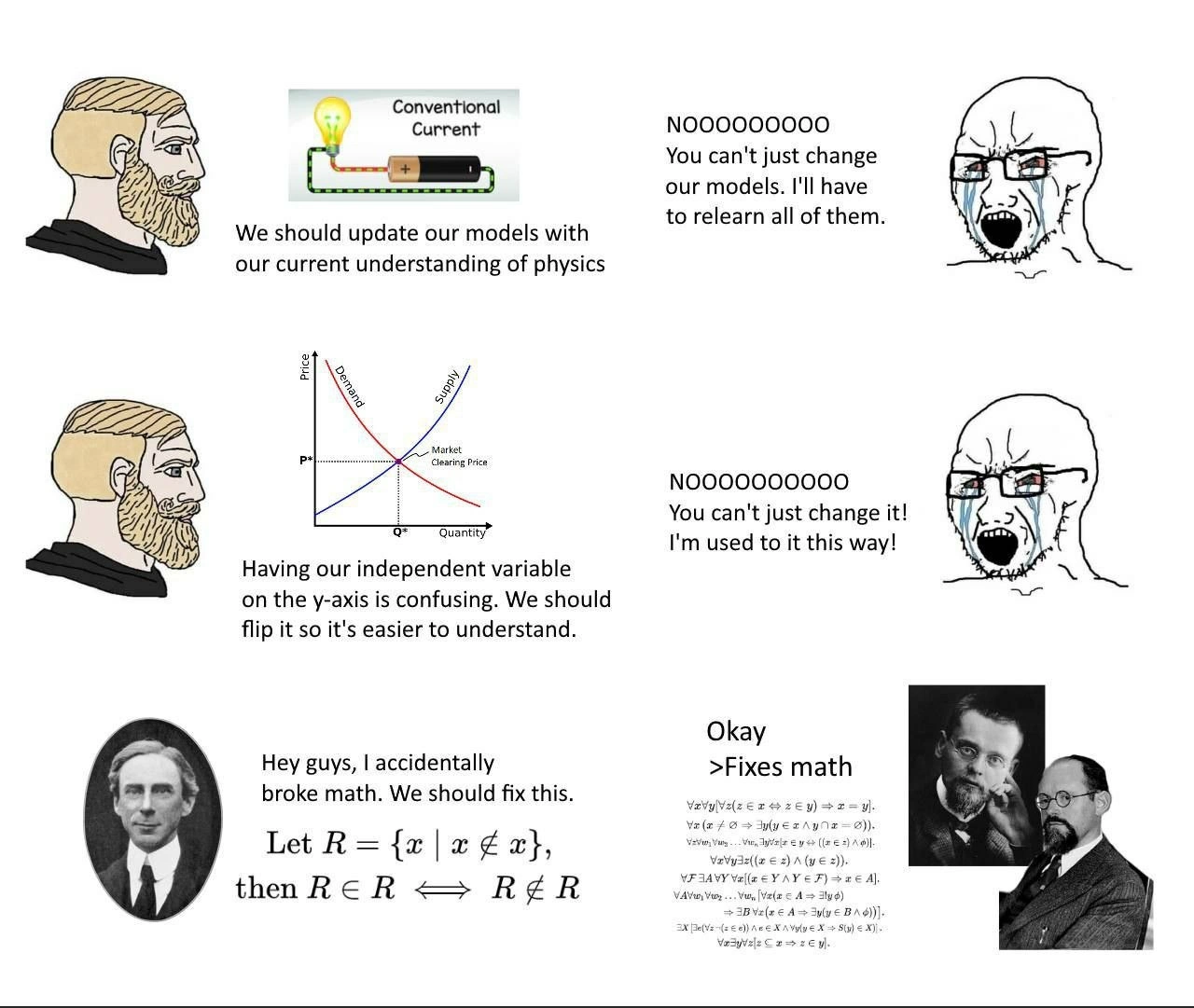
At its core, this meme highlights the learning curve problem when trying to pick up complex topics. Let’s break down the image: it’s styled to look exactly like a real math textbook from Springer’s famous Graduate Texts in Mathematics series. Those are real books – big yellow hardcovers – that cover advanced mathematics, usually for graduate students or very motivated undergrads. Right away, that design tells us, “This is serious stuff.” Now, the meme tweaks the title of the series to Didn’t Graduate Texts in Mathematics. That’s a playful jab: if you didn’t graduate (i.e. you don’t have an advanced degree in math), then these texts are going to be over your head. In other words, the series for experts has been rebranded for the rest of us… but still with all the expert-level content intact!

The big navy title on the cover says Introduction to That Thing. It’s intentionally generic and nonsensical – “That Thing” could be any complicated subject you’re trying to learn (maybe a tough programming concept or a deep math theory). By not even naming the topic, the meme suggests it almost doesn’t matter what it is; the point is it’s being called an Introduction while staying totally opaque. Beneath that, the subtitle But only for people who already know it spells out the joke plainly. It’s like the book is admitting: “This is an introduction, but only if you’re already an expert.” That defeats the whole purpose of an introduction! It’s a direct nod to any learning material that claims to be for beginners but then assumes those beginners have pre-existing knowledge. We’re talking about a serious mismatch between expectation and reality. The expectation: I’ll start from scratch. The reality: I needed to have read three other books first.

You’ll also notice the Second Edition tag on the cover. In real life, a second edition of a book means the authors revised it, often to make things clearer or update information. So including “Second Edition” in the meme adds extra irony: apparently even after revisions, this “intro” book is still impossible to understand unless you already knew the topic! It jokingly implies the first edition wasn’t beginner-friendly either, and the update didn’t fix that.

Now, look at that faint diagram with all the arrows and letters (in the lower half of the cover). That’s a commutative diagram. In plain terms, a commutative diagram is a picture that mathematicians use to show relationships between different things, where if you follow the arrows around in different ways, you end up at the same result. They’re common in high-level math fields like category theory and algebra. To someone new, that diagram just looks like a confusing grid of symbols. Including it on an “introductory” cover is a visual gag: it’s basically broadcasting, “Warning: abstract math ahead!” If you’re a beginner and you see a bunch of $A$’s, $B$’s, and arrows everywhere, you’re likely to feel lost immediately. So the diagram reinforces how advanced the content really is, despite the word "Introduction" in the title.

The bottom of the cover even has a fake Springer logo and a pretend URL (somethingorotherwhatever.com). Springer is a real publishing company known for academic and scientific books. Real Springer textbooks might have a DOI link or an official website on the cover – here it’s replaced with gobbledygook text for comedic effect. This detail makes the parody book cover feel legit at first glance, which makes the silly title stand out even more. It’s using a familiar format (the Springer yellow book meme format) to set up the joke. Basically, everything about the image’s design screams “official math textbook,” and then the content of the text flips it upside down.

For a junior developer or student encountering this meme, the message is very clear: sometimes “Intro” doesn’t mean easy. The meme is laughing at those times you open an intro book or tutorial and immediately feel like you’re in over your head. It’s highlighting a common learning experience where the expectations were set one way, and reality turned out very different. You thought you were about to learn the basics, but instead you got advanced material with no groundwork. In education, we’d say the material wasn’t scaffolded – it didn’t build from simple to complex, it just started complex. That’s why this is funny (in hindsight at least!). A lot of us have been that eager learner thinking “Yes, an Introduction! Finally, I’ll understand this,” only to slam into a wall of unexplained terms and complex diagrams. The meme takes that feeling and puts it on a fake book cover so we can all nod and laugh, knowing we weren’t alone in that experience.

Level 3: Gatekeeping 101

For seasoned developers and academics, this meme triggers a knowing groan. We’ve all opened “Beginner’s Guide” documentation only to hit an impenetrable wall of jargon on page one. The humor here comes from that too-real sense of bait-and-switch: you expect a gentle intro, but you get a final exam. It’s a textbook case of misaligned expectations. In theory, something labeled Introduction should start from fundamentals. In practice, though, many “intro” resources assume an ideal reader who’s already familiar with half the material. That gap between real world vs. theory is exactly why this meme elicits equal parts laughter and PTSD flashbacks. It’s poking fun at the LearningCurve from hell – an introductory book ironically advanced enough to weed out anyone without prior knowledge.

Think of a time you tried to learn a new framework or a hot technology from official docs. Maybe you grabbed a guide on a machine learning library or a cutting-edge DevOps tool. One paragraph in, it references monoidal transducer or covariant functor or some other dense term, and you’re instantly lost. It’s basically saying, “Welcome, beginner… hope you already speak expert!” That contradiction is exactly what the meme’s fake title spells out: Introduction to That Thingbut only for people who already know it. Seasoned folks find this hilarious because we’ve been there. We remember cracking open “Intro to ” and realizing we need to google every other word. If you’ve ever felt the sting of imposter syndrome because a so-called beginner tutorial made you feel stupid, this meme hits home. It’s a nod to all the times the learning curve was more of a cliff.

There’s a bit of catharsis and caution here for the experienced crowd. The meme calls out a form of intellectual gatekeeping that often happens unintentionally. Experts writing tutorials or books sometimes don’t realize they’ve left newcomers in the dust. The joke cover might as well have a gate on it saying “No entry unless you already know the secret handshake.” As a senior developer or researcher, you laugh, but you might also cringe thinking, “Have I written docs like this?” It highlights the importance of empathy in teaching. Good documentation ideally meets the reader where they are — not where we wish they were. The fact that this parody is set up as a Springer textbook is the cherry on top. Anyone who’s suffered through dense academic texts immediately recognizes that bright yellow format. By using the meme format of a Springer cover so faithfully (down to a fake Springer logo and gibberish URL), the joke lands instantly with the target audience. It’s the contrast of seeing a serious, highbrow cover with a ridiculous title that makes you chuckle. “Second Edition,” as if to say, Yes, we doubled down on confusing you. Seasoned learners know that pain, and they laugh because it’s true — sometimes version 2.0 of a guide is just as arcane as 1.0. In short, the meme is reflecting a shared industry gripe with a big wink: calling something beginner-friendly doesn’t make it so, and everyone in tech or math has watched that play out.

Level 4: The Ouroboros Curriculum

In advanced mathematics and theoretical CS, it’s common to encounter instructional materials that are anything but introductory. This meme’s parody of the iconic yellow Springer cover hints at a high-level math text – likely something like category theory – masquerading as an introduction. The faint commutative diagram on the cover isn’t just random decoration: it’s a typical notation in category theory showing how different compositions of mappings lead to the same result (the diagram "commutes"). If you already know what that diagram of arrows means, you’re essentially fluent in the very topic the book claims to introduce! In fields like category theory (sometimes jokingly dubbed “abstract nonsense” by mathematicians), an Introduction often assumes you’ve mastered a whole web of prerequisites: set theory, abstract algebra, maybe even a dash of logic. It’s not unusual for an "introductory" text to casually mention functors, monoids, or the Yoneda lemma in chapter 1 – concepts that normally require significant background to appreciate.

This creates a prerequisite paradox: the book is labeled as an introduction to "That Thing," but truly understanding it demands that you already know that thing (or a bunch of related things). It's like knowledge arranged in a circle – an academic ouroboros, the snake eating its own tail. In computer science terms, it’s akin to a circular dependency: to learn concept A from the book, you need concept B, but B’s explanation depends on understanding A. The meme captures this absurd self-referential loop. A classic example in programming is the notorious monad tutorial problem. Countless blog posts titled "Introduction to Monads" end up bewildering readers with abstract algebraic jargon. Frustrated learners joke that every monad tutorial expects you to already know what a monad is – a direct parallel to our meme’s subtitle, But only for people who already know it. When an introduction requires the very knowledge it's supposed to impart, we’ve hit a comedic kind of infinite regress in pedagogy.

Why does this happen? Often it’s due to the curse of knowledge: once you’re an expert, it’s hard to remember what it’s like not to know. Authors of graduate-level texts (or elite framework docs) might skip "obvious" steps because, to them, those steps were learned so long ago that they assume everyone has them. The result? An Intro pitched at expert level, leaving true beginners feeling like they’re reading a research paper or deciphering hieroglyphics. The meme nails this by imitating Springer’s real Graduate Texts in Mathematics series. Those books (with their trademark yellow covers) are indeed aimed at readers who have graduated into advanced math. By cheekily renaming the series Didn’t Graduate Texts in Mathematics, the meme winks: if you didn’t go through graduate-level training, these texts will sail over your head. Even the detail of calling it a Second Edition adds to the irony. Typically, a second edition might try to be more accessible or correct earlier confusions — yet here we are, edition two, and you still need a PhD to get it. This is intellectual gatekeeping turned into academic humor. It’s the kind of joke you might find on a grad student’s office door: a faux textbook that satirizes the very real pain of trying to learn cutting-edge theory with only “introductory” materials that read like advanced tomes.

Description

The image is a parody of a yellow Springer book cover, mimicking the famous “Graduate Texts in Mathematics” series. The spoof title at the top reads in large light-yellow letters, “Didn't Graduate Texts in Mathematics.” Below, on a darker yellow block, the supposed book title appears in bold navy text: “Introduction to That Thing,” followed by the subtitle, “But only for people who already know it.” A white “Second Edition” label sits to the right, and a faint commutative diagram of arrows and letters fills the lower half, under a fake Springer logo and the URL “somethingorotherwhatever.com.” Visually it replicates the layout, typography, and color palette of real Springer math texts, but the joke highlights how many so-called introductory resources in math, CS theory, or new frameworks assume heavy prior knowledge - an all-too-relatable pain point for developers trying to learn complex topics

Comments

6
Anonymous ★ Top Pick Our “Getting Started” doc for the new microservice stack feels straight out of Springer: Step 0 - assume your domain objects form a monoidal functor and you already have a multi-cluster Kubernetes deployment in prod
  1. Anonymous ★ Top Pick

    Our “Getting Started” doc for the new microservice stack feels straight out of Springer: Step 0 - assume your domain objects form a monoidal functor and you already have a multi-cluster Kubernetes deployment in prod

  2. Anonymous

    It's like our API documentation: "Getting Started Guide" that assumes you've already implemented OAuth2, understand our proprietary event sourcing pattern, and have memorized all 47 microservice boundaries we deprecated last quarter but still reference

  3. Anonymous

    This perfectly captures the Catch-22 of advanced technical documentation: you need to understand the material to understand the introduction that's supposed to teach you the material. It's like reading Kubernetes documentation that assumes you already architected a distributed system, or diving into category theory papers where the 'gentle introduction' starts with 'as we all know from basic topos theory.' The 'Second Edition' detail is chef's kiss - they revised it but kept the same prerequisite problem

  4. Anonymous

    Modern “Getting Started”: prerequisites - category theory and the internal DSL you haven’t discovered yet; after that, Hello World is trivial

  5. Anonymous

    Reads like our onboarding wiki: “Introduction to That Thing” - prereqs: having already built it; the only example is a commutative diagram that stops commuting the moment the network partitions

  6. Anonymous

    The prereq functor is faithful: maps novices to the empty category

Use J and K for navigation