The Unofficial GPT-5 Performance Roadmap
Why is this AI ML meme funny?
Level 1: Better Tools, More Chores
Imagine you have a basic toy or tool, and people ask you to do a certain amount of work with it. Now suppose you get a much better tool – suddenly everyone around you thinks, “Hey, you have this great tool, you should be able to do way more now, right?” This meme is just like that, but with computer smartness instead of toys.
Think of it like when you got a new bicycle that’s much faster than your old one. With the old bike, your parents let you just ride around the block. But with the shiny new fast bike, they say, “Since you can go faster, now you can go to the store for me, and also deliver this to the neighbor, and be back in 10 minutes!” They expect more from you because your bike is better. It’s exciting because you have this cool new bike, but also a bit tiring because now you’ve got extra jobs to do.
In the same way, GPT-5 is like a super advanced tool for making the computer solve problems or answer questions. Every time a new version (GPT-3, GPT-4, GPT-5...) comes out, it’s like the tool got better and better. And each time, people (bosses, users, anyone) raise the bar for what they expect. “GPT-5 is so powerful, it should be able to do everything!” – that’s what a lot of folks start thinking. If a developer was using an older GPT to, say, help answer customer emails, now everyone might ask, “Why not have the AI write all the emails and also chat with customers live? It’s so good now!”
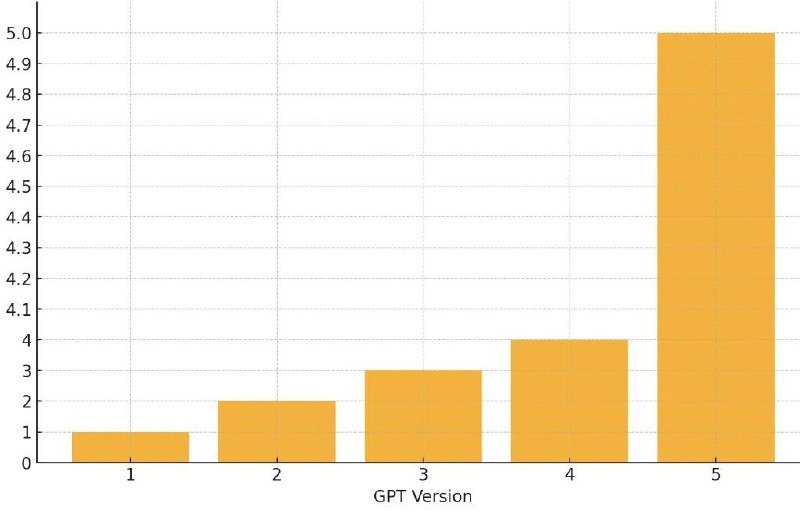
The meme’s bar chart shows this in a funny, very simple way: each orange bar is higher, meaning the tool is better each time, and so the last bar (GPT-5) is super high. That last big bar is like the super fast bike or a super-calculator in school – it sets a new record. And when there’s a new record, people naturally expect more. If you jump higher, they raise the bar for the next jump. Here, the “bar” is both literal (the bar in the chart) and metaphorical (the level of expectations).
Why is it humorous? Because anyone who has been in that situation recognizes the pattern: new gadget comes out, everyone around gets overexcited about what you can do with it. It puts a smile on your face because it’s true in so many situations, whether it’s toys, tools, or high-tech AI. It’s like if you got a new oven that can cook food twice as fast – suddenly your family expects you to cook dinner every night since it’s “so easy now!”. The poor developer (or the kid with the oven) is thinking, “The tool is great, but I still have to do the work and handle all the issues!”
So, at a very basic level, the meme is saying: every time our tool (the AI) improves, people want even more from us. It’s a funny way to show how technology can raise expectations. Even though the bars in the chart are about a computer thing, you can relate it to everyday life: better tool = people ask for more. The feeling behind it is a mix of excitement (wow, look what we have now!) and a little bit of overwhelm (uh-oh, look what they want from me now…). That’s why it’s both funny and true, even if you’re not an expert in AI. It’s basically, “Great, I’ve got superpowers now… and a super amount of chores to do with them!”
Level 2: Bigger Model, Bigger Hype
If you’re a junior developer or new to this whole AI craze, let’s break down the meme in simpler terms. The x-axis of the chart shows GPT Versions 1 through 5 – these refer to different generations of OpenAI’s GPT models (GPT stands for Generative Pre-trained Transformer). Think of GPT models as extremely advanced text generators: you give them some prompt or question, and they give you a human-like response. The y-axis (the vertical one) is some measure of how powerful or capable each version is (the meme doesn’t label it explicitly, but you can imagine it like an "impressiveness" scale from 0 to 5). Each orange bar represents how strong that version is, and you can see they get taller and taller from GPT-1 up to GPT-5.
In plain language, each new GPT version is way more impressive than the last:
- GPT-1 was the first baby step – it could produce understandable text, but it wasn’t anything to write home about.
- GPT-2 was bigger; suddenly the AI could spit out a few paragraphs that actually made sense most of the time. People were like, “Hmm, this is getting interesting.” It was good enough that there was even a bit of drama about releasing it because folks were worried about misuse (like generating fake news).
- GPT-3 was a massive leap. It has 175 billion parameters (basically the "knowledge knobs" in its neural network brain – a huge number). With GPT-3, you started seeing headlines because it could do crazy things like write short articles, answer programming questions, or have a decent conversation. Developers found that you could give GPT-3 a prompt like “Translate this English text to French” or “Write a poem about a tree” and it would do it remarkably well. It felt like sci-fi brought to life.
- GPT-4 (which came out later) leveled up again. It’s not just bigger (exact size not publicly stated, but definitely more advanced); it’s also smarter in new ways. For example, GPT-4 can handle images as input (describe what’s in a picture) and is better at tasks like logic puzzles or writing code. It’s the model behind things like the more advanced version of ChatGPT that could pass the bar exam or score high on the SAT—basically, it started acing tests designed for humans.
- Now, GPT-5 (in the context of this meme) is the hypothetical next step that everyone is hyped about. As of the date in the meme (August 2025), GPT-5 might be on the horizon or newly released, and people are expecting big things. The chart humorously makes GPT-5’s bar shoot up to the max of the scale, implying it’s a quantum leap over GPT-4. The caption “These gpt-5 numbers are insane 🤯” reflects how people are reacting — with amazement and a bit of shock.
So, the graph basically says: “GPT keeps getting better and better, ridiculously so by the time we hit version 5.” Now, why is that funny or noteworthy for developers? Because in real life, when a technology suddenly gets a lot better, everyone around gets ideas — often unrealistic ideas — about what can be done with it. The phrase “rising bar of developer expectations” means that as the AI’s capability bar goes up, the expectations placed on developers rise right along with it.
Think of it from your perspective as a developer: One year you integrate GPT-3 into your app to, say, power a customer support chatbot. It’s not perfect, but it’s pretty cool – it can answer common questions automatically. You still have to handle when it gets things wrong, maybe by checking its answers or only letting it answer easy questions. Now GPT-4 comes out, and it’s significantly better. Suddenly your product manager says, “Hey, I hear GPT-4 can handle more complex queries and it understands images. Can we upgrade and also have it, I don’t know, diagnose product issues from screenshots and long emails?” They now expect the chatbot to handle basically all customer issues (even tricky ones) because GPT-4 has a reputation of being smarter.
Fast forward to GPT-5 – now the expectations go through the roof. Non-developers (and even some developers caught in the hype) might say things like, “GPT-5 can build entire apps from scratch just by talking to it! Why are we spending time coding feature X? Let’s have the AI do it.” or “Our game’s NPC dialogue could be fully AI-generated now, it’ll be totally like talking to a person!” In meetings, you might hear half-joking comments like, “Do we even need a content writing team anymore? GPT-5 can generate all the marketing blog posts in seconds!” There’s excitement, but also pressure: suddenly you might be tasked with integrating this super AI into all corners of the product. It’s like the goalpost just moved farther away the moment you thought you were catching up. 💼💨
As a junior dev, this can be both thrilling and daunting. Thrilling because working with cutting-edge AI is fun and feels futuristic. You get to play with GPT-5’s API, see it generate amazing outputs, and you can build really cool features that weren’t possible before. It’s the kind of stuff that made a lot of us want to go into tech in the first place. But it’s also daunting because now there’s a spotlight on delivering big results with this tech. The hype means if something goes wrong, people might be less forgiving (“How can it mess up? It’s supposed to be so advanced!”). And if you’re still learning the ropes, integrating a giant AI model might be outside your comfort zone. There’s new documentation to read, possibly new frameworks or libraries to use, and pitfalls to avoid (like the AI confidently giving a wrong answer — a phenomenon we call an AI hallucination when it just makes facts up).
Let’s touch on a key term: AI hype cycle. This is a concept that describes how any new technology goes through phases: from an initial trigger, to a peak of inflated expectations (everyone thinks it will solve everything), then a crash when it doesn’t meet those impossible hopes, and eventually a realistic place where we find its actual valuable uses. Right now, generative AI is at that fever-pitch peak in many people’s minds. The meme’s huge GPT-5 bar is basically poking fun at that inflated expectation. It’s like it’s saying, “According to all the talk, GPT-5 isn’t just a bit better – it’s off the charts!” And indeed, in August 2025, you’d likely see breathless headlines and LinkedIn posts about how GPT-5 will change the world, revolutionize programming, cure writer’s block, do your laundry, etc. Seasoned devs know a reality check will come, but in the moment, the hype is very real.
From a practical standpoint, rising expectations mean a few things for developers:
- Learning and Adapting: Each GPT upgrade might come with new APIs or techniques (for example, prompt engineering for GPT-4 got more involved, using system messages, etc.). As a dev, you have to quickly learn how to get the best out of the new model. It’s like a new tool in your toolbox, but a really complex one that you must master on the fly.
- System Changes: If your app was using GPT-3 and now you want GPT-5, you might need to refactor things. Maybe GPT-5’s responses are longer or it allows larger prompts. That could mean redesigning parts of your UI or backend to accommodate those bigger responses or longer conversations. It’s not always plug-and-play.
- Cost and Performance Considerations: This part often surprises newcomers. Using cutting-edge AI can be expensive. For instance, if you’re calling OpenAI’s API for GPT-5, each call might cost more than previous versions. Those costs add up if you have lots of users. Or if you’re running it yourself (some companies fine-tune their own models), you might need powerful GPU servers. Also, these models can be slower if they are more complex – no one enjoys an app that hangs while an AI ponders a response. So, devs have to find ways to make the AI features efficient and affordable, sometimes by caching results or limiting how often they are used.
- Setting the Right Expectations: Part of a developer’s role, especially as you grow more experienced, is managing what your team or client should expect from the tech. If your manager thinks GPT-5 will produce flawless results 100% of the time, you might have to gently explain that it can error out or produce strange outputs, and that you’ll still need a review process or human in the loop for certain tasks. It’s similar to how we learned not to trust user input blindly; we also don’t trust AI output blindly. There’s testing and validation required.
So, this meme is something developers share to nod and laugh about the situation. The bars going up are like the hype meter going up. It’s funny because we all know someone (a client, a boss, the internet at large) who thinks the next version of a tech will suddenly solve all their problems by magic. And it’s a bit of a coping humor for devs who are thinking, “Alright, time to roll up my sleeves and deal with whatever crazy project comes out of this GPT-5 mania.”
In short, each GPT release raises the bar not just for AI performance, but for what people expect developers to do with that AI. It’s as if with every new model, the to-do list and the wish list given to the dev team both get longer. The meme captures that in one simple bar chart joke. If you’ve ever felt like technology improves and suddenly everyone expects you to instantly do more because of it, you’ll get the chuckle here. It’s saying: New tech, new expectations — good luck! 😅
Level 3: Mo' Models, Mo' Problems
For a senior developer, this orange bar chart lands as a mix of humor and PTSD. Each jump in GPT’s capability (bars shooting upward) translates directly into a jump in what management and clients expect us to deliver. It’s hype-fueled déjà vu. The moment a new GPT version is announced to have mind-blowing abilities, you can bet some stakeholder is going to say, “Did you see GPT-5? It’s insane! Can we have it do [insert ridiculously ambitious task] for our product?” The meme nails this pattern: new tech arrives → expectations skyrocket → developers face the fallout.
We’ve all ridden these waves of hype. A few years ago it was microservices and everyone wanted to break perfectly fine applications into 37 tiny pieces because Netflix did it. Then came the blockchain craze where suddenly every system needed a “distributed ledger” (never mind if it was a poor fit 🙄). More recently, it was all about Kubernetes or “serverless” solving world hunger. Now it’s AI, specifically giant LLMs (Large Language Models) like GPT-3/4/5, that occupies the peak of inflated expectations. The meme’s escalating bars – GPT-1 through 5 – perfectly capture how each successive breakthrough cranks the hype knob to 11. GPT-3 can autocomplete emails? Wow! → GPT-4 can pass the bar exam? Double wow! → GPT-5 will cook breakfast and cure cancer? GIVE ME THAT NOW! (slight exaggeration, but that’s how the boardroom conversations sometimes feel). Essentially, the gpt_version_progression in the chart mirrors the progression of our industry’s excitement (and sometimes delusions) about what AI can do.
Now, when those expectations flood in, it’s the engineering teams that have to turn lofty promises into working features. The boss sees a slick bar chart and assumes GPT-5 is literally “5” on a scale of 5 – like it maxed out perfection. A seasoned developer instead sees integration headaches lurking behind that tall bar. Let’s peel back what happens when we try to bring a new GPT into production:
- Infrastructure Strain: A more powerful model usually demands more computing muscle. GPT-5 might require specialized hardware or extra cloud instances just to run smoothly. That means dealing with deployment questions: Can our current system even handle this? Do we need to spin up GPU servers? What about scaling when 1000 users hit the AI at once? Latency (the time it takes for the model to respond) becomes a big concern — nobody wants an AI feature that makes users wait and wait. If GPT-4 already had us caching responses and optimizing every millisecond, GPT-5 might push us to redesign pipelines or stream responses in chunks to appear faster.
- Ballooning Budget: Each new model tends to come with new costs. Maybe OpenAI will charge more per API call for GPT-5’s “insane” capabilities, or if we self-host, the electricity and hardware costs will make finance faint. A senior dev might find themselves explaining to the CFO why the AI feature that “writes our reports for us” is racking up a cloud bill larger than all our previous infrastructure combined. (The shock on the finance team’s face is a whole meme of its own.) This is AIHype meeting accounting reality.
- Quality Control & Trust: Yes, GPT-5 is more advanced, but it’s not a magic oracle. It can still produce the wrong answer, or a nonsensical one, just with more eloquence. Those of us who integrated GPT-3 or GPT-4 remember spending a lot of time on hallucination control – putting in filters or checks so the AI doesn’t confidently spout misinformation or something off-brand. With greater capability, GPT-5 might even sound more convincing when it’s wrong. So we have to double down on testing its outputs. Did it just invent a fake statistic in that auto-generated report? Is it confidently answering a legal question it actually has no ground truth on? We need guardrails, sandbox environments, maybe even a “AI fact-checker” layer. Responsible-AI considerations go through the roof: we’re talking bias checks, content moderation, compliance with privacy – all the stuff the excitement in the chart conveniently ignores. In a senior-level meeting, someone’s gotta be the wet blanket and say, “Actually, we need an ethics review before we roll this out.” Often that someone is in engineering.
- Maintaining Control: Along with quality, there’s the general risk factor. A more powerful model can do bigger things – which means bigger potential screw-ups. We have to log what it’s doing, be able to trace back why it gave a certain answer (which is notoriously hard with deep learning models), and have a fallback if it starts acting up. It’s like deploying a very smart but unpredictable team member: you give them freedom to do complex tasks, but you also set up monitoring to make sure they’re not going rogue. When GPT-5 is plugged into, say, an automated email reply system, a senior dev will insist on a way to stop it or correct it quickly if it begins sending out odd or harmful emails at 3 AM.
- Learning Curve for the Team: Each new GPT comes with new APIs, new best practices (hello, prompt engineering 2.0), and sometimes whole new paradigms (GPT-4 introduced multi-modal inputs, what if GPT-5 adds real-time learning or something?). The dev team has to keep up. It’s almost comical: you finally got everybody comfortable with GPT-3’s way of doing things, and along comes GPT-4 and 5 with new documentation, new quirks. Senior devs often mentor the team on these changes, so there’s significant overhead in just skilling up for the new toy. Cue the eye-roll when higher-ups assume we can drop in the latest model like a swap of batteries. In reality, we might need a spike (an exploratory sprint) just to discover how GPT-5 behaves differently and update our integration code, tests, and monitoring accordingly.
Notice how none of that nuance appears in the meme’s upbeat plot. The exponential_hype_curve (that steep rise of orange bars) skips right over the engineering grunt work. And that contrast is exactly why this meme is chef’s kiss for dev humor. Experienced engineers see the tall GPT-5 bar and immediately recall the late-night ops pages, the budget meetings, and the frantic all-hands when a previous AI pilot went awry. There’s a shared understanding that “sure, it looks great on paper, until you have to implement and maintain it”. The phrase "rising bar of developer expectations" hits home – it’s essentially saying our job just got harder, again.
Historically, this pattern repeats. In the 90s, if your company bought a fancy new Sun server, suddenly everyone expected the system to be ultra-fast and never go down. In the 2000s, if you adopted “Big Data” tech, managers dreamed of magical insights pouring out overnight. Today, the buzzwords are all AI/ML. The stakes feel higher because AI is a more general-purpose promise (“It can do anything!” say the pundits). So the gap between expectation and reality can be hilariously wide. That’s why this meme resonates – it’s pointing at that gap with a wink. We joke that the AI hype train can derail into the "valley of disillusionment" (to borrow from Gartner’s Hype Cycle) soon after such peak excitement. In team chat, a senior dev might share this image and caption it, “Boss after reading the GPT-5 article this morning…”, and everyone will laugh because they know what’s coming: a flood of feature requests and unrealistic ideas, followed by a slog of real work to tame those ideas into something actually deliverable and sane.
So, the humor is both cathartic and cautionary. It says: We’ve been here before. Great new tech? Awesome – we love it. But we also know it’s not a silver bullet and integrating it has a cost. The rising bar in the chart might as well be the rising late-night stress level of the dev on call when the “AI-powered” feature misbehaves. The meme’s message to those in the trenches is, essentially, “brace yourself, the next hype wave is here, and it’s a big one.” And if you detect a bit of a weary sigh behind the laughter, you’re not wrong – that’s the battle-scarred veteran vibe, acknowledging that with more power (even AI power) comes more responsibility... and more 2 AM emergency fixes.
Level 4: Scaling Laws & Flaws
The meme’s simple bar chart implies an almost exponential improvement with each successive GPT version. Underneath that cheerful graph lies the gritty reality of how large language models actually scale. There are well-known scaling laws in machine learning that govern these models: roughly, as you increase the model’s parameters (N) and training data, certain performance metrics (like prediction error or perplexity) improve following a power-law curve ($Loss \propto N^{-\alpha}$ for some $\alpha < 1$). In plain terms, doubling the size of a model yields improvements, but each doubling gives a bit less benefit than the last – classic diminishing returns. So while the bars in this chart shoot upward as if each GPT is dramatically more capable than the previous, the actual gains are subtler. For example, going from GPT-3 to GPT-4 might reduce perplexity or error rates by a consistent fraction and bump up benchmark scores a few percentage points, not an outright order-of-magnitude leap in intelligence. But those modest metric gains can unlock qualitative jumps in capability – the infamous emergent behaviors.
All these GPT versions are built on the Transformer architecture (from the seminal 2017 paper “Attention Is All You Need”). This architecture scales remarkably well with more data and more parameters. To illustrate the progression: GPT-1 had about 117 million parameters, GPT-2 jumped to 1.5 billion, GPT-3 leaped to 175 billion, and GPT-4 is rumored to involve trillions of parameters or at least a far more complex setup (OpenAI kept GPT-4’s details hush-hush, adding to the mystique). Each climb in model size and training compute yields diminishing returns in a purely mathematical sense, yet beyond certain thresholds, new abilities suddenly emerge – e.g. GPT-3 surprised us by writing basic code and GPT-4 can handle multi-step reasoning far better than its predecessors. These surprising leaps at scale feed the perception of exponential progress and have even led researchers to discuss “emergent properties” of intelligence once models pass a critical size. It’s a bit like how water turning to steam is an abrupt phase change: one more degree of heat and poof, new behavior. In ML terms, scale up the neural network enough and poof, it can do something qualitatively new. No wonder each bar on the chart inspires awe.
However, the meme’s tidy bars don’t show the cost of those gains. Training GPT-3 was already extremely expensive (reportedly millions of dollars in cloud GPU time); GPT-4 pushed that further (think: specialized supercomputers crunching for months). By the time we imagine GPT-5, the training might involve entire data centers humming away. The only thing scaling as fast as GPT’s capabilities is the compute requirement – and that directly hits considerations like inferencing cost and latency. Serving a gigantic model in production is non-trivial: you need enough GPU memory, optimized algorithms to keep response times low, and a lot of engineering to prevent requests from timing out. We’re talking sliced model partitions across machines, quantization tricks, caching frequent responses – the works. Each taller bar in that chart could be nicknamed “more GPUs on fire.” 🔥
Another thorny aspect scaling up is alignment and reliability. As models grow more powerful (and seemingly more general in their intelligence), ensuring they behave usefully and safely becomes a complex challenge. Techniques like RLHF (Reinforcement Learning from Human Feedback) were introduced with GPT-4 to align its responses with human preferences and ethical guidelines. A raw, unaligned GPT-4 or GPT-5 might produce extremely weird or unsafe outputs because it wasn’t explicitly taught what not to say. Imagine the chaos if an unfiltered GPT-5 answered customer queries directly – it could unintentionally leak confidential info or go on bizarre tangents. So, ironically, as the model’s capability bar rises, an invisible bar of "how do we control this?" rises with it. Researchers and engineers have to develop new methods to fine-tune, constrain, and monitor these models. Each release (GPT-2, -3, -4…) came with improvements in this area, but none solved it completely. In fact, bigger models can even be harder to interpret or predict in behavior, making the whole AI governance problem more urgent. The meme’s exponential-looking curve hints at the mounting hype, but those in the know see equally mounting responsibility and risk management behind the scenes.
It’s also worth noting how the AI hype cycle accelerates here. The chart’s perfect upward trajectory looks like every optimistic research lab graph ever – smooth, unstoppable progress. Reality is bumpier. For one, we eventually hit limits: data isn’t infinite, quality of data matters, and fundamental algorithms might need to change (simply piling on parameters can’t go on forever, at least not efficiently). Already, research is shifting toward optimizing data usage (see the Chinchilla strategy by DeepMind, which argues for training on more data rather than just blowing up parameter count endlessly). There’s a growing realization that returns might plateau unless new ideas (architectures, training methods) come in. So an experienced eye might look at GPT-5’s huge bar and think, “Okay, impressive… but where’s that plateau hiding?” The meme exaggerates the linear climb in a tongue-in-cheek way, because we all know real progress isn’t a straight line forever. Still, in the moment, each new model feels like a giant leap. We’ve gone from GPT-2 writing quirky essays to GPT-4 reportedly passing the bar exam and doing math proofs. It’s hard not to get excited (or terrified) by what GPT-5 might do if that trend continued. Some even speculate about AGI (Artificial General Intelligence) – the point where an AI can do any intellectual task a human can. Those discussions ramp up with each big model release. A wry engineer might note that the only thing rising faster than the bars in this meme are the expectations of achieving AGI by next year. That’s the “rising bar” in a nutshell: not just performance, but ambition.
In summary, this meme condenses a lot of deep tech trajectory into a simple image. It’s poking fun at how every GPT version is portrayed as a massive stride (bar goes up and up) – and honestly, in some ways it has been. The humor (especially to a seasoned dev or ML researcher) comes from the knowledge that behind that clean exponential picture, there’s an army of PhDs and engineers grappling with fundamental limits, enormous costs, and new problems introduced by those very improvements. It’s funny because the bar does keep rising in public perception, even if under the hood we’re hitting our heads on some hard scientific ceilings. As one might quip, if GPT-5’s numbers are “insane” 🤯, by the time we get to GPT-6 we’ll need a taller graph (and probably a second mortgage to pay the cloud bills). The meme captures that breakneck pace and the almost absurd escalation of it all. It’s equal parts impressive and absurd – which is exactly what makes tech veterans smirk when they see those orange bars stretching to the sky.
Description
A simple bar chart with a light gray grid background and orange bars, illustrating a hypothetical performance progression across different GPT versions. The x-axis is labeled 'GPT Version' and marked from 1 to 5. The y-axis is unlabeled but has numerical increments from 0 to 5.0. The first four bars show a steady, linear increase in value: GPT-1 is at 1, GPT-2 at 2, GPT-3 at 3, and GPT-4 at 4. In stark contrast, the bar for GPT-5 shoots up dramatically, hitting the maximum value of 5.0 on the chart. This meme satirizes the intense hype and exponential expectations surrounding advancements in AI models. For experienced engineers, it's a humorous take on the ambiguous and often exaggerated performance metrics used to market new technologies, perfectly capturing the 'hockey stick growth' curve that every new version is expected to deliver, regardless of what is actually being measured
Comments
10Comment deleted
Ah, the classic unlabeled Y-axis roadmap. By that metric, my last refactor also achieved a 5.0 in 'perceived elegance' right before it failed all the integration tests
If that GPT-5 bar is accurate, it’ll auto-refactor our codebase - then generate five times as many Jira tickets describing the regressions
Ah yes, the classic 'version number equals capability' metric - because we all know GPT-5 will be exactly 25% better than GPT-4, just like how Java 21 is precisely 2.625 times better than Java 8. Next up: measuring database performance by PostgreSQL version numbers and determining code quality by the semantic versioning patch number
Ah yes, the classic 'each GPT version scores exactly its version number' chart - a visualization so perfectly linear it makes you wonder if the y-axis is measuring model capability or just counting integers. GPT-5 hitting exactly 5.0 is the AI equivalent of a developer's estimate being spot-on: theoretically possible, but in practice, a sign someone's gaming the metrics. At least when our production systems scale this predictably, we know something's wrong with the monitoring
My favorite benchmark: the metric is ‘unlabeled units,’ perfectly linear with version and inversely proportional to the error bars
Nothing says rigor like an unlabeled y-axis - capability equals version number; procurement calls it 5x, our MMLU harness calls it “depends on the seed.”
Scaling laws in action: turning exaflops of compute into competence, one vanishingly small prior version at a time
1 << version would be even more dramatic. Comment deleted
It reminds me about presentation room from Stanley Parable Comment deleted
Wasn't GPT5 supposed to be the world ending, earth shattering state of the art AGI? It's just another minor upgrade from the shitty GPT4? LMAO Comment deleted