Skip to content
DevMeme
5540 of 7435
GPT-5 Achieves PhD-Level Intelligence, Poses No Threat to Job Market
AI ML Post #6082, on Jun 26, 2024 in TG

GPT-5 Achieves PhD-Level Intelligence, Poses No Threat to Job Market

Why is this AI ML meme funny?

Level 1: Smart Robot, No Job

Imagine you built a super smart robot that knows everything – it’s like the smartest student in the world who’s read every book. People are saying, “Wow, this robot is as smart as someone who spent many years in college getting a PhD!” Now, normally if something (or someone) is that smart, you might think it could do any job easily. But here’s the funny part: think of a company rule that says “we only hire someone if they’ve already done this job for 7 years.” Silly, right? 🤷‍♂️ Well, your amazing robot just came into existence, so it hasn’t worked anywhere for even a single year. According to that strict rule, the company would tell the brilliant robot: “Sorry, you don’t have enough experience. No job for you.” It’s like having a kid who’s a math genius, but a school math team says, “You can’t join because you haven’t been on the team since kindergarten.” The joke here is that even though the robot is super-duper smart (maybe even smarter than the people afraid of losing their jobs to it), a goofy requirement – needing years of experience – means it can’t actually take anyone’s job. We find it funny because it’s a bit like a cartoon: the big scary robot gets tripped up by a banana peel that humans left on the floor. In real life, it points out how sometimes our rules for hiring people are so rigid or unrealistic that even the most qualified being in the world wouldn’t qualify! So people get to laugh and feel a little relieved: “Ha, that super smart AI isn’t coming for my job – it doesn’t have the work experience needed to get hired in the first place!”

Level 2: Experience Required

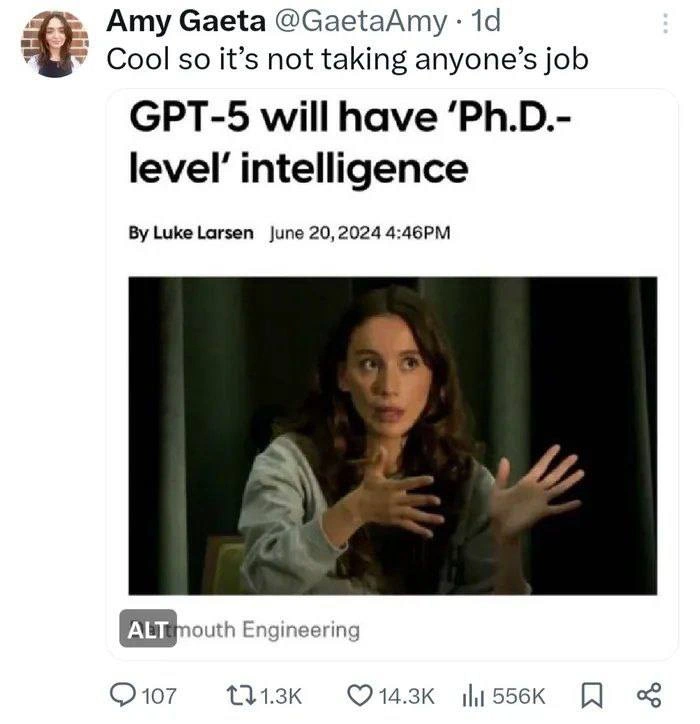
This meme is a screenshot of a tweet (a Twitter post) by a user reacting humorously to a news headline. In the tweet, Amy Gaeta says: “Cool so it’s not taking anyone’s job.” She’s responding to a news card that claims “GPT-5 will have ‘Ph.D.-level’ intelligence.” Let’s unpack this step by step, especially if you’re newer to these concepts or the humor:

First, GPT-5 refers to the next version of OpenAI’s GPT series (the AI models behind things like ChatGPT). GPT-4 is already known for being very advanced in understanding and generating text. So GPT-5 is expected to be even more powerful. When the headline says it will have “Ph.D.-level intelligence,” it’s suggesting GPT-5 could be as smart as someone with a PhD (the highest academic degree, meaning they’ve spent years becoming an expert in a niche field). That’s a bold claim! It implies this AI might solve really complex problems or answer very advanced questions – essentially performing like an extremely educated person. In the world of AI_hype, headlines often use dramatic language like this to get attention, even if it’s a bit unclear how an AI’s "intelligence" is measured in human terms.

Now, Amy’s tweet (“Cool so it’s not taking anyone’s job”) is dripping with sarcasm. To get the joke, you need to know a couple of things about both the tech industry and the job market:

  • People have job_displacement_fears regarding AI. They worry that if AI becomes super smart (like “Ph.D.-level” smart), it might replace human workers. For example, if an AI can write code or do research like a human expert, maybe companies won’t need to hire as many people.
  • However, Amy is implying the opposite: if GPT-5 is like a person with a PhD, then it won’t be taking anyone’s job. Why? There’s a tongue-in-cheek stereotype here that many PhD holders end up underemployed or struggling to find jobs in industry (especially if their field is very specialized or if employers think they’re overqualified). It’s a bit of dark humor about the job market: being extremely smart or educated doesn’t guarantee you a job these days.

The second part of the meme’s title about recruiters wanting “7+ years GPT-5 experience” highlights a common CareerHumor trope. In tech, job postings often have laughably unrealistic requirements. It’s not uncommon to see something like “Must have 5+ years experience in [Brand New Tech]” when that tech has only existed for 1 or 2 years. This happens because job descriptions can be out-of-touch or copy-pasted templates. Hiring_market_irony indeed – the people writing the job ad don’t always understand the timelines. For instance, when a new programming framework comes out, within a year you might see listings asking for multiple years of experience in it. Developers notice this and share it as a joke: “How could anyone have that much experience? Do they have a time machine?”

So, saying recruiters demand 7+ years of GPT-5 experience is an exaggerated example of this trend. GPT-5 isn’t even publicly available yet (as of mid-2024 it’s just a concept/news), so of course no one in the world has any experience using it, let alone 7 years. But it feels like something a clueless recruiter might ask for, based on past silliness. This is classic DeveloperHumor — poking fun at non-technical HR folks who don’t get the tech but write the job requirements.

Let’s define a few key terms and context to ensure it’s all clear:

  • GPT-5: Stands for Generative Pre-trained Transformer 5. It’s the hypothetical next version of an AI model that can generate text and answer questions. Think of GPT models as very advanced predictive text systems; they’ve read a huge chunk of the internet during training. GPT-4, for example, can write essays, code, and have conversations. GPT-5 is expected to be even more capable (the news headline suggests a big leap in “intelligence”). In short, GPT-5 is an AI that tech people are excited (and hyping) about, even if it’s not released yet.
  • Ph.D.-level intelligence: A Ph.D. is a doctorate degree – typically ~5+ years of study after college, involving original research. If someone says “PhD-level intelligence,” they mean really, really smart in a specialized way. It implies deep knowledge and the ability to reason through very complex problems. It’s not a formal metric (we don’t actually have an IQ test that equates to “PhD level”), but it paints a picture of an AI that might be able to reason or understand complex topics like an expert human could.
  • LLM (Large Language Model): This is the type of AI GPT-5 is. An LLM is essentially a program that has been trained on vast amounts of text data. It learns patterns in language, so it can generate human-like text. ChatGPT, which you might have used, is powered by an LLM. These models don’t truly “think” like a human, but they can imitate the way humans write and even solve problems by drawing on the information they learned. The larger the model (in terms of parameters and training data), generally the more fluent and knowledgeable it seems. GPT-5 would be one of these, presumably at a scale and sophistication beyond GPT-4.
  • “X years of experience”: In job listings, you’ll always see something like “N+ years of experience with [a technology].” This means the company wants someone who has worked with that technology or in that field for N or more years. It’s a proxy for skill – the assumption is, if you’ve been doing something for 7 years, you’re probably pretty good at it. But it’s often a blunt tool, and as mentioned, can be unrealistic if the tech itself is new. In meme-speak, whenever a shiny new tech appears, saying “7+ years experience” with it is a way to mock clueless or overly demanding recruiters.
  • Job displacement fears: This refers to the worry that people’s jobs will be taken over by machines or AI. It’s a common theme whenever technological progress jumps forward. For example, self-checkout machines prompted fears of cashiers losing jobs, and AI like GPT prompts fears of writers or programmers being replaced. In 2024, as AI models get better, a lot of folks are anxious about what work will look like in the future.
  • AI overqualification / Degree inflation: Overqualification means having more education or skill than a job requires. For instance, if someone has a PhD but is applying for an entry-level job, an employer might hesitate, thinking “They’ll be bored here or leave quickly.” Degree inflation is a trend where jobs that used to require a lower degree now ask for a higher one because more people are generally educated. In tech, you might see jobs that once required a Bachelor’s degree now quietly prefer a Master’s, or a Master’s job now wanting a PhD, even if the extra education doesn’t truly make someone better at the actual work. The meme touches on this by implying even a PhD-level AI isn’t assured a job.
  • Tweet screenshot meme: The format of the meme is literally a screenshot of a tweet with an attached article preview. This is common in online humor – someone shares a funny or sharp reaction (the tweet text), and it includes the snippet of what they’re reacting to (in this case, the headline about GPT-5). It’s a quick way to convey “look at this news, and here’s my sassy take on it.” For developer and tech memes, Twitter (or joking on tech forums) is a popular medium to call out hype or ironies in real time.

So, putting it all together in plain language: A news article claims a new AI (GPT-5) will be as brainy as a PhD holder. Amy responds with a joke that basically means, “If it’s like a PhD, it’s not going to steal jobs from us.” She’s implying that having super smarts isn’t enough to instantly land (or replace) a job because the job market has other barriers – like needing years of experience or dealing with hiring practices that might filter out even the smartest candidates. It’s both a jab at AI hype (saying “don’t panic, this AI won’t automatically take over human jobs”) and at hiring absurdities (saying “heck, the AI itself wouldn’t meet the silly job requirements out there”).

It’s a multi-layered joke that blends tech world news with everyday work-world cynicism. Even if you’re new to tech, you can appreciate the irony: imagine something incredibly capable being blocked by something incredibly trivial. As a budding developer or someone early in your career, you might not have encountered the “5 years experience in a 2-year-old tech” phenomenon yet, but trust us, it’s real and it’s hilarious when it happens. This meme is a light way of saying: keep calm, the robots aren’t replacing us today — they’d still have to get past HR. 😉

Level 3: Brains vs Bureaucracy

For seasoned engineers, this meme hits on a painfully relatable truth: cutting-edge tech often collides with old-school hiring practices, and the result is absurd. Here we have GPT-5, an AI hailed as the next big thing with “Ph.D.-level smarts,” squaring off against corporate bureaucracy – namely, recruiters and their checkboxes. The tweet’s author quips “Cool so it’s not taking anyone’s job” because those of us in the industry have seen this movie before. It’s classic AIHypeVsReality: a breakthrough is announced amid fanfare and IndustryTrends_Hype, everyone fears an army of robot geniuses will replace us, yet when the dust settles, the real obstacle isn’t Skynet—it’s HR’s ridiculous job requirements. The humor comes from knowing that even if an AI could, in theory, do a job, it wouldn’t get hired by the rules we’ve set up. We’ve all chuckled (or groaned) seeing job posts that make no sense, and this meme takes it to the extreme: even a super-intelligent AI would be stymied by a LinkedIn job listing.

Consider the trope of the overqualified human. Plenty of PhD holders in real life struggle to land industry jobs because they either get labelled “no relevant experience” or “too academic.” You might have a doctorate in computer science, but if you haven’t spent X years cranking out production code in Java or React, companies act like you’re an entry-level newbie. It’s a frustrating reality of Career_HR culture – companies often value specific experience with tools over raw intellect or potential. This meme riffs on that: GPT-5 is basically the ultimate brainiac (like a genius fresh out of academia), and the joke is that recruiters would still shrug and say, “Sorry, you don’t have the right experience.” In other words, welcome to the club, AI – join all the human PhDs driving Ubers or working outside their field! The tagline in the meme title about “7+ years GPT-5 experience” nails this absurdity. It’s poking fun at how recruiters sometimes treat hot-off-the-press tech as if it’s been around for a decade.

Experienced devs have countless anecdotes of this hiring_market_irony. Remember when React or Kubernetes first blew up? There were job listings demanding experts with 5-10 years experience in them, even though those technologies hadn’t existed that long. Everyone in the know rolled their eyes. One famous story: a company asked for 10+ years of experience in a framework that was about 6 years old – one of the framework’s creators joked even they wouldn’t qualify. The pattern repeats every time something new comes along. It’s a running joke in DeveloperHumor circles: “Must have 15 years experience in Terraform” (when the whole DevOps field isn’t that old) or “Looking for senior Swift developers with 8 years experience” (when Swift came out in 2014). This meme just extends that practice to GPT-5. AIIndustryTrends might move at lightning speed, but HR departments often don’t update their templates. They literally copy-paste requirements like a bad regex, swapping out “GPT-4” for “GPT-5” and upping the years by a few to sound safe. The result? Impossible criteria. It’s so common that seeing “7+ years of GPT-5” made developers smirk en masse – it’s exactly the kind of thing we anticipate with every new tech release.

Another layer here is the job_displacement_fears that have been swirling around AI. Media headlines love to scream “AI is coming for your job!” Whenever a new model one-ups humans at some task (chess, Go, coding interviews, you name it), people worry. By mid-2024, GPT-4 was already writing essays, debugging code, maybe even passing medical board exams. So GPT-5 talk ramps that up – Ph.D.-level intelligence sets the expectation it could potentially replace roles that require deep expertise. That’s intimidating! But this meme gives a seasoned reality-check with dark humor: even if an AI becomes that capable, organizations won’t know how to slot it in. It can’t literally apply for a job, and companies aren’t about to hand it a salary and health insurance. More likely, they’d create some new position for humans like “AI Whisperer” or "GPT-5 Prompt Engineer" (we actually saw this with GPT-4: roles where humans who know how to use the AI are in demand). And guess what those postings might say? “Experience with GPT-5 required.” 😏 So the AI might not take your job; instead, it becomes yet another tool you need to have on your resume – a resume that better show you’ve wrangled this unruly genius for years. If that sounds ridiculously backwards, that’s because it is. We’re effectively gatekeeping AGI with bureaucratic fine print.

This leads to the ultimate punchline for the tech veterans: the notion that an AI overqualification could be its own barrier. In the software world, we’ve seen degree_inflation and requirement creep turn job hunting into a farce. Entry-level positions ask for Master’s degrees plus 5 years experience. Meanwhile, genuinely talented newcomers or people with “untraditional” experience get filtered out by an algorithm or a clueless recruiter because they don’t tick every box. Here we have GPT-5, supposedly the Einstein of AIs, and we’re tongue-in-cheek saying it wouldn’t meet the criteria to get hired as, say, a junior analyst, because it lacks a LinkedIn profile with 7+ years of relevant work history. It’s a satirical way of highlighting how the hiring process often misses actual capability. The hiring_market_irony is almost protective in this case: our own absurd rules ensure no one, not even a super AI, meets the standard, thereby “saving” our jobs... at least until those rules change.

To really drive it home, picture a clueless hiring manager interacting with GPT-5: they ask it the typical interview question “Where do you see yourself in five years?” GPT-5 might reply with something ultra-logical like “I do not have personal aspirations, but I will likely be integrated into most digital services by that time.” The manager, not knowing how to process that, marks it down as a bad “culture fit.” 🤦‍♂️ It’s hilarious because it’s true: culture fit and bureaucracy often outweigh raw talent. AI_capability_hype meets corporate reality, and corporate reality wins on technicalities. As a community of developers, we laugh (maybe a bit bitterly) because we’ve experienced how fast technology evolves and how slow institutions adapt. There’s almost a comfort in the joke: for all the fears of intelligent machines, it turns out humanity’s greatest defensive weapon is our own nonsense. We won’t let a genius robot take over because our HR software will auto-reject it for not uploading a proper cover letter.

In sum, the meme resonates on multiple levels: it lampoons overhyped AI headlines, it satirizes the experience-obsessed mentality of tech hiring, and it gives a wink to all of us who have felt overlooked or misjudged by superficial job requirements. It’s a perfect storm of CareerHumor and AIHumor. The next time someone asks if you’re worried about GPT-5 taking your job, you can joke, “GPT-5 can’t even get a job without 7 years of GPT-5 experience – it’s in the same boat as the rest of us!” 🌧️🚢

# Hypothetical job listing, circa 2025
title: "Senior GPT-5 Solutions Architect"
requirements:
  - "7+ years of hands-on experience with GPT-5 in production"
  - "Ph.D. in Machine Learning or equivalent demonstrable Ph.D.-level intelligence"
  - "Proven track record deploying LLMs **before** they existed"
  - "Excellent communication skills (to translate AI gibberish to executives)"

Level 4: Intelligence != Experience

At the bleeding edge of AI/ML, the claim that GPT-5 will have “Ph.D.-level intelligence” hints at an AI approaching Artificial General Intelligence (AGI) territory – at least in headline terms. Technically, this implies a model so advanced it can perform tasks or reasoning at the caliber of an expert who spent ~8 years getting a doctorate. Under the hood, GPT-5 would likely be a Large Language Model (LLM) of unprecedented scale (think trillions of parameters) with architectures possibly building on the transformer design of GPT-4. In theory, such an AI could ace academic exams, write research papers, or solve specialized problems that normally only PhDs tackle. It’s leveraging vast training data to achieve emergent behaviors – those surprising leaps in capability where the AI starts handling tasks far more complex than anyone expected. From a pure algorithmic standpoint, it's like we’ve dialed the model’s knowledge to 11, packing in an entire library of expertise.

However, raw intelligence as measured by benchmarks or exams doesn’t automatically translate to real-world job skills. In computing terms, intelligence != experience (intelligence is not equal to experience). A PhD (human or silicon) excels at theory and specialized problem-solving, but experience is about applied, hands-on know-how accumulated over time. An AI might have read every software manual and research paper (it essentially ingested the internet during training), but it has zero days of actual on-the-job runtime dealing with unpredictable real-world scenarios. It’s the difference between a trained model that can generate a perfect plan and a seasoned engineer who has executed imperfect plans amid chaos and learned from the burns. The AI’s knowledge is broad and its reasoning is sophisticated in controlled contexts, but it lacks lived experience – it has never debugged a production outage at 3 AM, negotiated requirements with a client, or gradually improved a system through iteration. These are the unsung skills humans pick up over years of working.

This creates a paradox at the intersection of AI capability and human employment. On paper, a model like GPT-5 might outperform many humans on intellectual tasks (solving equations, writing code, answering complex questions). Yet when we talk about “taking jobs,” we’re implying the AI could function as an employee or a worker. In reality, GPT-5 is not an autonomous agent with a career; it’s more akin to an insanely knowledgeable tool. It doesn’t apply for jobs – it gets deployed to assist or automate tasks under human direction. That means its Ph.D.-level reasoning sits in a vacuum until a person or company integrates it into a workflow. And here’s the kicker: our human systems for evaluating candidates (like recruiters scanning resumes) don’t know what to do with an AI that has no resume, no references, and no years of experience checkbox filled out. In a way, the model is overqualified intellectually but underqualified by every traditional measure of “hireability.”

From a theoretical perspective, it’s a classic case of differing metrics. AI researchers measure intelligence with benchmarks (e.g. passing the bar exam, scoring high on IQ or GRE questions, writing credible research abstracts). But employers measure suitability with proxies like degrees, certifications, and years on the job. GPT-5 smashing academic benchmarks doesn’t resolve the real-world integration problem: it has no soft skills, no accountability, and no direct experience using its intelligence in a business context. Computer science has a concept of the transfer gap – performing well in a training environment vs. adapting to new, unforeseen situations. Here, GPT-5’s training environment is text and academia; the unforeseeable situation is the messy, multidisciplinary, interpersonal world of work. There’s even an analogy to be made with autonomous cars: a self-driving car might handle most driving scenarios flawlessly (like an AI savant), but throw it into a construction detour with a human waving directions and it might freeze – it lacks the experiential background to improvise. Likewise, GPT-5 can regurgitate and even synthesize knowledge at PhD caliber, but it has never sat through a sprint planning meeting or dealt with an annoying project manager. Fundamentally, it’s brilliant in theory and ignorant of practice.

So when a headline trumpets “Ph.D.-level intelligence,” AI experts temper that with context: it means the model is extremely advanced in controlled evaluations, not that it magically possesses a human scientist’s practical savvy. In fact, job_displacement_fears around AI often assume a one-to-one replacement of human roles, but neglect the last-mile problems of deploying those AIs in the wild. Here, that “last mile” isn’t a technical hurdle but a human one: convincing companies and Career_HR gatekeepers to trust and effectively utilize something that has no prior job experience. In the meantime, the model sits in a weird limbo – a super-intellect with potentially no job to do unless very specialized conditions are met. It’s an almost comedic inversion of the usual skills_required vs. skills_provided equation: the AI overshoots on knowledge but undershoots on the kind of credentialism and tribal knowledge our job market actually runs on. In short, the brains are there, but the resume is blank.

Description

A screenshot of a tweet by Amy Gaeta that layers a sarcastic comment over a news article snippet. The tweet reads, 'Cool so it’s not taking anyone’s job.' The underlying article headline states, 'GPT-5 will have ‘Ph.D.-level’ intelligence.' Below this is a reaction image of a woman looking earnest and gesturing as if explaining something. The humor is a classic self-deprecating jab at academia, implying that having a Ph.D. does not guarantee employment or a high salary. The tweet suggests that if an AI's intelligence is benchmarked against a Ph.D., it's no threat to the job market, humorously highlighting the perceived gap between academic credentials and real-world job prospects

Comments

18
Anonymous ★ Top Pick A PhD-level AI is perfect. It can explain in excruciating detail why your entire architecture is theoretically suboptimal while contributing absolutely nothing to the impending release deadline
  1. Anonymous ★ Top Pick

    A PhD-level AI is perfect. It can explain in excruciating detail why your entire architecture is theoretically suboptimal while contributing absolutely nothing to the impending release deadline

  2. Anonymous

    Relax - if GPT-5 really has a PhD, it’ll spend the next three years writing papers no one cites and still need a senior engineer to merge its pull requests

  3. Anonymous

    Finally, an AI with PhD-level intelligence - perfect for writing overly complex solutions to simple problems, arguing about edge cases nobody will encounter, and still somehow missing that production bug that takes down the entire system at 3 AM

  4. Anonymous

    Ah yes, GPT-5 with 'PhD-level intelligence' - because what we really needed was an AI that can spend six years researching a hyper-specific topic, produce a 300-page dissertation nobody reads, and still struggle to explain it to stakeholders in plain English. At least it'll fit right in with the rest of us overqualified engineers debugging CSS alignment issues at 2 AM

  5. Anonymous

    PhD-level GPT-5: Now it hallucinates with proper citations and a bibliography

  6. Anonymous

    If GPT-5 is PhD-level, it’ll crush novelty metrics and peer review, then stall at the change-approval board because no one granted it prod IAM or feature-flag permissions

  7. Anonymous

    If GPT-5 has Ph.D.-level intelligence, perfect - when PagerDuty fires at 3am it’ll deliver a 30-page literature review and label the rollback as “future work.”

  8. @ZgGPuo8dZef58K6hxxGVj3Z2 2y

    Bruh

  9. @SamsonovAnton 2y

    "AI will teach you how to go camping the right way".

    1. @AmindaEU 2y

      And how to die to carbon monoxide?

      1. @SamsonovAnton 2y

        Not before your skin crackles like chicken! (Far Cry 3 moment)

    2. @callofvoid0 2y

      you won't feel cold anymore

    3. @azizhakberdiev 2y

      how to make campfire even larger

  10. @Diotost 2y

    It will be like an almost senile professor.

  11. @CammyDeer 2y

    GPT IS! A! DOCTOR!

  12. @CcxCZ 2y

    https://xkcd.com/2044/

    1. @AmindaEU 2y

      https://m.xkcd.com/2044/

  13. @AmindaEU 2y

    And they don't understand what is happening within the docker and thus are unable to think outside of the box to figure out how to fix things!

Use J and K for navigation