Microsoft Outlook: The Ultimate Turn-Based Strategy Game
Why is this CorporateCulture meme funny?
Level 1: The Waiting Game
Imagine you and your friend are playing a game where each of you can only make one move at a time, and you have to wait a long time for the other person to take their turn. For example, say you’re playing checkers by mail: you send your friend a letter with your move, then a few days later they send a letter back with their move. Can you picture how slow that would feel? You’d make one move, and then just wait, twiddling your thumbs until the next letter comes. That’s exactly what using email at a big job can feel like!
In a big company, people often talk to each other by sending emails. When you ask a question in an email, the other person might not reply right away. They could be busy or in a meeting, so you might get an answer much later. It’s like playing a game of catch, but the ball is moving in super slow motion. 😅 The funny part of the meme is that it calls this slow back-and-forth email routine a “turn-based strategy game.” Normally, games are fun and something you choose to play. Here, the meme is joking that answering work emails has become a daily “game” for grown-ups — one where every turn (each email reply) takes a long time.
Why is that funny? Because nobody actually thinks work email is a fun game! It’s something people sometimes find boring or frustrating. By jokingly calling it a favorite game, it’s using irony – saying the opposite of what we really feel to get a laugh. The truth is, waiting for an email reply can be as tedious as waiting for your turn in a slow board game. Imagine asking your teacher a question, and they only respond the next day – you’d probably giggle at how silly that waiting feels. In the same way, developers laugh at this meme because it exaggerates their daily frustration in a playful way. They’re basically saying, “Haha, dealing with email at work is so slow and strategic, it might as well be a game!” And sometimes, having a sense of humor about it is the best way to get through the waiting game. 🎲📨
Level 2: Email Ping-Pong Overhead
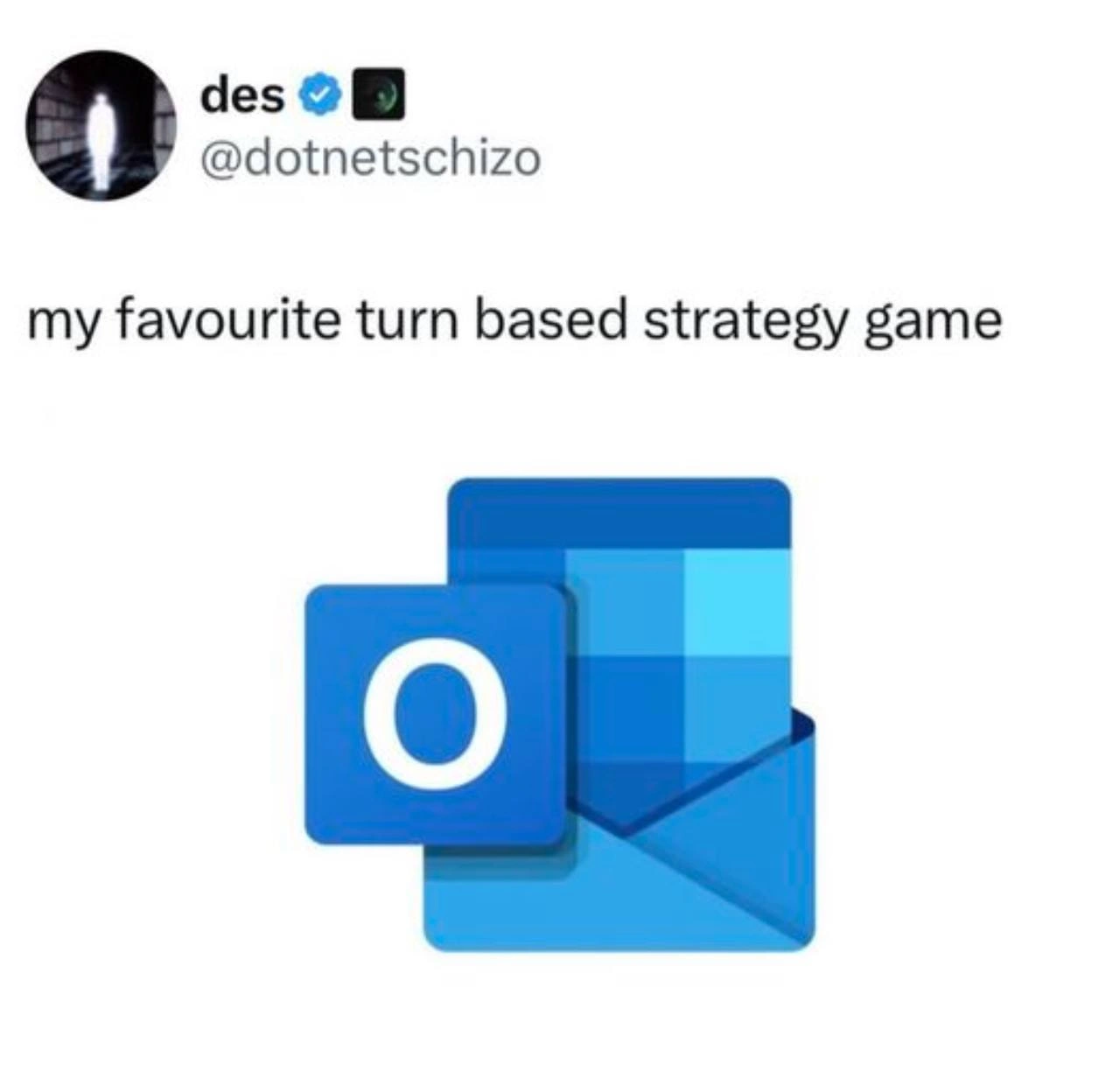
Let’s break down the joke in simpler terms. The meme shows the Outlook logo (the icon for Microsoft’s email application) under a tweet that says “my favourite turn based strategy game.” The humor here comes from comparing corporate email to a turn-based strategy game. Now, a turn-based strategy game is a type of game (like chess, or video games such as Civilization or XCOM) where players take turns to make moves. For example, in chess you move one of your pieces, then your opponent moves one of theirs, and you go back and forth. It’s not in real-time; you always wait for the other person’s turn before you can do your next move.
Now think about how email works in a company setting: you send an email asking a question or giving an update. You can’t get an instant answer because the other person will read it later and reply when it’s their turn (maybe in a few minutes, maybe in a few hours, maybe even the next day). It’s asynchronous communication – which means not happening at the same time. Unlike a phone call or a face-to-face chat (which are synchronous and immediate), email is a bit slow. You send your message and then you have to wait. When the reply finally comes, that’s like the other player making their move. Then it might be your turn again to reply back. This back-and-forth can continue through many “turns” in the email thread. If you’ve ever heard people say “email ping-pong,” this is what they mean – an email goes ping (sent), pong (reply), ping, pong, over and over. It’s essentially like a ping-pong match but with Outlook messages. 🏓📧
The phrase “communication overhead” refers to the extra effort and time spent just on communicating itself. In an ideal world, you ask a question and get an answer immediately, done. But with emails, especially in a big organization, there’s a lot of overhead: you spend time crafting the message, more time waiting, then maybe clarifying things if there was a misunderstanding, and so on. For a new developer, it can be surprising how much of their day might be consumed by reading and replying to emails rather than writing code. That’s part of the Developer Experience (DX) in many workplaces — using tools like Outlook, Teams, Slack, etc., becomes a big portion of the job. “CommunicationGap” is another related term, which is about misunderstandings or missing information when people communicate. Over email, it’s easy for a message to be unclear or for someone to overlook an important detail, and that gap can lead to even more emails to sort things out. This can make the whole process even slower, almost like taking an extra unwanted turn in our “game.”
The meme’s CorporateHumor lands well because if you work in a big company, you know that email threads (especially those with lots of people cc’d on them) can be ridiculously slow and overly formal. It sometimes feels like you’re playing a workplace version of a strategy game where everyone has to take turns giving their input. For example, imagine you need approval to implement a new feature: you email your manager about it, they eventually reply with questions, you answer those questions, then they loop in a director (adding them in CC) for another “turn,” and that director replies a day later, and maybe they want even someone else’s opinion… Each person’s response is another turn in this “game” and you’re just sitting there unable to proceed with your work until all the players have taken their turn. Relatable? Absolutely. This is why the joke is relatable humor for many developers – they see this situation all the time, and it’s both funny and frustrating.
The Outlook logo in the image makes it clear that the subject is Microsoft Outlook, which is the email client many enterprises standardize on (especially those deep in the Microsoft ecosystem, like .NET teams – notice the tweeter’s handle includes "dotnet"). Outlook has features like email, calendar, contacts, etc., and is often the center of corporate communication. So when a developer says Outlook is their “favorite game,” they’re being tongue-in-cheek. They don’t literally enjoy it like a game; rather, they’re poking fun at how dealing with Outlook has become a daily routine that requires thought and patience, just like playing a strategy game. It’s an industry in-joke: people who work in tech or large companies laugh because they know no one actually likes waiting on email, but we joke that it’s a “game we all end up playing.”
It’s also worth noting the context of this joke on Twitter. The tweet comes from a developer in the community (the blue verified check and the handle suggest it’s a known person in some tech circle). Tech Twitter often circulates memes where they compare work life to gaming or pop culture. In this case, calling Outlook a turn-based strategy game is a humorous exaggeration that other developers will “get.” If you haven’t experienced the slow pace of enterprise email, you might find it odd – “Is Outlook a game?” – but once you’ve been there, you understand the sarcasm. The tweet’s popularity (it was screenshot-worthy) indicates a lot of people felt the exact same way.
So, for a junior developer or someone new to corporate life: be prepared that email (yes, even something as ordinary as email!) can feel like a tactical exercise. You’ll learn things like: how to write succinct emails (a skill, almost like choosing the right action in a game), how to decide who needs to be CC’d (like picking your team players), and how to follow up if someone doesn’t reply (maybe poke them gently with a reminder – a little nudge in game terms). Dealing with these communication tools can be tiring – we call that enterprise tool fatigue. It means getting exhausted not by coding, but by using all the heavy tools big companies require, from Outlook to spreadsheets to ticketing systems. It’s a shared experience that brings developers together to laugh (and groan) about it. After all, when you’re stuck waiting on five different email threads before you can proceed with your tasks, you kind of have to joke that this is just your new “game” to stay sane.
Level 3: Turn-by-Turn Corporate Combat
"my favourite turn based strategy game" – The tweet’s dry quip is plastered over a giant Microsoft Outlook logo, instantly drawing a parallel between enterprise email and a slow tactical battle. Seasoned developers smirk at this because it rings painfully true. In large organizations, Outlook email threads often feel like an interminable round of Civilization or chess-by-email. Every email is a move in a high-stakes corporate campaign: you carefully craft your message (deploy your units), hit “Send” (press End Turn), and then wait... and wait. Just as in a turn-based strategy, nothing happens until the other side makes their move – which in corporate time might be later today, tomorrow, or next week. The meme lands as wry commentary on communication latency and decision-making drag in big companies. A senior engineer reading this has flashbacks to projects where choosing dark mode vs light mode became a week-long email saga.
In this Outlook “game,” experience teaches you to think like a strategist. A veteran dev approaches a Reply-All email chain the way a chess master approaches the board: anticipating each stakeholder’s response, plotting responses to their questions in advance, and deciding who to CC as if selecting which allies to bring into battle. Hitting "Reply All" is the ultimate tactical move – one must wield it carefully. Misjudge your reply-all strike (like accidentally CC’ing the entire department on a trivial update) and you trigger an email avalanche, akin to a chaotic in-game chain reaction. We’ve all witnessed a harmless status email turn into a 50-reply pile-up because someone misplayed by asking a broad question to everyone. That’s the corporate equivalent of aggroing the wrong monster, and suddenly your inbox counters are overflowing with notifications.
Inbox triage every morning feels like managing multiple fronts in a war. You scan your unread emails at 9 AM, prioritizing which threads to tackle first: a prod issue email from last night is a priority objective, while the lengthy design discussion thread can probably simmer until the other “players” make their moves. This prioritization is essentially resource management – allocating your limited attention and time, much like distributing resources to battles in a strategy game. A senior dev knows that if you respond too quickly to a non-urgent email, you might get dragged into an endless back-and-forth (the email equivalent of an infinite side-quest). So you plan your engagement timing strategically: sometimes it’s wiser to hold off and see if someone else on CC answers (let the other team members “take their turn”), especially if you’ve got real code to write. It’s a turn-based tactics meta that only veterans truly master.
The humor here also lies in the corporate culture reality that big enterprises move slowly. Decisions that could be made in a 5-minute hallway chat often involve a dozen people trading long Outlook emails over several days. That decision latency is irritating, so developers joke that they’re “playing Outlook” to cope with the absurdity. There’s a shared trauma being referenced: every engineer who’s been stuck waiting on an email approval while a project’s on hold knows the agony of this slow drip communication. It’s a CommunicationOverhead boss fight: the actual technical work is delayed, not by coding challenges, but by the endless “reply to all” cycle. In a darkly comedic way, calling Outlook your favorite game highlights how common and unavoidable this grind is. You don’t get to skip this level – if you work in a big company, mastering the email game is part of the job description.
On an industry level, this meme nails an inside joke about enterprise life. We’ve built amazing continuous integration pipelines and real-time dashboards, yet critical discussions still happen via slow email threads — it’s like having a state-of-the-art gaming PC but choosing to play in slow motion. The contrast between high-speed tech and low-speed comms is both ironic and universal. Why does this pattern persist? Because enterprise processes prize documentation and inclusive communication: emailing provides a paper trail and ensures everyone officially has a turn to voice concerns. It’s democracy via inbox, albeit a sluggish one. Every senior dev has stories of email ping-pong delaying deploys or design decisions. Over time you learn the tactics to cut through the wait: ping politely for updates (“nudging” is like casting a buff to speed up the next turn), or escalate by looping in a manager (the equivalent of summoning a boss character to move the game along). Even so, the game can’t be rushed beyond a point — much like you can’t rush the enemy’s turn in a board game, you can’t force Bob from accounting to answer any faster.
Ultimately, the meme is a salute to those battle-hardened developers who have leveled up not just in coding, but in email endurance. It’s funny because it’s true: Outlook email truly feels like a turn-based strategy game some days, except nobody is having fun. By framing it as a “favourite game,” @dotnetschizo injects sardonic humor into a daily frustration. It’s a reminder that in the WorkplaceHumor pantheon, sometimes you have to laugh at the tools that drive you crazy. After all, when you’re stuck waiting for that all-important approval email before you can merge your code, what else can you do but chuckle at the situation? As any cynical veteran will tell you with a shrug: “Welcome to the inbox warfare, kid. Get comfortable — it’s your move, but don’t hold your breath for the next turn.”
Description
A screenshot of a tweet from the user 'des' (@dotnetschizo). The tweet text simply says, 'my favourite turn based strategy game,' and is accompanied by a large icon of Microsoft Outlook directly below it. The humor lies in the deeply relatable analogy for anyone in a corporate or tech environment. It frames the daily grind of managing a flooded email inbox not as a communication task, but as a complex strategic game. Each email is a 'turn' from an opponent (a colleague, manager, or automated system), requiring a tactical response: when to reply, how to phrase the message, who to CC to cover yourself, and when to strategically ignore an email to manage workload. The meme perfectly captures the feeling that succeeding at 'email' requires more strategic maneuvering than actual productivity
Comments
21Comment deleted
My Outlook strategy has evolved into a zero-trust model. Every incoming email is a potential threat, 'Reply All' is a root-level command that requires three approvals, and my out-of-office reply is my primary firewall
Every sprint we talk about reducing cycle time, yet our real KPI is still ‘turns per Outlook thread.’
After 20 years in enterprise, I've realized the real distributed consensus problem isn't Paxos or Raft - it's getting five senior engineers to agree on a meeting time when everyone's calendar looks like a game of Tetris played by someone having a seizure
Outlook truly is the Dark Souls of enterprise communication - every email thread is a boss fight where you must carefully time your responses, manage your mana (attention span), and pray your 'Reply All' doesn't trigger a company-wide wipe. The meta-game involves mastering advanced techniques like the strategic 'BCC backstab,' the defensive 'delayed send' to appear productive at 2 AM, and the legendary 'moving this to a separate thread' maneuver to escape unwinnable encounters. Bonus points if you've unlocked the achievement for surviving a 47-person CC chain without losing your sanity or accidentally hitting 'Reply All' with a sarcastic comment meant for Slack
Outlook: where every reply-all is a Byzantine generals problem, and inbox triage demands CAP theorem tradeoffs
Outlook: the distributed‑saga simulator where every turn is a Reply‑All that increases fan‑out, and the boss’s OOO autoresponder is your deadlock detector
Outlook is the turn-based strategy where every reply-all is a distributed write, CC increases the quorum size, and the final boss is the calendar invite that enforces liveness
every 10 minutes you don't open an email you take poison damage Comment deleted
Explain pls Comment deleted
waiting for the enemy (coworkers) to attack (reply) Comment deleted
jrpg skill tree / spellcards Passive Aggression "As per my previous email" Summon "Their manager in CC" Demoralisation "I'll just schedule a quick Teams call" Storage Terrorism "Sending Logs over Mail" Corporate Speak "Layoff letter in ChatGPT" Gaslighting "Fake phishing test" Comment deleted
So Zoom is an RTS? Comment deleted
And in-person meatings are beat 'em ups. Comment deleted
Everyone knows how Feynman cracked safes at Los Alamos during Project Manhattan. But my favourite part is how they kept censoring chess-by-post game with his wife. Comment deleted
wtf Comment deleted
Get the book. It's so worth it. Comment deleted
which book Comment deleted
His memoir https://en.m.wikipedia.org/wiki/Surely_You%27re_Joking,_Mr._Feynman! Comment deleted
Also I think more people should know that https://en.m.wikipedia.org/wiki/Play-by-mail_game & https://en.m.wikipedia.org/w/index.php?title=Play-by-post_role-playing_game are a thing. Comment deleted
I've joked about making a staff wargame where your only interface is email. With speech recognition and synthesis AI advancements you could probably add telephone and vidcos to it. Comment deleted
Btw, elders played Galaxy plus this way... Comment deleted