The AI Power Shift: A 'Call an Ambulance' Meme Depicting Google's 2025 Comeback Against OpenAI
Why is this AI ML meme funny?
Level 1: Not So Fast
It’s like a story of a surprise comeback. Imagine two kids playing pretend battles. The younger kid jumps out and “defeats” the older kid at first. The older one even pretends to be hurt, saying “Oh no, I’m really hurt – call for help!” The younger kid thinks he’s won. But suddenly the older kid stands up smiling, totally fine, and pulls out a trick of his own, saying “Ha, not for me!” and then wins the game. The funny part is that the older kid looked like he was in big trouble, but it was a fake-out – he turned things around at the last second. In the same way, this meme shows Google as the older player who everyone thought was knocked out by OpenAI, but then Google surprised everyone and came back strong. It’s that “gotcha!” moment that makes us laugh – the one who seemed weak turned out to be okay and ended up on top.
Level 2: Turning Tables in Tech
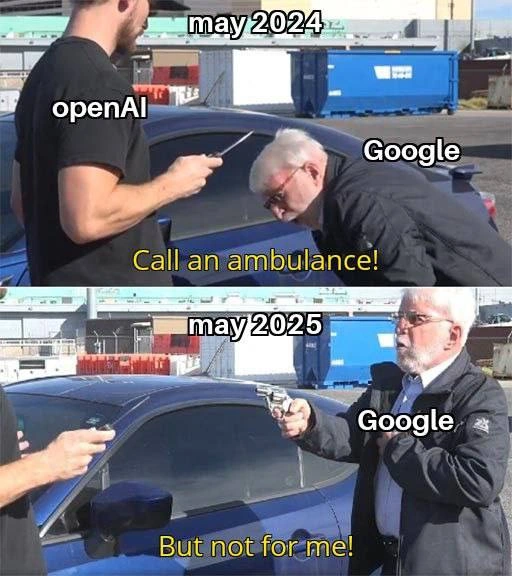
This two-panel image uses the classic “Call an ambulance… but not for me” meme format to illustrate a reversal in the OpenAI vs Google showdown. In the top panel (captioned “May 2024”), we see a younger man labeled "openAI" pointing a weapon-like object at an older man labeled "Google". The older guy is bent over, clutching his stomach as if he’s been seriously hurt, and he yells “Call an ambulance!” in the yellow subtitle. This is a direct reference to a popular meme scene where someone pretends to be in mortal danger. Here, it symbolizes Google seeming badly hurt in 2024 by OpenAI’s advances in AI. At that time, OpenAI’s creation ChatGPT (a powerful generative AI chatbot) had taken the tech world by storm. Microsoft even plugged ChatGPT’s tech into Bing search, creating a lot of buzz about generative search (search engines giving direct, human-like answers). People were excited and speculating that this new approach could seriously threaten Google’s core business (internet search and ads). In simple terms, OpenAI’s AI was so impressive that many thought Google was down for the count. Google appeared to be scrambling – for example, it rushed out Google Bard (its own AI chatbot) in 2023 to catch up, though that launch had some hiccups. “May 2024” in the meme represents this peak AI hype period, where it looked like Google might actually need an ambulance (metaphorically) because the challenge from OpenAI was so serious.
Now look at the bottom panel, labeled “May 2025.” The roles flip. The same older man labeled Google is now standing upright and pointing a revolver back at someone off-screen (presumably the younger OpenAI guy). Google now declares “But not for me!” This means “Call an ambulance, but not for me.” It’s the punchline of the meme format, where the person who seemed hurt reveals they were actually capable of fighting back all along. In the tech context, by May 2025 Google has recovered and is counter-attacking in the AI market. Over the year, Google apparently regrouped and developed its own stronger AI offerings, so it’s no longer the victim. The meme suggests Google launched something in 2025 that turns the tables – maybe an improved Google AI in search or a new advanced model (there were talks of a model named Gemini from Google’s DeepMind). Essentially, Google is saying it doesn’t need that ambulance anymore; instead, OpenAI might be in trouble now! This reflects an AI market flip: the competitive advantage swung back to Google. It’s common in tech for the incumbent (the established giant) to appear defeated by a nimble newcomer, only to use its resources and experience to catch up quickly. Here the “ambulance” represents help or rescue, and Google is boasting that they won’t be the ones needing help after all.
So in summary, the top image shows OpenAI seemingly “shooting down” Google in 2024 (symbolizing how ChatGPT and generative AI were hurting Google’s dominance). The bottom image shows Google in 2025 has pulled out a bigger “gun” on OpenAI (symbolizing Google’s comeback with its own AI advancements). The humor comes from this reversal: one moment Google looked like the victim (in 2024), the next moment Google is the one on the offensive (in 2025). This meme is a lighthearted way to say “Don’t count Google out!” using the fun “Call an ambulance… but not for me” template. It highlights how fast the AI industry trends can change – within just one year, hype can shift and today’s tech underdog can become tomorrow’s top player (and vice versa). Even though OpenAI gave Google a scare, Google’s counterpunch shows the competition in AI is far from over. In an arms race (a competition to build more powerful weapons, or in this case, more powerful AI), each side keeps leap-frogging the other. Here, the “weapons” are cutting-edge AI models and search innovations. The meme format delivers this serious tech rivalry in a jokey, memorable way that developers familiar with industry news will understand.
Level 3: The Empire Strikes Back
In the AI arms race of the mid-2020s, this meme captures a dramatic plot twist in the generative search wars. It’s May 2024: OpenAI (the upstart famed for ChatGPT) has Google looking mortally wounded. Think back to late 2023 and early 2024 – the hype around generative AI was at a fever pitch. OpenAI’s large language model was integrated into products like Bing’s generative search, and pundits were asking if this was a “Google killer.” Google seemed on the defensive, reportedly declaring a “Code Red” (corporate-speak for “Call an ambulance!” emergency) over fears its search dominance was in peril. The meme’s first panel nails this moment: a younger man labeled OpenAI aims a “weapon” (metaphorically, a groundbreaking AI tech) at an older man labeled Google. Google is doubled over as if gut-shot, echoing all those hot takes that Google Search was done for.
But fast-forward to May 2025 (second panel), and Google is standing tall again, pulling out a bigger “gun” of its own. In other words, the seemingly injured giant had a strategy pivot up its sleeve. Perhaps Google’s extensive R&D and massive compute resources paid off – by 2025 they retaliate with their own advanced LLM (Large Language Model) or generative search features. There were rumblings about Google’s Gemini AI project aiming to leapfrog OpenAI’s models. Whether through a superior model or by weaving AI into its existing products (think of Google’s search results enhanced with AI summaries and coding assistants in the browser), the incumbent struck back. The subtitle “But not for me!” is Google essentially saying: “You thought I needed that ambulance? Nope – that call was premature.” This twist reflects an industry trend we’ve seen before: a big tech incumbent, seemingly on the ropes from a disruptive newcomer, suddenly resurges thanks to deep pockets, talent, and data – turning the tables spectacularly.
There’s rich irony here. Google itself pioneered much of the AI tech fueling OpenAI’s rise – it was Google researchers who published the 2017 paper on the Transformer architecture that made GPT-style models possible. It’s as if Google handed OpenAI the weapon that OpenAI pointed back at Google! The meme’s humor plays on this narrative: OpenAI had Google at gunpoint with Google’s own invention. But the tables didn’t stay turned for long. By 2025, Google’s saying “I have my own gun now, surprise!” – implying they leveraged their vast resources (like countless GPUs/TPUs, decades of indexed web data, and integration across products) to outgun OpenAI. It highlights how AI hype vs reality can flip in just a year. The fickle nature of big-tech dominance is on display: Today’s wounded giant might be tomorrow’s avenger. We’ve seen echoes of this before – remember how everyone thought AltaVista or Yahoo! were unassailable in search until Google itself upended them? Tech history is full of “call an ambulance… but not for me” moments. The meme gets a collective laugh (and a knowing groan) from industry veterans because it captures that whiplash feeling: one year you’re writing an incumbent’s obituary, the next year they’re back with a vengeance. Plot twist indeed.
Description
A two-panel meme in the 'Call an ambulance, but not for me!' format, depicting the competitive struggle between OpenAI and Google. The top panel, dated 'may 2024', shows a man labeled 'openAI' holding a screwdriver and menacing an older man labeled 'Google', who appears injured. The yellow caption reads, 'Call an ambulance!'. The bottom panel, dated 'may 2025', reverses the situation entirely. The older man, 'Google', is now standing upright and pointing a silver revolver at his aggressor with the caption, 'But not for me!'. This meme humorously illustrates a perceived shift in the AI industry's power dynamic. It reflects the narrative that while OpenAI held a dominant, threatening position over Google in 2024, a dramatic turnaround is anticipated by 2025, with Google re-emerging as the dominant force. For senior engineers, it's a cynical but relatable take on the volatile nature of tech leadership and the high-stakes competition driving AI development
Comments
17Comment deleted
Google's transition from 'We have a moat' to 'Call an ambulance, but not for me' is the most aggressive product pivot we've seen since they killed another chat app
Apparently Google spent 2024 quietly pre-warming its TPU cluster - 2025 was just the cold-start callback
After years of 'Google it' becoming synonymous with search, watching them scramble to catch OpenAI in AI was like watching IBM discover they forgot to invent the PC. But if history teaches us anything, it's that Google's graveyard of products exists because they're really good at killing things - sometimes even the competition
Ah yes, May 2024: when Google was frantically rebranding Bard to Gemini while watching GPT-4 eat their lunch. Fast forward to 2025, and suddenly they've got Gemini 2.0 with multimodal capabilities that actually work, Deep Research that doesn't hallucinate your entire codebase into existence, and enough compute to make OpenAI's API bills look like a rounding error. Classic Big Tech move: lose the sprint, win the marathon by simply outspending everyone on TPUs until the problem goes away. Meanwhile, us senior engineers are just here maintaining the same CRUD app regardless of which LLM autocompletes our boilerplate
Every May the ambulance flips sides, so we built a provider-agnostic AI gateway - now the only thing getting shot is our eval suite’s credibility and Finance’s token budget
OpenAI disrupted with transformers; Google's quietly weaponizing two decades of search data and TPUs for the kill shot
Reminder: in AI, the hardest problem isn’t training - it’s distribution; flip a Chrome flag in May ’25 and the “ambulance” becomes everyone else’s deprecation notice
Can someone tell me what it is about? I'm live under a rock. Comment deleted
The last Google IO conference, they announced a lot of new AI applications. Many many things, here a resume in 32 minutes because I don't know where to start: https://www.youtube.com/watch?v=bDVpI23q8Zg Comment deleted
Anything important too or... Comment deleted
For devs, Jules (https://jules.google) . Is an asynchronous coding agent: You give it a GitHub repo and clones it in a Google Cloud VM, so you give it tasks and it does its job without supervision. But the presentation was full of new things, new models for specific tasks (programming, video, audio, etc), in Android, in Android XR (glasses, etc), in Chrome, etc. Comment deleted
So just AI AI AI AI? My excitement for language models has died down at this point and I never liked image models, don't get me started on video Comment deleted
Your thoughts on this one? Comment deleted
Here is a better Comment deleted
Like in R&M Comment deleted
Reddit/Lemmy artist luddites are pissing themselves rn, and I'm all for it. They are useless purists that only know how to draw horse futanari or whatever Comment deleted
@itsTyrion so what do you think? 🌚️️ Comment deleted