
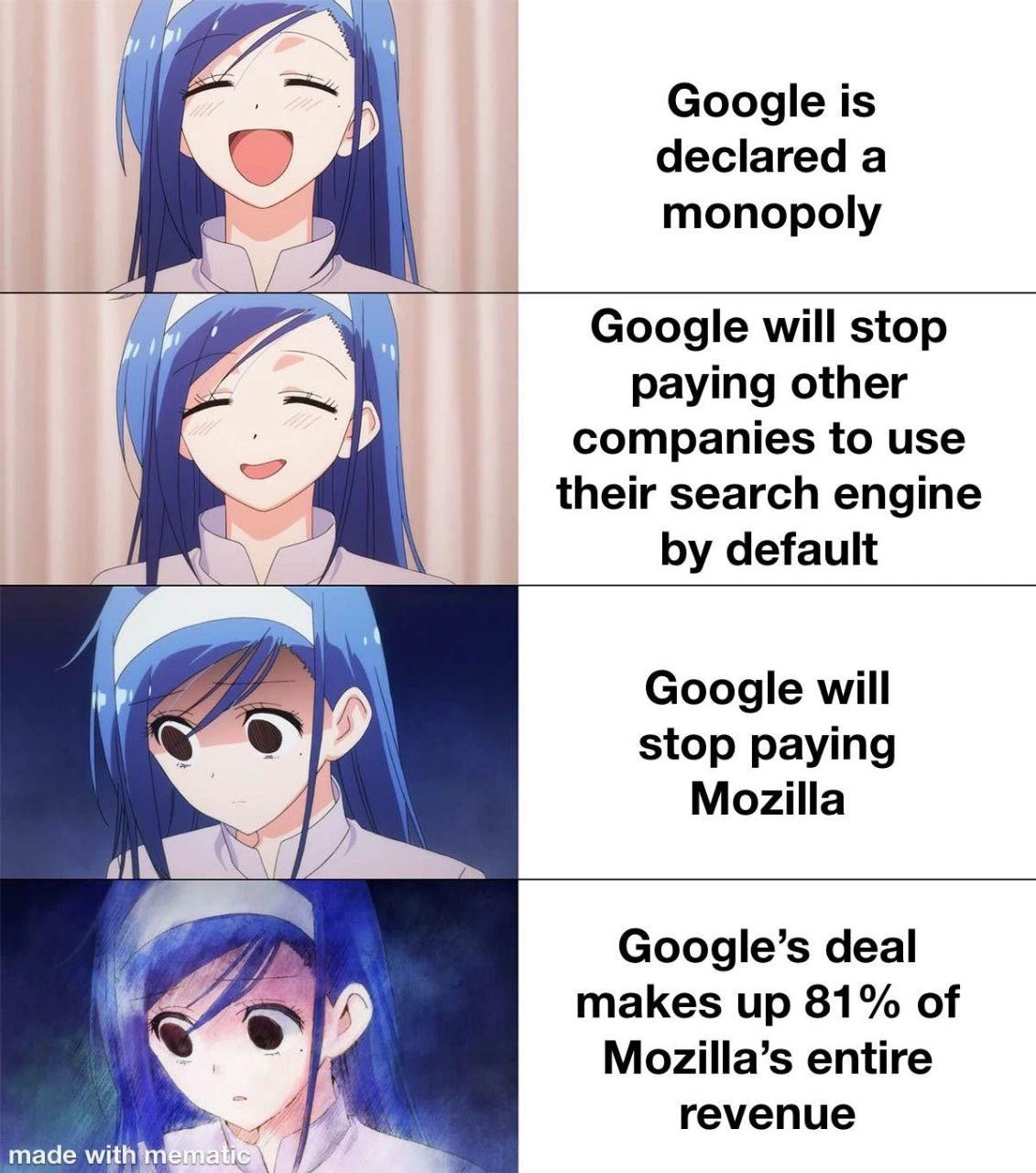
Firefox reacts to Google monopoly ruling and the loss of default search cash
Description
Four-panel anime reaction meme shows a blue-haired girl whose expression shifts from cheerful to cosmic horror. Panel 1 (smiling, bright background) contains the text: “Google is declared a monopoly.” Panel 2 (neutral, eyes half-closed) reads: “Google will stop paying other companies to use their search engine by default.” Panel 3 (wide-eyed, darker background) says: “Google will stop paying Mozilla.” Panel 4 (face distorted, blue haze) states: “Google’s deal makes up 81% of Mozilla’s entire revenue.” The lower-left corner includes the small watermark “made with mematic.” Technically, the meme highlights antitrust fallout, the economics of default-search-engine agreements, and Mozilla’s heavy reliance on Google payments despite being an open-source browser vendor - an ironic reminder of corporate dependencies in the web ecosystem



Comments
105Comment deleted
Mozilla spent a decade eliminating use-after-free bugs, only to discover its revenue pointer was still pointing to google.com
Mozilla discovering their entire business model is being Google's controlled opposition is like finding out your microservices architecture is actually just one monolith paying rent to different AWS availability zones
When your entire business model is essentially a single database foreign key constraint with ON DELETE CASCADE pointing to Google's payments table, and the DBA just announced they're dropping the relationship. Mozilla's architecture review suddenly revealed they've been running in production without a backup revenue stream - turns out 81% coupling isn't just a code smell, it's an existential threat. Time to refactor the funding pipeline before the garbage collector claims Firefox as unreachable memory
We preach “eliminate SPOFs,” yet Firefox’s revenue topology is a single upstream: Google.defaultSearch(); antitrust just flipped the circuit breaker
Mozilla's revenue model: ultimate single point of failure, making even your legacy monolith look resilient
Architects hate SPOFs; Mozilla put theirs in the revenue path. Antitrust toggles the “DefaultSearch=Google” flag and the P&L returns 503
OH NO, MY FAVORITE FURRY BROWSER!!! Comment deleted
That's why I switched from chrome to FF. This monopoly will not lead to something good. And all taking into the account google's changes related to the manifest v3 Comment deleted
Из этой дилеммы Эскобара кроме окна есть выход в Vivaldi Comment deleted
Firefox still sucks and they're paid by Google anyway Comment deleted
Anyway I want to stay away from direct supporting google's domination. I understand, that this will not change anything, but at least I doing something😁 Comment deleted
soon... Comment deleted
Switch to uBo lite or adguard Comment deleted
firefox* Comment deleted
Yes, use an inferior in basically every way browser instead of changing extensions and go through that pain. And yes, I'm aware this is an unpopular stance. IDC, and I'm tired of people pretending Firefox is any better Comment deleted
bruh, what pain? Comment deleted
How in hell firefox is inferior in «every» way? I know for a fact that firefox has better ways of managing tabs (basically it had something like current arc tabs for ages) and better memory performance. Firefox hater detected? Comment deleted
Firefox has significantly worse memory management, it's only a lower amount because they don't fully implement web isolation, the UI is ugly, the performance is sluggish compared to chromium, it has ads shoved into the browser itself, shutting off telemetry doesn't actually shut all of it off, Mozilla is literally paid by Google Comment deleted
Oh and mozilla's stance on security issues is idiotic at best Comment deleted
What, you mean firing the security team won't fix it? /S Comment deleted
If ff security is so bad why is Tor a firefox fork and not Chromium or WebKit? Comment deleted
Okay Chromium released in 2008 or so, fair but why havent they ported it? Comment deleted
Because they prefer it lmao Comment deleted
I think torproject.org has a faq entry about this that I would have to review Comment deleted
- IIRC you can literally change firefox ui however you want using plain css. - Chrome is literally written by google. So that’s not even a valid argument in that case. - For web isolation - honestly, cant say much as i don’t know much about firefox implementation of it. - For telemetry - same, i have no clue what telemetry there is in firefox so can’t argue here. But i could imagine chrome is way more tracking-heavy than firefox. Comment deleted
At least Google is honest. If Mozilla was honest, they'd put a "sponsored by Google so they can avoid antitrust laws" on Firefox Comment deleted
Wth, isnt it obvious why they dont ask you if your url bar can send of google data Comment deleted
Is anyone mentioning how the policy to change default search engine demands you use ESR or Nightly? Comment deleted
https://telemetry.mozilla.org/ but no idea how Anonym affects it, considering the official policy to disable it is disabletelemetry Comment deleted
Oh, I have a policy to force install new tab suspender Comment deleted
I'm waiting for you to say you use edge and like it Comment deleted
Hot take: Edge is still better than vanilla Chrome Comment deleted
Won't argue, used edge for a whopping 3 minutes this year Comment deleted
The only time I use Edge is when I accidentally click a UI element in Windows that shows me web content Comment deleted
yea microsoft is better at spyware than google nowadays Comment deleted
this has to be bait 😹 Comment deleted
My personal issues would be lack of PWA support, worse WebRTC support, and vertical tabs are actually in Nightly Comment deleted
Firefox does a terrible job in memory management if you ask me. And I am firefox user since edge switched to chromium Comment deleted
And before edge existed too Comment deleted
Extension change won't help as much as you seem to think what with Manifest V3 maximum filter size limits and all What are your issues with Firefox by the eay? Comment deleted
Doesn't V3 rely on predefined filters? Which would make it impossible for blocking ads on sites that frequently have self chnaging code like what youtube does? Comment deleted
Hmm, I am not entirely sure, while everyone says that, PrivacyBadger was fully converted to Manifest V3 and didn't lose the ability to learn from your browsing So I am just going to guess that if you want external lists, you ard limited, and if you can learn locally, you get a free pass and maybe Google is looking the other way due to Privacy Badger not being an adblocker Comment deleted
Firefox IS better. You can stop pretending you know best. People have a choice, don't shove your opinion onto people's throats. Comment deleted
It's cute you don't realize how ironic this message is Comment deleted
There isn't any irony, meme, or joke. Firefox has very little market share, you have less reason to cry a river. Please go back to papa Google, we're not stopping you. Comment deleted
No, I'm referring to the instant fight you get from Firefox users whenever you dare to say it's anything but God's favorite child while insisting the non Firefox user is the one "cramming it down your throat". I'm referring to the fact every time someone says they don't use Firefox, a Firefox user has to tell them how they're supporting evil evil Google. Comment deleted
So that is what it looks like, my policies have hidden it on my quick Chromium visits Comment deleted
btw Comment deleted
aaaaand it doesn't even support custom filter lists Comment deleted
All of this is actually implementable in mv3, adguard did it. The uBo devs are just throwing a temper tantrum because they've always treated chrome as second rate Comment deleted
If you can't see the problem with mv3, you should not be picking sides in the browser war Comment deleted
Ah yes, because ONE adblock developer is refusing to work with it, EVERYONE should hate chrome because "Google bad" Comment deleted
That's not even the problem... It's not uBlock's refusal to adapt to it, it's what it does and how much control Google is removing from users to continue to prey their data Comment deleted
So, throwing a tantrum and trying to force users to switch browsers for some imaginary war Mozilla lost a long time ago is going to do... What exactly? Comment deleted
Is going to inform users on what Google is doing and why they should care Comment deleted
its not one adblocker dev actually, if you have read a bit more, you might have known that for some extensions it is literally impossible to continue to work as the adguard dude Andrew Meshkov himself has said “Nearly all browser extensions as you know them today will be affected in some way: the more lucky ones will ‘only’ experience problems, some will get crippled, and some will literally cease to exist.” Comment deleted
have u tried to read some text on screenshot?.. Comment deleted
I did. And they're full of shit. But you do you. Comment deleted
You can use Asguard Comment deleted
inferior, u say... Comment deleted
Maybe this will make firefox great again They've been so comfy with this money that they use it to finance political projects Comment deleted
They don't sell your data It's more profitable to keep it to themselves Comment deleted
Aren’t they using this data to show you the ads? Comment deleted
Using is not the same as selling, especially as far as regulations are concerned Comment deleted
Regulations may be fine with it, but its funny to think that them selling a service which uses user data as a main selling point is not «selling» that data Comment deleted
I'm not even lol. I'm pointing out how fucking ridiculous it is to take mozilla's side in this Comment deleted
I've been using Internet Explorer 6 for years. I never had a problem. I might switch when I have more time after the election. Comment deleted
Who do you guys think it's going to win? Romney or Obama? Comment deleted
Definitely Bush (I'm on Netscape) Comment deleted
Ah, OG browsers war. Comment deleted
Time to switch Comment deleted
Well, why did Mozilla decide it was a good idea to get most of its funding from its main competitor to begin with. Now it's not the time to act all surprised Pikachu. Comment deleted
They will take it who cares if they have statistics that 99% of their userbase will set it to google anyway? Comment deleted
You don't think having your main competitor controlling your project is a bad idea? Comment deleted
Where are they controlling it? If they would then ff would also get rid of adblock capabilities like what google chrome masks as "Manifest V3" Comment deleted
They pull funding, Mozilla will be in a lot of trouble. Google has Mozilla in a leash. Comment deleted
The agreement goes as "here is money, you will set google as default" Comment deleted
You're cute. You actually think that's how that works. Comment deleted
Yeah, great idea... Comment deleted
MV3 doesn't kill adblockers, they just have to change a bit. The idea it does was perpetuated by uBlock and adguard originally, both of which benefitted from people being outraged by it Comment deleted
No. MV3 removed the ability to passthrough your traffic over extension... MV3 will only allow what safari on iOS does. Which is predefined filters. And they suck. Comment deleted
The inherent problem with that capability is for every capability you give a good extension, another dozen bad extensions will abuse it Comment deleted
Which is https://start.duckduckgo.com/?q=site%3Aeff.org+manifest+v3 ? Comment deleted
EFF is essentially a scam at this point Comment deleted
it's not that little though: Because the declarativeNetRequest API does not support the ability to enforce rules according to the top context, i.e. the URL in the address bar, the following capabilities can't be supported: • No remote fonts and no scripting per-site switches • Dynamic filtering • Dynamic URL filtering The declarativeNetRequest API does not allow to filter according to the content of response headers, thus not possible: • No large media elements per-site switch (webextensions #461) • header= filter option (webextensions #460) The following filter options can't be translated into DNR rules: • strict1p, strict3p: whether a network request is same-origin as its initiator • Entity-based values for domain= filter option (webextensions #394) • redirect-rule=: the DNR API does not support redirect-if-blocked concept (webextensions #493) • Regex-based removeparam= modifier filter options • Exceptions for all modifier filter options are not possible • Many very useful regex-based filters used in uBO are not allowed, or are rejected by the DNR API (webextensions #344) CNAME-uncloaking is up to each DNR implementation; no DNR implementation supports this capability at the time of writing. with new manifesto plugins lose quite an amount of features, which happen to strike adblockers the most. it is possible to use new manifesto, yes, f.e. ublock origin now has ublock origin lite version based on new manifesto. but the catch is that it loses capabilities in comparison, and this will impact efficiency eventually Comment deleted
Because Google has never made a change Mozilla has to follow, right? Comment deleted
Those chnages were what Microsoft wanted and the entertainment industry... Comment deleted
And microshit and goolag are in bed together, your point? Comment deleted
They pay to be the default search engine to still be able to sell your data, dominate the market and to avoid (unsuccessfully) antitrust laws through keeping competition semi-active. They don't "control" it. Comment deleted
Being the main funder of the project gives them control. Comment deleted
Where exactly? Comment deleted
Financial control. Comment deleted
well that "control" is clearly not enough to stop them from implementing built in tracking protection or to force them to implement manifest v3 Comment deleted
Do you understand what "exactly" means and that it's different from "the most vague answer possible"? Comment deleted
Yes. They control it exactly through their finances. They are the biggest source of income for Mozilla. If they pull financing Mozilla would be in big trouble and will be hard pressed to continue operating as the entity it is today. If you're too dense to understand that that's your fault. I can explain it to you, but I cannot understand it for you. Comment deleted
Your first word is already a lie, try better. Now, what does "exactly" mean? Comment deleted
How about you Google it ;) Google can destroy Mozilla. If you don’t believe it or don’t get it, I don’t have the time to try to convince you, sorry. Comment deleted
That's a nice topic shift, but that's not what we were talking about. Now, try combining the words "exactly" and "control" into one coherent sentence, because so far it's been no more precise than "they control it with power". This is not an argument. You might be confusing the words "control" and "dominate", in which case use a more appropriate term or specify precisely what you mean by "control", because everyone seems to be talking about how Google is affecting Mozilla's decisions (apart from the decision to take money from them for being the default search engine), and you seem to be talking about how powerful and dominant Google is and that it would "destroy" Mozilla (the thing nobody was really arguing against, since Google does dominate the market and could be more aggressive towards the competition if not for the lawsuits against it). Comment deleted
All firefox users now: "let's use modern private browser, how it names?.. oh, 😀😀🚶" Comment deleted
reject browsers, run npm scripts to access websites Comment deleted
At least Edge doesn't immediately access every file on every connected drive as soon as you open it (a real thing Chrome actually does) Comment deleted
yep, because compattelrunner.exe does it for u.... Comment deleted
true Comment deleted
Can't wait for Ladybird to arrive Comment deleted
I love Google ❤️ Comment deleted