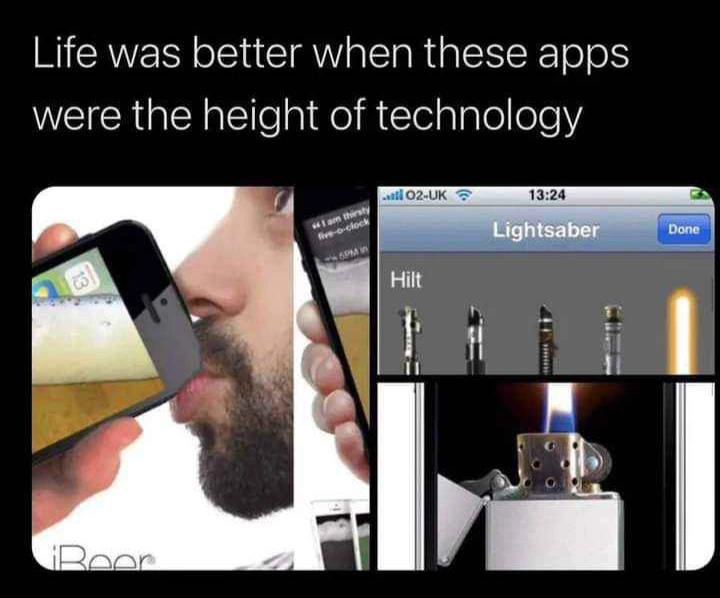
When iBeer and virtual lighters were groundbreaking mobile tech milestones
Why is this MobileDev meme funny?
Level 1: Simple Joys
Think of it like this: imagine when you were a kid and you had a very simple toy – say a little plastic beer glass that makes a fizz sound, or a toy sword that lights up. Those toys might not do much, but they can totally make your day because they’re fun and new. Now imagine as you grow up, toys (or gadgets) get way more complicated – like a video game system with amazing graphics, but it’s always pushing you to buy add-ons or watch ads, and you need to update it all the time. This meme is saying that life felt more fun when our phones were like those simple toys that just did one silly thing to make us laugh, compared to now when phones are super powerful but also bombard us with advertisements and endless features. It’s a funny way of sighing, “Ah, remember when something as goofy as a fake beer app was the coolest thing ever? That was kind of a nice, simple time.” In other words, sometimes we miss the simple joys over today’s complicated, noisy world.
Level 2: Novelty Apps Primer
Let’s rewind to the simpler_mobile_era of smartphones around 2008-2010. Back then, if you had a new iPhone, the coolest things you could show your friends were often these novelty_apps – fun little programs that showed off what the phone could do. Three legendary examples were:
iBeer – This app made your phone screen look like a glass of beer. When you tilted the phone as if drinking, the beer level would go down. It felt like magic! The trick was using the iPhone’s accelerometer (a motion sensor) to detect the tilt and animate the beer sloshing around. It didn’t do anything useful, it was basically a party trick – but in 2008, just having a touch-screen computer phone that could pretend to be a beer was amazing.
Virtual Lighter – Imagine holding up your phone and seeing a realistic Zippo lighter on the screen, complete with a flickering flame. You could “open” and “close” the lighter by swiping or tilting, and the flame would react. People even used this at concerts, waving their phones with the virtual flame instead of a real lighter during slow songs. Again, it didn’t provide any service except looking cool and showing off the phone’s graphics and touch abilities.
Lightsaber App – For Star Wars fans, this was a dream come true: your phone could become a pretend lightsaber. The screen would show a lightsaber hilt (handle), and when you swung the phone around, it would make that iconic “vooom-vwoom” lightsaber sound. The app likely used the accelerometer as well to detect movement. There were even options to choose different saber hilts. It turned your $399 gadget into a geeky toy – and people absolutely loved it.
Now, why does the meme say “Life was better when these apps were the height of technology”? It’s highlighting how MobileDevelopment and user expectations have changed. In those early days, smartphones themselves were so new that gimmick_apps like these were super exciting. The iPhone’s screen was only 320 by 480 pixels (compare that to today’s phones with HD or higher resolution), and it had far fewer features. Developers back then had a limited toolkit – they coded in Objective-C (the old programming language for iPhone apps before Swift) and used the original iPhone OS (what we now call iOS). There was no SwiftUI, no fancy 3D engines available to casual devs, no built-in AR or machine learning libraries. So, developers channeled creativity into simple apps that made people smile.
One important thing: these apps were usually paid apps (maybe $0.99 or so) or free just for fun. They didn’t have in-app purchases, and they definitely weren’t showing ads or secretly sending your data anywhere. When you bought iBeer, you got iBeer, period. It didn’t ask for permissions to access your contacts or track your location – why would a beer-in-a-phone need that? In other words, those apps were not ad-heavy or telemetry-laden. Telemetry here means the app collecting usage data (like what you tap or how long you use it) and sending it back to the developers or companies. Modern apps often do this for analytics – for example, a free game might track how often you play and show ads based on that. But the early novelty apps didn’t bother with any of that. They were usually offline and self-contained.
As the years went on, smartphones and apps became much more advanced. IndustryTrends shifted towards apps that could do many things (think of everything a modern social media or messaging app can do, or how mobile games now have online features, shops, etc.). User expectations grew too – after a while, just pretending to drink a beer wasn’t enough to impress anyone. People wanted more useful or more content-rich apps. To meet these expectations, apps got bigger and more complex. Developers also figured out new ways to earn money: instead of one-time purchases, many apps became free to download but showed ads or sold extra content (in-app purchases). With that came a lot of tracking and data collection (to personalize ads or understand user behavior).
So, the meme comes from developers (and users) who remember that DeveloperNostalgia era, when the bar was low in a good way. The “height of technology” for phones was literally something silly like an on-screen beer mug, and that was delightful. It’s a bit of sarcastic humor – of course technology has progressed, and we can do incredible things on phones now (like real augmented reality, high-end games, instant video calls, etc.). But with that progress came complexity and some headaches: huge app downloads, constant updates, ads everywhere, privacy concerns, and sometimes just the feeling that apps aren’t as straightforward fun as they used to be. Life seemed better (simpler, more carefree) when our biggest tech thrill was a goofy beer app. It’s a classic case of LegacyVsModern nostalgia: the “old days” feel charming compared to the feature-packed (but sometimes exhausting) digital world we have now.
Level 3: App Store Archaeology
"Life was better when these apps were the height of technology."
In the late 2000s, the iPhone App Store was a wild frontier where novelty apps reigned supreme. This meme digs up artifacts like iBeer, the virtual lighter, and a DIY lightsaber app – relics from an era when simply imitating a beer or a Zippo on a phone felt groundbreaking. It’s poking fun at how far MobileDevelopment has come: from playful one-trick apps on a 320×480 screen to today’s feature-bloated, telemetry-laden super-apps. Seasoned developers (especially those who survived the Objective-C era of IOSDevelopment) chuckle because they remember when this was the cutting edge of Apple innovation – and maybe, in some ways, it really was a happier, simpler time.
Back around 2008, Apple’s iPhone had just introduced third-party apps, and nobody quite knew what would stick. The result was an early_appstore gold rush of gimmicky delights. DeveloperNostalgia kicks in when recalling how a 99-cent iBeer app could top the charts simply by showing virtual beer "sloshing" as you tilted your phone. Under the hood, it likely used the phone’s accelerometer to track tilt – trivial by today’s standards, but back then seeing liquid respond to gravity in your phone was pure tech magic. Similarly, the unofficial Lightsaber app turned your phone into a Jedi’s toy: swing it around and it’d use motion data to hum and buzz like a sabre (no AR, no 3D – just clever use of sensors and sound). The virtual lighter did little more than display an animated flame, yet it earned oohs and aahs and even showed up at rock concerts as a modern replacement for real lighters. These apps had no cloud backend, no ads, no trackers – once downloaded, they just worked (and by “worked” we mean they entertained you for 5 minutes until the novelty wore off).
Fast-forward to today’s MobileDev reality, and the meme’s nostalgic punchline becomes clear. Modern mobile apps are behemoths: they demand constant data, bombard us with ads, and track every swipe in the name of “engagement.” By contrast, those early gimmick apps were essentially digital toys – and nothing more. There’s an implicit critique here of IndustryTrends: maybe we’ve lost some innocence in chasing monthly active users and ad revenue. A senior engineer might jokingly lament, “Remember when a weekend hackathon could build the #1 app in the store? Now it takes a team, a VC budget, and five analytics SDKs just to maybe get featured.” What was once a TechNostalgia novelty has evolved (or devolved) into today’s complex mobile ecosystem. The meme wryly suggests that LegacyVsModern comparison: a time when phones astonished us with virtual beer feels almost preferable to the current era of hyper-connected, over-engineered apps. It’s a tongue-in-cheek reminder that more sophisticated technology doesn’t always mean more joy – sometimes a silly gimmick_app on a first-gen iPhone brought a surprisingly pure delight.
To really highlight how far we’ve come, consider this comparison:
| Early App Store (2008) | Modern App (2024) |
|---|---|
| Purpose: fun gimmick, single novelty | Purpose: multi-feature, “platform” app |
| Size: a few MB at most | Size: hundreds of MB (plus data caches) |
| Tech: simple sensors (tilt, basic touch) | Tech: everything (AR, AI, GPS, IoT integration) |
| Dev Stack: Objective-C, no fancy frameworks | Dev Stack: Swift/SwiftUI, ML kits, ARKit, etc. |
| Monetization: $0.99 upfront (buy once) | Monetization: “Free” with ads, IAP, subscriptions |
| Data Collected: none (offline fun) | Data Collected: extensive analytics & telemetry |
| User expectation: Wow! My phone can pour beer! | User expectation: Why doesn’t this app also socialize, gamify, and order me a real beer? |
| Update cycle: rarely, if ever (it just works) | Update cycle: constant patches & new features |
Looking at this table, it’s no wonder devs get nostalgic. Early iOSDevelopment felt almost charmingly minimalistic. You built one of these gimmick_apps, maybe in a week or two of nights and weekends, and it could explode without need for A/B testing or growth hacking – mainly because there wasn’t much else competing for attention. Today, launching an app means wrestling with frameworks, IndustryTrends of engagement loops, privacy laws, app store optimization, and endless feature creep. The meme cleverly implies that maybe the peak of happiness (if not technology) was when our biggest mobile ambition was to simulate beer foam and lightsaber sounds. After all, the only permissions iBeer needed was access to your accelerometer – not your contacts, location, and calendar 😉.
Yet, as funny as it is, there’s genuine insight: in tech, more complexity can mean more power, but it also introduces fatigue. There’s a communal sigh among veteran developers, “Life was better...” not literally because we want to trade Swift back for Objective-C or give up modern comforts, but because we remember the wide-eyed wonder of that simpler TechHistory moment. The height of technology keeps rising, but it’s healthy (and humorous) to recall a time when that “height” was just an iPhone pretending to be a beer mug – and we were all totally amazed by it.
Description
Meme with black background text at top reading, "Life was better when these apps were the height of technology." Below, three nostalgic iPhone screenshots are collaged: left shows a tilted iPhone running the classic "iBeer" app with digital beer sloshing; upper-right shows an old iOS status bar ("O2-UK", "13:24") and the app title "Lightsaber" with buttons "Hilt" and "Done", displaying various saber handles; bottom-right shows a Zippo-style "virtual lighter" app with an animated flame. The image contrasts the simplicity of 2008-era gimmick apps with today’s complex, ad-heavy, telemetry-laden mobile software, poking fun at how far mobile development and user expectations have evolved. It resonates with developers who remember Objective-C days, 320×480 screens, and the novelty-driven App Store gold rush
Comments
12Comment deleted
2009: one junior, 2K lines of Objective-C, a tilt callback - iBeer hits #1. 2024: 30 engineers, 12 microservices, GDPR, SOC 2, three A/B layers, and we still need a post-mortem to ship a dark-mode toggle
Back when we charged $0.99 for apps that literally just displayed a JPEG and played a sound file, and somehow that business model was more sustainable than today's VC-funded SaaS platforms burning through millions to achieve negative unit economics
Back when 'mobile development' meant figuring out how to make a UIAccelerometer callback trigger a beer-pouring animation, and your entire tech stack was CoreMotion + AVAudioPlayer. No microservices, no CI/CD pipelines, no Kubernetes - just a developer, a lightsaber sound effect, and the revolutionary realization that phones could detect which way was 'up.' Simpler times, when your production incident was someone's iPhone not making lightsaber sounds, not your distributed system experiencing cascading failures across three availability zones
Back when 'flame graphs' meant debugging your virtual lighter, not profiling Kubernetes pods
Back when UIAccelerometer plus a beer PNG was “innovation,” now the same gag needs five SDKs, three consent modals, two feature flags, and a privacy review
Back when the App Store’s cutting edge was a lightsaber: zero backend, no SOC2, scales infinitely in airplane mode, and the only production fire was the Zippo animation
What a throwback Comment deleted
this one was the best, it's so sad developers started installing mandatory -32 GB Memory Card app Comment deleted
386to486.exe 486to586.exe Comment deleted
Gun sounds app were a game changer at school That came out wrong Comment deleted
Apps like shareit were a must have on every single phone Comment deleted
Ye Comment deleted