
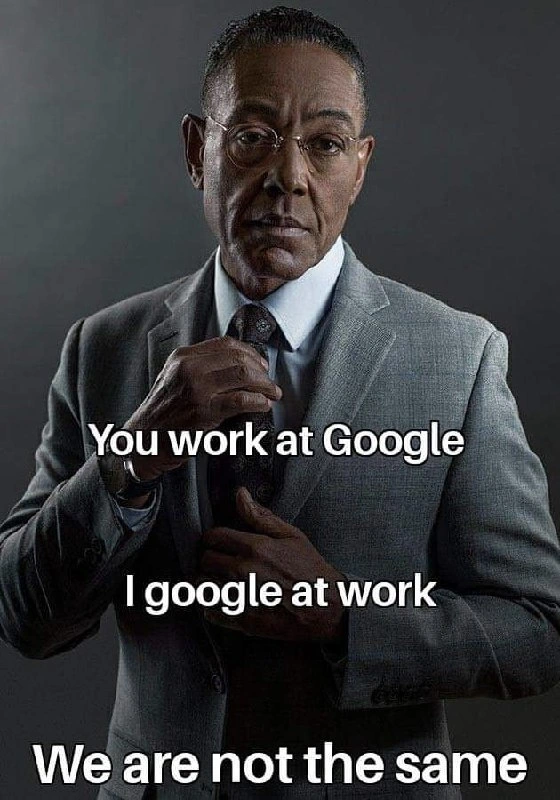
Google as a Job vs. Google as a Verb
Description
This image utilizes the 'We Are Not the Same' meme template, which features actor Giancarlo Esposito in character as the calm and imposing Gus Fring. He is depicted wearing a sharp grey suit against a neutral grey background, meticulously adjusting his tie while staring directly at the viewer with an intense, superior expression. White text is overlaid in three parts, stating: 'You work at Google', 'I google at work', and the punchline, 'We are not the same'. The humor is a clever play on words that resonates deeply with the software development community. It juxtaposes the prestige associated with working at Google, a top-tier tech company, with the universal, everyday reality of developers who rely on the Google search engine to do their jobs. For experienced engineers, 'googling' is a fundamental and acknowledged part of problem-solving, debugging, and learning. The meme ironically elevates this essential skill to a status comparable to - or even superior to - being an employee of the company itself, subtly mocking the obsession with FAANG credentials while celebrating a practical, universal developer trait
Comments
8Comment deleted
You get paid to pass Google's interview. I get paid because I can find the answer on the second page of Google's search results. We are not the same
You have a planet-scale monorepo with blazing-fast internal Code Search; I have 43 Stack Overflow tabs and a browser history that doubles as my dependency graph - same feature set, just 300 ms more latency
The real flex isn't working at Google - it's explaining to your relatives why you left Google to join a 3-person startup because 'the technical challenges were more interesting' and watching their confusion as you trade free gourmet meals for ramen and equity that might be worth something if the company doesn't pivot six times before your cliff vests
The L7 at Google and the dev googling at work are both paid for the same skill - knowing which result to trust
The real difference? Google employees have access to internal documentation that's actually up-to-date, while the rest of us are piecing together solutions from a 2014 Stack Overflow answer, three deprecated blog posts, and a GitHub issue thread where the maintainer's last comment was 'works on my machine.'
You work at Google; I google which of our 37 microservices Envoy is routing “save” to today
Googlers architect the monorepo; we Google 'git rebase gone wrong' to survive the next merge
You maintain PageRank; I maintain a ranked list of Stack Overflow tabs to brute‑force prod incidents - both search problems, different SLAs