When a client says 'it's a small change'
Why is this Stakeholders Clients meme funny?
Level 1: Erasing the Boos
Imagine you’re at a big school talent show. One kid’s performance made a bunch of the audience really upset – not because he sang badly, but because of something he did that they thought was unfair. So, a whole lot of people in the crowd start booing loudly and giving him thumbs-down. Now, picture the school principal sneaking onto the stage with a giant eraser and magically wiping away all those “boos” and thumbs-down signs, so that by the next day it’s like almost nobody was ever upset. 🤔 It sounds a bit unfair, right? That’s basically what happened here: lots of people gave the Robinhood app bad scores (like boos) because they were mad at something the company did, and then the big boss (Google, who runs the app store) quietly made most of those bad scores disappear. It’s kind of funny in a “wow, they can really do that?!” way. The meme is poking at that feeling when the one in charge just brushes away all the negativity as if saying, “Nothing to see here!” – leaving everyone else half-laughing, half-suspicious about how fair the whole thing really was.
Level 2: Review Bomb Defused
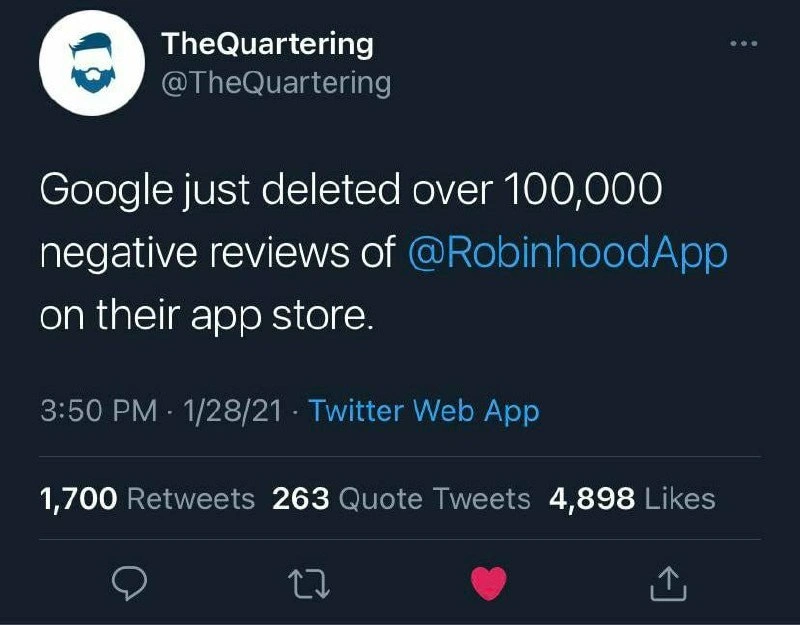
For a newer developer or someone outside the fiasco, let’s break down what happened. The meme shows a screenshot of a Tweet (in classic dark-mode Twitter style) by a user pointing out that Google deleted a huge number of negative reviews from the Robinhood app’s page on the Google Play Store. This actually took place on Android’s official app marketplace (the equivalent of Apple’s App Store for Android devices). Robinhood is a popular stock trading app. In late January 2021, a lot of people were really mad at Robinhood because it paused buying of certain stocks (notably GameStop) during a wild trading frenzy. Feeling betrayed, thousands of users ran to Robinhood’s app listing on Google Play and gave it 1-star ratings with angry comments. This surge of bad reviews is what we call a “review bomb” – basically a coordinated flood of negative feedback intended to punish or send a message, rather than reflect honest individual opinions about the app’s normal behavior.
Now, Google, like any platform, has rules about reviews. Play Store policy says reviews should be about the app’s quality and content, not unrelated grievances, and definitely not spammy or fraudulent. So Google’s Trust and Safety team stepped in with content moderation tools to handle the situation. In plain terms, they treated many of those 1-star reviews as spam or off-topic and removed them. They have automated systems (and people) that watch for sudden huge spikes in reviews which might indicate misuse or manipulation. In this case, over a hundred thousand reviews vanished from Robinhood’s page, and its star rating bounced back up a bit after the purge. The tweet in the meme basically broadcasted this event, and the fact it had thousands of retweets and likes shows that many people noticed and were either amused or annoyed by it.
For a junior developer or anyone who’s made a mobile app, this raises some interesting points. App ratings and user reviews are crucial for MobileDevelopment success – a higher star rating means more users will trust and download your app. If your app’s rating suddenly plummets, it can hurt your growth or even get your app flagged internally by the platform. Normally, you earn good reviews by making a good app. But here we see an external event (a business decision by the app’s company) causing a user backlash that had nothing to do with a software bug or a UI crash. It’s like waking up to find your app punished for reasons beyond code. Google’s removal of the reviews was essentially them saying, “These reviews aren’t fair game.” This benefits the developer (Robinhood) because their app’s score isn’t destroyed by the incident. However, it also looks fishy to outsiders – almost like Google sided with the company over the users. It’s a delicate balance: as a developer, you want protection from brigades and trolls, but as a user, you want your voice to count. The meme strikes a chord because it spotlights that power imbalance: Google can moderate (or manipulate) public perception on the store with a keystroke. In tech circles, this became a meme because it’s both a little funny and a little scary how quickly 100k negative signals were just… gone.
In the image, all the usual Twitter elements are present: the profile of the person tweeting (someone called “TheQuartering”), the tweet text itself in bold (“Google just deleted over 100,000 negative reviews...”), and the timestamp and metrics below. Those metrics (1,700 Retweets, etc.) show the tweet went viral. Essentially, this Twitter screenshot is being used as a meme to convey news with a side of humor: it’s a quick way of saying “Look how Google quietly cleaned up Robinhood’s mess.” In developer terms, it’s hinting: if your app ever faces a mob of angry reviews, know that the platform might step in – for better or worse. And as a part of CorporateCulture commentary, it’s suggesting big companies sometimes protect each other’s backs. Many junior devs might not realize such moderation happens routinely, so this meme is an eye-opener about what goes on behind that shiny app store rating.
Level 3: The Great Review Purge
When Google wields its mighty ban-hammer on the Play Store, even a tidal wave of user fury can vanish overnight. This meme references a real incident from January 2021, during the frenzy of the GameStop short squeeze saga. The stock-trading Robinhood App (ironically named, given the context) infuriated its users by halting trades on hot stocks. In retaliation, an army of angry retail investors and Redditors descended on the Google Play Store to leave 1-star reviews en masse – a classic case of a “review bomb”. One moment, Robinhood’s Android app rating plummeted to nearly one-star as if it were the worst app on Earth. The next moment, poof 💨 – over 100,000 of those negative reviews disappeared, as quietly as code being force-pushed on a Friday. The tweet in the meme captures this jaw-dropping app_store_review_purge: “Google just deleted over 100,000 negative reviews of @RobinhoodApp on their app store.” The engagement metrics (thousands of retweets, likes) show that devs, traders, and onlookers were stunned and amused by how blatantly the Play Store policy enforcement reshaped reality. It’s TechIndustryHumor at its finest: a platform literally pressuring CTRL-Z on public opinion.
From a senior developer’s perspective, the humor here is tinted with cynicism and déjà vu. We’ve seen content moderation algorithms and corporate handshakes pull off feats like this before. Google’s Trust and Safety systems are built to detect “coordinated inauthentic behavior” – basically, spotting when a mob of reviews looks fake or manipulative. Imagine an automated pipeline scanning new Play Store reviews in real-time: an anomaly detection service flags a sudden surge of one-star reviews containing keywords like “GameStop” or “short selling.” Maybe it’s an NLP model trained to catch off-topic rage, or simply a rule like “if 𝑥% of new reviews in an hour are 1-star, trigger purge.” The result? A backend script (or an over-caffeinated Google moderator) removes those reviews to prevent “ratings manipulation.” It’s a bit like a digital riot police dispersing a crowd. Here’s how we tongue-in-cheek imagine that code might look:
reviews = fetch_recent_reviews("RobinhoodApp")
for r in reviews:
if is_suspicious(r) or "GameStop" in r.text:
delete(r) # treat mass protest reviews as spam - problem solved, right? 🙃
The code above is facetious, but the point stands: Google likely deemed the 100k blitz of 1-stars as a violation of PlayStorePolicy (which prohibits review manipulation and off-topic brigading). The absurdity lies in the sheer scale – 100,000 voices – wiped out faster than a production database at the hands of an rm -rf /. It highlights the CorporateCulture reality: platform operators have god-like control over data we consider “public.” Star ratings and user reviews feel like a democratic voice of the people… until the house (Google) decides to shuffle the cards.
This meme pokes at an uncomfortable truth in the Tech Industry. On one hand, mobile developers know the pain of unfair review bombs – a single tweetstorm can tank your app’s rating, jeopardizing your user acquisition and reputation. For those devs, Google’s intervention might appear as a heroic bomb squad defusing an explosive situation. On the other hand, it’s a bit of a Robin Hoodwink: big tech sweeping unflattering feedback under the rug to protect a fellow corporate player. The duality is rich fodder for humor. Seasoned engineers smirk because it’s a textbook case of “inside baseball” – the public sees a pristine 4-star app again, while we imagine the engineers behind the scenes executing query statements to delete rows from the review database. TechHumor often thrives on this kind of “we know what really happened” irony.
Historically, this isn’t an isolated caper. Veteran devs recall other Great Review Purges: for example, when TikTok’s rating was rescued after a mass downvoting campaign, or how Steam introduced algorithms to hide off-topic user_review_manipulation on game pages. These events become tech lore. They reveal the invisible algorithms governing digital reputation. It’s funny in a dark way – like watching the referee secretly fix the score when the crowd gets too rowdy. The meme’s final punch is in its blunt caption, “Fuck em”. That crude remark (by the meme poster) encapsulates the fed-up sentiment: a mix of anger, resignation, and “of course the house always wins.” It’s the voice of the CynicalVeteran coder in all of us, half-laughing, half-sighing: Yup, big tech gonna do what big tech does – users be damned. In the end, the humor lands because it’s true: Google had the power to make 100,000 negative reviews vanish… and it actually used it.
Description
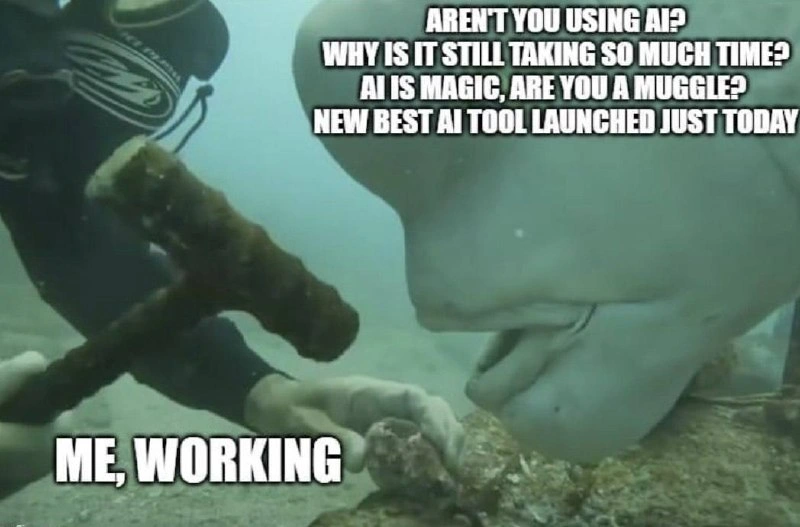
A meme based on the 'And I took that personally' format, featuring a determined-looking Michael Jordan from 'The Last Dance' documentary. The top text is a direct quote from a client: 'Can you make some small changes? It shouldn't be hard'. The image of Michael Jordan represents the developer's internal reaction, with the punchline at the bottom reading 'And I took that personally'. This meme perfectly encapsulates the frustration experienced developers feel when clients underestimate the complexity of a task. A 'small change' on the surface can often require significant refactoring, dealing with technical debt, or navigating a labyrinthine legacy codebase. It's a shared moment of pain and recognition for any developer who has had to explain that changing the color of a button isn't just a 'five-minute job.'
Comments
25Comment deleted
The client's 'small change' is usually a cursor pointer hovering over the one brittle, undocumented microservice holding the entire production environment together
Play Store post-mortem: “Incident - 100k one-stars. Mitigation - kubectl exec ratings-db -- sh -c 'DELETE FROM reviews WHERE stars=1'; Conclusion - data integrity is just another SLO when PR damage is in the error budget.”
When your anomaly detection algorithm flags 100K reviews as "coordinated inauthentic activity" but your business development team flags them as "coordinated authentic revenue protection"
When your production incident is so catastrophic that even Google's distributed systems team has to step in to handle the scale of your 1-star reviews. Classic case of needing horizontal scaling for negative feedback - though I'm sure their SREs would argue this falls under 'acceptable data loss' in their SLA
At scale, reputation is just eventual consistency: run nightly DELETE FROM reviews WHERE app='Robinhood' AND stars < 3; metrics converge, trust diverges
When app-store ratings are an OKR, the remediation runbook is a batch delete; great for dashboards, terrible for your platform’s trust SLA
rm -rf /playstore/reviews/negative --no-prompt; echo 'User sentiment optimized'
Что и требовалось доказать Comment deleted
а что там случилось? Comment deleted
пользователи Reddit договорившись резко подняли стоимость акций GameStop, одновременно покупая их. Скандал был большой, и он продолжается до сих пор. Настолько что часть платформ для торговли отказываются продавать вам акции GameStop и других компаний, которые реддиторы решили совместно поднимать. Но вот от "народной" платформы Robinhood никто такого не ожидал, они же всегда были как раз для молодых и за народ https://twitter.com/KHOUStephanie/status/1354781130021609478 Comment deleted
за один час приложение RobinHood получило более 100 тысяч отметок "1 звезда" в аппсторе и гуглплее. Comment deleted
praviesko truska sukada Comment deleted
sup dawg, bix nood? Comment deleted
На каком вы говорите блять?! Comment deleted
polish Comment deleted
gas the Comment deleted
Juice Comment deleted
skoviet durap stakovich? Comment deleted
priviot suker Comment deleted
patresko da Comment deleted
yo fo sho dagny gon bust a wacko yo crazy ass muppin' Comment deleted
rudavska privo misiek Comment deleted
0/ Comment deleted
They did the same for tiktok Comment deleted
What was the problem? Comment deleted