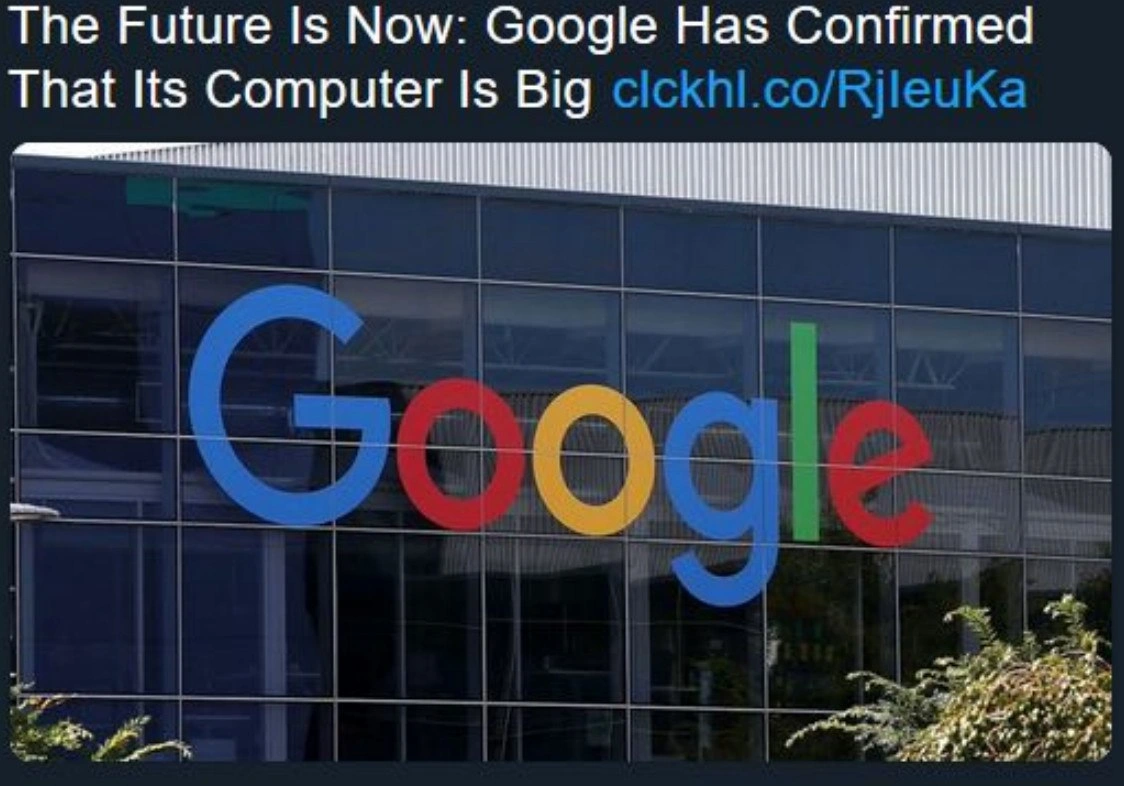
Google Confirms Its Computer Is, In Fact, Big
Why is this Google meme funny?
Level 1: Water Is Wet
Imagine you open a newspaper and see the headline: “Breaking News: Water Is Wet.” You’d probably giggle, right? It sounds silly because, well, everyone already knows that water is wet! It’s an obvious fact, not something you’d consider news. That’s exactly the kind of humor this meme is using. Instead of talking about water, it says “Google’s computer is big” as if it’s a big discovery. That’s funny because of course Google’s computer is big – Google is a huge company, so naturally they have a lot of computer power. It’s like someone excitedly announcing something completely expected, like “The sky is blue!” or “Fire is hot!” in a very serious tone. We laugh because they’re treating a super obvious thing like it’s a surprising update. The meme makes us feel the same kind of amused surprise, by pretending that the fact “Google has a really large computer system” is some futuristic, mind-blowing news. In simple terms: it’s funny because it’s saying something really obvious with a straight face, and we all get to be in on the joke.
Level 2: Inside the Big Computer
For newer developers or anyone just learning about the cloud, let’s break down what this meme is talking about. First, when we say “Google’s computer”, we aren’t talking about one single desktop or laptop. Google’s “computer” is a playful way to refer to Google’s entire network of data centers – huge buildings filled with thousands and thousands of servers (which are basically powerful computers that run services). Picture a warehouse bigger than a grocery store, but instead of food, it’s stocked with row upon row of machines stacked in racks, with blinking lights and whirring fans. That’s a data center. Google has many of these data centers spread across the world. They’re the physical homes of everything from Google Search and Gmail to YouTube and Google Cloud services. So when the meme says its computer is big, it’s referencing the fact that Google’s “computer” is actually millions of interconnected computers working together. It’s big in every sense – physically big (buildings full of hardware), big in computing power, and big in the amount of data it stores (we’re talking many petabytes of data, where 1 petabyte = 1,000 terabytes!).
Now, why is this funny? The headline in the meme is written like a news article for the general public, but it’s humorously oversimplified. It’s making fun of how some tech articles can sound when they try to dumb things down. Clickbait is the term often used for headlines that are mainly there to grab your attention, sometimes at the cost of accuracy or depth. For example, a clickbait tech headline might say something like “This New Phone Is Changing Everything!” when, in reality, it’s just a minor upgrade. Here, the headline sounds epic – “The Future Is Now:” – as if a huge revolutionary announcement is coming, but then it just says Google confirmed its computer is big. No details, nothing novel, just “big.” It’s like the article is treating “Google has a lot of computers” as breaking news. That’s the joke. It’s satirical tech news — meaning it’s a parody, not a real news article. The meme is imitating the style of news but with a silly twist.
Let’s clarify a few terms and ideas to ensure it all makes sense:
- Google: You probably know the name – it’s one of the world’s largest tech companies (BigTechCompanies), and it runs tons of online services. Because so many people use Google’s products, Google has built an enormous backend to handle all that activity. They don’t just have one server in a closet; they have entire warehouses of servers (data centers) around the globe.
- The Cloud: When people say “the cloud,” they usually mean services running on someone else’s computers, delivered to you over the internet. Instead of running a program on your own PC, you use Google’s (or another company’s) computing power far away. So “cloud infrastructure” refers to all the hardware and software that companies like Google, Amazon, Microsoft, etc., have set up to provide these services. Fun fact: a common joke is “The cloud is just someone else’s computer.” In this case, that “someone else” is Google, and yes, it’s a big computer farm!
- Data Center: Think of a data center as a huge library, but for computers. In a library you have lots of bookshelves; in a data center you have lots of racks filled with servers. There’s heavy cooling (big fans and AC systems) to stop the machines from overheating, and industrial power supplies to keep them running. All the things you do online (searching, streaming video, emailing) are handled by servers in data centers. Google’s data centers are among the largest in the world. Walking through one would feel like walking through a giant hallway of computers working non-stop.
- Oversimplification: This means explaining something complex in a way that leaves out so much detail that it might become misleading. In tech journalism, oversimplification might happen when writers try to convey a complicated technology to a general audience and end up with statements that sound almost childish. In the meme, saying “computer is big” is a huge oversimplification of Google’s infrastructure. It’s the kind of thing you might say if you don’t know the details — like how a kid might describe it.
So, the meme is funny to developers because it’s as if a very complex reality is being described with a ridiculously simple phrase. It’s poking fun at tech humor and how sometimes the media (or people in general) talk about technology. If you’re new to this, imagine you just learned about all these servers and data centers. You’re probably impressed at how massive it all is. Now picture a friend who hasn’t learned about that saying, “So... Google just has a really big computer somewhere?” You might laugh and say, “Well, not exactly – it’s more complicated than that!” That’s essentially what this meme is capturing. It’s both acknowledging that yes, Google’s setup is extremely large, and winking at how simplistic that sounds when put in plain words.
For a junior developer or someone starting out, there’s also a relatable element: when you first discover what’s behind a simple Google search, it’s mind-blowing. Many of us have that moment of awe: “Wait, my little search query went to a giant server warehouse and back in a split second!” We go from an oversimplified mental picture (“internet is just my computer and some magic”) to understanding the concrete infrastructure (“there are whole buildings of machines making this work”). This meme flips that learning on its head for comedy. It takes what we see as obvious after working in the field — that Google’s tech is huge — and teases it as if it were headline-worthy news. It’s a gentle reminder not to take everything in tech so seriously, and to laugh at how we might sound when simplifying things for others.
Level 3: Hyperscale Hyperbole
At first glance, the meme’s headline – “The Future Is Now: Google Has Confirmed That Its Computer Is Big” – reads like pure absurdity. It’s written in the style of a clickbait_headline, complete with a quirky shortened link (clckhl.co/...), reminiscent of satire sites like The Onion or its tech-themed sibling ClickHole. Seasoned engineers immediately smirk at this because it’s a TechIndustrySatire of the highest order. We have a grandiose lead-in (“The Future Is Now”) followed by a declaration so obvious it’s laughable (“computer is big”). The contrast is intentional and hilarious. It pokes fun at how tech news sometimes hypes up Industry Trends with dramatic headlines, yet the substance can be trivial or oversimplified.
What’s so funny about saying Google’s computer is big? For one, it’s obviously big – Google is a Big Tech giant running some of the largest cloud services on the planet. That part isn’t news to anyone in tech. By phrasing it as a “confirmation,” the meme mocks the way press releases or articles try to spin even the most self-evident facts as breaking news (“Tech Giant Confirms the Sky Is Blue!”). It’s the same energy as an overhyped press release announcing something banal. Engineers have seen headlines like these where the title promises a mind-blowing revelation, but the content makes you go, “Wait… that’s it?” This meme exaggerates that trope to comedic effect.
It also highlights the public’s oversimplified view of cloud infrastructure. Non-engineers might imagine the “cloud” as a single monolithic thing – maybe even a humongous server in a Google building that does it all. In reality, as we know, it’s distributed across many data centers. But here the joke plays along with that naive mental image. It reduces Google’s insanely complex, globe-spanning network to the phrasing a child might use: a big computer. For those of us who build and maintain these systems, that reduction is both amusing and a tiny bit painful (we spend years refining distributed algorithms, and someone sums it up as “big computer”).
The meme format itself parodies tech journalism hype. The phrase “The Future Is Now” is deliberately over-the-top, as if heralding some groundbreaking innovation – only to deliver the punchline that Google’s computer is (drumroll)… big. It’s satire targeted at industry buzz and hype culture, where every incremental update becomes “the next big thing” in headlines. Here, the next big thing is literally just bigness! The humor is definitely on the nose: it’s like running a headline “BREAKING: Fire Found to Be Hot.”
It’s worth noting that in real tech news, companies do brag about their infrastructure achievements, but usually with specific metrics – e.g. Google opens a new $600 million data center or announces a 5 exabyte storage system. Those are impressive, but they’re also kind of expected from a company at Google’s scale. This meme strips away the details and boils it down to a duh-level statement, which undercuts the grandeur in a wonderfully silly way. It’s a delightful satire on hyperscale infrastructure headlines: instead of marveling at how advanced or efficient Google’s systems are, it just flatly states the one thing no one can deny – it’s big.
For experienced developers, there’s a shared chuckle here at the expense of both media hype and public misunderstanding. We remember other times when non-technical descriptions made us cringe or laugh – for example, the famous gaffe of calling the internet “a series of tubes.” This headline hits that same vein of TechHumor. It’s the absurd simplicity that gets us. We’re laughing with the truth (Google’s computing resources are enormous) but at the way it’s presented (as if a five-year-old wrote the headline). It resonates because we’ve all seen the complex made to sound ridiculously simple.
In short, this meme lands so well among developers because:
- Stating the Obvious – It confirms something blatantly true. Google’s infrastructure is massive; saying “it’s big” is like a news flash that water is wet. That obviousness, presented with gravitas, creates instant comedy.
- Parodying Clickbait – The dramatic headline style (“The Future Is Now”) combined with a trivial fact is a send-up of clickbait and sensational tech journalism. We’ve all rolled our eyes at headlines that promise too much and deliver too little. This is that, dialed to 11.
- Oversimplification – It satirizes how complex tech (like cloud data centers) gets dumbed down. By treating hyperscale data centers as a single simple “computer,” it mirrors how outsiders might talk about it, highlighting the gap between reality and understanding. The joke rests on that childlike simplification of something very sophisticated, which tickles anyone who knows what’s being left out.
Visually, the choice of image adds to the humor. The photo of Google’s campus building with the giant colorful Google logo makes it look like we’re about to read a serious news article about the company. Seasoned folks know that behind those glass walls (and in many other unseen warehouses) lie countless racks of servers humming away. The meme pairs that official-looking imagery and headline style with a tongue-in-cheek content. It’s developer humor meeting everyday language: a collision of two worlds. We’re essentially laughing at how a billion-dollar, ultra-sophisticated system is summed up as if it’s a kid’s Science Fair project (“Look, it’s a big computer!”). And let’s be honest, sometimes when explaining our high-tech jobs to family or friends, we do end up saying things almost this simply – and even then we smile, knowing how much more there is to it. This meme captures that exact face-palm irony and turns it into a joke we can all share.
Level 4: Warehouse-Scale Wizardry
At the cutting edge of cloud infrastructure, companies like Google essentially treat an entire warehouse full of machines as one computer. This concept is often called warehouse-scale computing. Imagine thousands of servers (each a powerful computer) all hooked up with ultra-fast networks, acting in concert as a single giant system. Google's internal engineering has built what is effectively a planetary-scale operating system that coordinates these machines. Instead of one CPU, they have millions of CPU cores; instead of one hard drive, they have petabytes of storage spread across data centers on multiple continents. It's as if the world’s biggest PC is scattered across the globe, yet works together seamlessly.
To pull off this feat, Google employs some serious engineering wizardry:
- Cluster Orchestration – Google’s cluster management software (like their famous internal system Borg, a precursor to Kubernetes) functions like an OS scheduler for the entire data center. It decides which tasks run on which server, so all those machines behave like one big computer sharing the workload.
- Distributed Storage – Technologies like the Google File System (GFS) and Bigtable were created so that many machines’ disks act as one huge hard drive. When you save data in Google’s cloud, it’s chunked into pieces across many servers, but to you it looks like one place.
- Global Databases – Google Spanner, for example, is a database that keeps information consistent across data centers worldwide. It uses atomic clocks and GPS satellites (!) to synchronize time between data centers, pushing the limits of the CAP theorem. This way, even though data is distributed, it can still behave as if it’s in one location. Achieving this requires advanced consensus algorithms (like Paxos) to ensure all the far-flung parts of the system agree on the current state – essentially making thousands of separate computers reach one shared truth, like neurons in a brain.
- Networking & Load Balancing – Google’s network infrastructure links all these servers with immense bandwidth. Specialized load balancers and software-defined networking ensure that when you make a request (say, a Google search), it’s automatically routed to an available part of this giant cluster. You hit a data center near you, but that’s just a gateway into Google’s global machine. Under the hood, the request might bounce around Google's network so that the collective computing power can work on it and send back a result in milliseconds.
All of these pieces allow Google’s fleet of machines to behave as one cohesive distributed system. In academic terms, they’ve built a single logical computer out of microcomputers, creating a sort of unified hyperscale_data_center. It’s an incredibly complex, hyper-scale infrastructure where even things like the speed of light become design considerations (since signals take time to travel between continents!). Yet, despite that mind-bending complexity, the meme gleefully reduces it to a childishly simple truth: Google’s computer is big. It’s not wrong – Google’s “computer” (in the collective sense) is absolutely enormous – but it’s a bit like calling the ocean “a large puddle.” The humor at this level comes from how delightfully trivial the statement is, compared to the almost sci-fi engineering that makes it true.
Description
The image is a screenshot of a tweet featuring a photo of a modern glass-paneled Google office building. The tweet's text, displayed above the image, reads, 'The Future Is Now: Google Has Confirmed That Its Computer Is Big,' followed by a fictional-looking shortened URL 'clckhl.co/RjleuKa'. The humor is derived from the deadpan, comically simplistic language used to describe a presumably massive technological achievement, such as reaching quantum supremacy. It satirizes the often breathless and over-the-top headlines in tech journalism. For senior engineers, the joke lands by contrasting the immense complexity of modern large-scale computing or quantum mechanics with the most basic, un-technical description imaginable, mocking how these breakthroughs are often communicated to the general public

Comments
17Comment deleted
Our quantum computer can now solve in 200 seconds what would take a classical supercomputer 10,000 years. Marketing's official statement: 'The computer is big and does math good.'
Tech media: “Google confirms its computer is big.” Engineers: “Yeah, that’s what we call 38 datacenters, a planet-wide Paxos mesh, and atomic clocks pretending the whole Earth is localhost - but sure, let’s go with ‘big.’”
Breaking: After 25 years and $100 billion in infrastructure investment, Google's SRE team finally confirms what we suspected all along - their distributed system spanning 40+ data centers with millions of servers is, technically speaking, 'big'. Next week: Amazon discovers S3 contains files
Google's Willow chip finally achieved quantum supremacy, which means it can now experience all possible states of production bugs simultaneously. Meanwhile, the rest of us are still debugging Schrödinger's race condition - the one that both exists and doesn't exist until you add a print statement
Breaking: Google confirms its computer is big; translation for architects - if Borg schedules across continents and Spanner’s TrueTime makes it look like one machine, PR just calls the whole planet a server rack
Architect TL;DR: Borg + Spanner + Jupiter fabric ~= one warehouse-scale computer; PR translation: “our computer is big.”
Google's ultimate horizontal scaling: when your cluster spans the parking lot and sharding means annexing the next building
wat? Comment deleted
?? Comment deleted
Google: Big Computer Yandex: Smaller Computer My laptop: Quite a tiny computer that's crazy... Comment deleted
Whad? It is invalid link Comment deleted
It's the clickhole, the onions clickbait site Comment deleted
Big PP energy But not from Google Google is a dick Comment deleted
Science diagrams that look like shitpost Comment deleted
Sho? Comment deleted
Sho slishal, yak malenkiy. (What you've heard. Why are you like a boy?). Comment deleted
Chungus Comment deleted