Skip to content
DevMeme
5924 of 7435
The Definitive Guide to Shipping Imperfect Code
Deployment Post #6486, on Dec 23, 2024 in TG

The Definitive Guide to Shipping Imperfect Code

Why is this Deployment meme funny?

Level 1: Better Than Nothing

Imagine you have a school project due tomorrow. You wanted to make it perfect – a beautiful poster with lots of details – but you kinda ran out of time. So instead, you finish it quickly with just the basics and hand it in, hoping it’s good enough to get a passing grade. You know it’s not your best work, but hey, the deadline is here and something is better than nothing, right? This meme is joking that software developers do the same thing with their work. Shipping code “good enough to ship” means they send their program out for people to use even if it’s not perfect, because time’s up. It’s like turning in half-finished homework and thinking, “Welp, it’s the due date, let’s hope for the best!” It’s funny in a kind of uh-oh way – we all recognize that nervous feeling. Just like you might cross your fingers after giving the teacher your rushed project, developers cross their fingers when releasing a rushed update to an app. The picture on the meme – that penguin on a fake book cover – is a playful way of saying, “Yep, this is basically the rulebook we follow sometimes: if it sorta works, send it out!” It’s poking fun at how common this is, and everyone laughs because we’ve all been there, hoping our half-baked efforts don’t come back to bite us later.

Level 2: Works on My Machine

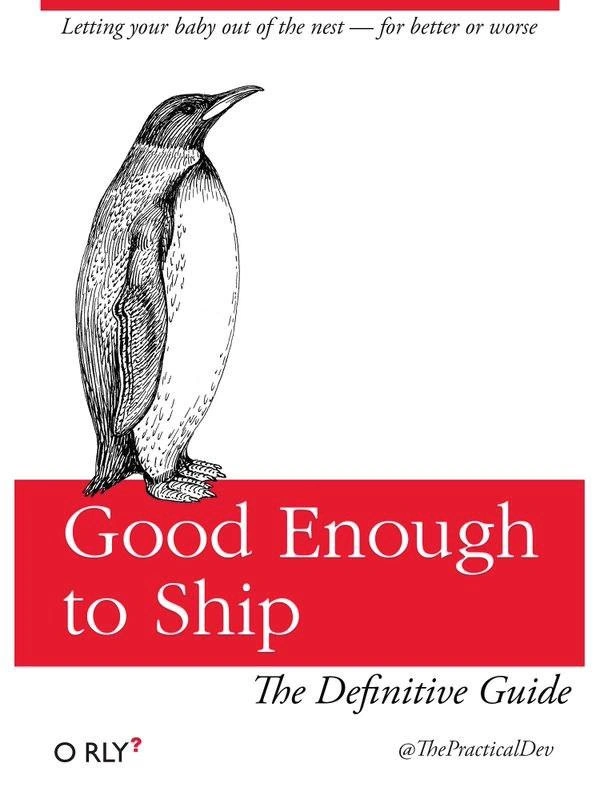
This meme is styled to look like a cover from an O’Reilly programming book, which is famous for its woodcut-style animal illustrations (like the penguin here) and titles like “XYZ: The Definitive Guide.” Seeing a big penguin with the bold red banner titled “Good Enough to Ship” immediately signals it’s a parody. There’s even a tiny logo that says “O RLY?” instead of “O’Reilly.” “O RLY?” is internet slang for “Oh, really?” – basically the meme is snarkily saying “Oh, really? You think it’s good enough to deploy?” The whole thing is mimicking an authoritative tech book, but the subject matter is really a joking critique of a common software engineering habit.

“Good Enough to Ship” is a tongue-in-cheek phrase in development. Let’s break it down: to “ship” code means to deploy or release it to users – like shipping a product out the door. “Good enough” implies the code isn’t perfect or fully polished, but it meets a minimal baseline: it runs, it sorta does what it’s supposed to, and crucially, the deadline is here. Imagine a team saying, “It’s not great, but it’s good enough to ship. Let’s push it live.” This is often said in crunch time when DeadlinePressure is high. Maybe the team has a commitment to release a new feature by Friday, and Friday arrives. The feature might still have rough edges or incomplete CodeQuality (like not enough tests or some known minor bugs), but the pressure to deliver on time (that ReleasePressure from bosses or clients) makes the team decide to release it anyway. The phrase captures a mix of confidence and anxiety: you think it will basically work (good enough), but you also know it’s not your best work.

The top tagline on the meme, “Letting your baby out of the nest — for better or worse,” compares releasing code to a parent bird letting its young one leave home. Your project is your “baby.” Once you deploy it, it’s out in the real world (the production environment). “For better or worse” hints that once it’s out there, anything can happen – maybe it’ll succeed (better), or maybe it’ll crash and burn (worse). This is a feeling many developers experience. No matter how much you test, releasing new code always comes with some butterflies in your stomach. When you know you haven’t tested enough, those butterflies are doing backflips. 🦋

Now, why a penguin? O’Reilly books always feature a random animal on the cover related in some quirky way to the topic. Here they chose a penguin possibly because penguins can’t really fly even if you toss them out of a nest 😅. It might symbolize that the code isn’t quite ready to “soar.” Or maybe it’s just for absurdity – a penguin on a guide about shipping code “for better or worse” is kind of hilarious by itself. And the “O RLY?” at bottom left is not a typo – it’s poking fun at the O’Reilly name while also saying “Oh, really?” as if questioning the wisdom of shipping code that’s only just good enough. There’s also a small signature “@ThePracticalDev” which tells us this meme was created by The Practical Dev, a popular social media personality/group that shares developer humor (they’re known for these spoof book covers).

Let’s discuss the real-life engineering context:

  • Deployment: This is the act of releasing or delivering software to users. For a web app, deployment means pushing the latest code to the production servers so the website or service updates for everyone. Deploying is exciting but also a bit scary, especially if the new code has issues.
  • Code Quality: This refers to how well-written and reliable the code is. High code quality means the code is clean, understandable, and well-tested, with minimal bugs. Low code quality might mean the code is messy, with potential bugs or poor structure. In a perfect world, we aim for high code quality before shipping.
  • Deadlines: These are due dates by which something must be completed. In software teams, deadlines might be tied to business goals – for example, “We must launch this feature before the holiday sales start” or “Release version 2.0 by end of the quarter.” Deadlines create urgency, and sometimes that urgency means developers have to rush.
  • Technical Debt: This is an important concept in programming. It’s a metaphor: when we take shortcuts in coding (like skipping tests, or using a quick-and-dirty fix instead of a proper solution), we save time in the short term, but we incur a “debt” that we’ll have to pay back later. “Paying it back” means later you’ll spend extra time fixing bugs or refactoring the messy code. Just like financial debt, if you keep ignoring it (never refactoring or writing those missing tests), interest builds up – the code base becomes harder to change, and small issues might turn into big problems. In our case, calling something “good enough to ship” often means we know we’re taking on some technical debt.
  • Release now, fix later: This is a phrase that sums up the strategy shown in the meme. It means go ahead and release the software now, even if not everything is perfect, and plan to fix the problems in a future update. It’s a bit of a gamble – you hope there’s time (and priority) to do those fixes later. Sometimes teams do come back to tidy up (pay off the debt), but many times new pressures arise and the fixes get postponed indefinitely. That’s how codebases degrade over time.

For a newer developer or student, this meme might also resonate with experiences like hackathons or school projects. Maybe you’ve experienced staying up late to code an assignment and at some point you say, “It’s 3 AM, this is good enough to submit.” You know the code isn’t elegant and you skipped writing comments or tests, but it produces the correct output once, so you turn it in before the deadline. In industry, it’s similar albeit more intense: a team might skip writing a thorough suite of unit tests for a feature because the release train is leaving the station now. They hope that the basic usage works (maybe they did a quick manual test run — that’s the blink test, basically just running the program and seeing no immediate crashes). If that passes, they deploy the code to production.

There’s also a well-known phrase devs use jokingly: “Works on my machine!” It’s half an excuse, half a boast. It means the developer ran the program on their personal development machine and it seemed fine there, implying that if it fails elsewhere (like in production or on a colleague’s computer), well, it’s not my code, it’s something else! The meme’s concept of “good enough to ship” is a close cousin of “works on my machine.” It’s basically saying, “It appears to work in this limited test, so let’s assume it will work for everyone.” Of course, seasoned devs know that’s a risky assumption – often something that “works on my machine” fails in a different environment due to missing configs, different data, etc. That’s why we usually have rigorous QA, code reviews, and automated tests. But under intense ReleasePressure, those safeguards can be rushed or skipped.

The humor and relatability of this meme come from the fact that most developers have been in this situation. The team doesn’t explicitly say out loud “we only care that it barely works,” but by their actions, that becomes the unspoken playbook. You learn that when the project manager is breathing down your neck, the standard for “done” quietly shifts from “fully tested and polished” to “it runs, and we haven’t found a showstopper bug yet, so ship it!” Everyone kind of nods and agrees silently because the alternative is missing the deadline, which often feels unacceptable. It’s a bit of a dirty little secret in the industry: even at places preaching “quality!”, the crunch time product is often held together by some prayers and quick patches.

This meme lightheartedly calls that out. By framing it as a fake book titled “Good Enough to Ship – The Definitive Guide,” it’s implicitly saying: this practice is so widespread we could write the manual on it. And every dev who’s been through a chaotic release laughs (or groans) in recognition. The categories listed (Deployment, CodeQuality, Deadlines, TechDebt) and tags like ReleasePressure and TechnicalDebt all point to this central tension in software development: balancing speed vs. quality. The meme strikes a chord because it’s a comedic reminder that, despite our best intentions, we often live in the world of compromises. For a junior dev, it’s a peek behind the curtain: even the pros grapple with these issues. The key lesson (with a smile) is: cutting corners might get the release out today, but be ready to deal with the fallout tomorrow.

In true O’Reilly fashion, this meme presents “Good Enough to Ship” as if it’s a serious tech manual — complete with an authoritative penguin on the cover. The O’Reilly book cover motif here is a tongue-in-cheek way to say: “We’ve practically written the book on shipping half-baked code.” The top tagline “Letting your baby out of the nest — for better or worse” frames deploying code as sending your precious fledgling app out into the wild. It’s equal parts proud and petrified: you release your code into production knowing it might fly… or faceplant. Seasoned engineers smirk (or cringe) at this because we’ve all lived that moment of “Well, it’s not perfect, but the deadline was yesterday, so… YOLO, deploy!”.

Why is this funny to experienced devs? It nails a painful truth: teams often have an unspoken release playbook where “good enough” quality wins over perfect quality when push comes to shove. Sure, every company preaches about rigorous testing and code quality, but the reality under deadline pressure is often different. We end up practicing a form of Test-Driven Development Blink-Test Driven Development – meaning if the app launches and doesn’t immediately burst into flames (you can blink and nothing explodes), we call it “ship-ready.” It’s a dark joke about ReleasePressure and DeadlinePressure: the code only had to look stable at a glance to get approval. The “O RLY?” logo in the corner is the cherry on top – that’s internet slang for “Oh, really?” expressed with playful skepticism. It’s as if the meme is winking, “Good enough to ship, you say? Oh really? 🙃”

This scenario is painfully familiar in Deployment culture:

  • Official Policy: “No code goes out without thorough QA and code review.”
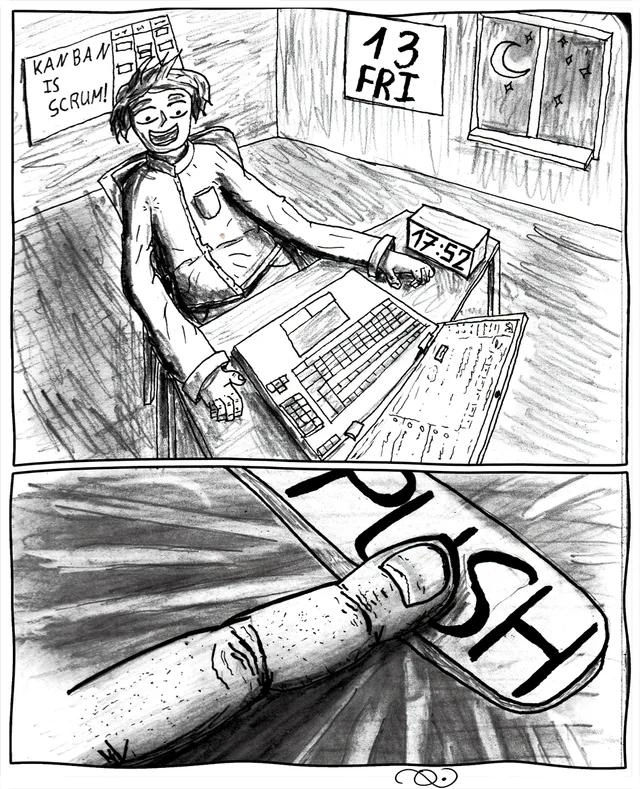
  • Actual Practice: “We ran it once on my machine, didn’t see anything explode, so we deployed on Friday at 5 PM.”
  • Official Motto: “Quality > Speed.”
  • Team’s Reality: “We’ll fix the bugs next week… if anyone complains.”

Every senior developer can recount a war story of a “ship now, fix later” decision that backfired. Perhaps you’ve seen commit messages like “Temporary hotfix – good enough for now” right before a release. Those temporary hacks tend to become permanent fixtures in the codebase, haunting us months later. That’s the essence of TechnicalDebt: each time we declare something “good enough to ship” and push it out the door with duct tape and TODOs still in the code, we’re swiping the company credit card at the Bank of Quick Solutions. The interest on that debt is paid in future pain: brittle code, weird bugs in production, frantic patch releases, and long nights for the on-call engineer (been there, fixed that at 3 AM 🚑). The meme’s faux-“Definitive Guide” is sarcastically saying this practice is so common, we might as well codify it. It’s the Definitive Guide to cutting corners — a book no one should write, yet here we are all subconsciously following it.

From a systems viewpoint, this reflects the classic Quality vs. Deadlines trade-off in software engineering. There’s even an ironic maxim: Fast, Good, Cheap: Pick Two.” When deadlines loom (gotta ship before end-of-quarter, or in this case, before everyone disappears for the holidays), CodeQuality often gets sacrificed for speed. The team justifies it with “minimum viable product” thinking: get the basic MinimumViableRelease out now and iterate later. But when “iterate later” never comes, those neglected tests and quick fixes become landmines in your code. This humor lands especially with senior devs because we’ve all seen how a Minimum Viable Product can degrade into a Maximum Viable Load of TechDebt.

Let’s be real: the meme wouldn’t be so spot-on if it wasn’t a universal experience. Continuous integration pipelines, code review tools, automated tests — we have all this fancy process, yet there’s always that critical feature that gets merged at 4:59 PM Friday with a comment, “works on my box, fingers crossed.” The next thing you know, you’re monitoring logs late at night, whispering “Please be good enough… please be good enough…” 😅. It’s funny because it’s true. The humor comes from recognition: the penguin might as well be a mirror. We’ve seen that DeploymentHumor scenario where a bug surfaces right after a rushed release and the whole team goes, “Welp, time to write the real fix.” In short, “Good Enough to Ship” is the dev team’s inside joke for a strategy we publicly deny using, but privately use all the time.

To illustrate, here’s a slice of our unspoken code workflow:

function releaseToProduction(build) {
    const testsPassed = runAllTests(build);
    if (!testsPassed) {
        console.warn("Tests failing, but deadline hit. Deploying anyway...");  
        // TODO: Write proper tests and error handling later
    }
    deploy(build);  // Ship it now, fix it later
}

This pseudocode captures the ethos of “Good Enough to Ship.” We see a runAllTests check — if tests fail, we still deploy with a warning because the deadline brook no argument. The // TODO comment is a classic hallmark: even the code acknowledges unfinished work that we’ll totally get back to someday. It’s a bit of gallows humor in code form. Senior devs read this and chuckle (or wince) because it hits home.

So, the meme resonates on multiple levels. It satirizes official tech literature by presenting a Definitive Guide to what is essentially a shortcut or anti-pattern. It highlights the disconnect between what we say we do (write clean, well-tested code) and what we sometimes actually do under pressure (ship the baby penguin out of the nest and pray it learns to fly on the way down). In the grand circus of software development, “Good Enough to Ship” is that risky trapeze act we all pretend we’ll never do — even as we’re doing it. It’s hilarious, it’s painful, and it’s oh-so-relatable.

Description

A meme designed to look exactly like the cover of a classic O'Reilly technical book. It features a white background with a detailed, black-and-white, sketch-style illustration of a penguin. Above the penguin, a tagline reads, 'Letting your baby out of the nest - for better or worse'. Below the penguin is a thick red banner with the main title in a white, serif font: 'Good Enough to Ship'. Underneath the banner, the subtitle says 'The Definitive Guide'. In the bottom left corner, where the 'O'REILLY' logo would normally be, it humorously says 'O RLY?'. In the bottom right, the Twitter handle '@ThePracticalDev' is credited. This image is a parody that satirizes the perpetual conflict in software development between striving for perfection and the pragmatic need to release a product. It humorously suggests a formal guide for the highly subjective and often stressful decision of when to stop iterating and just ship. The joke resonates with experienced developers who understand that no software is ever perfect and that 'good enough' is a necessary, albeit painful, compromise


Comments

14
Anonymous ★ Top Pick The appendix of 'Good Enough to Ship' is just a single, tear-stained page that says, 'It's not tech debt if you never plan to look at it again.'
  1. Anonymous ★ Top Pick

    The appendix of 'Good Enough to Ship' is just a single, tear-stained page that says, 'It's not tech debt if you never plan to look at it again.'

  2. Anonymous

    Some call it a release checklist; the rest of us know it’s just the CI pipeline’s final step: ‘git push && pray.’

  3. Anonymous

    After 20 years in the industry, I've learned that 'good enough to ship' is just code for 'we've run out of budget to fix the tech debt we created while fixing the tech debt from the last release' - but hey, at least the penguin looks production-ready

  4. Anonymous

    The eternal tension between 'ship it' and 'fix it' distilled into a single O'RLY cover. Every senior engineer knows that penguin's expression - it's the same look you give your code at 4 PM on Friday when stakeholders ask if it's ready for production. The answer is always 'technically yes,' followed by a very long pause and the phrase 'but let me tell you about our monitoring strategy.' Because nothing says 'enterprise-ready' quite like deploying on a wing and a prayer with a robust rollback plan

  5. Anonymous

    Senior definition of done: CI green, CAB nodding, SLOs probably fine, rollback documented but unpracticed - good enough to ship until the postmortem disagrees

  6. Anonymous

    Enterprise translation of “good enough to ship”: the canary survived five minutes, the kill switch is wired, and the rollback script has more tests than the feature

  7. Anonymous

    Perfectionism: keeping the egg warm forever while competitors hatch revenue in prod

  8. @tarasssssssssssssss 1y

    Is this an actual book? I need it so badly

    1. @ZgGPuo8dZef58K6hxxGVj3Z2 1y

      Yes /s

      1. @RiedleroD 1y

        big if true

  9. @GLXBX 1y

    Need a book on competitive Is there any?

  10. @GLXBX 1y

    Nah, I mean competitive sexism

  11. @mira_the_cat 1y

    typical perl?

    1. @andrei_nik_kolesnikov 1y

      competitive programming code is not written to be read again :)

Use J and K for navigation