Skip to content
DevMeme
5923 of 7435
A Random Variable is Neither Random Nor a Variable
Mathematics Post #6485, on Dec 23, 2024 in TG

A Random Variable is Neither Random Nor a Variable

Why is this Mathematics meme funny?

Level 1: Not Random, Not Variable

Imagine asking what a hot dog is and being told, “Well, it’s not hot, and it’s not a dog.” You’d probably blink in confusion, then laugh at how silly that sounds. This meme is playing with that same kind of idea. The term “random variable” sure sounds like it should be something that changes unpredictably, but the grown-up in the comic basically says it’s not that at all. It’s funny for the same reason a hot dog’s name is funny – the words don’t match what the thing really is. The poor LEGO student in the picture is having that “wait... what?!” moment when he hears the answer. And we laugh because we’ve all been in that spot: sometimes things have names that are totally misleading, and once you learn the real meaning, you can’t help but grin at how odd and ironic the name is.

Level 2: Misleading Name

In plain terms, a random variable is a fancy mathematical idea used in probability and statistics. Despite the odd name, it’s basically a way to assign numbers to outcomes of a random process. Think of it this way: if you have a random experiment (like rolling a die or flipping a coin), a random variable is a rule that says “take whatever happens and give me a number for it.” For example, consider flipping a coin:

  • We can define a random variable (X) that equals 1 if the coin lands Heads, and 0 if it lands Tails.
  • Before you flip the coin, (X) can end up being 0 or 1 – we don't know yet, because the coin flip is random.
  • Once you flip and get, say, Heads, then (X) for that trial is determined to be 1. If the next flip is Tails, (X) on that trial is 0. The rule (Heads → 1, Tails → 0) never changes.

So why do we say “not random” and “not a variable”? In the coin example, the mapping from outcome to number (Heads→1, Tails→0) was set in stone by us. There’s nothing random about that rule itself – it’s fixed. What was random was the coin flip outcome. And (X) isn’t a “variable” in the usual sense because we’re not changing its definition or assigning it new values during the experiment; we defined it once and then just observed its value as outcomes come in. In computer programming terms, you can think of (X) as a function rather than a storage variable:

# Define a random variable X for a coin flip:
def X(outcome):
    return 1 if outcome == 'H' else 0

# Simulate a random coin toss outcome ('H' or 'T'):
import random
outcome = random.choice(['H', 'T'])
print("Outcome:", outcome, "-> X(outcome):", X(outcome))

In this code, X is like our random variable function. The outcome is random (Heads or Tails chosen by random.choice), but once we have an outcome, X(outcome) is determined. If outcome is 'H', X(outcome) will always give 1. If outcome is 'T', it will give 0. The function X itself doesn't do anything random; it’s just a rule. The randomness came from the coin flip simulation.

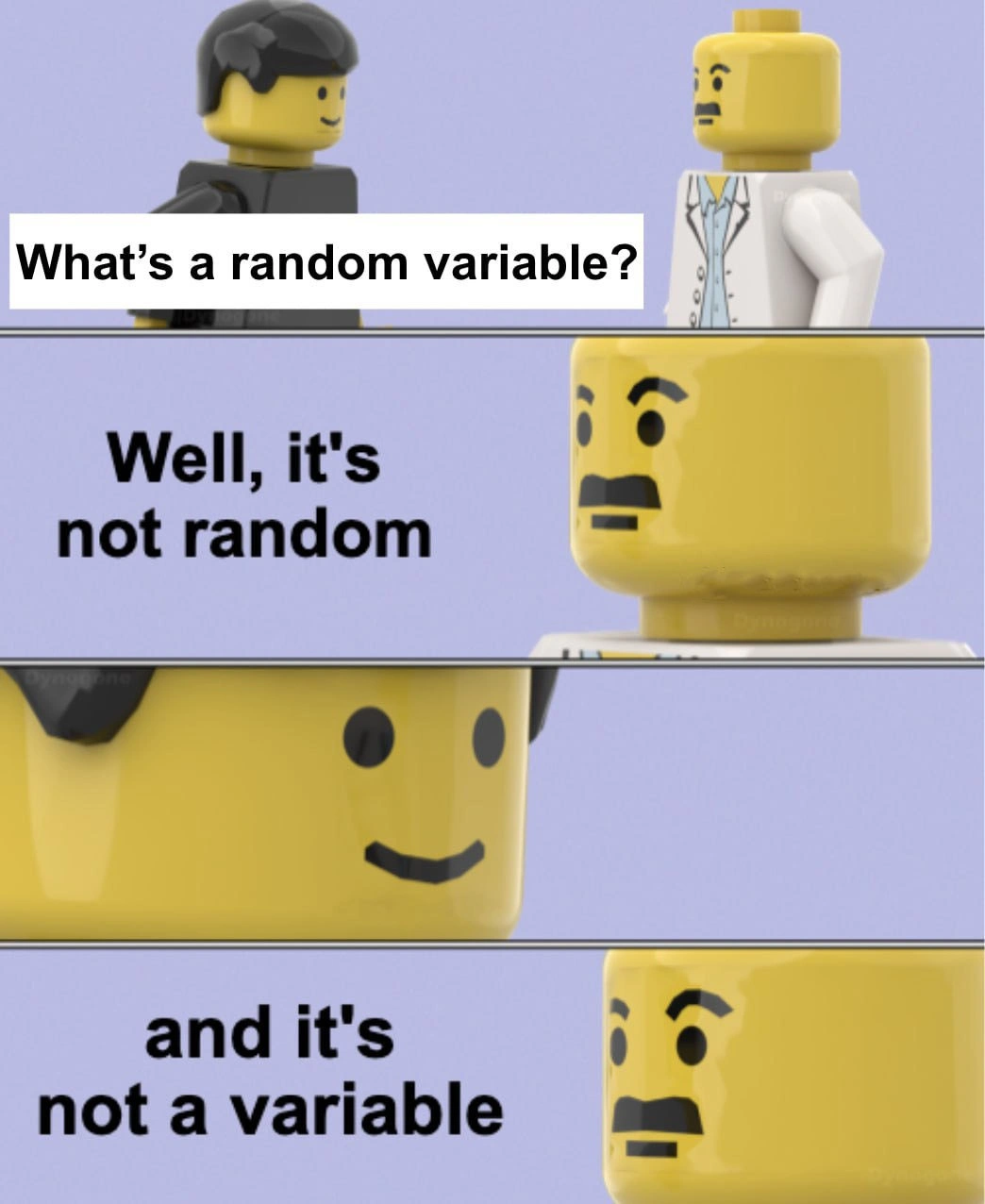
The LEGO meme illustrates this with a simple Q&A between a newcomer and an expert. The black-haired figure on the left asks, “What’s a random variable?” – this is a common question from someone new to probability or data science. The scientist minifigure on the right (in the lab coat, with a mustache) gives a cheeky answer broken into two parts: first “Well, it’s not random,” then “...and it’s not a variable.” That’s the punchline. It highlights the confusing naming: hearing that for the first time tends to make people stop and think (exactly like the smiling, slightly lost expression on the questioner’s LEGO face in the meme). The expert’s answer sounds almost like a riddle, but it’s accurate. He’s basically saying: a random variable isn’t a crazy, haphazard thing or a changeable container like the name might suggest.

If the conversation continued beyond the meme, the expert would explain in simpler words: a random variable is a predetermined way to translate random events into numbers. It’s a foundational concept in statistics and a key idea in CS fundamentals courses, especially for anyone doing statistical analysis or working in data science/ML. Once you learn it, you start to see random variables everywhere – from modeling how many users will click on an ad, to measuring the daily rainfall in a simulation. The name might throw you off at first, but it’s just the standard term everyone uses. So every newcomer has that little “Huh? It’s not really random or variable?” moment (which the meme captures), and then gets over it when they understand the definition. It’s a funny reminder that sometimes in tech and math, names can be totally misleading, and you have to learn what’s really behind the words.

Level 3: Not-so-random Variables

For an experienced developer or data scientist, this meme sparks a knowing chuckle. It highlights one of those classic misconceptions in tech (specifically, a stats misunderstanding) that we’ve all encountered early in our careers. The question “What’s a random variable?” sounds so innocent, and the deadpan answer “Well, it’s not random ... and it’s not a variable” is funny precisely because it’s technically true. This joke lands well with anyone who’s had to slog through a probability theory class or explain statistics to newbies in a data science team meeting.

Why is this combination so humorous? Because it encapsulates the counter-intuitive naming that trips people up during their learning curve. The term is a great example of how naming is hard in technical fields. In everyday English, “random” means unpredictable and “variable” means something that changes. But in a stats or CS fundamentals context, a random variable is a fixed definition, and the unpredictability lies in the outcome, not in the definition itself. We have this serious concept that sounds like a paradox — it's an official term that behaves oppositely to what a naive reading would suggest. Seasoned engineers who have dealt with statistical analysis or machine learning pipelines recognize this irony. They’ve seen that bewildered look (just like the Lego figure’s blank smile in panel 3) on fresh grads when you drop the bombshell: the “random variable” isn’t literally random or a variable!

This shared experience often leads to some tongue-in-cheek commentary in data teams. For instance, a senior might jokingly reassure during a modeling discussion: “Don’t worry, our random variable for user behavior is completely deterministic — the randomness is all in the users!” Cue the groans and laughs. The meme’s LEGO scientist with a mustache embodies that seasoned professor or team lead who has answered this question a dozen times. The brevity of his answer (“not random ... not a variable”) humorously mimics how veterans sometimes explain jargony concepts bluntly, half-expecting the student to be even more confounded. It’s funny because it’s true: every statistics instructor and quant mentor has watched students process this brain-twisting definition, much like the minifigure in panel 3 silently going “wait... what?!”.

Historically, we got stuck with this terminology from the early development of probability theory, and now we're all obliged to clarify it to each new generation. The phrase “random variable” has been in use for over a century, so imagine trying to change it now – good luck reprinting all those textbooks and retraining everyone! Instead, experienced folks have essentially turned it into an inside joke, a wink to others who survived Stats 101. Joking about confusing terms like this is a staple of TechHumor and DataScienceHumor threads online. It’s a form of nerdy camaraderie: once you truly grasp what a random variable is, you’ve earned the right to laugh at how absurd its name sounds (and maybe tease the next newbie with the same line!). The meme capitalizes on that communal memory. By using the playful LEGO format to deliver a dry textbook truth as a punchline, it bonds those in the know over the absurdity of technical language. And honestly, who can’t relate to the feeling of being the confused student at least once? That shared “yep, I’ve been there” feeling is exactly why this comic is “too real” and hilarious for anyone initiated into the world of probability and data science.

Level 4: Measurable Misnomer

At the highest theoretical level, a random variable in probability theory is ironically neither truly “random” nor a traditional “variable” as we might think in programming. Formally, a random variable (X) is defined as a measurable function (X: \Omega \to \mathbb{R}) from an underlying sample space (\Omega) (the set of all possible outcomes of some experiment) to real numbers (or another target set). This definition, established by the mathematician Andrey Kolmogorov in his 1933 axioms of probability, reveals the hidden truth: (X) is a well-defined rule that assigns a specific number to each outcome (\omega \in \Omega). In other words, if you know the outcome (\omega), then (X(\omega)) is determined with no randomness at all. The randomness lies entirely in which (\omega) you get (governed by a probability measure (P) on (\Omega)), not in the mapping rule (X) itself.

To break it down: the term “random” refers to the unpredictable selection of an outcome (\omega) by nature or chance, and “variable” refers not to a mutable storage location, but to the idea that (X(\omega)) can vary as (\omega) varies across different trials. Yet (X) acts like a fixed formula. It's deterministic in definition – for each possible input outcome, there's a predetermined output. When people first encounter this, it's almost a Zen riddle of math: the function (X) doesn't roll dice; the dice were rolled to pick (\omega), and then (X) calmly delivers the corresponding value.

From a measure-theoretic perspective, requiring (X) to be measurable ensures we can compute probabilities about the values of (X). For example, the probability that (X) falls below some value (x) is given by:

$$
P(X \leq x) = P(\{\omega \in \Omega : X(\omega) \leq x\}) \,,
$$

which simply means the chance that the outcome (\omega) lands in the subset of (\Omega) that (X) maps to a number (\leq x). This is how a random variable's distribution is derived from the underlying random experiment. So, mathematically, random variables are stable bridges between pure chance and calculus: they let us apply algebra and analysis to random phenomena by turning uncertain outcomes into numeric quantities.

The meme’s punchline – “Well, it’s not random ... and it’s not a variable” – is precisely highlighting this formal subtlety. It’s a nod to the counterintuitive jargon that even though we call (X) a “random variable,” it’s really a deterministic function (hence not random in itself) and a defined mapping rather than a mutable quantity (hence not a variable in the usual sense). In advanced modeling, this isn’t just a cheeky statement; it’s an important clarification. When modeling a data-generating process (like in statistical simulations or building an ML model), the structure of the random variable (the mapping (X)) is fixed, while the outcomes change across trials or samples.

It’s a beautiful abstraction once it clicks: you’re effectively saying, “Give me any possible world (outcome) and my random variable will deterministically tell you the number I care about in that world.” The only unpredictable part is which world you get to live in for that trial. Seasoned data scientists and mathematicians appreciate this as a powerful idea – by separating the randomness of nature from the deterministic measurement, they can compute things like expected values (E[X]) or variance (\mathrm{Var}(X)) using integrals or sums, even though the inputs are random.

In short, at the deepest theoretical level, the humor in the meme draws from the elegant truth that a random variable is a fixed rule applied to random events, not a whimsical or changeable entity itself. The terminology might sound like a paradox, but it’s actually a precise concept that underpins everything from simple coin-flip probabilities to the foundations of modern data science algorithms.

Description

A four-panel meme using rendered LEGO minifigures to explain a concept. In the first panel, a LEGO character with black hair asks another character with a mustache and a lab coat, 'What's a random variable?'. In the second panel, a close-up of the lab-coated figure's face shows him explaining, 'Well, it's not random'. The third panel is a humorous cutaway to the first character's head, now upside-down with a simple smiling face, representing blissful ignorance or confusion. In the fourth and final panel, the expert concludes, 'and it's not a variable'. This meme is a classic joke for anyone with a background in statistics, data science, or computer science. It plays on the notoriously confusing name 'random variable,' which, in probability theory, is technically a deterministic function that maps the outcomes of a random process to a set of numerical values. The humor lies in the pedantic but accurate deconstruction of the term, which is a common stumbling block for students
Comments

9
Anonymous ★ Top Pick A random variable is a function, a REST API is rarely restful, and a serverless architecture is full of servers. It seems our entire field is built on beautifully ironic misnomers
  1. Anonymous ★ Top Pick

    A random variable is a function, a REST API is rarely restful, and a serverless architecture is full of servers. It seems our entire field is built on beautifully ironic misnomers

  2. Anonymous

    Random variables are to probability what your so-called “random” flaky tests are to the CI pipeline: deterministic functions in disguise, delighting in the chaos they create

  3. Anonymous

    After 20 years in the industry, I've finally accepted that 'random variables' join the pantheon of misleading tech terms alongside 'serverless' (runs on servers), 'NoSQL' (often uses SQL), and 'machine learning' (neither machines nor learning, just gradient descent having an identity crisis)

  4. Anonymous

    This meme perfectly captures the moment when a mathematician joins your engineering standup and derails the entire sprint by pointing out that your 'random' number generator is actually a deterministic PRNG seeded with system time, and that what you're calling a 'variable' is really a probability distribution function. Technically correct - the best kind of correct - but now your deployment is delayed while everyone debates whether to refactor `getRandomValue()` to `sampleFromPseudorandomDistribution()`

  5. Anonymous

    Random variable is X: Ω→ℝ - a pure function with misleading branding; the randomness lives in ω, as honest as JavaScript’s var

  6. Anonymous

    It’s the only ‘var’ that’s pure - the randomness lives in the sample space, not your code… unlike that constructor seeding the RNG in your unit tests

  7. Anonymous

    Random variables: the stats term designed to make every dev question their mutable vs immutable life choices

  8. @tuguzT 1y

    pseudo-random value 🤓

  9. @king_usgn 1y

    Seems legit

Use J and K for navigation