Skip to content
DevMeme
3195 of 7435
Go Gopher Discovers Prehistoric Scala Debates
Languages Post #3516, on Aug 8, 2021 in TG

Go Gopher Discovers Prehistoric Scala Debates

Why is this Languages meme funny?

Level 1: Caveman at a Fancy Party

Imagine you’re at a super fancy dinner party where everyone is dressed in suits and using the perfect silverware for each course. The chefs have prepared very complicated, gourmet dishes that only a few expert cooks know how to make. This is like the team using Scala with Scalaz – everything is elegant and complicated, maybe a bit too fancy for its own good. Now picture the boss standing up and saying, “We don’t need all these fancy things anymore!” Suddenly, a friendly caveman (hairy and naked, straight out of the Stone Age) crashes into the dining room holding a simple dish (maybe just grilled meat on a stick) and smiling a goofy smile. He represents Go, the super simple approach. The caveman shouts “LOLWTF!” which in kid terms is like him laughing and saying, “Whoa, what is happening right now?!” Everyone at the party is stunned and can’t help but laugh because it’s such a crazy sight: going from a very formal, high-tech setup to an ultra-basic one in an instant.

In simpler words, the meme is joking about switching from something very fancy to something very simple, really fast. It’s funny for the same reason it would be funny to see a caveman suddenly show up at a black-tie dinner – the contrast is huge and unexpected. The Scala side is the fancy dinner with special recipes and tools; the Go side is the caveman saying, “Let’s just cook plain and easy.” The humor comes from that extreme change and the “What just happened?!” feeling everyone has. Even if you don’t get the tech details, you can laugh at the idea of a caveman barging into a classy party – it’s silly, surprising, and it perfectly captures how developers feel when a super complex plan is dropped for a super simple one out of the blue.

Level 2: Abstractions vs Simplicity

This meme shows a comparison between two programming approaches: one very fancy and abstract (Scala with the Scalaz library) and one very simple and straightforward (Go language). Let’s break down the characters and text we see:

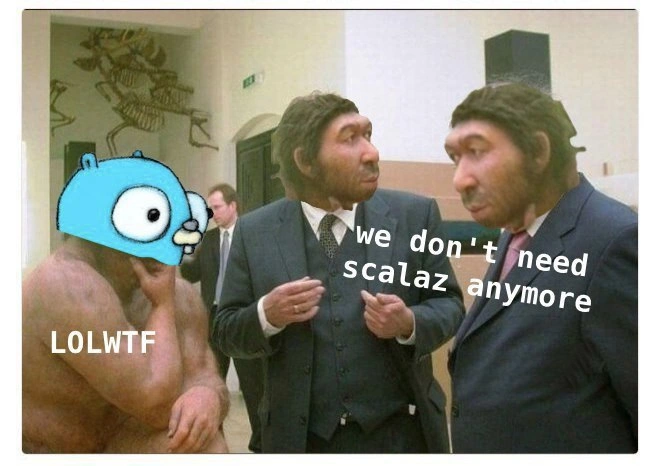
  • The men in suits represent the developers/management in a Scala team during a formal event (like a metaphorical “Scala party”). They look serious and sophisticated, much like Scala’s reputation in the programming world.
  • The nude, hairy man with the Go gopher head represents the Go programming language crashing this party. The bright-blue cartoon head is the official Go gopher mascot – Go’s symbol often used in gags and memes. By putting the gopher’s head on a caveman-like body, the meme is portraying Go as something primitive or bare-bones suddenly appearing in a refined setting. It’s a visual way to say “Go is basic (naked) compared to Scala’s dressed-up complexity.”
  • The white slanted text over the right suited man, “we don't need scalaz anymore”, is shown like a quote. This means one of the suit-clad guys (think of him as a manager or team lead) is saying that line. Scalaz is the name of a Scala library (pronounced “Scala Z”), which provides a bunch of functional programming abstractions. When he says “we don’t need Scalaz anymore,” it implies that the team has decided to stop using that complex library. In plainer terms, management believes those extra-complicated tools aren’t necessary now.
  • Next to the gopher-headed caveman, we see “LOLWTF” in bold letters. “LOL” means “laugh out loud” (something is funny) and “WTF” is short for “what the f* (an expression of confusion or disbelief). Combined as LOLWTF, it’s a very internet-slang way of saying “Haha, what on earth?!” It captures the comical shock of the situation. In the meme, it’s like the Go gopher (or the viewers) reacting with amusement and bewilderment at crashing this serious Scala gathering.

Now, what exactly are Scala and Go, and what’s Scalaz?

  • Scala is a programming language that runs on the Java Virtual Machine. It’s known for blending object-oriented and functional programming paradigms. In Scala, you can write code in a very high-level way: for instance, using functional concepts like passing functions around, using immutable data (data that never changes), and dealing with things like missing values in a safer way with types like Option.
  • Scalaz, in particular, is an add-on library for Scala that leans heavily into the functional side. It introduces a lot of additional tools (called abstractions) inspired by mathematical concepts. For example, Scalaz encourages use of monads – which you can think of as a pattern to handle computations step-by-step (like “do this, then do that, and if at any point something is missing or fails, stop”). A simple built-in example of a monad in Scala is Option: an Option[Int] might contain an integer or not (None). With monadic methods, you can chain operations on an Option without constantly checking if the value is there; the fancy library handles it. Scalaz takes this further, providing monads for many situations, and other structures like Either (for computations that might fail and carry an error) and a whole lot more. It even provides alternate (often more concise or symbolic) ways to do these operations. All this can make Scala code very concise and powerful, but also pretty hard to read if you’re not used to it. Imagine reading code filled with symbols like >>=, \/ or methods named bind, join, etc., and you have to understand a bit of abstract math to know what’s going on – that’s the kind of complexity Scalaz brought in.
  • Go (Golang), on the other hand, is a newer language (created at Google) that was designed to be simple, clear, and efficient. Go’s syntax and features are much simpler. For a long time (until recently), Go didn’t even have the concept of generics (reusable code for any type) that languages like Scala and Java have – everything was very concrete and explicit. For example, error handling in Go doesn’t use special monads or fancy constructs: a function usually returns a value and an error, and you write if err != nil { ... } to check if something went wrong. It’s very manual but also very straightforward. No magic, no hidden functional wizardry – what you see is what you get. Go also has a built-in way to handle doing many things at once (concurrency) using goroutines and channels, but even that is designed to feel simple (sort of like dealing with threads but easier). The blue gopher is the fun mascot representing this easy-going, no-fuss philosophy.

So, the meme sets up a contrast:

  • The Scala side (with Scalaz) is like a formal, complex approach – imagine developers writing code that feels like solving a math puzzle. It’s powerful but only if you understand the theory behind it.
  • The Go side is the casual, get-things-done approach – like developers writing code quickly, in a way that most programmers can read and understand without special training, almost like writing in simplified C or Python.

This is a classic language war scenario: one camp finds the sophisticated approach superior, another camp prefers the simpler approach. The term language tribalism refers to how programmers sometimes form almost “tribes” around their favorite language or paradigm, complete with biases and jokes about the other side. In our case, a Scala+Scalaz fan might joke that Go is so primitive a “caveman” could write it, because it lacks the high-level abstractions. Conversely, a Go fan (or a pragmatic manager) might say the Scala folks are over-engineering, disappearing into an ivory tower of category theory while real-world needs go unmet.

The humor is that the corporate team depicted has swung from one extreme to the other. They’re effectively saying: “All that fancy Scalaz stuff? Yeah, we’re done with it.” And symbolically, they’ve brought in the Go gopher – portrayed as a naked caveman – to replace it. It’s an exaggeration, of course. In reality, adopting Go might be a sensible simplification. But the meme exaggerates it to an absurd visual: it’s like firing the team of chefs who were preparing a delicate gourmet meal and instead handing everything to a guy who just barbecues meat on a stick. The text “LOLWTF” captures everyone’s stunned laughter at how abrupt that change is.

For a newcomer: the main takeaway is that this image jokes about a team abandoning a very complex technical approach in favor of a much simpler one. It name-drops Scalaz (a notoriously complex Scala library for functional programming) and Go (a much simpler programming language) as the two extremes. Even if you don’t know the intricacies of those technologies, you can appreciate the general idea: complicated vs. simple, fancy vs. basic. The suited men vs the caveman, the high-brow Scala party vs the low-brow “LOLWTF” gopher – it’s all illustrating that contrast in a funny, exaggerated way. Developers find it relatable because tech stacks do change like this sometimes, and it often feels just as jarring as a caveman walking into a cocktail party.

Level 3: Caveman in the Boardroom

Seasoned developers will recognize this scenario immediately: a company dives headfirst into an über-sophisticated tech stack, only for management to later yank the leash and holler, “Too complicated! Back to basics!” Here, the Scala team at the “formal reception” has been diligently using Scalaz, bringing all the nice but brain-bending functional patterns into their code. Perhaps for a while, they revelled in pure functions and mathematically proven correctness. But over time, reality (and new hires struggling to grok a StateT[IO, ?, ?] monad transformer) has caught up. The white text “we don't need scalaz anymore” slapped over the suit on the right is basically a manager or tech lead deciding to purge those functional abstractions from the project. Maybe the CTO read a blog about how Go makes microservices simpler, or maybe the only developer who truly understood Scalaz left the company – either way, boom, suddenly the team is told to drop the fancy stuff.

Enter the Go gopher: that bright-blue cartoon critter head pasted onto a nude, hairy caveman body. In this meme’s little story, Go is literally the party crasher at a formal Scala affair. The suited Scala folks are in a refined setting (marble floors, business attire, likely representing a sophisticated enterprise environment or high ceremony of engineering), while Go shows up nude and unrefined – essentially a caveman who wandered into a black-tie event. The contrast is gloriously sarcastic: one moment everyone’s discussing category theory and Scalaz typeclasses, the next moment management drags in Go and its mascot like, “This will solve our problems – and it’s so much simpler, see?” The gopher’s expression tagged with “LOLWTF” perfectly captures the hilarity and shock. It’s ambiguous who’s saying LOLWTF – it could be the gopher itself reacting to the stuffy Scala party it just crashed (“What on earth are you nerds doing with all that Scalaz?”), or it could be the Scala devs and onlookers reacting to management’s sudden decision (“Are you kidding? We replaced our advanced toolkit with this?”). That double-take is exactly what makes developers smirk: we’ve all seen abrupt tech pivots that make us go “WTF” while half-laughing in disbelief.

This meme skewers a common real-world pattern in tech teams. Language wars and framework fads often swing like a pendulum. Not long ago, Scala (especially with libraries like Scalaz) was the hotness in certain circles – promising safer, concurrent code through immutability and functional purity. Some companies went all-in, writing code that read like abstract algebra. Fast-forward a few years, and along comes Go with its promise of straightforwardness and low learning curve. Suddenly management is excited about faster compile times, simpler deployment (a single binary! no JVM!), and code that even non-math-genius developers can reason about in a hurry. For a senior developer, it’s déjà vu. It’s reminiscent of those earlier times when, say, everyone adopted heavy J2EE application servers and XML configs, then ditched them for leaner Spring Boot apps; or when monoliths were broken into microservices, only for some to later regret the complexity. Here it’s functional programming zeal being replaced by Go’s procedural pragmatism.

Why is this funny to us in the trenches? Because it’s painfully true. You might have spent months untangling a gnarly Scalaz Future or debugging a monad stack in production at 3 AM, questioning all your life choices. Then some higher-up decides to rewrite things in Go – which, while not a silver bullet, at least means when something breaks, you get a plain old stack trace without the metaphysics. The meme’s caveman aesthetic nails this feeling: after drowning in abstract complexity, switching to Go can feel like throwing out a labyrinthine map of twisty passages and just drawing a straight line instead. It’s simultaneously a relief and a “WTF” moment. Senior devs know there’s a cycle: today’s “must-have advanced framework” often becomes tomorrow’s “LOL, remember when we tried that?” anecdote. We also recognize a bit of tribalism here: Scala aficionados pride themselves on sophisticated code; Go fans brag that they cut through the BS and get things done. Put them in one room (or one project timeline) and you get exactly this kind of culture clash, ripe for humor.

The line “we don't need Scalaz anymore” is corporate-speak for “that experiment in fancy-pants functional programming is over.” This suggests some organizational backstory: perhaps management lost faith in the value of all those abstractions. Maybe maintainability suffered because only 2 out of 10 developers could read the code without a PhD in category theory. Junior devs were onboarded and promptly went 😕 *“What is all this > and >>=?” Meanwhile, hiring Scala/Scalaz experts is hard; but plenty of devs know basic Go. From a business perspective, the decision has a cold logic: simplify the stack, reduce dependencies on niche skills. But the way it’s portrayed – with a primitive gopher-man at a genteel party – pokes fun at how crude that simplification can feel. It’s like solving the problem of a complex gourmet recipe by just serving plain bread – sure, no one’ll get confused eating it, but you lose the fancy flavor. The seasoned engineer in us laughs because we’ve survived these see-saw decisions before. The scars of last year’s grand functional rewrite (that promised to solve all bugs with math) are still healing when this year’s decree to “just rewrite it in Go” lands on our desk. Of course, the meme exaggerates to make the point: it imagines the Scala team as overly formal cavemen themselves (notice the suited figures have an almost Neanderthal look with those blurred, heavy-brow faces) and the Go gopher as literally naked – essentially calling Go’s approach bare-bones. It’s a roast of both sides: Scala’s camp comes off as elitist or antiquated, Go’s camp as simplistic to a fault. And yet, many of us chuckle because at the end of the day, when deadlines loom, a working crude solution often beats an elegant broken one.

This humorous tableau also hints at the language tribalism in developer culture. One tribe (Scala+Scalaz enthusiasts) throws around terms like Functors, Applicatives, Monoids and reveres pure FP as the one true path. Another tribe (Go folks) rolls their eyes and says “YAGNI” (You Aren’t Gonna Need It), advocating for code that looks like C knocked back a few beers. In the meme’s tiny narrative, the Go tribe wins this round – barging in shamelessly. The suits choosing Go are essentially defectors, abandoning the Scala tribe’s elaborate customs. To any senior dev, the subtext is clear: tech choices aren’t just about tech – they’re about people, egos, maintainability, and sometimes faddish management decisions. That combination is ripe for satire. So we get this absurd scene: a hairy Go gopher man (image of raw simplicity) plopped next to uptight suited Scala devotees, with a big “LOLWTF” to underline how ridiculous yet familiar it all is. It’s the kind of scene that makes you both laugh and sigh, remembering the last time you had to throw out perfectly good (if overly complex) code because someone higher-up read about a new flavor-of-the-month solution. In short, it’s humorous because it’s a truth of software development exaggerated into a caveman gag – a perfect depiction of complexity vs. simplicity in the ongoing language wars.

Level 4: Category Theory Crashers

This meme highlights a clash between advanced functional programming abstractions and brute simplicity, essentially pitting category theory against caveman coding. The Scala library Scalaz is infamous for injecting category theoretic concepts (like monads, functors, and monoids) into everyday code. In theory, these abstractions give your code algebraic rigor: you treat computations as math objects and combine them according to proven laws. A monad, for example, is a construct from category theory that lets you build sequences of operations while abstracting away details like missing values or asynchronous waits. Scalaz provides a whole zoo of such abstractions – from Option as a Maybe-type monad to fancy constructs like Kleisli arrows, Applicatives, and even weirdly named operators (>>=, , etc.) – essentially smuggling an entire Haskell-like toolkit into Scala. The upside is theoretically elegant code: fewer null-pointer surprises and more reusable patterns, all backed by math. The downside? Your codebase starts to look like a research paper.

In contrast, Go (Golang) comes sprinting in the door with a totally different philosophy – one that a category theorist might call primitive, but a pragmatist calls refreshingly straightforward. Go was designed with simplicity in mind: minimal features, no exotic type gymnastics (at least until generics showed up much later), and a concurrency model inspired by Tony Hoare's CSP that favors plain goroutines and channels over complex async monads. Where Scalaz might handle an error with an Either type or a \/ (pronounced “disjunction”) monad chaining through multiple contexts, Go just returns an error code and expects you to handle it with an if. It’s like replacing an entire algebraic typeclass hierarchy with a couple of for loops and if-statements. On a theoretical level, this is a showdown between lambda calculus sophistication and imperative bluntness. One side harnesses academic Category Theory (think functor laws, monadic identity and associativity), the other side wields the raw power of “do this, then that” sequential logic.

The humor here is rooted in the absurdity of tossing out deep functional abstractions in favor of a far simpler model. It’s as if a formal proof-laden approach to programming – where every effect is wrapped in an IO monad and every function composition obeys semigroup laws – is being unceremoniously booted out by a language that proudly proclaims, “I don’t even know what a monad is, and I’m fine.” The Go gopher barging into a Scala party represents this abrupt theoretical downgrade. After all, when you’ve spent months wrestling with higher-kinded types and Yoneda lemmas to make your code pure, it’s both horrifying and comical to hear someone say, “LOL, we’re ditching all that and rewriting everything in Go!” The category theory purists might clutch their pearls, but the battle-scarred veteran in the corner is smirking: sometimes the elegant O(n^2) abstract solution gets beaten by the caveman’s straightforward O(n) hack that just works. This level of humor comes from recognizing those deep theoretical stakes – monadic versus mundane – and seeing them crash into each other in one picture.

Description

A meme set in a museum, juxtaposing different programming cultures. On the right, two figures with Neanderthal heads are dressed in modern business suits, engaged in a serious conversation. One says to the other, 'we don't need scalaz anymore'. On the left, a shirtless, muscular figure sits in a contemplative pose, but his head has been replaced with the bright blue mascot of the Go programming language, the Gopher. Below the Gopher is the text 'LOLWTF'. The background features dinosaur skeletons, reinforcing the 'prehistoric' theme. The humor is derived from the clash of communities: the Scala developers (depicted as Neanderthals) are debating the relevance of Scalaz, a notoriously complex functional programming library, a debate that a Go developer, whose language prioritizes radical simplicity, would find absurd and outdated - hence the 'LOLWTF' reaction
Comments

12
Anonymous ★ Top Pick Go's approach to complexity is 'if err != nil'. Scala's is to find the right Monad transformer in a library that has more operators than the Greek alphabet
  1. Anonymous ★ Top Pick

    Go's approach to complexity is 'if err != nil'. Scala's is to find the right Monad transformer in a library that has more operators than the Greek alphabet

  2. Anonymous

    Five years refining monad transformers in Scalaz, five minutes for management to learn Go makes a single static binary - now the whole architecture is goroutines, interface{}, and absolutely no pants

  3. Anonymous

    After spending three sprints debugging a monad transformer stack, the team discovered they could have just used a goroutine and a channel - but at least they understood category theory now

  4. Anonymous

    After years of explaining to stakeholders why a simple feature required understanding Kleisli arrows, Free monads, and HKT encodings, the Scala team finally realized that 'we don't need Scalaz anymore' was the most liberating sentence in their codebase - meanwhile, the Go developers in the corner are still wondering why anyone thought wrapping everything in seventeen layers of abstraction was a good idea in the first place

  5. Anonymous

    Leadership announced 'we don’t need Scalaz,' and suddenly the rewrite swaps monad transformers for WaitGroups and channels - amazing how deleting twelve abstractions cuts p99 and the ops budget at the same time

  6. Anonymous

    We sunset Scalaz for Go - apparently associativity doesn’t help when the pager goes off at 3 a.m

  7. Anonymous

    Serverless fixed scaling - until the bill and cold starts proved the dino wrong

  8. @sany_nikonov 4y

    Is scala deprecated?

  9. @RiedleroD 4y

    no idea what that even means

  10. @dsmagikswsa 4y

    Any Explanation?

  11. @teggot 4y

    Scala has functional library "cats" which is much better than "scalaz". However, IDK what this meme is about.

    1. @jedichchch 4y

      Golang supremacy, that's what it's all about😏

Use J and K for navigation