Deep Learning's Laughter at Traditional Complexity
Why is this AI ML meme funny?
Level 1: Hard Work vs Quick Trick
Imagine two friends trying to solve a really hard riddle. The first friend is old-school: he sits down, concentrates really hard, and starts explaining step by step why the riddle is so tough. He’s drawing diagrams, counting possibilities, basically giving a big lecture about how complicated it all is. This is like someone doing things the hard, methodical way – checking every detail and worrying about how long it might take. Meanwhile, the second friend has a quick trick up his sleeve. While the first friend is still talking, the second friend quietly uses a special app on his phone that instantly solves the riddle. Suddenly, the phone shows the answer! The second friend bursts out laughing in surprise and triumph, because it was so easy for him with that tool. The first friend (who was in the middle of a serious explanation) just stops, mouth open, kind of shocked and maybe a little annoyed: all that hard work and time spent thinking turned out to be unnecessary.
This meme is just like that story. The hard-working explainer is the traditional algorithm – doing things by the book and stressing about how hard the problem is. The laughing friend with the phone is the deep learning approach – using a powerful but not-so-obvious trick to get the answer quickly. It’s funny because the one who worked smarter (or had a magic shortcut) completely upstaged the one who was working harder. We find it humorous and a bit satisfying when someone or something sidesteps a huge complicated process and still succeeds. It’s like watching a character in a cartoon pull a lever that says “easy mode” while another character is sweating over a mountain of calculations. In simple terms: one tried to solve the problem by thinking a lot, the other solved it by letting the computer do the heavy lifting – and the second one is now giggling because it looks so easy. The meme makes us laugh because we all love a good shortcut, especially when the usual way was super hard and serious!
Level 2: Math vs Data
Let’s break down the joke in simpler terms. We have two characters symbolizing two approaches to solving problems:
Traditional methods (Jerry the mouse) – This means solving problems with classical algorithms and step-by-step logic that a programmer writes by hand. When faced with a problem, this approach involves analyzing how hard that problem is using math. For example, a traditional algorithm might be something like a sorting routine, and we determine its efficiency using Big O notation (say it’s
O(n log n), which means if you double the number of items to sort, the time grows a bit more than double). Explaining the complexity of a problem is exactly what a computer science instructor would do: break down the problem’s steps and count how they grow. They might say, “If we have to check every pair of items, that’s on the order of n² steps, which becomes huge when n is large!” In the meme, Jerry has that role – he’s up on a stool, looking annoyed and flustered, presumably mid-rant about how terribly complex the problem at hand is. This is a familiar scene to anyone who’s taken an algorithms class or had to consider performance: you spend a lot of effort quantifying the difficulty (like, is it going to take 1 second or 1 year for the computer to handle X amount of data?). Jerry’s angry, strained expression says he’s not thrilled about the complexity – maybe the problem is a real head-scratcher and he’s sounding the alarm.Deep Learning (the yellow bird) – Deep learning is a subset of MachineLearning where instead of writing out the solution steps yourself, you build a model (often a neural network) that learns the solution from examples. Think of a neural network as a big web of simulated neurons that can be trained to recognize patterns. You don’t tell it “follow these 10 steps to solve it”; you show it lots of input-output pairs and it adjusts itself internally to be able to produce the right output for a given input. In the meme, the bird is labeled “Deep Learning” and in the first panel it’s sitting calmly on a stool, listening to Jerry’s intense explanation. The bird looks almost bored or unimpressed. This represents how deep learning practitioners often don’t engage in lengthy complexity arguments – they’re more interested in whether feeding data to a neural net will work out. Deep learning has a bit of a black-box nature: we might not easily explain why a trained neural network made a certain decision, because it’s all hidden in hundreds of thousands of numeric weights inside the model. But we care that it gets the right answer. In practical terms, if an algorithm is like a recipe, a deep learning model is like an experienced chef who just knows what tastes right by trial and error, without consulting a step-by-step recipe every time. The meme’s bird character literally flipping into laughter in the second panel suggests that deep learning finds the whole fuss about “how hard the problem is” amusing – because it went ahead and solved it without all that hand-wringing.
To visualize the contrast, imagine these two approaches in a scenario developers know:
- A traditional algorithm approach to, say, recognizing handwritten digits would involve you (the programmer) explicitly coding rules: measure each stroke, classify shapes of curves, etc., and analyzing how each additional pixel or complexity in the image might slow things down. You’d be calculating the complexity, maybe “O(n) per image” or something, and carefully optimizing the code.
- A deep learning approach would say: “Forget writing rules. Here’s a bunch of example images and their correct labels. Let’s feed them into a neural network and let the computer figure out the pattern.” You might not ever compute a formula for how the solution’s runtime scales; instead, you rely on the fact that modern computers can crunch a lot of data. You press Train on a neural network (using a library like PyTorch or TensorFlow), wait for it to adjust and learn from the data, and then you have a model that, given a new image, spits out what digit it thinks it is. The complexity in this approach is mainly in the training process (which could take hours and involve millions of calculations). But when you actually use the trained model on one image, it’s very fast – just a bunch of multiplications and additions, which computers are insanely good at. So you, as the developer, didn’t spend time explaining or analyzing complexity in terms of n – you just trusted that with enough data and compute, the model would handle it.
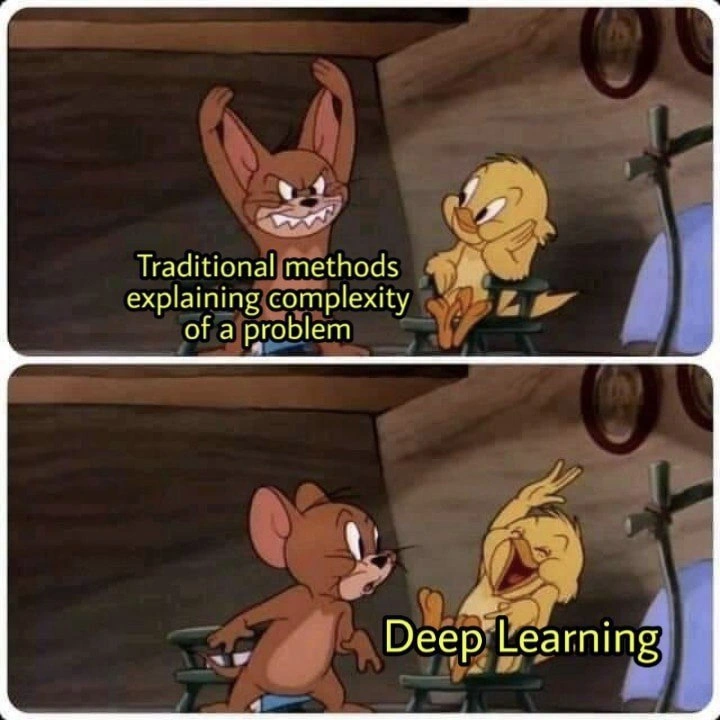
Now, the meme uses a two-panel cartoon format (a classic meme style) with characters from old-school animation. Jerry the mouse (from Tom and Jerry) is a stand-in for the old, grumpy algorithm explaining the problem’s difficulty. The small yellow bird resembles Tweety (from Looney Tunes) and plays the part of the new cool kid, Deep Learning. In the first image, Jerry is animatedly talking (his big ears are up, face angry) with the caption “Traditional methods explaining complexity of a problem.” The bird is sitting laid-back, as if listening but not taking it too seriously. In the second image, we see the caption “Deep Learning” next to the bird who is now leaning back laughing hysterically, and Jerry looks stunned into silence. This reversal is the punchline. It’s showing in a humorous way that after the long lecture about how complex the problem is, the deep learning solution comes in and basically treats that lecture as a joke because it solved the problem anyway.
Why is this funny (especially to programmers)? Because it’s not too far from reality! It captures an exaggeration of a real trend:
- Traditional approach: “Let’s fully understand the problem, quantify its complexity, and solve it with well-defined steps.” (Picture a professor drawing graphs on a whiteboard, talking about how complexity grows.)
- Deep learning approach: “Let’s just throw a ton of data and a big neural network at it and see if it works.” (Picture a data scientist hitting ‘run’ on a powerful computer, then shrugging when asked about Big O notation.)
And often, the deep learning approach does an amazing job on tasks that are really hard to pin down with manual rules (like recognizing images, understanding language, etc.). It can feel almost like cheating or magic. Developers who’ve been in the field recall times where someone painstakingly engineered a solution, only for a machine learning model to come along and beat it without that detailed kind of problem-specific tuning. The meme is a light-hearted nod to that experience. It’s tagged with things like AlgorithmComplexityAnalysis and AIHumor because you kind of need to know both worlds to get the joke: the rigorous world of analyzing algorithms, and the fast-moving world of AI where neural networks are king.
To sum up the contrast, here’s a quick side-by-side comparison:
| Traditional Algorithm (Jerry’s approach) | Deep Learning Model (Bird’s approach) |
|---|---|
| Method: Write explicit code with clear steps to solve the problem, based on human understanding. | Method: Set up a neural network and feed it lots of data so it can learn the solution by example. |
| Complexity Focus: Calculate and think about the Big O complexity (how does runtime grow with input size?). e.g. “This sorting algorithm is O(n log n).” | Complexity Focus: Hardly discussed explicitly. Training the model may be costly (maybe hours on a GPU), but using the model is fast and we don’t usually express it in O() notation. |
| Transparency: You can explain how it works step by step (since you coded the logic). It’s clear why it produces a correct result, and you can reason about worst-case scenarios. | Transparency: The learned solution is a black box of numbers (weights). It’s harder to explain exactly why it works – we just know it gets high accuracy from testing. Worst-case behavior isn’t obvious without empirical testing. |
| Needs: Clever insights, mathematical proof of correctness, and often optimizations by the programmer. (E.g., figuring out how to prune search space in a puzzle solver.) | Needs: Lots of data, powerful hardware (GPUs for training), and careful tuning. The “cleverness” is in the model architecture or training procedure, not in step-by-step problem-solving logic. |
| Example: Writing a custom route-finding algorithm for a map and analyzing its performance as the map grows (maybe it’s O(n²) with n intersections, so it gets slow fast). | Example: Using deep reinforcement learning to have an AI learn to navigate the map. You don’t derive a formula for how it scales; you train it on many example routes. Later, it just outputs a route when given a new map, and you measure success by testing, not by formula. |
In the meme, the traditional side is effectively saying, “This problem might blow up in our faces as it gets bigger; it’s really complex!” and the deep learning side is like “Haha, I solved it while you were worrying about that.” This is why the bird is laughing. The humor comes from that role-reversal and the element of surprise. Normally, you’d think the one who deeply analyzes a problem would have the upper hand, but here the one who seemingly didn’t care about the complexity (the deep learning approach) wins out. It’s a bit like watching a student who didn’t study at all ace an exam while the one who studied intensely struggles – in real life that might be frustrating, but in this meme context it’s played for laughs at the quirks of our tech industry.
Level 3: Big O vs Big Data
At a high level, this meme humorously pits Big O notation against big data mojo. In the top panel, the traditional methods character (grumpy Jerry the mouse on his stool) is like that senior engineer or CS professor passionately explaining “just how hard this problem is.” He’s embodying the cautious voice of CS_Fundamentals: detailing how the runtime might explode with more input, warning about edge cases, and probably referencing an algorithm textbook. We can almost hear him say, “This algorithm runs in quadratic time, and if the dataset doubles, it will take four times as long! If it’s an NP-complete problem, well, forget about it for large N...” Meanwhile, the little yellow bird (chilling on the side) represents a Deep Learning specialist listening with a confident smirk. This bird isn’t sweating at all. Why? Because the unspoken punchline is coming: maybe we don’t need to meticulously derive those complexity formulas if a neural network can just bulldoze through the problem with enough data and compute.
In the bottom panel, the roles flip comically. Now the bird labeled “Deep Learning” is practically rolling on its back laughing, and Jerry (traditional algorithm) is dead silent, ears drooping in defeat. This captures that “Are you serious?!” moment many experienced developers have felt in recent years. It’s poking fun at the reality that deep learning solutions often outperform or at least outshine hand-crafted algorithms, sometimes in domains the classic methods struggled with. The deep learning side is essentially saying, “All that complexity analysis you did — and I solved it with a giant neural net. Hah!” It’s the swagger of modern AI techniques, a bit of AIHumor directed at our traditional problem-solving pride. Think of scenarios like: a vision researcher spent years perfecting an edge-detection algorithm and proving its efficiency, and then a graduate student with a GPU comes along and in a week trains a convolutional neural network that recognizes objects ten times more accurately without ever explicitly coding those rules. The neural net approach blows the old method out of the water, and it doesn’t even provide a neat Big O equation to explain itself. No wonder Deep Learning is laughing in the meme – it’s a lovable show-off.
This pattern is familiar across the industry. Consider how we used to write expert systems or hard-coded logic for tasks like translation, chess, or speech recognition, carefully handling myriad cases. Then came deep learning models (like transformer networks for translation, AlphaGo for Go-chess, RNNs for speech) which simply learned from data and surpassed decades of hand-crafted solutions. Those who championed the classic approaches often found themselves with a mix of admiration and “welp, I guess that works too!” frustration. The meme resonates because it dramatizes exactly that: the academically inclined approach monologuing about complexity, and the data-driven approach casually one-upping it. In developer terms, it’s the meeting where the old guard engineer warns “This scheduling problem is NP-hard; we might need to limit scope or use approximation algorithms,” and then the young machine learning engineer goes “Hold my GPU, I’ll train a model” 😄. A few days of training later, the ML solution is giving decent results. The complexity guru is left thinking, “But...but...the theory—!”. Deep learning’s big-data-fueled confidence can sometimes feel like an outright laugh in the face of classical theory.
It’s worth noting, as seasoned folks do, that this humor glosses over some caveats. Deep learning doesn’t actually violate complexity laws; instead, it often shifts the heavy workload to the training phase or leverages cases where typical inputs have exploitable patterns. Training a large model might involve billions of operations (a fact that would give any algorithmist pause), but thanks to parallel processing and the once-and-for-all nature of training, we don’t talk about it in the same way as algorithm runtime for each input. After training, applying a neural network (inference) can even be O(1) or O(n) for an input of size n — effectively very fast and not dependent on solving an exponentially hard search each time. So from the outside, it feels like the deep learning solution is effortlessly handling complexity that would choke a handcrafted program. It’s as if the deep learning crowd found a loophole: throw enough linear algebra and data at the problem, and laugh all the way to a solution.
This meme strikes a chord because it also reflects a cultural shift in programming and engineering. There’s a gentle ribbing here: the traditional_methods vs deep_learning_supremacy debate. The “traditional methods” camp values interpretability, proven correctness, and knowing the bounds of your solution. The “deep learning” camp is okay treating the problem like a black box to be conquered with computation and large datasets. When those two mindsets meet, you get exactly the scene in the meme. One side is giving a serious lecture on why the problem is a big deal; the other side responds with a belly laugh, effectively saying “I didn’t even attend your lecture, and I aced the test.” 🤣 Among developers, this generates both laughs and a touch of impostor syndrome: should we all just drop what we’re doing and learn TensorFlow now? The meme’s answer (in jest) is: probably yes, or be ready to have a bird laugh at you! It encapsulates a very modern flavor of tech humor: recognizing that despite all our deep academic knowledge of algorithmic complexity, sometimes a data-driven approach just wins by brute force – and it’s kind of hilarious and humbling at the same time.
Level 4: Complexity Classes Collide
In theoretical computer science, algorithmic complexity isn’t just a casual topic – it’s a rigorous study of how problem difficulty scales. The meme’s setup of “Traditional methods explaining complexity of a problem” evokes images of computer scientists proving whether a problem lies in class P or is NP-hard, meticulously analyzing worst-case scenarios. The Jerry-like character on the stool could be imagined rattling off Big O proofs or referencing the infamous P vs NP dilemma. Perhaps he’s warning that the problem's time complexity grows exponentially with input size, meaning it quickly becomes intractable. This is the world of formal complexity classes: where we categorize problems as polynomial-time (feasible) or NP-complete (likely requiring super-polynomial time), and where we derive bounds like O(n^2) or O(2^n) to describe an algorithm’s running time. It’s a cornerstone of CS_Fundamentals to measure how scalable and hard a problem is.
Now enter the small yellow bird labeled “Deep Learning.” From a theory standpoint, this character represents a completely different approach that almost shrugs at classical complexity concerns. Modern DeepLearning leverages huge amounts of data and computational power to find solutions empirically rather than by following a fixed step-by-step algorithm crafted by a human. It’s as if the bird is operating outside the traditional complexity framework. For example, a classical algorithm might formally prove how hard it is to solve a certain NP-complete problem (like the Traveling Salesman Problem) exactly, but a deep learning model might learn heuristics or patterns to get good-enough solutions on typical cases without ever solving the worst-case scenario explicitly. There’s a sense of deep_learning_supremacy here: the neural net acts unbothered by theoretical limits, tackling tasks that would make a theory-minded person cringe.
Under the hood, of course, training a deep neural network is no trivial matter either – it’s just a different kind of complexity. In fact, finding optimal weights for a deep network involves navigating a highly non-linear, high-dimensional search space (tuning potentially millions of parameters). In theory, solving this optimization globally is NP-hard too! Yet in practice, techniques like stochastic gradient descent, clever network architectures, and massive parallelism (thank you, GPUs and TPUs) let us approximate good solutions in reasonable time. It’s a beautiful irony: the algorithmic complexity hasn’t disappeared; it’s been tamed by empirical methods and brute-force compute. Researchers are actively trying to explain why large neural networks often train successfully despite the potential for getting stuck – touching on deep theories like the lottery ticket hypothesis, PAC learning bounds, and the information geometry of network loss surfaces. They’re essentially reconciling how deep learning defies traditional expectations by focusing on average-case performance and leveraging structures in real data.
So when the meme shows the deep learning character roaring with laughter, it symbolizes that from a high-level perspective, deep learning seems to laugh off those intimidating complexity proofs. It’s a clash of mindsets: formal complexity analysis versus empirical machine learning. The traditionalist (Jerry) represents the view that one must respect computational limits and analyze problems rigorously. The deep learning bird exemplifies the new-school attitude: “Sure, your proof says it’s hard, but look – my neural network solved it (at least for what we care about)!” Fundamentally, the humor emerges from this almost paradoxical situation: deep learning often succeeds in domains considered hopelessly complex by classical analysis, by leveraging statistics and data in ways theory might not fully grasp yet. It’s a modern computational twist on the age-old brain teaser: when theory says no free lunch, along comes a neural network feasting anyway – leaving the theorist scratching their head (or in this case, speechless on a stool).
Description
A two-panel meme using scenes from the cartoon 'Tom and Jerry'. In the top panel, Tom the cat looks angry and animated, with his hands up in frustration. A small yellow duckling sits on a stool, looking bored and unimpressed. Yellow text overlay reads: 'Traditional methods explaining complexity of a problem'. The bottom panel shows Jerry the mouse entering the scene with a surprised look, as the duckling is now falling off its stool, laughing hysterically. The yellow text overlay simply says: 'Deep Learning'. The meme humorously contrasts the rigorous, often convoluted, process of explaining and solving problems with traditional, explicit algorithms against the often opaque but powerful nature of deep learning. For senior engineers, the joke lies in the shared experience of wrestling with complex, explainable systems, only to see modern deep learning models achieve superior results as a 'black box,' making the old struggles seem absurd and laughable

Comments
15Comment deleted
Explaining a problem with traditional methods is a 30-page design doc. Explaining it with deep learning is just saying '...and then the matrix multiplication happens,' and hoping nobody asks for details
Turns out O(credit-limit) is the only Big-O that matters - six months shaving a log factor can’t compete with six minutes spinning up a billion-parameter model on the company card
After 15 years of explaining O(n log n) to stakeholders, I've discovered the ultimate complexity class: O(¯\_(ツ)_/¯) - where your model achieves 99.8% accuracy but the only explanation you can give the compliance team is 'the matrices liked each other.'
This perfectly captures the moment when your carefully crafted O(n log n) solution with detailed proof of correctness gets outperformed by someone who just threw the problem at a transformer with 175 billion parameters and called it a day. Sure, you can explain exactly why your algorithm works and its theoretical guarantees, but can you explain why adding more layers and attention heads somehow solved the halting problem? Didn't think so. Welcome to the era where 'just add more GPUs' is a valid architectural decision
Traditional CS: prove it’s NP-hard; Deep Learning: prove it’s H100-complete
We used to argue O(n log n); now it’s O($/hr of A100s) - interpretability=false, budget is the stopping criterion
Deep learning explains complexity like Jerry: emergent magic from backprop hell, zero LIME/SHAP required
Did not get Comment deleted
Please call Poyasnitilnuyu brigadu Comment deleted
you mean the explanation squad? Comment deleted
Yes, you are right :) Comment deleted
this is English-only chat, so please add a translation of your text (even in stickers and other media) to English (English-only should mean that talking other languages is prohibited, but it isn't - just add a translation) Translation: (line 1) Explanation Squad (line 2) won't come Comment deleted
So, an Explanation squad has not came :( Sadness Comment deleted
I might guess that in deep learning world you don't worry about mathematical complexity, you just "add more layers" and it works. Comment deleted
Also you kinda look like a giant from Twin Peaks? Comment deleted