Welcome to the Go-lag
Why is this Languages meme funny?
Level 1: Bruised but Not Broken
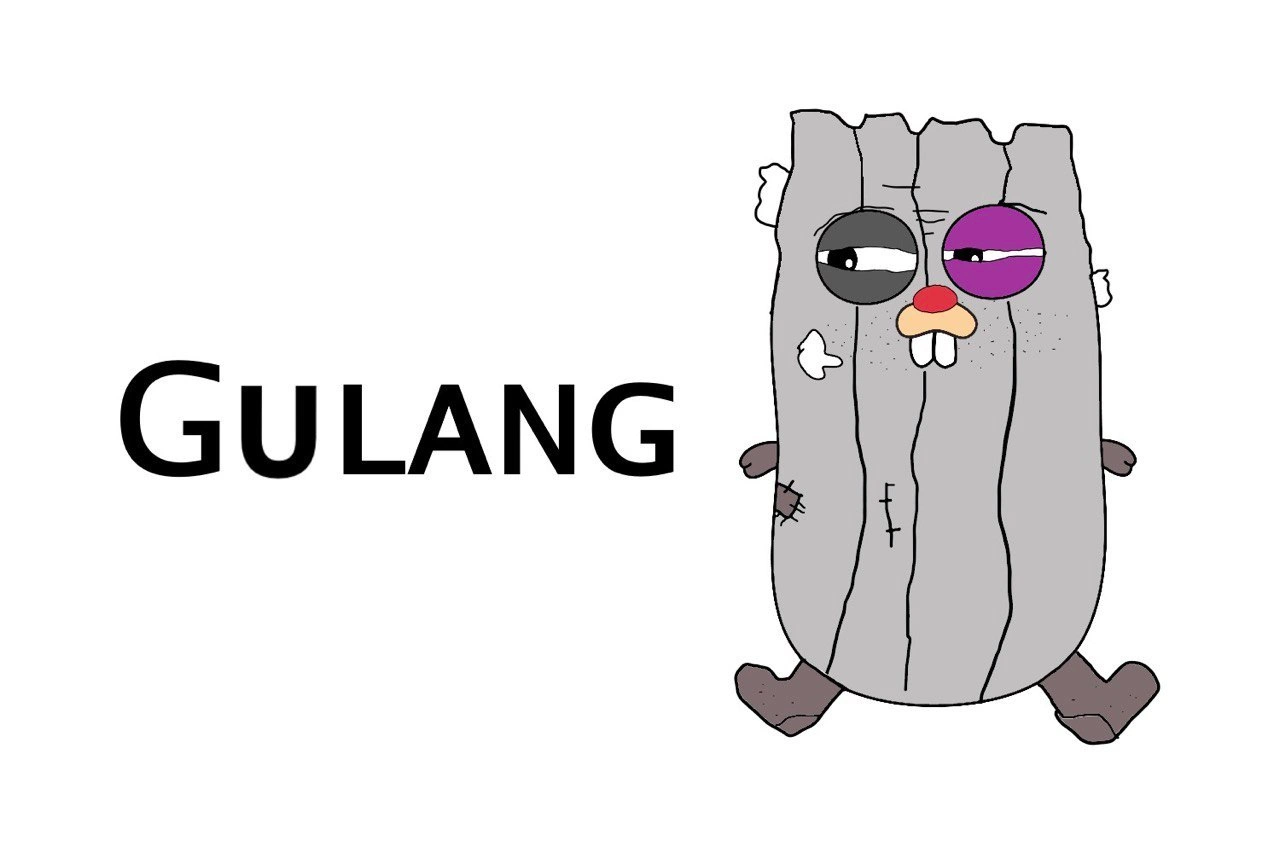
Imagine you have a favorite toy that is usually bright, clean, and smiling. One day, that toy goes on a big adventure – maybe it fell in the mud, got bumped around in a backpack, and even fought off a naughty puppy. When it comes back home, it has band-aids, scratches, and a black eye, but it’s still your same beloved toy and it’s still in one piece. In this picture, the Go gopher (a friendly cartoon character for a computer language) is like that toy. It’s all bruised and patched up after a rough time, but it’s still walking forward, not giving up.
This is funny because we don’t usually think of a programming language or a piece of software as something that can get hurt. It’s a bit like seeing a cartoon character after a silly fight: one tooth chipped, wearing a big bandage, but making a goofy face and continuing on. The word “GULANG” is a play on the name “GoLang” (the Go language) and sounds like something tough happened, kind of like how a hero in a story might come back from a challenging journey. The gopher has ouchies and booboos, just like a kid who played too hard, yet it’s still going.
The feeling this picture gives is both funny and proud. It’s funny because a cute blue gopher we expect to be cheerful is shown like it had a tumble in a rock quarry – all grey and cracked like wood with mismatched shoes. But it’s also a bit proud and happy, because even though it got hurt, it didn’t break. Just like you might giggle and give your scruffy teddy bear a hug after it survived the washing machine, we laugh and nod at this gopher. It reminds us that even when things get hard and messy (in technology or in life), we can come out the other side a little scratched up but still okay. The gopher may be limping home, but it’s home, carrying its scars like badges of honor – a funny little warrior who won the day.
Level 2: Production Bruises
In this meme, we see the Go gopher looking like it just went through a really rough day. The Go gopher is the cute official mascot of Go (often called Golang), a programming language created at Google known for being simple and fast. Normally, the gopher is drawn as a happy little blue creature. But here? It’s been turned into a beat-up grey plank of wood with cracks, bruises, and patches. Even the text has changed from “Go” to “GULANG”, a playful twist. That extra “U” hints at the word “gulag” – historically, a gulag was a terrible, grueling work camp. In a joking way, this suggests that working with Go in tough situations (like real-life big projects) can feel like an ordeal.
Let’s break down the scene: The gopher has two black eyes, a red swollen nose, and even its front tooth looks chipped. It’s wearing two mismatched boots and has little arms sticking out as it trudges along. There are obvious cracks running down its body and a patch sewn on its side. All these details are cartoonish symbols for “Ouch! This poor gopher has been through a lot.” For developers, each crack and patch is immediately recognizable as a metaphor for what we call “production incidents” or “war stories.” A production incident is when something goes wrong with a software application while it’s running live for users – like a major bug, a crash, or an outage. These are the emergencies that have engineers fixing things at odd hours (often half-dressed, much like the gopher’s odd boots!). Every time you rush a fix to save a system, the codebase gains a new patch or scar – just like the stitches drawn on the gopher.
The word “GULANG” itself is a pun on “GoLang.” By swapping the “Go” with “Gu,” it makes us think of the word “gulag,” implying the gopher (and maybe the developers using Go) has survived some brutal punishment. It’s a tongue-in-cheek way to say: “We love Go, but wow, sometimes working with it (or any language) under pressure is rough.” This relates to common developer humor. In tech circles, people often joke about how a project looked shiny at the start but turned into a patched-up mess after deadlines, bugs, and quick fixes. The gopher’s weary expression – one eye half-open – perfectly captures how a coder feels after a night of debugging a crashing server.
The meme also touches on “language wars.” That’s what we call those endless debates about which programming language is the best. For example, fans of Go might argue with fans of Python or Rust about whose language is superior. These debates can get surprisingly heated (at least on internet forums), almost like comic battles. The gopher’s bruises could be seen as “battle scars” from those fights. Imagine the Go gopher play-wrestling with Python’s snake or Rust’s crab mascot: each comes away with a black eye, but it’s all in good fun (mostly). It’s an inside joke among programmers – every language has strengths and weaknesses, and we tease each other that our favorite tool has been “through the wringer.”
Additionally, there’s mention of refactor frenzies. Refactoring means changing code to improve it without altering what it does. A frenzy suggests it was done a lot, maybe too quickly. Think of taking a clean design and then rearranging it over and over to add new features or fix problems. If it’s done hastily, the code can start to feel messy or “splintered,” much like the gopher’s wooden body. The meme implies that perhaps this Go project was refactored repeatedly under pressure – each time leaving a few more splinters and band-aids. It’s common for younger developers to witness their first big project evolve from something elegant into something held together by duct tape and late-night caffeine. Seeing the Go gopher turned into this patched plank pokes fun at that common experience.
In summary, this meme uses the Go gopher mascot in a funny, exaggerated way to tell a story every coder understands: writing and running code in the real world can be a battle. Go is a programming language (category: Languages) often praised for being robust, but even it isn’t magic. “GULANG” shows that after enough crashes, quick fixes, debates, and rewrites, even the toughest tech can look a little rough. It’s a lighthearted reminder that behind every sleek software application, there might be a team of tired developers and a codebase full of patches – bruised, but still moving forward.
Level 3: Golang in the Trenches
GULANG – just one letter off from GoLang, yet a world apart in connotation. This meme portrays the normally cheerful Go gopher as a battle-weary veteran. The cute blue gopher mascot (usually a symbol of Go’s simplicity and efficiency) is transformed into a cracked, patched-up wooden plank of a creature limping forward. It’s a visual punchline that seasoned developers recognize instantly: this is what a codebase (or developer) looks like after surviving brutal production incidents and endless refactor fights. In the world of software, we often joke about systems coming back from the “gulag” of production – and here we have the Go gopher literally turned into “GULANG,” a pun blending GoLang with the hardship of a gulag. It’s a darkly funny nod to the war stories every experienced programmer has.
Why is this so humorous to a senior engineer? Because it’s painfully relatable. Go was sold to many of us as a simple, modern language that just works: with goroutines for effortless concurrency, a smart garbage collector, and a minimalist syntax. In theory, you’d think nothing could go wrong – until reality punches that optimism right in the face (or in the gopher’s case, gives it two black eyes). Those bits of wood chipping off and the stitched patch on its side perfectly represent our beloved production services after a few years (or a few all-nighters) in the real world. Each crack in the plank? That’s a design flaw or a tech debt fissure we discovered under high traffic. The hastily stitched patch? That’s the quick hotfix we slapped on at 3 AM to stop an outage, promising ourselves we’d “clean it up later” (but never quite getting around to it).
Notice the mismatched boots on our poor gopher: one shoe from who-knows-where, the other barely hanging on. This is peak “whatever works, just keep the system running” fashion. In a crisis, nobody cares if our solutions are elegant – we borrow one fix from Stack Overflow (left boot) and yank another from an old internal tool (right boot), and we deploy. It’s not pretty, but it gets the job done. The gopher’s swollen purple eye and red nose tell the same tale: dignity and perfection took a backseat to survival. Anyone who’s been on call can practically see themselves in that gopher – bleary-eyed, bruised, but trudging forward with coffee pure willpower fueling the march.
The title “Meet GULANG” hints at the gopher’s ordeal. It’s a sly reference to how a once fresh-faced codebase written in Go can feel like it’s been through a Soviet-era gulag after enough production war stories. Think of microservices gone awry, goroutines spawning uncontrollably, memory leaks from that one forgotten channel, or a database migration script that locked up every table at midday. Sure, Go’s mantra is “don’t communicate by sharing memory, share memory by communicating” (a nod to its CSP roots for concurrency), but no amount of mantra protects you when an unexpected nil pointer dereference takes down your service during peak hours. The gopher’s thousand-yard stare (one eye greyed out) is the look of having seen things – like tracing a critical outage back to a one-line bug in a rushed patch or discovering your goroutine leak only after the server OOMs in production.
This meme also winks at the infamous language wars. Go has passionate fans and equally passionate critics. Over the years, Gophers have weathered heated debates against the Python snake, the Java coffee cup, and the Rust crab. For every Rustacean touting fearless concurrency, there’s a Gopher saying “But we handled 10k requests/sec with half the code!” These debates can feel like trench warfare on Reddit and HackerNews. Our gopher’s bruises? Maybe some of those came from sparring with other language communities: “No generics? Take a hit.” “No exceptions, only errors? Boom, right in the kisser.” Every time Go’s simplicity was challenged by another language’s feature set, the gopher took a few lumps. The punched-in face reflects how the Go community might feel after constantly defending minimalism: a bit battered, but still standing by their design choices.
Despite all this carnage, the gopher is mid-stride, trudging forward. That’s the resilient spirit of software engineers and systems in production. We joke that any system that hasn’t been broken in production yet just hasn’t lived. Battle-hardened code isn’t pretty – it’s full of weird edge-case handling (if err != nil { /* oh no, not again */ } everywhere), odd performance tweaks (using sync.Pool like duct tape to plug memory leaks), and comments like “// TEMP FIX – revisit in Q4”. The meme’s hilarity is that it literally personifies all those scars in the form of this gopher. It resonates with senior devs because we’ve all met “Franken-code” that, much like GULANG, looks beat to hell but somehow still works. We’ve been that gopher, too: deploying five hotfixes in one night, then limping home as the sun rises with the same shell-shocked expression.
In short, “GULANG” is a cathartic chuckle at the disparity between Go’s promise (fast, clean, fun to use!) and the battlefield reality of maintaining software in production. It’s a reminder that no language – not even Go with its gopher mascot armor – is spared from the entropy of real-world usage. And yet, battered as we may get, we keep going. The code runs, the service stays up, and the gopher lives to fight another day (albeit with a few extra splinters). This senior-level inside joke celebrates the unsung heroism of surviving production with your sense of humor intact.
Description
A simple, stark image with a white background. On the left, the word 'GULANG' is written in a bold, black, sans-serif font. On the right is a cartoon character that is a parody of the Go programming language's gopher mascot. This version of the gopher is grey, appears to be made of cracked concrete or stone, and looks severely beaten up. It has a purple black eye, another eye that's grey and sullen, a red nose, buck teeth, and patches with stitches on its body. The character looks exhausted and defeated. The humor is a dark pun, blending 'Golang' (the programming language) with 'Gulag,' the brutal Soviet-era labor camps. It serves as a critique of the Go language, suggesting that the developer experience is punishing, restrictive, and devoid of modern comforts, a sentiment sometimes expressed by developers who dislike its forced simplicity and verbose error handling
Comments
7Comment deleted
The Go compiler is the warden, `if err != nil` is the mandatory hard labor, and generics were the care packages that only started arriving after 2021
Meet Gulang - the gopher that staggers out after you’ve shipped a “stateless” Go service, ignored context timeouts, leaked 40k goroutines, and still claimed the SLA’s fine because /healthz returns 200
After 20 years of building distributed systems, I finally understand why Go has no generics until 1.18: they wanted us to experience what our CPUs feel like executing the same code over and over with slightly different types
When your Go service has been running in production for six months with 'temporary' goroutine leaks, mysterious panics at 3 AM, and a race detector that's been silenced because 'it's probably fine' - you don't have Golang anymore, you have GULANG. The gopher's mismatched eyes represent simultaneously reading stack traces and monitoring dashboards, while those stitches are from patching memory leaks with sync.Pool after the CFO asked why the AWS bill tripled. That thousand-yard stare? It's from finally understanding why 'Share Memory By Communicating' doesn't mean you can ignore proper channel closure patterns
Call it 'Golang' again and the gopher becomes a write‑ahead log - append‑only, immutable, and still more consistent than our prod logging strategy
Call it GULANG: six months after the Go rewrite, the gopher is triaging channel deadlocks, goroutine leaks, and gRPC timeouts while the SLOs multiply faster than goroutines
Golang gopher post-CGO trauma: ragged edges from foreign function pointer leaks, muttering 'GULAGANG' while runtime keeps spawning goroutines