The Archetypal Go Developer Enthusiast
Why is this Languages meme funny?
Level 1: Empty Lemonade Stands
Imagine a kid who builds 47 lemonade stands all over the neighborhood, complete with fancy decorations and equipment, but hasn’t convinced a single person to come buy lemonade. He even says he didn’t use the easy lemonade mix because it’s “too slow” to pour, so he squeezed real lemons by hand for extra quality – even though no one is waiting in line. He spends all day setting up each stand with umbrellas and coolers (each stand is like one microservice in the joke), and he’s super proud telling everyone that his lemonade business is huge. But in reality, not a single cup of lemonade has been sold.
This is what the Go programmer friend in the meme is like. He made a ton of separate little servers (stands) for his project, far more than needed, and he’s bragging about it. But he has zero users – no one is actually using his creation, just like no customers at the lemonade stands. He’s focusing on all the wrong things: the kid focused on the number of stands and fancy setup instead of getting customers, and the friend focused on using fancy tech (47 microservices, a fast language like Go) instead of making something people actually need.
It’s funny and a little silly. Even a child can see the humor: so much effort for no result. The friend’s face (the Go gopher cartoon) looks cluelessly confident, kind of like a kid smiling proudly next to all his empty lemonade stands. We laugh because sometimes people get so carried away with doing things in a “big” way that they forget the simple truth: if you have no users (or no thirsty customers), all that extra work doesn’t really matter. It’s a gentle reminder not to put the cart before the horse – or in this case, not to build 47 stands when you just need one good lemonade stand and a few customers.
Level 2: Over-Engineering 101
At this level, let’s break down the meme’s references in plain terms and explain why they’re funny to those who know a bit about Go and backend development:
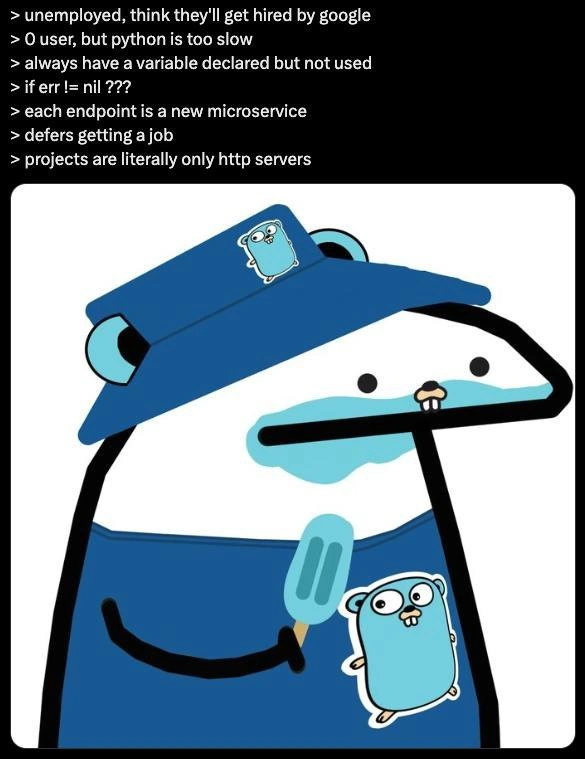
The format of the text at the top is 4chan-style greentext. On forums like 4chan, putting a > at the start of a line turns it green and is used to quote or narrate stories in a sarcastic tone. Here each > line is a facet of the Go developer friend’s situation or behavior, described with irony. Now, let’s go through those lines one by one:
"> unemployed, think they'll get hired by google": The friend doesn’t have a job, yet they are confident that their skills will land them a job at Google. Google is a dream employer for many programmers. The joke is that merely liking Google’s technology (like Go, which was made at Google) or building complex projects isn’t a guarantee of being hired. It pokes fun at a bit of delusion or naive optimism. Many newbies dream of being at Google, but here the friend isn’t focusing on basics like getting any job – they’re holding out for the tech giant while tinkering with personal projects.
"> 0 user, but python is too slow": This line says the friend’s project has zero users, but they claim “Python is too slow” for it. Python is a programming language known for being easy to write but not the fastest at runtime. Go is much faster in execution. The humor is that with zero users, performance doesn’t actually matter at all – there’s no traffic to be “slow.” Yet the friend chose Go over Python citing speed. This is a classic case of premature optimization: worrying about speed or scalability before there’s any need for it. It’s like tuning a race car engine while it’s still in the garage with no races planned. For a beginner, using Go instead of Python might just be an excuse to play with a new language or to feel more “professional,” even though realistically Python would work fine until the project becomes popular (which might never happen).
"> always have a variable declared but not used": In Go, if you create a variable and don’t end up using it in your code, the compiler will throw an error and refuse to build the program. For example, if you wrote:
func example() { err := doSomething() // if we never use err or check it, this is a compile error in Go }Go would complain that
erris declared and not used. This meme line jokes that the friend always has such unused variables. It suggests they often write skeleton code or start implementing something but never finish using the variables they set up. Maybe they copy-pasted some boilerplate for all 47 microservices and each one has variables that are left hanging. It’s a beginner mistake or a sign of sloppy coding. People familiar with Go recognize this immediately because they’ve had to fix that error. It’s funny because it paints the picture that this self-proclaimed sophisticated developer is still tripping over basic Go compile rules."> if err != nil ???": This is showing the friend’s confusion about Go’s error handling.
if err != nilis a common snippet in Go that means “if an error occurred, do something (like return or log it).” In Go, functions often return anerrortype as their last return value. You’re supposed to check that right away. For example:result, err := someOperation() if err != nil { return err // handle the error, perhaps by returning or logging } // use result if no errorThe
???in the meme implies the friend might be unsure what to do when an error happens, or is just frustrated by writing this repeatedly. It’s making fun of Go’s explicit error handling – unlike languages with exceptions where errors might bubble up automatically, in Go you manually check errors constantly. New Go devs sometimes find this verbose or tedious ("Why do I have to write if err != nil every other line?"). Those in on the joke understand that this is just how coding in Go is, and you eventually get used to it. The friend’s confusion suggests they are copying the pattern without fully appreciating it, which undermines their bragging about being advanced."> each endpoint is a new microservice": Microservices are an architecture style where instead of one big application (a monolith), you have many tiny services, each responsible for one thing, communicating with each other (usually over a network). An "endpoint" typically means one URL or route in a web server (for instance,
/loginor/getUserData). Usually, one service can handle many endpoints. But this friend made each endpoint its own service – that’s extreme. For a concrete example, imagine a simple app that has a user sign-up, login, profile, and logout. In a normal design, one server application would have endpoints for each of those actions. In the friend’s design, there might be a separate “SignUp Service”, “Login Service”, “Profile Service”, and “Logout Service” – four different programs, possibly each running on its own port or container. And they’d call each other or the front-end would call them separately. This is over-engineering because it complicates things a lot: you now have four deployments to manage, four codebases maybe, and they have to talk over the network instead of simple function calls internally. Doing this for every endpoint (and having 47 of them) is ridiculously inefficient for a project with no users. The joke highlights that the friend is applying enterprise-scale architecture (used by big companies with huge systems) to a tiny project. It’s like using a separate pizza oven for each slice of pizza you want to bake – technically you can, but it’s unnecessary and exhausting to maintain."> defers getting a job": This is a play on words with the Go keyword
defer. In everyday language, to defer means to delay or postpone. In Go,deferis used to postpone a function call until later (usually the end of the current function). For instance:file, _ := os.Open("data.txt") defer file.Close() // this will close the file when the function returnsIt’s a handy feature to ensure cleanup code runs. The meme uses "defers getting a job" to humorously say the friend is postponing finding employment. They are so occupied with their elaborate project that they keep pushing off the job hunt. It’s funny because it’s probably true – this person is spending all their time perfecting a project that has no users, instead of, say, working on their resume or applying for jobs. It also subtly jabs at the friend’s maybe misguided confidence: they might be thinking “once Google sees what I built, they’ll hire me,” so they defer a regular job in the meantime. The pun works especially for those who know Go; it’s combining coding terminology with real life in a witty way.
"> projects are literally only http servers": This means that all the friend’s programming projects boil down to HTTP servers – basically web service backends that listen for web requests and respond, without doing much else. “Literally only HTTP servers” implies there’s no complexity like data processing, algorithms, or interesting features in these projects – they are just frameworks waiting for users to call them. Perhaps each microservice the friend made is just a stub: it starts up, listens on a port, has endpoints defined, but maybe returns a fixed message or something trivial. In other words, he hasn't built a functional application (like something useful or user-facing); he’s just built the plumbing (the network and server part) 47 times over. For someone boasting about their system, it’s humorous because it’s all scaffolding and no content. It’s as if a chef bragged about having 47 ovens but hasn’t cooked any actual dish in them.
Now, consider the image below the text: it’s the Go gopher character drawn in a style used for meme characters (Wojak style, which often portrays a simplistic, goofy human face). The gopher is wearing a blue cap and apron emblazoned with the Go mascot – kind of like a uniform – and holding a pale-blue popsicle. The gopher’s expression has tired, half-open eyes and a drooping mouth, which artists use to depict someone who is clueless or in their own world, yet oddly confident. This visual tells a story: the friend is all decked out in Go merchandise, as if they are the ultimate Go fan or employee (the cap and apron make it look like he’s working at a "Go shop"), and he’s casually enjoying a popsicle. It adds to the idea that this character is a bit oblivious – happily confident in his setup, but somewhat naive. The popsicle might just be there for a silly, innocent vibe (and matches Go’s blue theme). Overall, the image amplifies the joke: the gopher looks like a wannabe professional who doesn’t realize how absurd his situation is.
To sum up, this meme is a mix of Go language in-jokes and general tech humor about over-engineering. It resonates with backend developers because:
- It references specific Go quirks like
if err != nilchecks and the unused variable compile error, which are daily realities when coding in Go. - It mocks the trend of building many microservices just for the sake of it, a trap that even real companies can fall into, let alone an individual hobbyist.
- It points out the irony of focusing on tech stack and performance (Go vs Python) without having any actual users or a real product – something juniors might do when excited about new technology.
In essence, anyone who has worked on software can recognize the exaggerated scenario: a friend making something far more complicated than it needs to be and feeling proud of it, while missing the practical point. The meme is funny because it’s true enough to be recognizable and ridiculous enough to make us grin.
Level 3: Resume-Driven Development
From a senior developer’s perspective, this meme nails a very relatable dev experience: the friend who over-engineers projects in hopes of landing a big job. We’ve all seen (or been) that person who builds a cathedral for a project that’s the size of a sandbox. The phrase "resume-driven development" comes to mind – choosing technologies and architectural patterns not because the project needs them, but because they look impressive on a CV or GitHub. Here, our Go enthusiast has spun up 47 microservices, bragging about a super scalable backend architecture, yet has 0 users actually using the system. It’s a hilarious skewering of misplaced priorities: instead of starting with a simple solution and finding users or a real use-case, they jumped straight into complex MicroserviceArchitecture because it’s the hot thing in backend development and sounds impressive during meetups or job interviews.
Each line of the green text is dripping with sarcasm that seasoned developers immediately recognize:
"> unemployed, think they'll get hired by google" – This sets the scene. The friend is currently jobless but fantasizing that their skills will land them a job at Google. Google hiring is famously tough and looks for solid fundamentals and impact, not just buzzwords. The joke implies a delusion: the friend equates fiddling with Google’s open-source tech (like Go and Kubernetes-style microservices) with being qualified to work at Google. It’s a gentle jab at the Google_hiring_dream many newbies have, thinking mastering a trendy language or tool will automatically make them Googlers.
"> 0 user, but python is too slow" – A classic case of premature optimization that every experienced dev can chuckle at. The friend has literally no users, but has already dismissed an easy solution like Python for performance reasons. It suggests they rewrote or built their project in Go because “Python is too slow,” even though with zero (or even just a few) users, Python’s speed would be more than sufficient. This is common in tech humor: new developers often worry about efficiency long before it matters. A senior engineer knows you should first make something people want; if you ever get thousands of users and hit performance bottlenecks, then you optimize or consider faster tech. By lampooning Python as “too slow” in an empty system, the meme points out the absurdity of using performance as an argument when there’s no load. It highlights the friend’s priorities are skewed toward technology choices over actual user needs.
"> always have a variable declared but not used" – Every Go programmer remembers encountering the compiler error about unused variables. In Go, if you declare a variable (e.g.,
x := 5) and never usexin your code, the program won’t compile. Seasoned devs understand this is a feature to keep the code tidy and bug-free – it forces you to remove or utilize leftover code instead of leaving it orphaned (which could be a sign of a mistake or forgotten logic). The meme jokes that this friend “always” has an unused variable, implying they frequently start implementing something or copy-paste code but never finish or utilize it. Perhaps they declared an error variable or a response object in every microservice endpoint template, but half of those services don’t actually do anything with them yet. It’s a subtle roast of their coding style: lots of scaffolding, not much substance. People familiar with Go recognize this immediately because they’ve had to fix that error. It’s funny because it paints the picture that this self-proclaimed sophisticated developer is still tripping over basic Go compile rules."> if err != nil ???" – This references the idiomatic error handling in Go. The friend is apparently confused or annoyed by repeatedly writing
if err != nil { ... }after every function call that returns an error. A seasoned Go developer accepts this pattern as normal (if verbose) and important: it forces you to handle errors at each step. However, the friend’s “???” suggests bewilderment – maybe they’re new to Go and find it tedious, or they include the checks without truly understanding how to handle errors (maybe they just print them and continue, which is bad practice). The humor here is twofold: one, it’s poking at Go’s well-known verbosity in error handling (something many backend Go devs joke about), and two, it’s showing that our friend might be cargo-culting code (writing theif err != nileverywhere because that’s what Go tutorials do, but not necessarily thinking through error management). The senior perspective knows that robust error handling is crucial in backend services – if you ignore those nil checks or do them wrong, your service will crash or misbehave. The “???“ hints the friend might not fully grasp this, making all those microservices pretty brittle in reality. It’s a nod to BackendHumor: only in programming do we find jokes about writingif error not nildozens of times funny, because we’ve lived it."> each endpoint is a new microservice" – Here’s the core of the microservice satire. The friend has taken the idea of “micro” services to an extreme, treating each API endpoint as its own service. In a normal design, especially for a small app, you’d likely have a single service (or a few services by domain) serving multiple endpoints (routes). Splitting every endpoint into its own service means you might have something absurd like a “login service” separate from a “logout service” separate from a “profile info service,” even if they all logically belong to one user-auth system. It’s architectural overkill. The experienced dev reading this immediately thinks: imagine the deployment and coordination headache! They’d need 47 different servers or containers, each hosting a tiny piece of what could have been one server. This line satirizes the misunderstanding of microservice architecture – it’s not about slicing things as thin as possible for bragging rights. Without careful boundaries, you end up with a distributed monolith (tons of services that still depend heavily on each other or the same data, just harder to maintain). We find it funny because we’ve seen management or inexperienced architects do something similar: breaking things apart without a good reason, then struggling with integration, network issues, and duplication of effort across services. It also hints that the friend is chasing quantity over quality (“47 microservices!” sounds impressive as a number, as if each endpoint had to be its own project).
"> defers getting a job" – As soon as a Go programmer sees the word "defers" here, it jumps out as a pun.
deferis Go’s keyword to postpone execution of a function until a return, and here the friend is literally deferring the real-world task of job hunting. The senior perspective might chuckle at how accurately this describes some passionate hobbyist developers: so absorbed in their pet project that they postpone real life commitments. It’s a little tongue-in-cheek life advice wrapped in code humor – perhaps the friend should stop “deferring” and handle that particular “error” condition (i.e., unemployment) now rather than later. The pun works on the technical level (you’d say "deferring a cleanup function" in code) and on a personal level (the friend delays getting a job). Many reading this have balanced jobs vs. side projects, and know the trap of endlessly tweaking personal code in lieu of job applications or actual work. The joke lands because it’s true: you can’t just calldefer getJob()in real life and hope it’ll be taken care of automatically when your function (project) ends!"> projects are literally only http servers" – This line mocks the lack of real functionality in those projects. If all 47 microservices are essentially just HTTP servers, it implies they might not have significant logic beyond setting up routes and maybe returning “Hello, World!” or simple JSON responses. It’s a jab at the friend’s projects being all infrastructure, no product. The senior dev sees this and thinks, “Ah, they’ve made a bunch of skeleton services with fancy endpoints, but there’s no business logic, no real features or data model behind them.” In other words, the friend is great at spinning up new Go web servers (one of Go’s strengths is how easy it is to start an HTTP server), but hasn’t actually built something useful on top of that. This is common early in a backend developer’s journey: one might learn to create a server for each idea, but all those servers do basically the same trivial thing. It’s funny in contrast to the grandiose “47 microservices” claim – sure, there are many services, but each is almost empty or identical, serving perhaps a ping endpoint or a static response. It emphasizes the over-engineering: the friend is focusing on quantity of services rather than depth of functionality or having actual users.
All these points reflect a gap between textbook best practices and the reality of what’s necessary. The friend is effectively cosplaying as a senior Google engineer: using Go, obsessing over speed, building microservices everywhere. But a veteran developer reading this knows that if you truly had a system requiring 47 microservices, you’d also have a ton of challenges the friend isn’t even aware of – database sharding, eventual consistency, monitoring dashboards, on-call rotations for when those services fail at 3 AM, you name it. The friend has built a tiny empire of HTTP servers that no one is using, and yet brags as if they’ve architected the next Google-scale infrastructure. It’s both comical and a little endearing – we see a younger developer’s clueless confidence (perfectly captured by the wide-eyed Go gopher Wojak in the image). Seasoned devs laugh because we remember having that confidence before reality humbled us, or we’ve had teammates like this who dream big but skip steps.
The image of the gopher (the Go mascot) drawn in Wojak style wearing a Go-branded cap and apron adds to the humor from an experienced viewpoint. The gopher looks goofy and a bit bedraggled (those tired eyes!), which is how a veteran might view someone who’s been grinding on unnecessary microservices for days without real progress. The apron and the little pale-blue popsicle give the character a naive, almost childlike demeanor – like a kid playing dress-up at being a “professional Go developer”. It subtly hints that the friend might be kitted out with all the Go swag and cool tech, but ultimately, they’re just playing at being an engineer rather than solving real problems. The Backend developer community often uses the Go gopher in memes, and dressing it like this is a comical way to say, “Here’s a Go fanboy who is in over his head.”
In summary, from the senior angle, the meme is poking fun at over-engineering and misplaced priorities. It’s an inside joke among developers:
- Build something simple that works before you brag about scale.
- Don’t split your project into microservices until you’re dealing with the kind of complexity that truly demands it (often, you ain't gonna need it – a principle known as YAGNI).
- Focus on making something people actually use; otherwise all the fancy tech in the world is just for show.
It’s DeveloperHumor 101: recognizing the patterns of enthusiastic but inexperienced devs. We laugh a bit at the friend’s expense, but also empathetically, because many of us have had that phase of learning where we tried to use every new tool just because it was cool. It’s a cautionary chuckle that reminds us how easy it is to lose sight of delivering value when we get too caught up in architecture astronautics.
Level 4: Premature Scalability
At the deepest technical level, this meme ridicules the overzealous application of microservice architecture without any real need – a textbook case of premature scalability. In distributed systems theory, microservices are meant to solve problems of scale, team autonomy, and fault isolation that arise when you have numerous users and large, complex applications. Each microservice is a self-contained process (often running in its own container) handling a distinct part of a system. This design introduces all the intricacies of distributed computing: network communication overhead, data consistency challenges (think CAP theorem trade-offs between consistency and availability), and the need for robust orchestration and monitoring. Usually, these complexities are justified only when a system has to serve massive traffic or be developed by many independent teams.
In the meme, the Go developer friend proudly touts "47 microservices" for a project that has zero users. From a seasoned architect’s perspective, this is an absurd inversion of normal priorities. Conway's Law famously states that system design mirrors the communication structure of the team – large companies like Google or Netflix break systems into many microservices because they have multiple teams and enormous workloads. Here, one person (with no users) has artificially fragmented a simple system into 47 pieces. The result is a distributed system with all the overhead and none of the benefits. Instead of a straightforward monolith (one cohesive program), the friend now must manage inter-service APIs, configuration for each service, and perhaps even containerization or service discovery – all for an application with no real traffic or complexity. It's like implementing a full Kubernetes cluster to run a personal to-do list app; technically impressive, but practically overkill.
This deep dive humorously highlights how accidental complexity can balloon when someone enthusiastically applies enterprise-scale patterns at the wrong scale. For example, with dozens of microservices, intra-service calls that could have been function calls become HTTP requests or RPC calls, adding latency and points of failure. If there were users, one might worry about latency, error propagation (if one service fails, others might go down in a cascade), and data consistency across services. But with zero users, these theoretical issues lie dormant; the friend isn't encountering the real hard parts of distributed systems (like partial failures or eventual consistency problems) because nothing is truly being used. The humor is that they’ve built a bulletproof distributed architecture to handle non-existent scale.
Even the programming language choice – Go (Golang) – nods to optimization before necessity. Go is designed by Google for building scalable, high-performance backend services. It excels in concurrency and efficient execution, often outperforming slower languages like Python in raw speed and throughput. However, when you have "0 user", any performance gains are purely academic. Choosing Go over Python because "Python is too slow" with no users is a comic case of premature optimization. Donald Knuth’s old adage “premature optimization is the root of all evil” echoes here: the friend fixated on speed and scale long before there’s a real problem to solve or audience to serve.
Interestingly, the meme also pokes fun at Go’s language quirks in an advanced context. The friend “always has a variable declared but not used” – a reference to Go’s strict compiler rules. In Go, unused local variables result in a compile-time error. This language design decision enforces code cleanliness and catches potential bugs (why allocate a variable and never use it? It might indicate a mistake or forgotten logic). It’s a sensible rule for large codebases: it prevents accumulated cruft and addresses things like forgotten error checks. However, here it’s played as a trope – our over-enthusiastic dev likely creates variables (perhaps planning complex logic that never materializes) and then leaves them unused, constantly fighting the compiler. It implies the friend writes more code structure than actual logic, a symptom of focusing on architecture over implementation.
Another advanced aspect is Go’s approach to error handling, hinted by the line “if err != nil ???”. In contrast to languages that use exceptions for error handling, Go famously encourages explicit error checking. Every time you call a function that might fail, you often get an error value back and have to write:
if err != nil {
// handle the error, maybe return or log it
}
over and over again. This explicit pattern is so pervasive that it's a running joke in the Go community; it results in verbose code but has the benefit of making error cases explicit at each step. The meme’s question marks convey a newbie’s perplexity or exasperation at repeating if err != nil ad nauseam. From a theoretical standpoint, handling errors inline like this avoids hidden control flow (no stack unwinding like exceptions) and keeps the programmer aware of every possible failure. But to someone boasting about microservices scale without actual experience, these repetitive checks might feel like noise – they haven’t yet realized that real systems spend a lot of code on error handling and edge cases.
Furthermore, the meme text “defers getting a job” is a clever play on Go’s defer statement in advanced usage. In Go, defer schedules a function to run later, usually for cleaning up resources when a function returns. It’s often used for things like defer file.Close() right after opening a file, ensuring the file will close when the surrounding function is done, no matter how it exits. It’s a powerful control flow feature to manage resources safely and reduce repetition in cleanup code. The joke here is on two levels: the friend is literally deferring (postponing) the act of job searching while tinkering with his projects, and he’s presumably enamored with the defer keyword itself. In a meta sense, he might be writing defer in his code to handle cleanup, while also deferring real-world responsibilities. This dual meaning is a nod that seasoned Go developers will smirk at – they know defer is not only a keyword but also an English word meaning "postpone". It’s a subtle linguistic joke packaged for those deep into programming culture.
All together, at this level, the humor emerges from recognizing the gap between world-class engineering practices and a hobby project’s actual needs. It’s a critique of architecture astronautics – implementing cutting-edge, industrial-strength patterns (47 microservices, strict Go conventions) in a context so small it’s laughable. There’s an implicit understanding of how complex and well-thought-out Go and microservices are supposed to be, and how mismatched it is to use them in this trivial, user-less scenario.
To put it in an absurd equation for the mathematically inclined:
$$
\text{Microservices per user} = \frac{47}{0} \to \infty
$$
The ratio of microservices-to-users is mathematically infinite (since dividing by zero users is undefined). That tongue-in-cheek formula underscores the ridiculousness: an infinite architecture for no customers. In essence, the meme tickles those who know backend architecture deeply – it's highlighting a situation that violates the fundamental principle of matching complexity to scale. The Go gopher decked out in full gear (cap, apron, and even a popsicle in hand) is the avatar of this over-engineered enthusiasm, proudly geared up with nowhere to go. This is tech humor at its finest: you laugh because, in theory, everything about the tech is right – microservices, Go concurrency, clean compile rules – but in practice, it's completely out of place.
Description
The image presents a 'Flork of Cows' meme character personifying the stereotype of a Go language enthusiast. The character is clad in a blue uniform and cap, both prominently featuring the Go Gopher mascot, and is holding a blue popsicle. Above the character, a 'greentext' list outlines their supposed traits: '> unemployed, think they'll get hired by google', '> 0 user, but python is too slow', '> always have a variable declared but not used', '> if err != nil ???', '> each endpoint is a new microservice', '> defers getting a job', '> projects are literally only http servers'. The humor satirizes the 'Gopher' subculture by portraying them as dogmatic about performance, obsessed with microservices, and blindly loyal to Go's verbose error handling ('if err != nil'). The clever pun 'defers getting a job' uses Go's 'defer' keyword to mock their perceived lack of real-world application, while the aspiration to work at Google (Go's birthplace) combined with unemployment highlights a disconnect between theoretical purity and practical success

Comments
7Comment deleted
Their entire career is a single goroutine with no select statement, just a blocking channel waiting for a Google offer letter that never arrives
go vet will flag an unused variable, but it won’t warn you that your 47-service Istio mesh is an unused product
The Go developer who spent six months building a "highly concurrent, zero-allocation HTTP router" for their blog that gets 3 visitors a month - all of them bots checking if WordPress is installed
The real red flag isn't the microservices or the unused variables - it's when a Go developer's entire GitHub is just variations of 'http.ListenAndServe' wrapped in enough boilerplate to justify rewriting it in Python. But hey, at least they're handling those errors... by questioning their entire existence with '???' every three lines
Only in Go does a contact form fan out into a dozen net/http services with perfect 'if err != nil' coverage - p99 optimized for zero users while the job search is deferred
Microservices: perfectly distributing your 'works on my machine' failures across 50 pods
Go dev roadmap: make every endpoint its own HTTP server, prove Python is “too slow” for 0 users, defer the job search, and if err != nil { start another microservice } while the Google interview goroutine blocks forever on a nil channel