The Evolution of Git Branch Names According to Pooh
Why is this VersionControl meme funny?
Level 1: The Fancy Name Game
Imagine you have a favorite teddy bear. At first, you just call it “Bear” – plain and simple. That’s like the old name “master” for the main code. Later on, you decide to give your bear a nicer name, so you call it “Mr. Bear” to sound a bit more proper – that’s like changing the name to “main,” a friendlier term. But then, just for fun, you go all out and start calling your bear “Sir Bearington Fluffypants the Third” in a playful, exaggerated voice. Now it’s super fancy and silly! 🤭
This meme is doing exactly that, but with the name of a coding branch. First it uses a normal name (“master”), then a more polite name (“main”), and finally a ridiculously fancy-silly name (“senpai uwu”) that makes people laugh. It’s funny because no matter how over-the-top the name gets, it’s still the same comfy old teddy (or in this case, the same code branch). The joke shows how we sometimes take a simple thing and give it fancier and fancier names just for giggles. In the end, it reminds us that a name can change, but the thing we’re naming is still the same – and making up wild names is a fun way to be creative and poke fun at ourselves.
Level 2: Default Branch Glow-up
Let’s break down the joke in simpler terms. In Git, which is a popular version control system, a branch is like a separate line of development in your code. One branch is usually the main line where all finished code ends up – traditionally, this default branch was called “master”. When you created a new repository (a new project) on GitHub before 2020, it would automatically name the primary branch “master”. That’s just how things were set up by convention.
However, around 2020, many people in tech started reconsidering some old terms to make sure they weren’t using words that could be hurtful or exclusionary. The word “master” can remind people of master/slave terminology, which is associated with slavery, so folks thought it would be more welcoming to use a different word for the main branch. GitHub and other communities chose “main” as the new term. So instead of saying “master branch,” we now say “main branch” for the default code line. Functionally it’s the same thing, just a different name. Changing a branch name in Git is easy technically (you can just run git branch -m master main to rename master to main), but it was a significant cultural move. It showed that the DevCommunity cares about the language it uses.
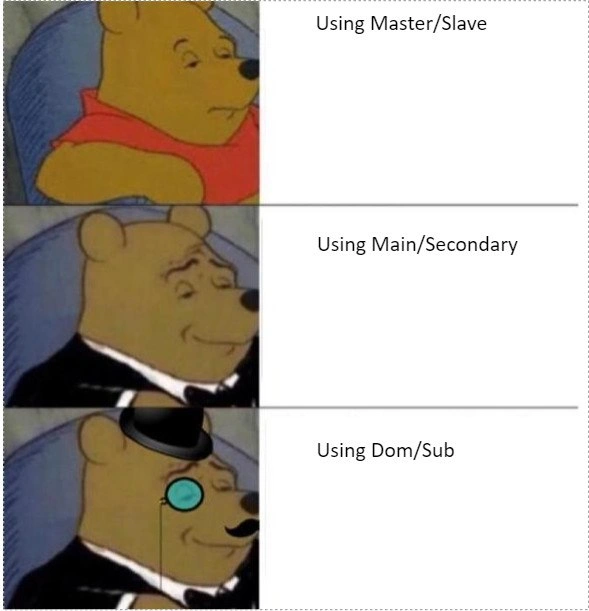
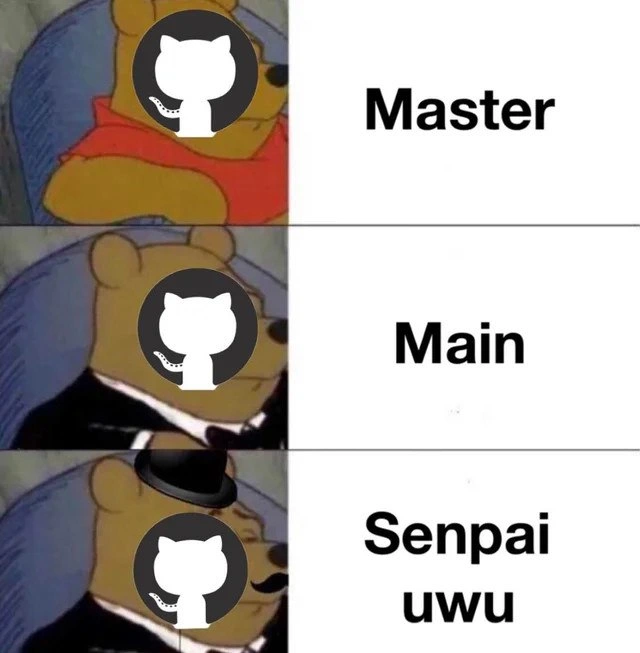
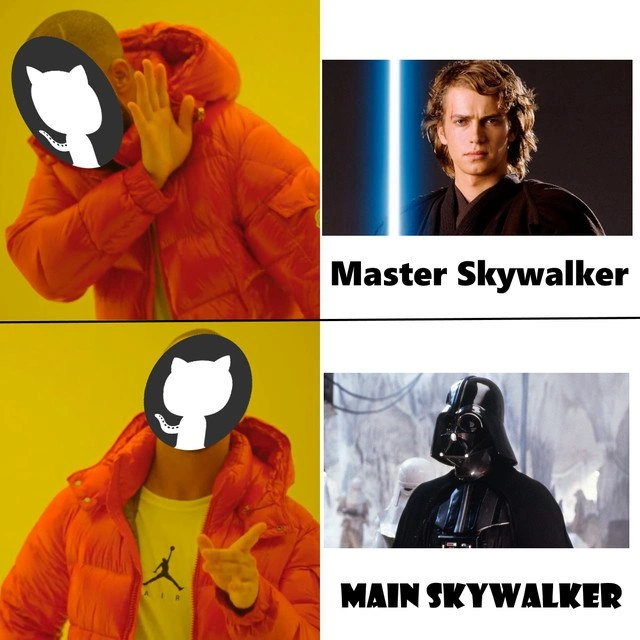
Now, the meme image uses a three-panel Winnie-the-Pooh format to illustrate this change in a humorous way. In each panel, Pooh Bear’s face has been replaced by the GitHub Octocat logo, effectively making Pooh represent GitHub (or generally developers using Git). In the first panel, Pooh is in his casual red shirt, looking indifferent, next to the word “Master.” This represents the old default branch name. It’s shown as the plain, baseline choice. In the second panel, Pooh is wearing a tuxedo and looking more smug, next to the word “Main.” The tuxedo signifies that “main” is seen as a more polished or modern choice — essentially, an upgrade over “master.” This aligns with how many developers felt that switching to “main” was a classier, more respectful move.
Then we hit the third panel, where the meme dials the silliness up: Pooh now has a top hat, monocle, and mustache (like an extremely aristocratic or high-class version of Pooh), and he’s labeled “Senpai uwu.” This is not an actual suggested branch name in real life — it’s a joke. The phrase “senpai uwu” is cobbled from internet and anime slang. “Senpai” is a Japanese word often used in anime/manga contexts to address someone you look up to (like an older mentor or a school senior). Fans online use it jokingly to sound overly deferential or affectionate. “uwu” is an emoticon representing a cute, happy face; it’s kind of like a playful emoji made out of letters, used to convey an adorably happy or smug expression. People often say “uwu” in a joking way to mimic a cute, innocent tone. So, slapping “senpai” together with “uwu” is deliberately crafting an over-the-top cutesy phrase. It’s something you might see in lighthearted online chatter, certainly not in serious technical documentation!
By putting “Senpai uwu” as a branch name, the meme-maker is being facetious — they took the idea of renaming the main branch and ran wildly with it to something absurd. The top hat and monocle on Pooh in this panel add to the absurdity: it’s like GitHub/Git has become so fancy and pretentious about branch names that it went into full parody mode. It implies, “We made ‘master’ more proper by calling it ‘main’… what if we went even further and got ridiculously fancy or trendy with it?” It’s exaggeration for comedic effect.
For someone newer to development: no, we’re not actually renaming the main branch to “senpai uwu”! 😂 This part of the meme is pure DeveloperHumor. It lampoons our habit of bike-shedding over names. (Bikeshedding means spending a lot of time on trivial decisions — the term comes from the idea of arguing over what color to paint a bike shed while bigger issues are ignored.) Choosing a branch name is relatively minor in the grand scheme of building software, but it’s easy to debate because everyone can chime in. So this meme suggests that after all the serious discussion of “master” vs “main,” developers might jokingly propose something crazy next, like an anime reference, just because. It’s making fun of how community discussions can sometimes spiral into the silly or extreme.
Also, it’s highlighting that naming conventions in tech can feel a bit like fashion trends or status symbols. “Master” was the norm, then “main” became the new norm (with an aura of being the better, modern choice). The meme pushes this to a ludicrous conclusion: maybe the ultimate elite choice would be a name so fancy and niche (like “senpai uwu”) that it’s complete nonsense. This is poking fun at us developers for sometimes trying too hard to be clever or unique with our naming. In reality, good naming conventions are about clarity and avoiding offense, but as a joke, why not veer into complete gibberish?
In terms of community reaction, this meme was born out of a mix of earnestness and playfulness. In 2020, when the branch renaming topic was hot, many devs were supportive, some were confused (“Does the computer care what the branch is called?” Answer: not really, it’s mostly for humans), and some joked about it just to relieve tension. Memes like this popped up in forums and chats as a way to say, “Yes, we see the point of changing to ‘main,’ but let’s also laugh at how much we fuss over something as simple as a name.” It reflects engineering_culture: part serious improvement of our practices, part endless joking about those very practices.
To sum up this middle level: The meme shows Git branch naming conventions evolving — from master (old default) to main (new default) to a completely jokey option (“senpai uwu”). It uses the Winnie-the-Pooh in a tuxedo meme format to visually emphasize how each step is seen as more “fancy” or self-important. For a junior dev or someone new to this, the key points are: Git’s main branch got renamed for inclusivity reasons, devs love to argue about naming things, and we also love to make fun of ourselves with silly memes. In practice, you’ll likely use “main” as your default branch name nowadays. And while you probably shouldn’t name your real branches “senpai” anything, seeing a joke like this is a rite of passage in the world of DeveloperMemes – it means you’re learning the code, and also the inside jokes that come with the culture! 😸
Level 3: Bikeshedding Branch Names
At the deepest level, this meme riffs on a GitHub culture shift and the perennial struggle of naming things in software. In mid-2020, the developer community grappled with a change in Git’s default branch naming: moving from “master” to “main” to promote more inclusive language. The first two panels of the meme reflect this real evolution. The word master (once the default branch in Git) appears next to a casual Pooh (with a red shirt), signaling the old convention. In the second panel, main is shown beside Pooh in a tuxedo—GitHub’s attempt at a “refined” default branch name for new repositories. This was a serious initiative in the VersionControl world: dropping problematic terminology and modernizing BranchingStrategy etiquette. Experienced devs see this and nod—yep, we lived through the big branch rename of 2020.
But then comes the punchline: the third panel’s “Senpai uwu”. Here, tuxedo Pooh has leveled up further with a monocle, top hat, and mustache, parodying an excessively fancy branch name. It’s an absurd, tongue-in-cheek escalation. Why that phrase? “Senpai” (先輩) is a Japanese honorific for someone senior or admired, popular in anime circles; uwu is an internet emoticon for a cutesy happy face. In developer meme culture, sprinkling in anime or gamer references is a way to crank the silliness up to 11. So “senpai uwu” as a branch name is deliberately over-the-top and completely impractical — no serious project would name their main branch that, which is exactly why it’s hilarious. The meme format (the tuxedo Winnie-the-Pooh progression) is a well-known template for showing increasing levels of sophistication or pretentiousness. By the final panel, GitHub’s Octocat-faced Pooh has gone from casual to elite aristocrat — and correspondingly, the branch name has jumped from a standard term to a ridiculously ornate meme name.
The humor here comes from juxtaposition and shared dev experience. On one hand, we have a real technical and social change — renaming “master” to “main” to foster inclusivity — something that sparked many heated discussions in dev communities (some earnest, some skeptical). On the other hand, the meme exaggerates the situation to satirize how developers can bikeshed endlessly about naming. Bikeshedding is that classic scenario where people argue over trivial issues (like what color to paint a bikeshed) while ignoring more important problems. In software, choosing naming conventions often becomes a bikeshed topic: everyone has an opinion, it’s easy to debate, and it sometimes devolves into holy wars over a word. By suggesting an outrageously silly branch name like “senpai uwu,” the meme pokes fun at the idea that if we keep fussing over the perfect name, we might end up with something utterly nonsensical. It’s essentially asking: After “main,” what’s next? Are we just trying to sound fancier for its own sake? The engineering_culture being lampooned is one where developers perform linguistic gymnastics to signal virtue or trendiness, possibly losing sight of the fact that, technically, you could name your main branch anything and your code would still run the same.
Yet, there’s another layer: many veteran devs will recall the maxim, “There are only two hard things in Computer Science: cache invalidation and naming things.” Naming is notoriously hard because it’s about communication and consensus, not just code. The NamingConventions and debates around them can consume inordinate time. By presenting “master” -> “main” as a sophistication upgrade (casual to tuxedo) and then leaping to a flamboyant anime phrase, the meme wryly comments on our tendency to overthink and over-engineer something as simple as a label. It resonates with senior engineers because it captures that mix of DevCommunity earnestness and absurdity: we earnestly improve terminology (that’s the tuxedo-level maturity), but we also can’t resist a good DeveloperHumor in the process (the monocle-level absurdity).
Behind the laughs, there’s a real historical context. Git’s default branch was named “master” since its creation by Linus Torvalds in 2005, likely derived from master copy (as in the main line of development), not explicitly from “master/slave.” However, by 2020, in the wake of social justice movements, the tech industry started scrubbing archaic or potentially offensive terms from documentation and code. GitHub_default_branch naming became a very visible part of this trend: GitHub announced in mid-2020 that new repos would default to “main” instead of “master.” This inclusive change was widely supported, but it did ignite debate (and a bit of eye-rolling in some circles about whether it was a priority). The meme captures the zeitgeist of that moment: it acknowledges “main” as the fancy new norm (hence Pooh dons a tux), and humorously suggests the community might one-up itself with something even more extravagant (Pooh with monocle declaring “senpai uwu”). It’s poking fun at DevCommunities that sometimes take a good idea and run ridiculously far with it.
Technically speaking, renaming the default branch is trivial from a VersionControl perspective—just a git branch -m command. Culturally, though, it was a big deal, requiring coordination across documentation, build scripts, and developer muscle memory. This mix of the trivial and the significant is fertile ground for memes. The BranchManagementStrategy itself isn’t impacted by the name (“main” or “master” still plays the same role), yet the symbolic change felt like an upgrade in values (hence the formal wear on Pooh). The meme exaggerates that feeling of upgrade to comedic effect. It suggests that some folks treat naming like an Ultimate Upgrade feature, almost a status symbol — and what better way to symbolize status than a monocle and top hat? The addition of ridiculous anime honorifics (senpai uwu) is a nod to how internet subcultures bleed into developer humor. It’s the meme saying: After we finish debating serious naming conventions, we’ll probably start suggesting something goofy from pop culture, because, well, we’re nerds and we can!
In summary, at this senior dev level, the meme is a witty commentary on engineering culture: it compresses a real inclusive language change, the communal tendency to bikeshed over naming, and the blending of dev professionalism with irreverent CodingHumor. It’s funny because it’s true (we did argue about “master” vs “main”), and it’s even funnier because it escalates to the absurd (thankfully, no one’s actually pushing “senpai uwu” as a standard… yet 😜).
Description
A three-panel meme using the 'Tuxedo Winnie the Pooh' format to satirize the changing conventions for the default branch name in Git. In all panels, Winnie the Pooh's face is replaced with the GitHub Octocat logo. The first panel shows the standard Pooh in his red shirt, next to the word 'Master', representing the original default branch name. The second panel features Pooh in a sophisticated tuxedo, next to the word 'Main', representing GitHub's updated, more inclusive default name. The third and final panel shows Pooh looking even more dapper with a tuxedo, a top hat, and a mustache, alongside the text 'Senpai uwu', an absurd and humorous escalation referencing anime culture. The meme pokes fun at the discourse surrounding the branch name change, presenting 'main' as a more refined choice than 'master', and then comically proposing a cringe-worthy, weeb-inspired name as the pinnacle of sophistication
Comments
7Comment deleted
The best part about renaming the default branch to 'Senpai uwu' is that every time a junior dev opens a pull request, they're forced to say 'Please notice me, Senpai.'
GitHub’s master→main switch took 30 seconds; untangling the Jenkinsfiles, Helm charts, and that one COBOL batch job still hard-wiring ‘senpai-uwu’ is our Q3 OKR
We spent three sprints bikeshedding the master-to-main migration, only to discover half the team had already been pushing to 'develop' for two years because Jenkins was hardcoded that way and nobody wanted to touch the groovy scripts
After GitHub's master-to-main migration, some teams discovered their CI/CD pipelines had hardcoded branch names in 47 different places, their deployment scripts broke in production, and three senior engineers spent a week updating documentation - only to realize the intern had already pushed to 'senpai-uwu' and somehow it passed all checks because nobody thought to validate branch naming conventions in the pre-commit hooks
Master got canceled, Main plays it safe, but Senpai uwu demands tribute merges or it's rebase oof
git branch -m was trivial; unraveling a decade of Jenkins/GitHub Actions filters, release regexes, and protection rules hardcoded to “master” was the project - pray no one bikesheds “senpai-uwu” into the protected pattern
Renaming master to main was easy; the incident was explaining why CI shipped from “senpai-uwu” to production - turns out our pipeline follows HEAD, not the naming committee