How QA Engineers Cross the Street
Why is this QA meme funny?
Level 1: Better Safe Than Sorry
Imagine you’re going to cross a street that is supposed to be safe because cars can only come from one direction. Your parent or friend taught you to look both ways anyway, left and right, just to be extra safe. That’s a bit like a careful programmer: even if a rule says “cars only come from the left,” they still check the right too, just in case something unexpected happens. It’s being better safe than sorry.
Now, picture you have another friend who is even more careful – almost like a superhero of caution. Before crossing, this friend not only looks left and right, but also looks up into the sky (to make sure nothing is falling, like maybe a piano from a cartoon or a flower pot from a windowsill!). They also look down at the ground (checking for any holes or banana peels they could slip on). They look straight ahead to see what’s on the other side of the street (maybe there’s a bike coming on the sidewalk). They even close their eyes for a second to imagine crossing as if they couldn’t see, just to be prepared for anything. It sounds kind of silly, right? You might giggle because who actually checks that much before taking a step!
But here’s the thing: that super-cautious friend is like a tester for software. Testers are people who try everything possible to make sure a new app or game works. They’ll do things nobody else would think of, just to see if the program can handle it. In the street example, our cautious friend even “messes with the clock” – meaning they pretend it’s a different time. Imagine them saying, “Let’s pretend it’s night time now, would I cross differently? What if it suddenly became yesterday or tomorrow?” This part is extra funny, because changing time like that is impossible in real life without a time machine! ⏰ But in the world of computers, a tester can actually trick a program into thinking the time has changed.
So why is this funny? Because the friend’s behavior is so over-the-top. We laugh at how absurd it is to check the sky for falling pianos or to pretend we can time-travel before crossing a road. It’s an extreme cartoon of being careful. However, it also makes us feel kind of glad that someone this careful exists! In real life, having a friend who is ultra-cautious might save you from that one-in-a-million accident. And in software, having testers who think of wild, crazy scenarios means the app you use is less likely to crash or have problems. We often say, “better safe than sorry,” and this meme is a fun way of showing just how far some people will go to be safe. It’s like having a friend who carries an umbrella every single day “just in case” – you might find it funny on sunny days, but you’ll definitely appreciate it when it rains!
Level 2: Edge Cases Everywhere
At its core, this meme uses a simple scenario—crossing a one-way street—to explain how programmers and testers think differently. In a one-way street, cars are only supposed to come from one direction. A typical person might just check the direction of oncoming traffic. But here, the programmer in the joke still looks both ways. Why? Because a good programmer is taught to never assume things won’t go wrong. This is an example of being extra cautious, like double-checking even when theoretically you shouldn’t need to. In coding, developers often add checks or error handling for conditions that are not supposed to happen, just in case something is misconfigured. For instance, if there’s a rule “users can only input numbers”, a careful programmer might still write code to handle the scenario where a letter sneaks through somehow. It’s like saying, “I trust the road is one-way, but I’ll verify anyway.”
Now, the QA (Quality Assurance) tester takes this to another level of thoroughness. Quality Assurance folks are responsible for testing software to find any bugs (problems or errors) before the product reaches real users. They think about all the edge cases – that means all the unusual or extreme situations that might break the software. The meme humorously shows this by saying the QA person doesn’t just look left and right; they look up, down, straight ahead, inward, and even close their eyes. These directions symbolize all the extra tests a QA might do:
- Looking up: checking if there’s some external problem that could happen. In a real street, that means maybe something falling from the sky. In software, think of something like an external service failing or a network disconnecting. A junior developer might not initially test what happens if the internet drops while uploading a file, but a QA will definitely try that scenario!
- Looking down: checking the ground or foundation. In computing terms, that could mean testing on different operating systems or devices (the foundation the program runs on). For example, “Does our app work on older Android phones or under low-memory conditions?” This is like ensuring the ground you’re standing on is solid.
- Looking straight ahead: making sure the path forward has no hazards. In an app, this can be testing the next steps in a sequence. Say you fill out a form (cross the street) – straight ahead is what happens when you submit that form. Does the next page load correctly? QA often goes step by step through user journeys to see if any step fails.
- Looking inwards: this one is a bit abstract, but you can think of it as checking inside oneself. For a tester, “inwards” might mean checking the internal state of the app or doing regression testing (verifying that new changes didn’t quietly break something that used to work). It’s like double-checking your own feelings or guts while crossing – in software, QA might peek at logs or internal error reports that aren’t visible to normal users. They want to catch issues that aren’t obvious on the surface.
- Closes his eyes: Why would anyone do that while crossing a street? In the meme it’s a funny exaggeration, but it represents testing under odd conditions – like a user doing something without looking, or using a screen reader, or maybe the app running when the screen is off. It’s a stand-in for “what if the normal visuals/assumptions aren’t there?” For example, a tester might try using the app with no internet, or try inputting data using voice commands only. It’s all about thinking outside the normal use case. Also, closing eyes might imply randomness — like moving through the app in a random, unexpected order just to see if something weird happens.
Finally, the meme mentions the QA “starts messing with the clock.” This is a classic tester move: change the system time or date to see how the software handles it. Time-related problems are common in software. Imagine a new programmer writing a calendar app – they might not remember to test what happens on leap day (February 29) or when the year changes from 2021 to 2022 at midnight. A QA engineer will test those things. They might set their computer’s date to December 31, 11:59 PM and see what happens at New Year. Or set the clock to a different time zone and launch the app to see if times and dates display correctly. They even check things like: if your software license expires tomorrow, what happens if I manually adjust my clock to next week? Does the app correctly realize the license is expired? These are edge cases that real users might encounter (or sometimes cause on purpose, like changing the date to get free lives in a mobile game – yes, testers think of that too!). By “messing with the clock”, QA can uncover bugs that only show up when time plays tricks – like an alarm not ringing due to daylight savings, or a file seen as “from the future” causing errors.
For someone early in their career, this meme is a lighthearted lesson: Test beyond the obvious. New developers often test the “happy path” – the scenario where everything is used correctly. But as you gain experience (or work with a great QA team), you learn to consider the weird stuff: what if the user inputs really large numbers? What if they use the app on February 29, or at 23:59 just before midnight? What if they put an emoji or a foreign character in their name? What if they yank the power cord out in the middle of saving a file? These might sound unlikely, but each is an example of an edge case that has caused real software bugs in the past. QA engineers are trained to be creative and a bit skeptical; they assume nothing is too strange to test. That’s why in the meme the QA person is basically doing things that sound absurd (like an astronaut-level of caution crossing a street). It’s exaggeration with a purpose: to show that good testers leave no stone unturned.
So if you’re new to development, the takeaway is to appreciate that QA mindset. It might feel like overkill at times (“really, you’re going to change the date to 1970 to test this?”), but guess what – users have a knack for doing unexpected things too, and the environment won’t always be perfect. The meme is telling you that a “good programmer” is careful, but a “good QA” is super careful. In practice, teams that cultivate a QA-style thinking in all members tend to catch more issues early. It’s a fun way to remember: always test your code as if someone might use it upside-down or in the wrong year! And if you have a QA team doing this, be thankful – they’re the ones making sure your software doesn’t crash when reality doesn’t match the ideal conditions.
Level 3: Expect the Unexpected
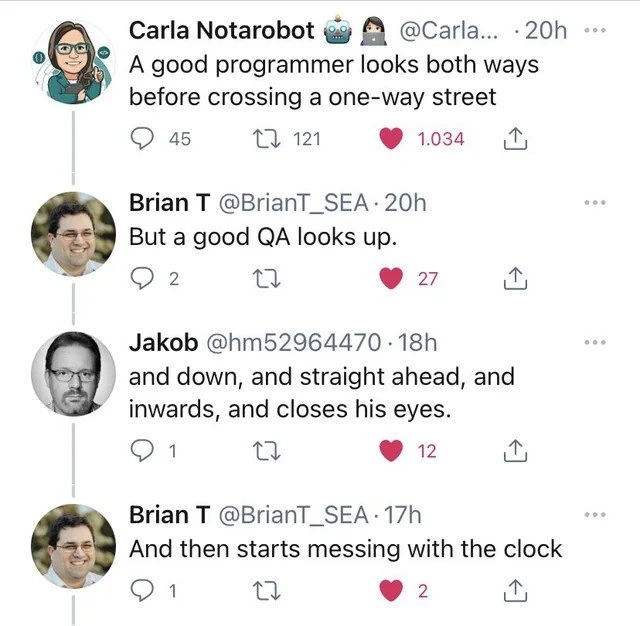
This meme hilariously highlights the contrasting mindsets of developers versus QA testers. The Twitter thread format sets up a witty escalation: each reply cranks up the paranoia to new heights, reflecting how QA will test scenarios that a developer might never even dream of. The initial tweet by Carla Notarobot says, “A good programmer looks both ways before crossing a one-way street.” This one-way street metaphor captures a classic programmer attitude: defensive programming. Even if traffic (or data flow) is supposed to come only from one direction, a prudent developer still checks both ways. In software terms, that’s like double-checking an input that “should never be wrong” or handling an error case that “shouldn’t happen.” It’s a nod to cautious coding practices, where a developer anticipates that specifications or environments might lie. (Think of a function that’s only supposed to get positive numbers, but a careful dev still writes an if (number < 0) check just in case.)
Brian T’s reply raises the stakes: “But a good QA looks up.” This is where the QA vs programmer perspective kicks in. If the developer is cautious, the tester is outright paranoid – in a good way. Looking up when crossing a street is comically over-cautious; it implies worrying about dangers outside the normal plane, like a piano falling from the sky (a classic cartoon catastrophe 😄). In software, “looking up” means considering external or unconventional factors. A good QA engineer asks, “What else could go wrong beyond the obvious?” For example, if the app is a web service, a developer might test valid and invalid inputs, but a QA will also test things like a sudden loss of network (something literally out of the blue, akin to a thunderbolt from the sky). They might check if a server gives a weird response, or if the user’s device is set to an odd locale. This is edge case handling in action: testers shine at thinking of bizarre scenarios that fall outside the happy path.
Then Jakob’s reply humorously adds: “and down, and straight ahead, and inwards, and closes his eyes.” Each direction here symbolizes another layer of thorough testing:
- Down: Perhaps checking the ground right under your feet. In tech, this could mean verifying the platform or environment itself. Is the operating system or hardware causing any hidden issue? Did the file system run out of space? A QA might even check logs or lower-level data (the “ground truth”) to see if something is amiss. It’s like testing for a trapdoor or sinkhole in that one-way road – unlikely, but if it exists, QA will find it.
- Straight ahead: This suggests looking where you’re going – ensuring the path forward is clear. For software, it means testers verify the end-to-end flow. Does the next step after crossing (like the next screen or subsequent operation) behave correctly? It’s not enough that you survive the street; what if there’s another hazard right beyond it? QA thinks about the whole user journey, not just one interaction.
- Inwards: This one is a bit abstract, but it hints at introspection. A tester might “look inward” by examining the internal state of the application. For instance, after a complex operation, they might inspect memory usage or internal variables (via logs or debugging tools) to catch any silent errors. Maybe the app didn’t crash outwardly, but did it set some wrong state internally? It’s like checking your own heartbeat while crossing – is everything okay on the inside? A senior tester knows a program can appear fine externally while things are broken internally, leading to bugs later (kind of like walking away from the street unscathed, but with a sprained ankle you didn’t notice 😜).
- Closes his eyes: Imagine testing what happens if the user isn’t even watching. This could represent simulating user inattention or unexpected input timing. In practice, a QA might run tests with the screen off, or the app in the background, or simulate a user doing something blindly (pressing the wrong button by accident). It’s a playful way to say a good tester even tries ridiculous scenarios—like using the app in complete darkness or with no visual feedback—just to see if it fails gracefully. There’s also an element of chaos testing here: deliberately doing things in the “wrong” way. Closing eyes might also imply randomness: the QA isn’t following the normal script, they’re clicking around aimlessly to see if they can break something. Many of us have seen a tester do things with our software where we exclaim, “Why would anyone ever do that?” — yet those wild actions often uncover the most interesting bugs!
Finally, Brian T caps it off with: “And then starts messing with the clock.” This line takes the cake, referencing one of QA’s most powerful secret weapons: temporal testing. It’s the ultimate “expect the unexpected” move. Changing the system time can expose issues that no amount of normal clicking around would find. For example, a QA might shift the date to tomorrow, next week, or 30 years ahead. Why? Perhaps to see if a bug appears when a certificate becomes invalid or when the year changes. Maybe the application has a trial period that should expire, or it might not know how to handle February 29 when leap year comes. Testers will also check edge times like 23:59:59 turning into 00:00:00, or what happens when daylight savings time shifts clocks backward by an hour (a real nightmare for scheduling logic!). Regular developers sometimes forget these odd cases, focusing on core functionality, whereas a tester lives to uncover them. The quip about “messing with the clock” also pokes fun at how QA engineers can seem almost magical or devious: it’s akin to them bending reality (“rewinding time”) to break the code. Many developers have that half-admiring, half-terrified feeling towards a thorough QA who finds bugs by doing things like changing time zones mid-use or setting the device clock to 1970 (which, fun fact, on Unix systems is the epoch start and can cause weird behavior 🕑).
In essence, this Twitter thread is testing humor that every dev team can relate to:
- Developers often test the expected conditions (checking both ways on a one-way, just to be safe). They’re optimistic but a bit cautious, trying to ensure their code works in the scenarios they can foresee.
- QA testers test everything else (looking up, down, around, and beyond). They’re deliberately pessimistic, assuming nothing can be trusted— not even time itself! This “paranoia” isn’t negative; it’s a professional skill in QA process. It’s how we catch those one-in-a-million issues before real users do.
The humor lands so well because it’s built on truth: developers might chuckle and shake their heads remembering how QA broke their “pretty good” feature with a bizarre test. And QA folks laugh because, well, this is literally their job. The meme acknowledges the indispensable role of QA in bug fixing and quality control. It’s essentially saying: a developer with good habits will catch many problems (look both ways), but a great QA will catch the rest by imagining pianos falling from the sky and clocks going haywire. No stone (or sky, or timeline) is left unturned. The result? Fewer surprises in production. As the saying goes in testing circles, “Nothing breaks a developer’s code faster than the creative curiosity of a QA.” This meme playfully celebrates that dynamic, with each line of the thread upping the ante just like a tester upping the rigor of a test plan. By the end, we’re picturing QA as this all-seeing, time-bending guardian against bugs in software — and that’s both funny and kind of awesome.
Level 4: Temporal Torture Testing
When the QA starts messing with the clock, we’ve entered the realm of temporal edge-case handling. Time is a notoriously tricky dimension in computing—so tricky that seasoned engineers swap war stories about date bugs. Changing a system’s clock can expose deep, hidden issues in software logic. For example, many programs assume time only ever moves forwards. If a tester sets the clock backward (say from 2022 back to 2021), suddenly all those assumptions break: scheduled tasks might run twice, security tokens could become “valid” again, or caches might never expire. Conversely, leaping the clock forward can cause missed events or bugs like negative durations (imagine an event ending before it starts because the clock jumped ahead!).
This isn’t just theoretical—time-related failures have real history behind them. The infamous Y2K bug was essentially a time bug (where the year 2000 wasn’t handled correctly). There’s also the Year 2038 problem in Unix systems, where time values overflow a 32-bit integer. Testers who think ahead will simulate these scenarios years or decades early. It’s a QA tradition to set clocks to December 31 or leap-day February 29 to catch date-handling mistakes. In fact, robust systems distinguish between a monotonic clock (steady tick for measuring intervals) and the real-time clock (wall-clock time) specifically because time can jump or shift (think daylight savings or manual changes). A good QA knows that an app oblivious to these nuances might crash or corrupt data when the unexpected happens. By deliberately warping time—like accelerating to next year or rolling back an hour—a tester is effectively performing torture testing on the timeline of the app. They’re unveiling race conditions, expired certificate issues, or temporal bugs lurking in code. It’s a sophisticated, almost scientific approach: treat time as just another variable to twist, much like a physicist probing the limits of a system. The meme’s final line about “messing with the clock” nods to this advanced QA technique: it’s a humorous exaggeration (imagining QA as time-travelers) grounded in very real QA practices. After all, if your software can survive a QA time-travel experiment, it’s probably ready for anything reality throws at it.
Description
A screenshot of a humorous Twitter thread that contrasts the mindsets of programmers and QA engineers using a metaphor. The first tweet by Carla Notarobot states, 'A good programmer looks both ways before crossing a one-way street,' illustrating defensive coding. Brian T replies, 'But a good QA looks up,' suggesting QA tests for the unexpected. Jakob expands on this, saying a QA also looks 'down, and straight ahead, and inwards, and closes his eyes.' The final reply from Brian T adds, 'And then starts messing with the clock,' a direct reference to a common QA technique of changing the system time to uncover time-sensitive bugs. The thread perfectly captures the developer's cautious approach versus the QA engineer's mandate to explore every improbable, illogical, and dimension-bending failure scenario
Comments
7Comment deleted
A dev will test if the street is null. A QA engineer will set the system date to the Jurassic period and see if a dinosaur crosses it first
Developer: “Relax, it’s a one-way street.” Senior QA sets the clock to 03:14:07 UTC Jan 19 2038, inserts a leap second, switches locale to Kathmandu, and waits for the convoy of “impossible” traffic
The real senior QA engineer would also test it during daylight savings time transition, in a different timezone, while the street is being renamed in the database, and with a user who has admin privileges to make it a two-way street mid-crossing
This perfectly captures the eternal dance between developers and QA: developers write code that works in the happy path, while QA engineers are professionally paranoid enough to test what happens when users run the app on February 29th at 23:59:59 UTC while their system clock is set to 1970, the network is flaky, and they're holding their phone upside down. The 'messing with the clock' comment is especially on point - time-based bugs are the gift that keeps on giving, from leap seconds to timezone DST transitions to NTP drift. A senior engineer knows that if your test suite doesn't include time manipulation, you're just waiting for production to become your QA environment at 2 AM on a Sunday
Real QA “looks up” by setting the node to 2038, adding a leap second, and seeing which service used wall clock for timeouts instead of a monotonic clock
A good dev looks both ways on a one‑way street; a great QA kills NTP, jumps the clock over a DST boundary, and files a P0: “Crosswalk uses wall‑clock instead of monotonic time - cars time‑travel.”
Programmer: O(1) both-ways check. QA: Brute-force every dimension, including clock skew in prod