Skip to content
DevMeme
1795 of 7435
A C++ Family Portrait: From Stack Variables to Immortal Hardware
Languages Post #2002, on Sep 3, 2020 in TG

A C++ Family Portrait: From Stack Variables to Immortal Hardware

Why is this Languages meme funny?

Level 1: Cleaning Up Your Toys

Imagine you’re playing with different kinds of toys and each toy has a rule about how it gets put away:

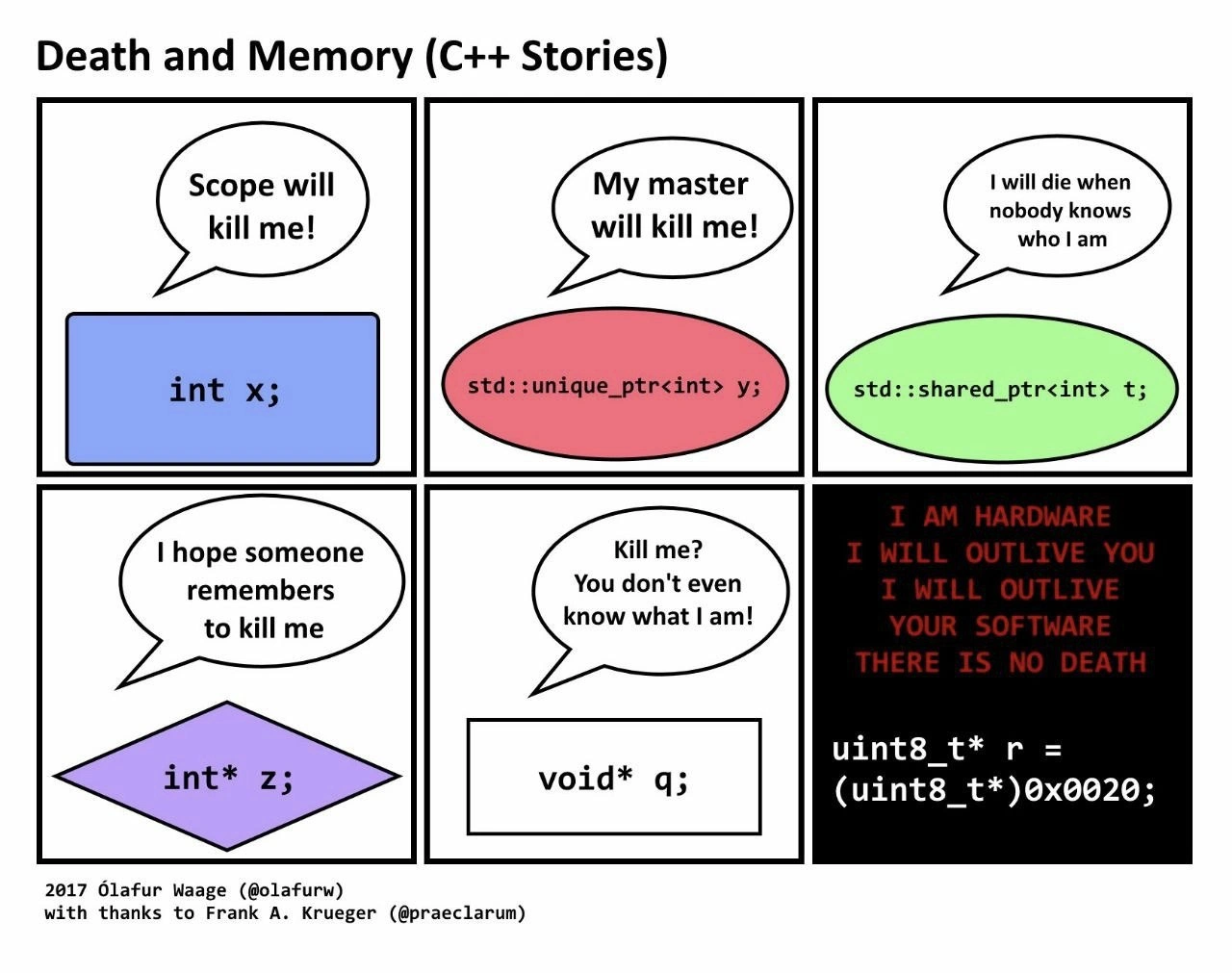
  • First toy is like a ball you only play with inside a small play area. As soon as playtime in that little area is over, the ball magically returns to the toy box by itself. You don’t have to do anything — when you leave the play area, poof, the ball is back on the shelf. This is like the local variable int x that disappears on its own when you leave the function. Easy cleanup.

  • Second toy is one special toy that only you are allowed to play with. When you’re done playing and leave, you are responsible for putting that one toy away immediately. In fact, you always do, because you know you’re the only one who will clean it up. This is like a std::unique_ptr owning a piece of memory: it makes sure to clean up exactly when the one owner (you) is done. It’s like a rule: "if I took it out, I put it back."

  • Third toy is a game that a group of friends are playing together. The rule here is the game stays out until the last person is done playing. So if 3 friends are playing and 2 go home, one friend is still playing, the game isn’t cleaned up yet. Only when the final friend leaves do we pack the game up into the box. This is like std::shared_ptr: as long as someone still "knows" or is using the toy, it stays around. When nobody is left with the toy, it gets put away. It ensures the toy isn’t accidentally put away while someone is still using it.

  • Fourth toy is something you pulled out to play, but there’s no set rule or person to clean it up. Maybe you or maybe your sibling will remember, or maybe... uh oh, everyone forgot and it’s still on the floor. That’s the raw pointer case: if no one cleans up, the toy (memory) just stays lost under the couch. It’s like when you have to clean your room yourself — if you forget, mom might later find a mess. In computer terms, that forgotten toy is a memory leak: memory that never got cleaned up because the program forgot.

  • Fifth toy is a mystery box. You took it out, but you’re not even sure what toy is inside or which shelf it’s supposed to go back to. You definitely can’t ask someone else to put it away because they wouldn’t know where it belongs either. This is the void* scenario: without knowing what something is, it’s hard to clean it up properly. It’s as if you have a piece of something and you’re like, "I don’t even know what this is or where it goes!" You’d have to open the box and figure it out (like casting to the right type) before you can put it away correctly.

  • Sixth and final: a huge boulder in the playground. It was never in your toy box at all; it’s part of the playground. You can push it or climb on it, but when playtime is over, you just leave it there. It’s not your job to carry it home or put it on a shelf — it’s going to be there tomorrow and the day after. This is the hardware memory. The program can use it (like writing to that special address might turn something on), but when the program is done, that hardware (the boulder) stays put. There’s effectively no "cleaning up" by the program that makes it vanish.

In the meme, each of these "toys" talks about how it gets cleaned up or if it worries about not being cleaned up. It’s funny because they’re acting like they're alive and concerned about being left out or taken away. But behind the humor is a lesson: just like toys, some things in a computer are cleaned up automatically, some you must clean up yourself, and some aren’t yours to clean at all. The last panel with the hardware is like the boulder saying in a deep booming voice, "I will still be here long after you’re gone!" — which is a silly way to show that hardware doesn’t disappear when your program does. The joke makes the scary topic of C++ memory management a bit more lighthearted and easier to remember: always put your toys away properly, unless it’s the boulder – that one lives in the playground forever!

Level 2: Pointer Lifecycle 101

At a more beginner-friendly level, this comic is explaining different ways C++ handles storing things in memory, and when those things get cleaned up (or not). Let’s go through each panel in plain terms, defining the key concepts:

  • Local variable (int x;): This is something you create inside a function or a block of code. For example:

    void f() {
        int x = 5;
        // ... use x ...
    } // x is automatically gone here when the function ends
    

    Scope means the section of code where a variable exists. Once execution leaves that scope (like the function ends, or the { } block closes), any local variables in it are automatically cleaned up by the C++ runtime. So int x; inside a block will be destroyed at the end of that block. The comic shows x scared of scope because as soon as the program leaves that part of code, x will indeed cease to exist (freed from the stack). This is automatic memory management by the language for local variables. It's safe and simple: you don't have to do anything, it just happens. But if a program mistakenly tries to use x after that (which it shouldn’t), it’s a bug, because x no longer lives there.

  • Unique pointer (std::unique_ptr<int> y;): This introduces a smart pointer. std::unique_ptr<int> is a C++ feature that helps manage memory for you. Normally, if you allocate memory with new, you should free it with delete. A unique_ptr is a class that holds a pointer to something on the heap, and when the unique_ptr is destroyed (goes out of scope), it automatically calls delete on that pointer. Think of unique_ptr as a dedicated owner of a heap object. Example:

    {
        auto y = std::make_unique<int>(42);
        // uses heap to allocate an int with value 42
    } // y goes out of scope here, so ~unique_ptr runs and deletes the int
    

    In the comic, y says "My master will kill me!" because y (the unique_ptr) is like the master of the heap-allocated int. When y is done (destroyed), it will free ("kill") that int. This is actually a good thing — it ensures no memory leak happens. For a beginner, the important point is: unique_ptr takes care of calling delete for you when it itself is destroyed. You don't have to remember to free the memory manually, as long as the data is owned by a unique_ptr. That’s why unique_ptr is super useful to avoid forgetting to free memory.

  • Shared pointer (std::shared_ptr<int> t;): Another smart pointer, but with a twist: it allows multiple owners for the same pointer. std::shared_ptr keeps a count of how many shared_ptrs point to the same thing. Every time you copy a shared_ptr, it increases the count, and every time one goes away, it decreases the count. When the count drops to zero (meaning nobody knows about that object anymore), it automatically deletes the object. For example:

    std::shared_ptr<int> a;
    {
        auto b = std::make_shared<int>(99);
        a = b; // now a and b both point to the same int, count is 2
    } // b goes out of scope, but a is still alive, count goes from 2 to 1 (int not deleted yet)
    a.reset(); // now count goes to 0, so the int is deleted here
    

    The cartoon line "I will die when nobody knows who I am" describes exactly that: the int will stay alive as long as there's at least one shared_ptr pointing to it. Only when the last one is gone, it's deleted. For someone learning, this means you don’t manually delete things with shared_ptr either – it's like a group agreement, when the group of owners becomes empty, the cleanup happens. This is safer than raw pointers because it won't get freed too early if someone is still using it. But you do have to be careful: if two objects reference each other via shared_ptr, they can keep each other alive forever by cycle (which is why C++ also has std::weak_ptr to handle that scenario). But basic use of shared_ptr is straightforward: many parts of the program can share one object, and you won't leak that memory as long as eventually they all release it. The key term here is reference counting – it's counting how many references (owners) exist.

  • Raw pointer (int* z): This is the classic pointer in C and C++. If you do int* z = new int(7);, you now have a pointer z to an int on the heap. The problem is, C++ will not automatically delete that for you at any point. It's your job to eventually do delete z; when you're done with it. The cartoon has z saying "I hope someone remembers to kill me!" because if you (the programmer) forget to delete it, that chunk of memory stays allocated forever (or until the program ends). That's called a memory leak – memory that isn't used anymore but also isn't freed. Leaks are bad because if a program keeps leaking, it will consume more and more memory over time. Beginners often run into this if they allocate memory and don't free it, maybe because they lost the pointer or just didn't know they had to. Also, if two pointers point to the same thing and you delete it through one pointer, the other pointer is now pointing to an invalid location (dangling). Using that can crash the program. So raw pointers are powerful (they're simple addresses) but dangerous because there's no safety net. It's like having to remember to clean up after yourself every time, and if you don't, the mess accumulates. Modern C++ advice is to avoid using new and raw pointers directly when you can use smart pointers or other automated memory management, precisely to avoid these issues. But when you do use raw pointers, always think "who will delete this?" and "when will it be deleted?".

  • Void pointer (void* q): A void pointer is a pointer that doesn't have a type associated with it. In C++, you might encounter it when working with C libraries or doing very low-level stuff. void* q can point to "something" in memory, but the compiler doesn’t know what. For instance:

    void* q = malloc(4); // allocate 4 bytes, but we haven't said what for
    int* p = (int*)q;    // cast void* to int* assuming those 4 bytes are an int
    

    Here, malloc (a C function) gives a void pointer to 4 bytes. We then cast it to int* because we intend to use it as an int. The trouble is, if all you have is the void pointer q, you can’t do much until you cast it to the right type. The comic text "You don't even know what I am!" is pointing out that void pointers are type-agnostic. If you tried delete q; in C++, it won’t compile because the compiler needs to know the type to delete (to call the correct destructor or free the right amount of memory). In C, you'd use free(q) for memory from malloc, but even then you must remember what was there. Essentially void* is used when you need a generic bucket to hold an address (like in some APIs that pass around data of unknown type, and it's up to the receiving side to cast it back). For a newer dev, a key takeaway is: avoid void* unless you really have to, because you lose all type safety. It's easy to mess up. If you do get a void*, make sure you know exactly what it points to (and who is responsible for freeing it). It's like a mystery box – useful in certain low-level cases, but you have to recall what's inside.

  • Hardware address pointer (uint8_t* r = (uint8_t*)0x0020;): This one is a bit outside normal everyday programming unless you do embedded systems or OS kernel work. Here, 0x0020 looks like a memory address written in hexadecimal (0x20 is 32 in decimal). In some systems, that address might be special (for example, it could be the memory location of a hardware register). The code is forcibly treating that number as an address by casting it to uint8_t* (pointer to an 8-bit unsigned integer). Now r points to that address. If this were an Arduino or microcontroller, for example, address 0x20 might correspond to some I/O port or configuration register. By doing *r = 0xFF;, you might be, say, turning on some LEDs connected to that port. The key point is: r wasn't obtained by new or malloc. It's a hard-coded address. So you would never delete r – that doesn't make sense because you didn't allocate it, it's part of the hardware. The comic phrases it as this address being immortal: "I will outlive you, I will outlive your software". It's true in the sense that the hardware exists independently of the program; your program is just temporarily accessing it. When the program ends, the hardware is still there (maybe in whatever state you left it). For someone new, this concept can be strange: we’re used to only dealing with memory that our program allocates, but in low-level programming, sometimes you directly access memory that maps to devices. It's like a window into the hardware. There's no "freeing" such memory from a program. If anything, the operating system or the embedded runtime sets that up and it persists. Think of it as writing a letter to a physical mailbox – you don't "free" the mailbox after you use it; it's just there always. The comic exaggerates it for effect, making hardware sound like some eternal being. The practical message is: not all pointers in C++ point to regular RAM that you manage; some point to fixed locations that the program doesn't control in terms of allocation.

So, overall in simpler terms: The meme shows different situations of C++ objects/pointers and who or what is responsible for cleaning them up:

  • A local variable cleans up itself when it goes out of scope (automatic).
  • A unique_ptr automatically cleans up the one object it owns when it’s done (one owner scenario).
  • A shared_ptr cleans up the object when everyone holding a shared pointer to it is done (group ownership scenario).
  • A raw pointer doesn’t clean up anything by itself — you must handle it (manual cleanup needed).
  • A void pointer is like a raw pointer but you even lose the info about what it is, making cleanup tricky unless you keep track externally.
  • A hardware-mapped pointer isn’t cleaned up by the program at all, because it wasn’t allocated by the program; it’s just an address to some device or physical memory that exists regardless of your code.

Each one of these corresponds to a common concept in C++ programming, and the humor comes from imagining these pieces of memory "talking" about how they might meet their end (or never end). For a newcomer, it teaches that C++ gives you a lot of control over memory, but with that comes the responsibility to manage object lifetimes properly.

Level 3: Ownership and Lifetimes

In this C++ comic, each panel is a tongue-in-cheek allegory of object lifetime and memory ownership that every experienced C++ developer can relate to. The humor works because it's painfully accurate: we’ve all dealt with these scenarios and their consequences. Let’s break down why each frame is so familiar:

1. "Scope will kill me!" (Local int x;): In C++, a simple stack-allocated variable like int x lives and dies by scope. Seasoned devs immediately recognize this as the most basic memory lifecycle: when the function or block ends, x is gone. It’s funny to personify x fearing the grim reaper of scope, because that’s precisely what happens thousands of times in every program without fanfare. If you’ve ever accidentally returned a pointer or reference to a local variable, you’ve met this grim reaper the hard way (with a crash!). That scenario is a classic newbie mistake: returning a pointer to x that no longer exists, leading to a dangling pointer. The comic tickles the memory of senior devs who might recall that bug from early in their career or from reviewing someone’s code. The phrase also nods to the RAII practice we preach: trust the scope to clean up. It's a gentle poke at how brutally efficient scope-based lifetime is – no negotiation, no escape.

2. "My master will kill me!" (std::unique_ptr<int> y): This depicts a heap object that’s owned by a smart pointer (specifically a unique pointer). The "master" is the unique_ptr managing the dynamic memory. Experienced developers chuckle here because we anthropomorphize a common pattern: one object (the smart pointer) is in charge of another object's fate. This is everyday C++ modern style – using std::unique_ptr or similar RAII wrappers to avoid memory leaks. The humor carries a whiff of relief: "my master will kill me" is said almost gratefully, because it’s far better than no one killing me. We've all seen code with raw new that should have been a unique_ptr; the comic implicitly champions the modern best practice (own your heap objects with smart pointers). It subtly acknowledges the power dynamic: the pointed object has no say – when the unique_ptr is destroyed, it will delete the int without mercy. As a senior dev, you appreciate that determinism. So the panel resonates as "we have a clear contract now; we prefer the predictability of RAII (the master) over leaving things to chance".

3. "I will die when nobody knows who I am" (std::shared_ptr<int> t): Ah, the shared pointer. The panel gets a knowing grin from those who have dealt with complex object-sharing in a codebase. It’s highlighting reference counting in a whimsical way. The line could almost be a philosophical musing on existence: an object persists as long as someone (some pointer) still “knows” it. Industry veterans remember the introduction of std::shared_ptr (boost::shared_ptr in the early days) as a game-changer for managing shared ownership. But they also recall chasing down memory leaks caused not by forgetting to delete, but by inadvertently creating reference cycles or global static shared_ptrs that never get released. The comic’s wording is relatable: sometimes you’re debugging and thinking “Why is this object still alive? Who still has a reference to it?” Eventually, you find that one last shared_ptr lingering around. So the humor is in the accuracy: the object’s life truly depends on "nobody knowing it" anymore. It’s essentially a friendly roast of garbage collection vs reference counting, in a C++ flavor. Unlike a GC that might be non-deterministic, shared_ptr is deterministic but still hands-off in daily usage – you might not explicitly delete it, but you better ensure references go away. Senior devs also recognize the cautionary tale: if somebody (even inadvertently) always knows about the object, it will never die (memory leak!). There's also a nod to thread-safety complexities – shared_ptr’s atomic count is great, but you still worry if multiple threads hold references unpredictably. In short, this panel is funny because it dramatizes the very guarantee (and subtle trap) of shared_ptr: we promise to clean up, just don't let any stray references hang around.

4. "I hope someone remembers to kill me" (int* z raw pointer): This line probably gets the biggest empathetic groan-laugh from C++ veterans. It encapsulates decades of bugs and nightmares in manual memory management. A raw pointer that points to dynamically allocated memory is essentially praying that some part of the program will eventually delete it. The humor is dark because we know many times, in bad code, nobody remembered! That’s how you get memory leaks – forgotten deallocations that might accumulate and lead to an application gobbling up more and more memory. Senior devs have likely fixed leaks where an allocation was done deep in some function, and the cleanup was missed on some error path or forgotten entirely. The phrasing "remembers to kill me" is spot on: deleting a raw pointer is not automatic, it relies purely on programmer vigilance. It’s also a wink at the idea that the pointer itself can't do anything about it; it's a helpless little chunk of memory. This panel succinctly highlights why modern C++ style frowns upon naked new and delete sprinkled around – because humans are fallible. We forget. Memory allocated in one place might need to be freed in another far-removed context (and if that context never runs or programmer oversight happens, leak ensues). The veteran viewer might also think of the worst-case: not just leaks, but also the dreaded double deletion or use-after-free. If one part "remembers" to delete, but another part also "remembers" (erroneously, due to a duplicated pointer or mistake), the poor object gets killed twice - usually leading to a crash or corrupted heap. So this panel’s plea is humorous because it’s exactly how a raw heap allocation would feel if it had feelings: anxious, dependent on its programmer’s memory (pun intended) and discipline. It's the polar opposite of RAII safety – it's an accident waiting to happen. Many of us have the battle scars from this; hence we smirk and nod.

5. "Kill me? You don’t even know what I am!" (void* q): This one tickles a very specific frustration known to those who straddle C and C++ or work with low-level APIs: the infamous void*. The comic cleverly captures the confusion around void pointers. Seasoned C++ devs know that a void* is used when you want a generic pointer – but that comes at the cost of losing type information. The line is funny because it's true: you can’t directly delete a void pointer in C++. You must cast it back to the correct pointer type, otherwise delete isn't even allowed by the compiler (and free() won’t call destructors). There's a shared memory of debugging scenarios: maybe you got a void* from a C library (like pthread_create takes a void* argument or a callback gives you void* data), and you had to figure out "what was I storing there again?" The humor arises from a void pointer being a black box – imagine an object screaming "you don't even know what I am!" to a programmer frantically checking documentation to remember if that void* was pointing to an int or a struct or something else. It’s relatable because forgetting to cast or using the wrong type with a void pointer can cause weird bugs (imagine deleting it as the wrong type – bad news). It also cheekily hints at C++’s strong typing: after all the niceties of unique_ptr and shared_ptr, dealing with a void* feels like going back to the Stone Age of type systems. Seniors who have interfaced with old C code or written generic containers before C++ had templates (the old void*-and-cast trick) will chuckle at how well this panel encapsulates that headache. It's essentially a jab at type safety – void* throws safety out the window, so you better keep track manually. The comedy here is the exasperation of the memory itself: as if the allocated block is incredulous that you’d attempt to manage it without even knowing its type. We’ve all been there, little void*, we understand your plight.

6. Hardware "I AM HARDWARE... I WILL OUTLIVE YOUR SOFTWARE" (uint8_t* r = (uint8_t*)0x0020;): The grand finale is a bit absurdist and delights the especially low-level folks. It's portraying a memory-mapped hardware address as this immortal, almost villainous being. Why is this funny? Because it’s essentially true – hardware registers or memory-mapped IO regions don’t follow program life cycles. A pointer to an address like 0x0020 might correspond to some hardware control register that will be there and active regardless of what your program does. You don’t allocate it with new, and you certainly don’t free it. The comic cranks this reality up to eleven by having the hardware address boast about outliving the programmer and software. Anyone who has done embedded programming recognizes the scenario: you might write values to an address like that to, say, turn on an LED or send data to a device. When your program ends, that address might still hold whatever last value you wrote (the LED stays on until you explicitly turn it off or power down). It’s humorously dramatic, but it underscores a real concept: the persistence of state outside software control. This panel also resonates with systems programmers who know that unlike a malloc’d buffer that you free, hardware state is controlled by physical processes. It's almost a reminder that "there are more things in heaven and earth, Horatio, than are dreamt of in your memory manager." The line "there is no death" winks at the fact that you can’t 'delete' hardware – it will be reset by hardware mechanisms or remain until next reboot, regardless of your program logic. From an OS perspective, if you’re in user space, you wouldn’t directly use a literal address like this; so seeing this code implies either a kernel/driver context or an embedded system with no OS protection. Senior devs find that bold, because messing with raw addresses is powerful and dangerous – one wrong move and you can crash the system or corrupt device state. The all-caps rant of the hardware pointer might even evoke that slightly terrifying excitement when you first learned you could cast integers to pointers and poke memory directly. It’s dark humor: the memory saying "I will outlive you" is like the hardware laughing at how ephemeral software is. Many of us have seen hardware remain in production for decades, while software is rewritten multiple times - so there's a grain of truth in it! All told, this final panel is a brilliant exaggeration that takes the joke beyond software-managed memory into the realm of hardware interfacing — a domain where typical rules (and safety nets) of memory management just don't apply.

In summary, the meme strings together a progression of C++ memory management methods, each with its own quirks and pitfalls, and personifies them to highlight why they’re laughably true. Seasoned developers enjoy this because it’s effectively a checklist of “things I’ve had to learn the hard way about memory.” It pokes fun at how we talk about objects "dying" when freed, and then takes it to an extreme with hardware that never dies (in software terms). The shared experience of debugging these different lifetimes gives this comic its relatable edge. From the strict scope-bound lifetimes to the wild unmanaged hardware, it’s both an educational sequence and an inside joke about the hierarchy of who controls an object’s destiny: the language, the programmer, or the universe (hardware) itself.

Level 4: Immortal Memory Addresses

At the deepest technical level, this cartoon highlights C++ object lifetimes in the context of the language’s memory model and even touches the boundary where software meets hardware. Each character in the panels represents a different storage duration or ownership paradigm:

  • Automatic storage (int x;) lives on the stack, allocated when its scope begins and automatically freed when its scope ends. This leverages the C++ runtime to manage memory without explicit allocation. In low-level terms, x resides in a stack frame and its address is valid only until the function returns. The moment the scope ends, x is "killed" by the stack unwinding – its memory is reclaimed, making any further access a serious undefined behavior bug (a "dangling pointer" if someone kept &x). The cartoon’s panic "Scope will kill me!" is a dramatization of block scope semantics – a fundamental concept in languages influenced by block-structured memory lifetimes. It’s a nod to RAII (Resource Acquisition Is Initialization), where acquiring a resource (like memory) ties its release to scope exit, ensuring deterministic destruction. In mathematically inclined terms, one might say x's lifetime follows a LIFO discipline (last-in, first-out) just like the call stack itself.

  • Single-owner dynamic memory (std::unique_ptr<int> y) introduces the idea of RAII-managed heap allocation. When y is created (say via y = std::make_unique<int>(42)), it calls new int(42) under the hood. The unique pointer y itself is an object with automatic storage (like x on the stack or in a containing object), but the integer it owns is on the heap (dynamic memory). The critical part is that std::unique_ptr's destructor will automatically delete the heap integer when y goes out of scope. In the comic, "My master will kill me!" refers to y being the master/owner of that heap-allocated int. This is ownership semantics at work: the unique pointer represents exclusive ownership. Only y has the authority to kill (free) the integer. Under the hood, unique_ptr is essentially a tiny wrapper that holds a raw int* and on destruction calls delete on it (unless a custom deleter is provided). This is a concrete instance of RAII ensuring memory is freed exactly once. Formally, the unique pointer's design prevents copying (so you can’t accidentally have two owners calling delete twice), only allowing move semantics to transfer ownership safely. This aligns with a fundamental principle of memory safety in C++: ownership must be clear to avoid leaks or double frees. The "master" metaphor humorously acknowledges that an object's fate is decided by who owns it – conceptually akin to a garbage collector with one specific pointer acting as the GC for that object. In terms of the C++ standard, this mechanism relies on deterministic destruction—when y goes out of scope, the destructor runs synchronously, an important aspect of C++'s design that differs from languages with nondeterministic garbage collection.

  • Reference-counted dynamic memory (std::shared_ptr<int> t) exemplifies a shared ownership model. Here multiple pointers can point to the same heap object, and internally a reference count tracks how many owners exist. The quote "I will die when nobody knows who I am" is precisely how std::shared_ptr works: the pointed int will be deleted only when the last shared_ptr referencing it is destroyed or reset. This is implemented via a control block that holds the count; each shared_ptr<int> copy increments an atomic counter, and each destruction or reset decrements it. When it hits zero, the allocated int is freed. This mechanism draws from concepts of garbage collection but is manual and deterministic: it’s basically a form of manual garbage collection by counting references (a technique dating back to research in the 1960s on memory management). It’s not infallible – it can leak if you create reference cycles (two objects referencing each other with shared_ptr won't ever drop to zero without help). But within its limits, it ensures memory is freed eventually when unreferenced, a strategy known as deferred reclamation. The humor here might resonate with those who have chased down why an object wasn’t freed: "nobody knows who I am" implies all references were gone. In code, it’s like:

    std::shared_ptr<int> a = std::make_shared<int>(42);
    std::shared_ptr<int> b = a;
    // (count is 2 now)
    b.reset(); // one owner gone, count down to 1
    a.reset(); // last owner gone, count goes to 0, int is deleted here
    

    Only when both a and b stopped "knowing" the int (their reference count knowledge) did the int die. Under the hood, shared_ptr uses atomic operations for thread-safe counting and a heap-allocated control block to store metadata including a pointer to a deleter function. This control block itself is often freed when the object is freed (except in weak_ptr scenarios). The senior engineers reading the comic can practically hear the "reference count = 0, commence deletion" moment. This technique relates to fundamental CS ideas of resource tracking and is a cousin to garbage collectors, albeit simpler and programmer-controlled.

  • Raw dynamic memory (int* z) is the wild west of manual memory management. The pointer z just holds an address to an int allocated on the heap, e.g. via int* z = new int(42);. But unlike the smart pointers above, nothing will automatically free that int. The dark humor in "I hope someone remembers to kill me" personifies the fate of a dynamically allocated object with no owner tracking. It's entirely up to the programmer to eventually call delete z; somewhere. If they forget, the object becomes a memory leak (it remains allocated until program exit, or worse, forever in a long-running process, slowly eating memory). Raw pointers have no concept of ownership or lifetime — they’re just memory addresses. This reflects a low-level programming reality: the language gives you direct control for efficiency and flexibility, but with that comes the responsibility of manual housekeeping. There’s an implicit reference to the horror of dangling pointers too: if someone does delete z too early while another part of the code still has a copy of that pointer, that other part now has a pointer to memory that's already freed (a "dangling" pointer). Using that will likely cause a crash or corrupt data. The comic doesn’t explicitly show a dangling pointer scenario, but the raw pointer’s plea hints at the common pitfalls of manual memory management. This manual new/delete model in C++ is inherited from C's malloc/free model (with new/delete adding constructors and destructors invocation in C++). Historically, plenty of C++ folklore revolves around one line of code allocating memory and some far-removed part of code freeing it (or forgetting to). Tools like Valgrind or sanitizers exist to catch leaks and invalid frees, underscoring how error-prone this can be in practice. In theoretical terms, manual memory management imposes a burden analogous to manual reference counting in one’s head; failing to decrement (free) at the right moment leads to leaks, decrementing too much leads to freeing live memory – both are catastrophes for program correctness.

  • Void pointer (void* q) introduces type erasure into the mix. A void* in C/C++ is a pointer that can hold the address of any data, but without any type information attached. The speech bubble "Kill me? You don’t even know what I am!" highlights the conundrum: if all you have is a void* that points to some allocated memory, the runtime can’t deduce what kind of object lives there (if any). In C++, you cannot directly call delete on a void* because delete needs to know the type in order to invoke the correct destructor and free the correct amount of bytes. Even doing pointer arithmetic is illegal on a void* (since the pointer doesn’t know the size of the pointee type, how would q + 1 be defined?). This is why the comic implies an identity crisis for q. In real code, void* often appears in low-level interfaces or C libraries: for example, C’s malloc returns a void* which you then cast to the desired type. If you allocate memory as a void* q = malloc(n), you must remember exactly what you allocated and cast q back to the correct type to use or free it. If you free the wrong amount or forget what q pointed to, you’re in trouble. The cartoon exaggeration hints at type safety issues: void* removes compile-time type checking, making it easier to mix things up. It's a throwback to C’s flexibility, which C++ tries to avoid unless necessary. Under the hood, void* is just a raw address too (it doesn't carry runtime type tags or anything fancy), so "you don’t even know what I am" rings true. At a deeper level, we can connect this to the idea of polymorphism and type information: in C++ if you want a generic pointer that still knows how to destroy objects properly, you’d use a base class pointer with a virtual destructor or something like std::any or templates. But a plain void* is blind. It’s essentially an address without context, so freeing it correctly relies purely on convention and careful tracking by the programmer. Seasoned devs have been bitten by mismatched malloc/free or casting the wrong type with a void* – a subtle memory bug that might corrupt the heap. Thus, this panel channels the ghost of debugging sessions where you’re not even sure what that mysterious pointer is supposed to point to.

  • Hardware-mapped memory (uint8_t* r = (uint8_t*)0x0020) is where the comic goes full low-level (bare metal) programming. The final panel’s black, ominous background with red text "I AM HARDWARE I WILL OUTLIVE YOU... THERE IS NO DEATH" comically personifies a memory address that isn’t part of normal RAM at all, but rather a fixed address likely mapped to hardware. In many systems programming scenarios (especially embedded systems or operating system kernels), certain memory addresses correspond to hardware registers or ROM that exist independently of program memory allocation. For example, address 0x0020 could be a memory-mapped I/O register – perhaps controlling an LED or reading a sensor on an embedded board. The code uint8_t* r = (uint8_t*)0x0020; casts the numeric address 0x0020 to a pointer-to-byte. Using a uint8_t* (byte pointer) is intentional: it lets the programmer read or write a specific byte at that physical address, and also uint8_t is a convenient type for pointer arithmetic at the granularity of bytes if needed. This pointer r doesn’t point to heap or stack memory allocated by the program; it points to a hardware device's memory, which is outside the program’s control. You don’t allocate it, and you certainly don’t free it – it will be there as long as the hardware is powered (and even after your program exits or the machine resets, that address likely still maps to the device). In an OS with protected memory, dereferencing an arbitrary address like 0x0020 in user space would typically crash the program (segfault) because it's not a valid mapped address for the program. But in an embedded context or kernel space, that might be a valid operation to talk to hardware. The meme’s dramatic "I will outlive your software" is reflecting the reality that hardware registers and physically mapped memory have a lifespan beyond any one program’s runtime. They are effectively immortal from the perspective of your code. This touches on the boundary between software and hardware: the C++ language doesn’t have a concept of "freeing hardware". The hardware is initialized and cleaned up by other means (maybe by the OS or just by powering off). In more abstract terms, this final panel is a cheeky nod to how not all resources are memory in the traditional sense – some are just interfaces to eternal entities. If an earlier panel was about the GC-like behavior of shared_ptr, this one is about something even a garbage collector can’t reclaim: memory that isn’t allocated by the runtime at all. This is a domain where the rules of memory management as taught in software do not apply. It's the ultimate low-level scenario: a pointer not governed by any scope, owner, or reference count, but by physical reality. For senior developers, especially those who have dealt with device drivers or microcontrollers, this exaggeration hits home – it humorously captures that eerie feeling that the hardware lives on, sometimes even outliving multiple software generations (hardware can indeed stay in operation running new software over decades, or your program may come and go while hardware is the constant).

Thus, at this deepest level, the comic is spotlighting multiple layers of abstraction in memory management:
C++ gives deterministic object lifetimes (stack scope, RAII) and tools to manage dynamic memory safely (smart pointers), but also allows dropping to raw, unsafe operations (manual new/delete, void pointers). Ultimately, the absolute bottom layer is interfacing with memory addresses that don’t obey program lifetimes at all. The humor emerges from these stark contrasts in how "death" (deallocation) is handled at each level of abstraction – from automatic, to owner-driven, to collective agreement (ref counts), to "not at all unless someone remembers," to "not even possible in software." It’s a playful way to summarize decades of evolution in memory management techniques, from manual control to safer idioms, culminating in the primordial reality that bits in hardware memory have a life of their own. This resonates with low-level programmers because it’s a reminder that no matter how high-level our abstractions, at the end of the day our code runs on physical machines that have their own rules.

Description

A six-panel comic titled 'Death and Memory (C++ Stories)' that personifies different C++ variable and pointer types to explain their memory lifecycles. Panel 1 shows a stack-allocated 'int x;' saying, 'Scope will kill me!'. Panel 2 shows a 'std::unique_ptr<int> y;' saying, 'My master will kill me!'. Panel 3 shows a 'std::shared_ptr<int> t;' saying, 'I will die when nobody knows who I am'. Panel 4 shows a raw pointer 'int* z;' saying, 'I hope someone remembers to kill me'. Panel 5 shows a 'void* q;' saying, 'Kill me? You don't even know what I am!'. The final panel is black with red text declaring 'I AM HARDWARE... THERE IS NO DEATH' above a pointer initialized to a hardware address, 'uint8_t* r = (uint8_t*)0x0020;'. The comic humorously and accurately illustrates the spectrum of C++ memory management, from the automatic and safe (stack, smart pointers) to the dangerous and manual (raw pointers), and finally to the persistent (memory-mapped hardware). The footer credits '2017 Ólafur Waage (@olafurw) with thanks to Frank A. Krueger (@praeclarum)'

Comments

7
Anonymous ★ Top Pick A raw pointer in C++ is just a memory leak with a 'TODO: remember to delete this' comment attached
  1. Anonymous ★ Top Pick

    A raw pointer in C++ is just a memory leak with a 'TODO: remember to delete this' comment attached

  2. Anonymous

    Stack variables die at the first closing brace, unique_ptrs at their owner’s funeral, shared_ptrs when the entire posse forgets the secret handshake, raw pointers in an unsolved homicide, void* walks free on a type-erasure technicality - and that memory-mapped register is already engraving your tombstone

  3. Anonymous

    The real horror isn't the memory leak from forgetting to delete that raw pointer - it's explaining to the junior dev why the hardware register you accidentally overwrote just bricked the embedded system, and now you need to reflash the bootloader while the CTO is asking why the production line stopped

  4. Anonymous

    This comic perfectly captures the existential hierarchy of C++ memory management: stack variables live and die by the tyranny of curly braces, unique_ptr practices benevolent dictatorship, shared_ptr runs a democracy where the last voter turns out the lights, raw pointers are that one teammate who never responds to Slack and you're not sure if they're still employed, void* is having an identity crisis, and hardware-mapped pointers are the immortal eldritch beings that will outlast your codebase, your company, and possibly civilization itself - sitting at address 0x0020, silently judging your RAII patterns while your software rots around them

  5. Anonymous

    C++ offers five death models: scope, RAII, refcount, hope-and-delete, and MMIO - the only one with a longer tenure than your monolith

  6. Anonymous

    C++ lifetimes: RAII books the funeral; shared_ptr dies when the refcount gossip ends - unless a cycle makes it a vampire; raw pointer is thoughts-and-prayers; void* is John Doe; MMIO registers only respect volatile

  7. Anonymous

    In C++, unique_ptr grants a dignified scope-exit funeral; raw 'new' ensures your heap joins the ranks of immortal legacy zombies

Use J and K for navigation