Skip to content
DevMeme
1529 of 7435
GitHub's Overzealous Inclusive Language Enforcement
VersionControl Post #1710, on Jun 16, 2020 in TG

GitHub's Overzealous Inclusive Language Enforcement

Why is this VersionControl meme funny?

Level 1: Names Can Be Tricky

Imagine you and your friends have a special toy or game, and you’ve always called the leader of the game the “Master.” One day, a teacher hears this and worries that the word “Master” might remind people of something hurtful from history (even though you didn’t mean it that way at all). So the teacher suggests, “Hey, let’s use a different word like ‘Main’ for the leader, just to be safe and kind.” Some kids agree and start calling the leader “Main,” but other kids are a bit confused because to them “Master” was just a simple name with no bad meaning.

Now picture this: the teacher, to make sure everyone is on the same page, brings out a big checkbox form. It’s like those forms online where you tick a box to prove you’re not a robot. But instead, this one says: “Check here to confirm you’re not a mean, racist person.” It sounds over-the-top, right? You’d probably giggle at how silly that is. After all, none of you thought using the old name made you bad people!

This funny image in the meme is doing the same thing. It’s joking that programmers had to promise “I’m not racist” just because of what they called something in their code. It’s a bit like if you had to swear you’re a good person just to keep calling your teddy bear by its old nickname. The reason it’s funny is that it takes a serious idea (being careful not to hurt people with words) and shows it in a super exaggerated, cartoonish way. It reminds us that sometimes grown-ups (or in this case, developers) can argue a lot about names, and it can get so dramatic that it becomes almost ridiculous. In real life, nobody actually had to click a “I’m not racist” button — that’s just the joke. The big feeling behind it is this: names and words matter to people, but making someone tick a box to prove they’re nice because of a name is a crazy, funny pretend solution. So, the meme makes us laugh by showing how silly things could be if our debates about words went just a little bit off the deep end.

Level 2: Mastering Git Branches

Let’s break down the technical and cultural references behind this meme in simpler terms. First, Git is a popular tool programmers use for version control, which means tracking and managing changes to code. Think of it like a history of a project, where each change is recorded. In Git (and on GitHub, a website for hosting Git projects), developers often create separate lines of development called branches. One branch is usually the main or primary line of code – the one that eventually gets released. Historically, Git’s default name for that main branch was master. When you created a new repository, Git would init it with a branch named master automatically. This convention wasn’t unique to GitHub; it was baked into Git’s design from early on, and most developers just accepted “master” to mean the main code branch.

Now, what’s the controversy? In mid-2020, there was a big discussion about whether the term “master” might be problematic due to its association with master/slave terminology. Those terms “master” and “slave” have been used in various tech contexts (like databases, replication, and hardware) to denote one thing controlling or leading another. Of course, master and slave also echo the horrible historical context of slavery. The inclusive language debate was about removing terms that could remind people of racism or oppression, especially when neutral alternatives exist. Even though Git’s master branch was not paired with a “slave” branch, some people felt the word master alone could still evoke that master/slave image. Others pointed out that in Git, “master” was intended more like “master copy” or “master recording”, with no ill intent. Nevertheless, in the summer of 2020, lots of tech communities and companies started rechecking their language. This included replacing terms like whitelist/blacklist (which imply “white = good” and “black = bad”) with allowlist/denylist, and yes, discussing whether master branch should be called something less loaded, like main branch.

To give a clearer picture, here are some examples of terminology changes that were happening:

Original Term Replacement Term Reason for Change
master branch (Git) main branch Avoid possible slavery connotation (use a neutral term for primary branch)
whitelist allowlist Avoid racial color association (“white” isn’t inherently “good”)
blacklist denylist Avoid racial color association (“black” isn’t inherently “bad”)
master/slave (databases, etc) primary/replica or leader/follower Remove direct reference to slavery hierarchy

The Git branch rename was one of the more visible changes because GitHub is used by millions of developers. In fact, around that time, GitHub announced it would set “main” as the default branch name for new repositories going forward. Many open-source projects also proactively renamed their primary branch from master to main (or to something else like “default” or “development”). This was mostly a one-time hassle: things like update scripts, CI/CD configurations, and contributor documentation needed to swap master for the new name. For a newcomer to Git, you might have learned with “main” from the start, especially if you started after that change. But developers who had been using Git for years were very used to “master” and had emotional attachments or simply muscle memory with that name.

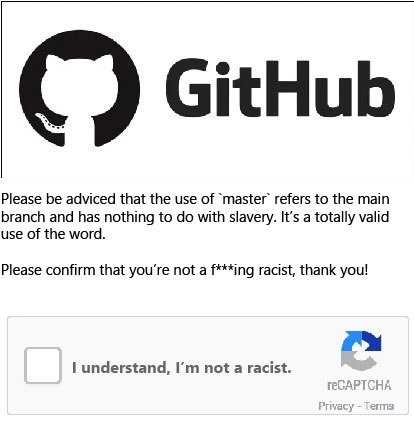
Now, the meme itself is a joke playing on that situation. It shows the official GitHub logo and name, making it look like an authoritative announcement from GitHub. The text in the meme says (paraphrasing): “Just so you know, the term master for the main branch has nothing to do with slavery or racism. It’s a valid use of the word.” Then it humorously adds: “Please confirm that you’re not a freaking racist, thank you!” and shows a checkbox you’re supposed to tick that says “I understand, I’m not a racist.” This checkbox area is a clear parody of those reCAPTCHA prompts on websites that usually say “I’m not a robot.”

For context, reCAPTCHA is that little test on websites where you often have to click a box or identify images to prove you’re human and not an automated bot. Here, the meme replaces “robot” with “racist.” It’s making fun of the idea that a developer might have to prove they are not racist just to continue using a technical term or feature. During the real debate, some people indeed felt pressure — as if if you didn’t agree with renaming, you could be seen as insensitive or prejudiced. The meme exaggerates this feeling to comic effect by imagining an absurd scenario: GitHub forcing you to explicitly declare “I’m not racist” via a checkbox before proceeding. It’s a form of parody. No, GitHub never actually did this! But the joke lands because it captures the mood of how the debate felt to many developers. It’s poking fun at how dev communities sometimes handle serious issues with a mix of earnest actions and over-the-top social shaming.

To put it simply, the meme highlights the social pressure developers experienced on this topic in a tongue-in-cheek way. It uses the familiar interface of an “I am not a robot” check – something many of us have clicked countless times – and twists it into a cheeky comment on the situation. The phrase “Please confirm you’re not a f*ing racist” is deliberately crude and blunt, which is unexpected in a professional context. That shock value is part of the humor. It underlines the absurdity of conflating a naming convention with a person’s character. The meme is essentially saying: “Look, just because I use the word ‘master’ for my Git branch doesn’t mean I’m a horrible person – isn’t it ridiculous I’d even have to say that?”

For a junior developer or someone new to this issue, the key points to understand are:

  • Git’s master branch = the old default name for the main code line.
  • Git’s main branch = the new default name many have adopted for that same thing.
  • The change was suggested to be more inclusive and avoid possibly hurtful terms.
  • Not everyone agreed on whether this change was necessary, leading to debate in the developer community.
  • The meme jokingly portrays GitHub as overzealous, making users confirm they aren’t racist if they continue with the old term – an exaggeration meant to be funny.

In developer culture, there’s a common saying: “There are only two hard things in Computer Science: cache invalidation and naming things.” Naming things (like branches) is notoriously tricky – not technically, but because of the human factors and bikeshedding it can involve. This meme is a lighthearted example of that adage. It turns an industry in-joke about naming into a visual gag. Even if you’re new to Git, you can appreciate that people sometimes quarrel over what may seem like small details. And if you’ve ever checked an “I’m not a robot” box and chuckled at the idea of having to prove your identity to a machine, you can see why having to assert “I’m not racist” in a similar way is both funny and pointed. It’s humor with a bit of an edge, reflecting the mix of frustration and comedy that developers found in the master/main branch controversy.

Level 3: Bikeshedding the Branch

At the height of a 2020 tech firestorm, the developer community found itself arguing over a single word: the name of Git’s default branch. This meme riffs on the master-to-main rename debate that swept through version control circles. In Git, the main line of development had long been called the master branch. Suddenly, amid broader calls for inclusive language, that term came under scrutiny. Some developers proposed renaming master to main (or another neutral term) to avoid any perceived reference to slavery – even though in Git there is no explicit “slave” counterpart. It was a symbolic change, meant to make everyone feel more welcome by dropping a term potentially loaded with historical baggage. Others in the community, however, felt changing the name was unnecessary bikeshedding – focusing on a minor issue rather than substantive problems. They argued that “master” in this context simply meant main copy (as in “master recording”) and was never intended with racist meaning. The debate grew surprisingly heated and personal, with opinions flying on Twitter, GitHub issues, and mailing lists. It became more than a technical discussion; it was about what the industry stands for and how developer culture should respond to social issues.

To seasoned developers, this was a familiar pattern: we’ve seen terminology controversies before. Naming conventions in tech have always evolved – consider how master/slave terminology for databases and hardware has largely been replaced with primary/replica, leader/follower, or other pairs. Back in the day, older version control systems like Subversion didn’t even use “master” at all – they called the main branch trunk, and nobody thought twice about it. In fact, GitHub’s own move to abandon “master” was part of a larger industry trend: around the same time, many projects and companies were purging terms like “whitelist/blacklist” in favor of allowlist/denylist. The inclusive_language_debate was all about making tech jargon more neutral and respectful. But as often happens, a well-intentioned change exposed rifts in the dev community. Some veteran coders grumbled that this was pure performative action or “virtue signaling,” while others felt it was a small but meaningful step toward a more inclusive culture. The tension came from a clash of perspectives: one camp saw a chance to fix something that might alienate developers of color; the other camp saw it as fixing a “non-problem” and possibly labeling good people unfairly.

This meme captures that tension through dark humor. It mimics an official GitHub announcement but cranks the absurdity to 11. The top shows the GitHub logo and branding to set the stage. The text then essentially says, “Please be advised that the use of master refers to the main branch and has nothing to do with slavery. It’s a totally valid use of the word.” In other words, it’s pretending GitHub might defend the term “master” by explicitly clarifying it’s not meant in a racist way. This alone is ironic, because in reality GitHub chose the opposite solution (changing the word, not defending it). Then comes the kicker: “Please confirm that you’re not a f*ing racist, thank you!” followed by a fake reCAPTCHA checkbox labeled “I understand, I’m not a racist.”

Why is this so funny to developers in the know? For one, it’s using shock value and corporate parody. Seeing profanity and an accusation of racism in what looks like a standard GitHub notice is jarring and comical. It lampoons the social pressure felt during the debate – the feeling that if you didn’t immediately agree to rename your branch, you might be seen as racist. The meme exaggerates this sentiment to the point of absurdity: imagine having to tick an “I’m not racist” box just to use a source control tool! It’s a play on the familiar “I am not a robot” captcha that websites use to distinguish humans from bots. Here, the joke implies that continuing to use the word “master” might mark you as something inhuman (or at least inhumane) in the eyes of the community. The anti_racism_captcha_parody brilliantly highlights how moral righteousness can sometimes be reduced to performative checkbox-clicking. This resonates with cynical devs who felt the debate was full of posturing. The humor lands because it takes a serious accusation – racism – and juxtaposes it with the mundane act of clicking a checkbox in a UI. It’s an extreme satirical scenario, essentially saying: “We believe you that ‘master’ isn’t meant offensively… but just to be sure, prove you’re not a bigot before you push your code.”

Technically, the meme is also poking fun at GitHub’s UI and the role of big platforms in setting norms. Github had the power to change the default branch name for millions of repositories, and in late 2020 they indeed made “main” the new default for newly created repos. That decision was met with both applause and annoyance. Experienced developers recall the scramble: updating CI pipelines, documentation, and scripts that assumed master existed. The meme imagines an alternate reality where, instead of changing the default, GitHub might have simply added a blunt warning and required an acknowledgment from users. It’s a ridiculous idea – hence it’s funny – but it reflects a kernel of truth about how awkward the situation felt. Many developers joked during the controversy, “What’s next, a popup asking if I’m an okay person every time I git push?” Here we effectively have that popup in visual form.

The branch_naming_controversy became an industry in-joke about how something as simple as naming can turn into a sprawling argument. It’s a classic case of a DevCommunity dispute where technical practice meets social values. Seasoned engineers find humor (and perhaps a bit of catharsis) in this meme because they’ve lived through similar “holy wars” over tabs vs spaces, brace styles, or other conventions – but this time the stakes felt higher, intertwined with real-world social justice issues. The meme acknowledges the absurdity without directly dismissing the importance of inclusion; instead, it satirizes the over-the-top way people sometimes signal their virtue or accuse others. It’s developer humor at its finest: referencing an industry in-joke (branch name debates) with a dash of profanity and a twist on everyday tech (captchas) to underscore how blown out of proportion the situation became. In short, the meme uses biting sarcasm to commiserate: “Wasn’t that whole master/main blow-up just crazy? I mean, look how far we could take it – confirm you’re not a racist to use Git – how insane is that?”

Description

A satirical meme formatted to look like a GitHub confirmation dialog. At the top, the official GitHub logo with the Octocat is displayed. Below it, text reads: 'Please be advised that the use of `master` refers to the main branch and has nothing to do with slavery. It's a totally valid use of the word.' This is followed by a more aggressive demand: 'Please confirm that you're not a f***ing racist, thank you!'. At the bottom, there is a reCAPTCHA-style checkbox with the label 'I understand, I'm not a racist.' The meme humorously critiques the tech industry's debate over changing the 'master' branch name in Git to 'main' by exaggerating the enforcement into an absurd, accusatory CAPTCHA, touching upon the frustrations some senior developers feel about culture wars bleeding into technical domains
Comments

7
Anonymous ★ Top Pick I'm fine with renaming the master branch, but if my IDE starts asking me to confirm I'm not a racist every time I type 'git push origin master', I'm switching to Mercurial
  1. Anonymous ★ Top Pick

    I'm fine with renaming the master branch, but if my IDE starts asking me to confirm I'm not a racist every time I type 'git push origin master', I'm switching to Mercurial

  2. Anonymous

    GitHub’s newest CAPTCHA: check “I’m not racist,” then refactor every Terraform module, Jenkinsfile, and Helm chart that still points at origin/master

  3. Anonymous

    The real merge conflict here is between git's 15-year naming convention and HR's diversity training slides - though honestly, the hardest part wasn't changing 'master' to 'main', it was explaining to the C-suite why their Jenkins pipelines broke overnight

  4. Anonymous

    Ah yes, the classic 'master' branch debate - where we spent more engineering hours bikeshedding terminology than actually fixing the O(n²) algorithm in production. Nothing says 'we care about inclusion' quite like a CAPTCHA that assumes you're not racist before you can push your hotfix at 2 AM. Meanwhile, our legacy COBOL system still has a database table called 'SLAVE_RECORDS' that nobody's touched since 1987 because the documentation is lost and the original developer retired to Boca Raton

  5. Anonymous

    Clicking “I’m not a racist” is easy; the real CAPTCHA is hunting down every CI script, Jenkinsfile, Helm chart, and Terraform module that still hardcodes origin/master

  6. Anonymous

    The only merge conflict tougher than rebasing a monolith: git's master branch culture war

  7. Anonymous

    Renaming master to main took five minutes; finding every Jenkinsfile, webhook, and Terraform module still hard‑coded to origin/master took two quarters - ethics scales faster than YAML

Use J and K for navigation