Skip to content
DevMeme
1528 of 7435
The Cynical Take on Renaming Git's Master Branch
VersionControl Post #1707, on Jun 16, 2020 in TG

The Cynical Take on Renaming Git's Master Branch

Why is this VersionControl meme funny?

Level 1: One Word, So Much Work

Imagine your teacher decides that a common word you’ve been using in all your school work isn’t a good word to use anymore and wants everyone to use a different word instead. Let’s say every student has a notebook with the title “Master Notebook” on it, and the teacher says, “From now on, we should call it ‘Main Notebook’ because it’s a nicer word.” It sounds like a small change, just one word, right? But now every student has to go to every single notebook, folder, and assignment and change the word “Master” to “Main.” They have to erase it on covers, update it on title pages, maybe even tell the school office to update it in the system. It turns into a big project! In this story, the teacher is very happy and excited about using the new word (because it makes people feel more included and respected), but the students doing all the erasing and rewriting find it tiring and boring. The funny part of the meme is just like that: it’s joking that a whole bunch of programmers had to do a lot of boring, repetitive work (like those rowers pulling oars in a ship) just to change one word (“master” to “main”) everywhere. One person is cheering “Yay, new name!” while everyone else is sweating a bit to actually make it happen. It’s a silly way to show how something small can turn into a lot of work for the people who have to carry it out, making us smirk because we’ve all been in that situation where a tiny change ends up being a big chore.

Level 2: Main Is The New Master

Let’s break down what’s happening here. Git is a popular version control system that developers use to track code changes. In Git (and on platforms like GitHub), each project or repository typically has a default branch. This default branch is usually the main line of development—where code eventually lands when it’s ready. For many years, by convention, this default branch was named master. When you created a new repo, GitHub would initialize it with a master branch by default. Developers are very used to this; it’s been part of the branching strategy and naming conventions since Git’s early days.

Now, around June 2020, there was a big push in the tech community to adopt more inclusive language. That means avoiding terms that might carry hurtful historical baggage. The word “master” can remind people of master-slave terminology (like in historical slavery or even in tech contexts where one device was called “master” and another “slave”). So, the idea was to change the default branch name from master to something less loaded. The choice was main, a simple, neutral term that basically means “primary” or “mainline”. GitHub’s CEO and others agreed this was a good move, and they decided to make main the new default for all new repositories. The tweet screenshot on the meme shows this conversation: Una Kravets expresses happiness about renaming “master” to “main,” and Nat Friedman (then CEO of GitHub) replies that GitHub is on it. This was essentially the official announcement that the change was coming.

So what does renaming a branch involve for developers? If you’re a junior dev who hasn’t done this, the process is a bit of a chore. You can’t just magically change the name everywhere with a single click (at least not at that exact moment — GitHub later added tools, but initially it was manual). Here’s roughly how a developer would rename the default branch from master to main on an existing repo:

# Check out the current master branch
git checkout master

# Rename the local 'master' branch to 'main'
git branch -m master main

# Push the new 'main' branch to the remote (GitHub)
git push origin main

# Change the remote HEAD to point to 'main' as the default (done on GitHub web or CLI)

# (Optional) Remove the old 'master' branch on the remote to avoid confusion
git push origin --delete master

In plain terms, these commands do the following: you switch to your master branch, rename it to main locally, push the new main branch up to GitHub, and then delete the old master on GitHub. But that’s not the end! After this, you usually have to go into your project settings on GitHub and mark main as the new default branch (so that new pull requests go to main by default, not the now-nonexistent master). Any open pull requests that were targeting master might need to be retargeted to main. Every developer who already had the code on their computer needs to update their local copy: they might have to fetch the new branch and update their tracking references (otherwise their Git will complain that origin/master is gone). On top of that, any scripts or CI/CD pipelines (Continuous Integration/Continuous Deployment setups) that explicitly mention “master” have to be updated to say “main” instead. This could include build scripts, deployment scripts, config files, you name it. It’s a lot of little updates scattered everywhere.

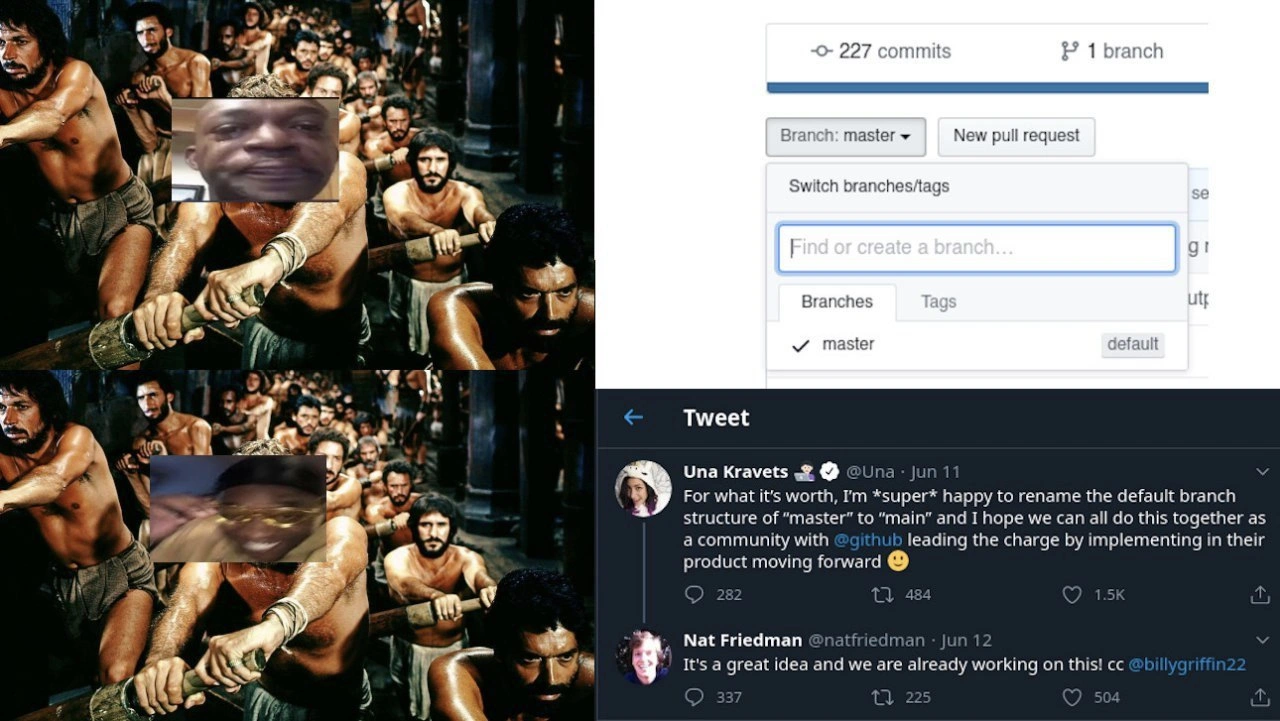
The left side of the meme – those two identical images of men rowing in a galley – is a scene depicting extremely hard, repetitive labor. These men are literally galley slaves from an old movie (chained up and forced to row a big ship). It’s an intense image, and the meme is using it to symbolize how developers felt doing the tedious work of renaming branches in countless repositories. The joke here is that renaming a branch, which is a repetitive, mechanical task when you have to do it over and over, made the devs feel like they were slaves rowing a boat, working in unison on something exhausting that wasn’t exactly fun or exciting.

Now, notice in the lower left image, one of the rowers has a superimposed meme face with gold sunglasses, grinning enthusiastically. This is a popular meme face used to show over-the-top excitement (often it’s the “party” or “excited” meme face). That one rower represents the person or people who are really happy about the change. It could be interpreted as Una (who was excited to make the change) or GitHub’s leadership being proud of leading the charge. Basically, while most of the “rowers” (developers) are depicted as strong but unhappy workers doing this chore, one of them is abnormally excited — likely poking fun at how management or some community members were cheering for the new naming convention, while developers doing the work felt it was a slog. This contrast is classic DeveloperHumor: one person is hyped on Twitter about “doing the right thing,” and everyone else quietly sighs and starts the hard work to actually implement it.

On the right side of the meme, we see a snippet of the GitHub web interface and the Twitter conversation. The GitHub UI bit shows a repo that has “227 commits and 1 branch,” with a dropdown labeled “Branch: master”. Right below it, there’s a text box “Find or create a branch…” This likely illustrates the moment before creating the new main branch or just highlighting that the default is still master (since it’s the only branch, labelled as default). It’s basically the starting point: a repository that hasn’t been changed yet. Underneath, the captured tweets are evidence of why all this is happening. Una’s tweet is saying she’s super happy to rename “master” to “main” and hopes the community will do it together, with GitHub leading. Nat’s reply confirms GitHub was already working on changing the GitHub default branch name at the platform level. For a junior dev reading this, it shows that this wasn’t just a random meme scenario – it was a real policy change in the tech world!

The categories here – VersionControl, DevCommunities, CorporateCulture – all intersect in this meme. Version control is the tech context (Git branches), Dev communities refer to the developer community-driven push for change (developers discussing on Twitter, etc.), and corporate culture is involved because companies like GitHub and others officially implemented these changes as part of a culture shift towards inclusivity. The meme is highlighting how these worlds collide: community values prompted a corporate policy update, which then required lots of version-control housekeeping by individual developers. It’s a perfect storm of a social change meeting a technical reality.

For someone new to this, the meme’s humor comes from exaggeration and relatability. Renaming branches isn’t physically painful, but it can be time-consuming and dull. By comparing it to ancient slaves doing backbreaking rowing, the meme humorously exaggerates how developers felt (“Ugh, this is such a slog!”). That one happy face is the exaggeration of how the higher-ups or some advocates seem super thrilled about the change, maybe not fully acknowledging how much busy-work it creates. Everyone in tech who experienced this change chuckles because, yes, we remember going through those motions for dozens of repos. It’s a shared experience—inclusive_naming_change or not, we all had to deal with it. And at the end of the day, it’s a change that doesn’t add new features or fix bugs; it’s purely a semantic, cultural improvement. This is why it’s funny: it underscores the sometimes absurd feeling of doing a mountain of work for a subtle, non-technical outcome. It’s a form of inside joke among developers: “We know it’s right to do it, but boy, it felt like rowing a giant ship to move a tiny inch.”

Level 3: Chained to Main

In mid-2020, a top-down decree swept across DevCommunities: rename every Git repository’s default branch from master to main. Simple in theory, brutal in practice. Overnight, what was once an innocuous naming convention became a massive to-do list item for every team. The intention was noble—embracing inclusive language by purging terms with oppressive connotations—but the execution felt like being shackled to an oar below deck. The meme’s imagery nails this: dozens of developers as galley slaves, chained and sweating over heavy oars (or in our case, terminals), doing the thankless rowing of branch updates under orders from on high. One rower sports that ecstatic party face with gold sunglasses, symbolizing the enthusiastic corporate cheer for the change even as the rank-and-file grind away. It’s a biting satire of CorporateCulture: leadership beams about a progressive initiative while the engineers furiously update scripts and pipelines.

From a VersionControl perspective, renaming your main development branch sounds trivial—just change a label, right? But in distributed systems like Git, no change is isolated. That 1 branch shown in the GitHub UI screenshot isn’t just a word in a dropdown; it’s baked into CI pipelines, deployment scripts, and every developer’s local clone. Many of us had hard-coded references to “master” lurking everywhere. Continuous integration jobs assumed master as the build target, branching strategies and merge workflows all revolved around that name. Suddenly, all those references became technical debt overnight. As the meme suggests, it felt like rowing in unison to move a giant ship: everyone had to coordinate and pull their weight to avoid drifting into chaos.

And coordination was key. GitHub’s CEO Nat Friedman publicly replied to a tweet (captured on the right) saying “It’s a great idea and we are already working on this!” – effectively greenlighting the change platform-wide. Great, except GitHub implementing it in their product didn’t automagically fix existing repos. We had to do it ourselves, repo by repo. For each project, a maintainer had to create a new main branch, update the default in settings, retarget open pull requests, and delete or deprecate the old master. On top of that, every developer needed to update their local clones (git pull wouldn’t cut it until they switched the HEAD to main). If any automated deployment assumed master, well, hope you enjoy surprise outages or late-night hotfixes. It’s the classic “seemed easy until we actually tried it” scenario. Best case, you write a quick script to batch-retire “master” across dozens of repos; worst case, you click through each repo’s settings by hand like a prisoner at the oar. No wonder the meme leans into dark humor: the grunt work was real.

This branch_renaming_meme also speaks to a larger pattern in tech. We periodically purge old terminology once social consciousness catches up. In the same era, whitelist/blacklist became allowlist/denylist, slave databases became replicas, and so on. The table below highlights a few such changes that had devs collectively groaning and refactoring:

  • master (branch name) → main (new default branch on GitHub)
  • master/slave (replication) → primary/replica or leader/follower
  • whitelist / blacklistallowlist / denylist

Each change was well-intentioned, addressing terminology that could marginalize or offend. But each also required a non-zero amount of actual work to implement. The inclusive_naming_change essentially added an unscheduled sprint task for every team on GitHub. And like clockwork, the DeveloperHumor kicked in as a coping mechanism. Comparing ourselves to ancient galley slaves might be hyperbole, but on that Friday afternoon when yet another repository needed its default branch switched and half the build scripts broke, it sure felt like rowing against the current under someone else’s drumbeat. The meme’s comedy comes from that grain of truth: one person’s PR-friendly idea (“We’re being inclusive!”) became thousands of devs’ collective headache. The next time someone quips “it’s just a find-and-replace”, seasoned engineers might respond with a weary grin — we’ve heard that before, right before we start rowing.

Description

A four-panel collage meme commenting on the tech industry's move to rename the 'master' branch in Git. The left side features a dramatic scene of galley slaves from a historical movie, with the faces of two slaves replaced by distorted, anguished-looking meme faces of Black men. The top-right panel is a screenshot of the GitHub interface showing the 'master' branch as the default. The bottom-right panel displays a screenshot of a Twitter exchange where developer Una Kravets expresses happiness about renaming 'master' to 'main,' and then-CEO of GitHub, Nat Friedman, replies that they are already working on it. The meme creates a provocative juxtaposition, contrasting the corporate and community push for what is presented as a progressive language change with visceral, historical imagery of slavery, suggesting a cynical view that the name change is a performative act of 'virtue signaling' that is disconnected from addressing real-world issues
Comments

7
Anonymous ★ Top Pick The company spent a month renaming all our 'master' branches to 'main' for inclusivity. Our mono-repo's CI pipeline is now so broken, it has achieved true equality: it fails for everyone
  1. Anonymous ★ Top Pick

    The company spent a month renaming all our 'master' branches to 'main' for inclusivity. Our mono-repo's CI pipeline is now so broken, it has achieved true equality: it fails for everyone

  2. Anonymous

    “git branch -m master main” feels gloriously progressive - right up until 17 Jenkinsfiles, three Helm charts, and a forgotten COBOL release script remind you that the galley chains are still hard-coded

  3. Anonymous

    The hardest part wasn't migrating thousands of repos from master to main, it was explaining to the C-suite why we spent three sprints on it while the production database was still running MySQL 5.6

  4. Anonymous

    Ah yes, the classic 'we're all in this together' moment where leadership announces a breaking change and suddenly every engineer is frantically updating CI/CD configs, documentation, deployment scripts, and explaining to stakeholders why their pipelines broke. Nothing says 'community effort' quite like 227 commits of find-and-replace across infrastructure-as-code repos while your build system screams about missing branches. At least the galley slaves got to row in unison - we just get merge conflicts and broken webhooks

  5. Anonymous

    We finished the org-wide master->main rename and immediately learned how ‘distributed’ git really is - the hardcoded origin/master lived in 500 CI YAMLs and one very opinionated submodule

  6. Anonymous

    Master→main: 1 GitHub toggle, 47 broken Jenkins pipelines, 12 submodules, 3 Terraform states, and a build fleet still rowing toward origin/master

  7. Anonymous

    Master-to-main rename: GitHub's gift of inclusivity that nuked every unchecked-out alias, Jenkinsfile, and prod deploy script overnight

Use J and K for navigation