Skip to content
DevMeme
1530 of 7435
The Sophistication Levels of Distributed System Terminology
DevCommunities Post #1716, on Jun 16, 2020 in TG

The Sophistication Levels of Distributed System Terminology

Why is this DevCommunities meme funny?

Level 1: Mean, Nice, and Silly Names

Imagine you have two toy robots that play together. At first, you call one robot the “Master” and the other the “Slave.” That’s a really mean way to name them because it sounds like one robot owns the other (not nice at all!). So you decide to fix it and choose nicer names: now you call them the “Main robot” and the “Secondary robot.” That feels much more nice and fair – one is the leader and the other is the helper, without any hurtful words. But then, your jokester friend comes along and says, “Oh ho, those names are too simple. Let’s call them something super fancy, like ‘Dom’ and ‘Sub’!” Those words sound silly and come from a totally grown-up joke, so you all giggle. The friend even pretends the main robot should wear a little top hat and monocle like it’s extra fancy. 🤭 It’s funny because you went from a not-okay name, to a good name, and then all the way to a ridiculously fancy (and goofy) name just for laughs. In the end, you learned that picking the right name is important – and sometimes pretty hard – but it can also make everyone smile when you find a funny one!

Level 2: Naming Conventions 101

Let’s break down each phrase in the meme and why it’s significant to developers, especially in the context of version control and coding terminology:

  • Master/Slave: In tech, master/slave describes a relationship where one thing is in charge (master) and others follow orders (slaves). For a long time, this was a common way to label systems. For example, in Git (a system programmers use to track code changes), the default main branch was called master branch. In databases, a master database would accept writes, and a slave database would copy everything from the master. However, these terms reference slavery, which is hurtful and inappropriate. As the tech community became more mindful about language, people realized using “master/slave” in documentation and code could be offensive and exclusionary. Around 2020, a big shift happened: projects and companies actively searched for better words that carry the meaning without the negative connotation.

  • Main/Secondary: This is one of the straightforward replacements for master/slave. Main suggests the primary or lead component, and Secondary suggests a subordinate or backup component, without any implication of slavery. In Git version control, many teams now name their default branch main instead of master. This change was supported by major platforms (GitHub, GitLab, etc.) to make new projects default to “main.” Similarly, instead of calling something a slave database, you might call it a secondary database or a replica. The Pooh Bear in a tuxedo represents this choice as more refined or modern – it’s effectively the “polite company” version of the term. Using inclusive, neutral terminology like this helps make tech environments more welcoming. New developers are often quickly introduced to this updated vocabulary. If you join a project today, you’re likely to push code to a main branch, not master. The change might seem small, but it reflects a big cultural improvement in tech.

  • Dom/Sub: This final term is not an official or serious naming convention you’ll find in any manual – it’s a joke. The meme is playing with words here. DOM in a technical sense stands for Document Object Model, which is a structured representation of a web page (all the HTML elements in a hierarchy). But “Dom/Sub” spelled like that immediately brings to mind the shorthand for Dominant/Submissive in an adult context (BDSM). The meme uses this phrase to be cheeky. Imagine a developer trying to one-up the “main/secondary” terminology by proposing “Dom/Sub” – it sounds latently technical because of “DOM,” but it’s clearly too clever for its own good and would raise eyebrows in any serious discussion. Winnie-the-Pooh with a top hat and monocle emphasizes how overly sophisticated and absurd this suggestion is. This is poking fun at how developers sometimes invent overly elaborate names or silly puns when debating terminology. It’s relatable humor: after long hours of arguing about the perfect term, someone might crack a joke like this to lighten the mood. While no project is actually going to call their primary/secondary setup “Dom/Sub” (for very obvious reasons!), seeing it in the meme gives developers a laugh. It’s the contrast between the ultra-formal presentation and the downright inappropriate suggestion that makes it funny.

Overall, the meme is reflecting a real-world trend (moving away from master/slave naming to something like main/secondary) and then cranking the dial to humorous extremes. It touches on the inclusive terminology debate, which many junior developers might have heard about when joining modern teams. You might even have had to rename branches or adjust to new terms in your first job or open-source contribution. It also highlights how developer humor often involves puns and double meanings. The use of a familiar cartoon character (Winnie-the-Pooh) in increasingly fancy dress is a popular meme format to compare three ideas: from the old and unimproved, to the improved, to the ridiculously over-the-top. If you’re new to coding, don’t worry – no one is actually expecting you to call things “Dom” or “Sub”! The takeaway is that finding good names in tech is important, and sometimes a headache, but the community knows how to laugh about it once the serious work is done.

Level 3: Semantics & Sensibility

Naming things in software is notoriously difficult — so much so that there’s a classic joke:

"There are only two hard things in Computer Science: cache invalidation, naming things, and off-by-one errors."

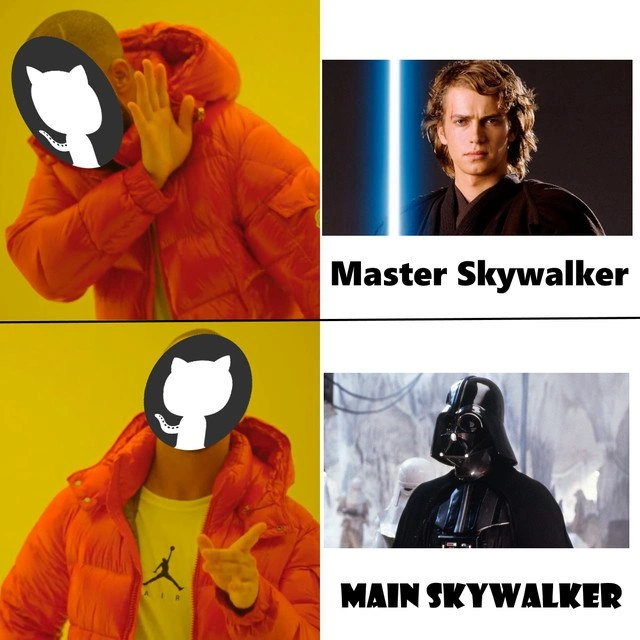
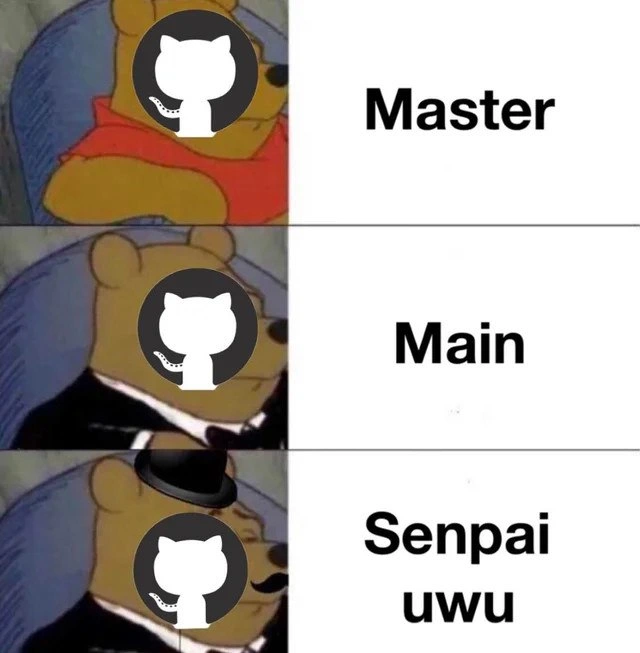
In this meme, the challenge of naming conventions is front and center, with a side of developer humor. It shows Winnie-the-Pooh becoming progressively more sophisticated (from a casual pose to a tuxedo to a tux with a monocle and top hat) as the terminology for a primary-secondary relationship evolves. This format is a wink to experienced devs: the fancier Pooh looks, the more pretentious or tongue-in-cheek the naming scheme has become.

The first panel’s label “Using Master/Slave” references an old-school terminology in computing. For decades, tech used “master/slave” to denote one main controller and one subordinate component. For example, older databases had a master server that handled writes and slave servers that replicated data. Even hardware from the 90s (like IDE drives) had jumpers for Master and Slave drives. It was a common metaphor, but also an obviously loaded one – borrowing terms from human slavery. By 2020, the industry recognized these terms as offensive and outdated. A major push for inclusive language was underway (spurred by social awareness movements that year), encouraging more neutral terminology. Many projects and version control systems started replacing “master/slave” with cleaner alternatives.

Enter the second panel: “Using Main/Secondary.” Pooh is now in a neat tuxedo, looking content. This represents the more refined, considerate choice of words. In Git (the popular version control system), the default branch was historically named master by convention. Around mid-2020, platforms like GitHub officially began shifting the default branch name to main to remove unnecessary references to “master.” Similarly, the term “slave” in contexts like database replication was replaced with “secondary”, “replica”, or “follower.” These changes aimed for clarity and inclusivity – “main/secondary” gets the point across without evoking slavery. Seasoned developers recognize this panel as the industry catching up with the times. It nods to real debates in engineering teams and open-source communities about purging problematic terms. There’s also a hint of relief: finally, a naming convention that is technically accurate and socially acceptable.

But developers wouldn’t be developers if they didn’t inject some cheeky humor into even serious changes. The third panel delivers the punchline: “Using Dom/Sub.” Now Pooh is extra decked-out with a top hat, monocle, and mustache – the epitome of tongue-in-cheek sophistication. This label is a playful overcorrection. It suggests an absurdly “fancy” terminology, one that no sane coding standard would actually adopt, but which makes techies smirk because of its layered meaning. “Dom/Sub” on the surface looks like another attempt at neutral naming (perhaps short for Dominant/Subordinate?), but anyone with an eye for puns will catch the double entendre. DOM is a well-known acronym in tech – it stands for Document Object Model, the hierarchy of elements in a webpage’s structure. However, written as “Dom/Sub,” it unmistakably alludes to BDSM role terminology (Dominant/Submissive) – a completely different domain of discourse! This is dev humor 101: mixing a developer in-joke with a bit of risqué wordplay. It’s poking fun at the endless quest for the perfect naming system by suggesting something so sophisticated-sounding that it trips right into the realm of absurdity. The monocled Pooh implies, “Ah yes, behold our truly enlightened naming scheme, good sir,” as if renaming a branch were some aristocratic endeavor. We’re basically laughing at ourselves – after all the serious effort to rename “master,” here we are amusing ourselves with a term that would never pass HR, let alone a code review.

The humor works on multiple levels that seasoned devs appreciate. First, it satirizes the inclusive terminology debate: important, yes, but often contentious and ripe for bikeshedding (endless discussions over trivial details). Everyone agrees “master/slave” had to go, but what to use instead? Teams debated options like primary/replica, leader/follower, main/secondary – sometimes at length. The meme’s escalation exaggerates this process: we found a good solution (“main”), yet the conversation comically doesn’t stop and lands on “Dom/Sub,” which is clearly too far. It’s a joke about how developers, consciously or not, tend to run ideas into the ground for the sake of one-upping each other or proving a point. Second, it highlights how naming things often feels like a creative writing exercise. We want names that are precise, unambiguous, and inoffensive, but also not overly sterile. Striking that balance invites lots of opinions and occasional ridiculous suggestions. (If you’ve ever sat through a meeting about what to name a function or a server, you know the struggle is real.) The meme exaggerates a scenario where a well-intentioned renaming effort jumps the shark. The final “Dom/Sub” suggestion is so over-the-top that it parodies the very notion of always seeking a more sophisticated name. It’s the meme equivalent of someone raising their pinky while drinking tea and saying, “Let’s call it something truly elegant,” except their idea is hilariously inappropriate.

Finally, there’s an element of relief and solidarity in the laughter this meme provokes among veteran developers. We’ve all experienced the perennial pain of naming things in software. It’s a shared headache from junior days right through architecture discussions at senior levels. This Pooh Bear meme encapsulates that perfectly in three frames. By chuckling at “Using Dom/Sub,” devs are virtually high-fiving each other – acknowledging that yes, we finally got rid of an offensive term, and no, we’re not actually going to call our branches “Dom” and “Sub,” but imagining it sure tickles the funny bone. It’s humor that says: We take our work seriously, but we can still laugh at how seriously we sometimes take it.

Description

A three-panel 'Tuxedo Winnie the Pooh' meme format is used to compare different terminologies for primary/secondary relationships in tech. The first panel shows a standard Pooh next to 'Using Master/Slave,' representing the old, problematic standard. The second panel shows a more sophisticated Pooh in a tuxedo next to 'Using Main/Secondary,' representing the current, more inclusive industry standard. The final panel shows the most sophisticated Pooh, complete with top hat, monocle, and mustache, next to 'Using Dom/Sub,' a humorously inappropriate BDSM reference that escalates the naming convention to an absurd level. The meme satirizes the recent push for inclusive language in technology by proposing a comically unprofessional alternative
Comments

7
Anonymous ★ Top Pick My lead insisted we move from master/slave to primary/replica. When I suggested leader/follower, he said it wasn't descriptive enough. Now I'm just waiting for the right moment to propose dom/sub during architecture review
  1. Anonymous ★ Top Pick

    My lead insisted we move from master/slave to primary/replica. When I suggested leader/follower, he said it wasn't descriptive enough. Now I'm just waiting for the right moment to propose dom/sub during architecture review

  2. Anonymous

    Waiting for legal to approve, I’m pretty sure the next push will be to origin/consenting_adult_partner - while Jenkins stubbornly checks out legacy/master from 2014

  3. Anonymous

    Spent three sprints migrating from master/slave terminology only to have the junior engineer's PR comment ask why our distributed systems architecture document now reads like someone's FetLife profile

  4. Anonymous

    The real sophistication is when you realize that after migrating from 'master' to 'main', you still have to explain to stakeholders why the deployment pipeline broke because someone hardcoded branch names in 47 different YAML files, 3 Jenkins jobs, and that one Bash script from 2014 that nobody dares to touch

  5. Anonymous

    Master/Slave deprecated for insensitivity, Main/Secondary for blandness - Dom/Sub: now your replicas submit eagerly, until safeword 'rollback' hits prod

  6. Anonymous

    We went from master/slave to main/secondary to “Dom/Sub” - and the cluster still elects whoever survives the partition; authority is a runtime concern, not a naming convention

  7. Anonymous

    We spent two sprints renaming “master/slave” to “main/secondary” before someone proposed “dom/sub” - meanwhile the topology still has one write node; the only thing we replicated was the bikeshed

Use J and K for navigation