Git Rebase Master as the Trolley Problem Where Everyone Gets Hit
Why is this VersionControl meme funny?
Level 1: All-In-One Trouble Track
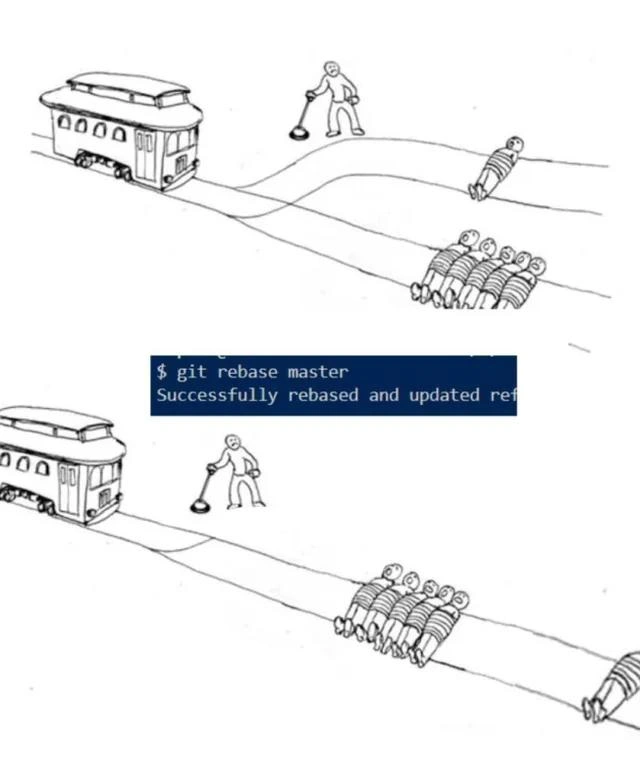
Imagine you’re playing with a toy train set that has a fork in the tracks. On one track, you placed one toy figure, and on the other track, you placed five toy figures. Normally, if a train was coming, you’d try to send it down the track with only one figure to avoid knocking over all five on the other track – that’s the common sense choice. But in this silly picture, someone uses a “magic switch” that joins the two tracks into one single track. Now all six toy figures are standing together on that one track, right in the train’s path! 😮 When the toy train comes, it’s going to bump everyone because there’s no other route. This is funny because the person solved the problem in the worst possible way – instead of saving some toys from getting hit, they made sure all of them get hit at once. It’s an exaggerated, goofy way to show a mistake. In simple terms, the joke is like when you try to fix something but end up combining all the problems and making a bigger mess. Developers find it funny because it reminds them of times when a fancy tool or command (the “magic switch”) was supposed to help, but ended up causing more trouble for everyone (just like that train hitting all the toys!).
Level 2: One Track History
Let’s break down the joke in simpler terms. Git is a popular tool for version control – it helps developers track changes in code and collaborate. Developers create branches in Git to work on different features or fixes without disturbing the main codebase (often the main branch is called master or main). Think of a branch as a separate track for the code: you copy the code’s state and then the branch moves independently, like a train on a different track. While one branch goes its way, the main branch might move forward with other updates. Eventually, you’ll want to bring your branch’s changes back into the main line. There are a couple of ways to do that: one is merging, which is like building a junction to join the two tracks (you end up with a commit that connects both histories, and both the original branch and main survive in history with a link). The other way is rebasing, which is more like picking up your train car and placing it at the end of the main track, removing the separate branch track entirely.
In the top panel of the meme’s cartoon, the situation mirrors a typical branching scenario. The trolley’s tracks split into two like a codebase that forked into two branches. On the left track, five people are tied down – this is analogous to the main branch which has a lot of changes or stake in it (possibly five commits, or just a larger group impacted). On the right track, one person is tied down – analogous to a smaller feature branch with fewer changes (maybe just one commit or one developer’s work). The trolley represents the progress of the project or the next deployment coming down the line. The switch operator standing by the lever is like a developer or release manager who has to decide how to integrate these branches: which track should the trolley take? Normally, the ethical choice in the classic trolley problem is to pull the lever and divert the trolley to the track with only one person (sacrificing one to save five). In software terms, that could correspond to choosing a path that causes the least damage or conflict – maybe merging in a way that only one part of the code is heavily affected instead of five parts.
However, the bottom panel introduces the Git command: $ git rebase master. This is the developer saying, “I’ll solve this by rebasing my branch onto master.” When Git rebases, it takes the changes from the one-person track (the feature branch) and integrates them onto the main track as if they had been there all along. The text “Successfully rebased and updated ref” is Git’s way of confirming it moved the branch pointer to the new combined history. After the rebase, as depicted humorously, the right-hand branch (where that one person was) vanishes – just like a branch history disappearing – and now we see all six people on one single track in front of the trolley. In Git terms, what happened is: there is no separate branch history anymore; the feature branch’s commit is now appended to master’s commits in one straight line. The one person got moved to join the five people on the main track.
Now, why is that funny or important? Because in the cartoon world, removing the branch means the trolley no longer has an alternate route – it’s definitely going to run over everyone on the track. 😨 In developer terms, by rebasing in a complex situation, you might have just ensured that every conflict and issue from both branches will be faced head-on in one go. It’s joking that the attempt to avoid choosing between two sets of problems ended up combining them. All the little and big problems are lined up together. There’s also a play on the idea of “rewriting history”. Git rebase actually changes the commit history of your branch. It’s like saying “pretend I started my work after the latest changes on master, not from where I originally branched off.” This can be neat and tidy because the project history becomes linear (one track). But it can also be troublesome: if someone else was working with your old branch, their Git will get very confused because the history it knew (with a separate branch) no longer exists. That’s why developers are often cautioned: “Don’t rebase a shared branch” – meaning if other people have copies of that branch, rebasing it will require everyone to reconcile to the new history. It’s generally safe to rebase your private feature branch before merging, but doing it at the wrong time or in the wrong way can cause headaches.
The meme exaggerates the headache. By showing all people on one track, it implies that the whole team might suffer (“doomed the whole team”) from this action. Perhaps if there were conflicts between the branch and master, now those have to be resolved in one sequence, possibly affecting all parts of the code at once. In a less metaphorical sense: let’s say the five people represent five features or five developers’ contributions on master, and the one person is your feature. If your feature had conflicts with each of those other contributions, rebasing could mean you have to resolve conflicts related to all five as you apply your one commit on top of them. Merge conflicts might pop up for each section of code that overlaps. It’s a bit like having to answer six tricky questions in a row rather than dealing with one and maybe avoiding the others.
For a newer developer, this meme is pointing out a common situation: Git commands can be powerful but have unintended results if used without care. git rebase is often used to keep a project history linear and clean (no extra merge commits cluttering the timeline). But the downside is it rewrites the commit history. The joke here is that by rewriting history (removing the branch split), you’ve also removed the ability to “choose a lesser evil.” Everything is merged into one outcome. It’s funny in a nerdy way because it connects a life-or-death philosophical puzzle with a mundane but sometimes stressful coding task. And it’s relatable because many of us have typed a Git command hoping to elegantly resolve differences, only to end up with a bigger mess (and had that “uh-oh” moment when all the problems pile up). The trolley problem imagery just makes that feeling extra dramatic and clear.
Level 3: Merging the Dilemma
For seasoned developers, this meme lands as a brilliant mash-up of version control humor and a classic ethics thought experiment. The trolley problem is all about a harrowing decision: do you pull a lever to sacrifice one person on a side track to save five on the main track? In the context of Git, the “lever” is analogous to how we choose to integrate branches. Here, rebasing becomes the darkly comedic anti-hero. Instead of choosing one path or the other, git rebase master yanks the tracks so that there’s only one combined path—and unfortunately, everyone is now stuck on it. It’s a hilarious exaggeration of what can happen when a developer tries to “clean up” a messy history: sometimes our attempt to simplify can amplify the pain for the whole team.
Why is this so relatable in a dev’s world? Because many of us have been that well-intentioned engineer who decided to rewrite history on a shared branch or force a tidy linear timeline, only to unleash chaos. The meme hints at “branch_management_woes” and ethical merge conflicts we’ve all seen. In a real project scenario, imagine you have a feature branch that diverged from master days ago. Master’s progress (our left track with five people) includes lots of other changes by colleagues. Your feature branch (the right track with one person) has your work. There’s a merge dilemma: do you integrate by merging, which would preserve both lines of development with a merge commit (analogous to choosing one track and only hitting either five or one)? Or do you rebase your work onto master, effectively pretending your work started after all those other changes? This meme jokingly shows the rebasing choice as the lever pull that should produce a cleaner outcome – but instead of saving anyone, it consolidated all the trouble. All differences and conflicts end up on the same track, like piling every code change (and all those five other developers’ commits) together with your changes in one big bundle. The trolley (representing the relentless march of deployment or integration) now is going to run through every issue in one go. It’s a “no Mercy merge” scenario: no alternate routes, no survivors (metaphorically speaking, of course!).
This resonates with developers because of the unspoken trauma of merge conflicts and botched rebases. When you do git rebase, Git tries to automatically apply each of your commits onto the new base. If any of those commits conflict with what’s already on master, you hit a conflict that must be resolved manually. In the meme’s terms, each conflict is like a person on the track that you now have to deal with. A straightforward merge might have only required resolving direct conflicts once, and you’d still remember there were two distinct sources of changes (the merge commit acts like a record of “we had two tracks that we joined”). But a rebase can force you to resolve conflicts at each commit replay, and when it’s done, the history looks as if all changes happened in sequence on one line. This can be confusing and dangerous on a shared repository: if Alice and Bob both branched off master and Alice rebases onto master then pushes, Bob’s repository now faces a weird situation — the history Alice published has the same changes but brand new commits. Bob might feel like the ground shifted under his feet (like our trolley operator having the tracks suddenly rearranged!). Everyone who pulled the old branch now has to reconcile with the new rewritten history. This often means force-pulling or manual patching — a rite of passage in Git where one might inadvertently overwrite someone’s work or create duplicate commits. It’s the dev team’s equivalent of being all tied to one track in front of the speeding project timeline. RelatableDevExperience? Oh yes, deeply.
The text overlay “Successfully rebased and updated ref” is pure dark comedy to an experienced dev. It’s the Git CLI cheerfully reporting success, while the next panel shows utter catastrophe. We’ve seen similar vibes in production: “Deployment successful” messages followed by everything catching fire. Here, Git’s success message belies the fact that the branch has vanished (it’s been fast-forwarded or moved) and the main line now contains all changes. The side track (branch) is gone, just like how rebase removes the branch divergence. This can doom a team when done incorrectly — for example, rebasing a public/shared branch is almost always a no-no because it rewrites history others are working with. It’s the equivalent of forcing everyone onto the same troubled track without warning. The humor also pokes at the ethics of rewriting history: there’s an almost moral developer debate – is it “right” to alter commit history for a cleaner project timeline? Some treat it as a necessary cleanup (like saving the five by sacrificing the one – fewer but bigger commits, maybe squashing insignificant ones). Others consider it dangerous or dishonest (altering the historical record of who did what and when, akin to just letting the train run and dealing with the slightly messier but truthful outcome). The meme’s answer to that debate is a cheeky nihilism: the attempt to enforce a tidy ethical solution (linear history) ended up maximalist bad – an outcome only a cynical veteran would joke about, but every senior dev can chuckle and cringe at it.
In practice, this scenario has played out countless times: someone eagerly runs a rebase to integrate upstream changes, hits complicated conflicts (maybe merge markers everywhere like <<<<<< HEAD in files), spends an afternoon resolving them, and then pushes the rebased branch. Colleagues who weren’t informed pull the latest and suddenly their Git complains about a mismatch (“fatal: refusing to merge unrelated histories” or a bunch of duplicate commits). The entire team now has to stop and sort out the mess – effectively, everyone is tied to the track dealing with the fallout. It’s a comedic exaggeration, sure, but not far from how it feels when version control choices backfire. That’s why this meme elicits nervous laughter: it dramatises a common Git nightmare using the trolley problem – a scenario engineers ironically know all too well, where a seemingly logical decision leads to disproportionate collateral damage.
Level 4: Flattening the Multiverse
In Git’s universe of branching timelines, git rebase is like performing a cosmic realignment on the commit history. Under the hood, Git manages code history as a directed acyclic graph (DAG) of commits. Each branch is like an alternate timeline in this graph—a parallel universe of code changes diverging from a common ancestor. When you run $ git rebase master, you’re effectively collapsing one branch’s timeline into another, replaying the branch commits onto the tip of the master (now often called main) branch. This operation destroys the old fork in history and creates a single linear sequence of commits, as if the code always evolved in one straight line. It’s akin to taking a classic many-worlds scenario and forcing a single outcome: multiple possible histories of your project get merged into one “true” timeline.
From a theoretical standpoint, this is a form of history rewriting. The commit objects get new parent references and new identities (SHA hashes), meaning the original branch’s commits become orphans in the git object store until garbage-collected (like discarded alternate realities). The analogy to the trolley problem is striking at this level: before rebasing, our commit graph had two possible “futures” (one where the trolley goes left, one where it goes right). By rebasing, we’ve topologically sorted these futures into a single path. The trolley (like the development timeline) no longer has a fork in the tracks at all. In effect, rebase linearizes the partial order of commits into a total order. This can be thought of as forcing a quantum waveform collapse – all the potential divergences of code are resolved into one outcome. No more superposition of “maybe feature A happened after B” – after rebase, there is one definitive sequence: A then B, or B then A, but not both.
This high-powered rewrite comes with deep implications. In distributed version control theory, every developer’s repository is a potential multiverse of branches. Rebasing is a bold operation that says, “Let’s pretend our branch fork never really diverged; we’ll retroactively attach these commits as if they were born on the main line.” It preserves the diff content of each commit (the code changes) but changes the context in which those changes happened. In the meme’s imagery, the top panel shows two distinct tracks (branches) with separate outcomes (who gets hit). The bottom panel’s terminal output – “Successfully rebased and updated ref” – indicates Git has rewritten the branch’s history pointer. The result is visualized by the single track with all persons lined up: an absolutely linear history. The dark humor here is that by eliminating the branch (the alternate track), we lost the ability to choose an outcome – the timeline has been flattened so thoroughly that all impacts occur in sequence. It’s a tongue-in-cheek reference to how powerful and unforgiving rewriting history can be. Just as altering timelines in sci-fi can cause paradoxes or wipe out possibilities, rewriting a shared commit history in Git can obliterate diverging changes or cause massive conflicts if others were depending on the original branch. The meme wittily warns us: messing with the fabric of commit time (especially on a public/shared branch) can have morally and practically disastrous consequences, echoing the philosophical weight of the trolley problem in an absurdly literal way.
Description
A trolley problem meme in two panels. Top panel shows the classic trolley problem: a trolley heading toward a fork in the tracks, one person tied on one track and a group of people tied on the other, with someone at the lever. Bottom panel shows a terminal command overlay: '$ git rebase master / Successfully rebased and updated ref' and the tracks have been merged into one straight line so the trolley now hits everyone on the combined track. The meme brilliantly visualizes how git rebase 'flattens' history by putting all commits on a single line -- and in the trolley analogy, this means everyone gets run over
Comments
9Comment deleted
git rebase: the only command that solves the trolley problem by ensuring everyone dies on a beautifully clean linear timeline
Some say `git merge` is ethical because it preserves history, warts and all. `git rebase` advocates know that history is written by the victors - specifically, the ones who can squash their commits and force-push without getting fired
Sure, rebase cleans up the commit graph - just don’t ask what happened to the bodies in git-history-without---preserve-merges
The real trolley problem in software engineering: choosing between preserving the sacred commit history with all its context and merge commits, or achieving that pristine linear history through rebase while your colleagues discover their local branches now point to an alternate timeline where their work never existed
This perfectly captures the existential dread of running 'git rebase master' on a shared branch at 4:45 PM on Friday. Sure, you get that beautiful linear history the architect demanded, but you've just force-pushed the trolley problem onto your entire team's Monday morning. The real philosophical question isn't about the trolley - it's whether your coworkers will forgive you for rewriting three weeks of their commit history because you wanted to avoid one merge commit
Rebase is how seniors resolve ethical merge conflicts - linearize the graph, centralize the blame, then push --force-with-lease like it was always the plan
git rebase master: linear history for one, merge-conflict therapy for the team
Rebasing is SCM’s trolley problem: you remove the junction, then spend the afternoon explaining to compliance why you force‑pushed eight commits and Git blame insists it’s always been linear
git reset —soft HEAD~ git stash git push —force //let train go git stash pop git commit git push Comment deleted