Skip to content
DevMeme
1296 of 7435
Nature is Healing, But Apple's Port Selection Isn't
Apple Post #1450, on Apr 30, 2020 in TG

Nature is Healing, But Apple's Port Selection Isn't

Why is this Apple meme funny?

Level 1: Ports Are Back

Imagine you have a special toy box that used to have a bunch of different holes to plug your toys and gadgets into. One hole for power, one to connect to the internet, one for showing video on the TV, and so on. It was super easy – every cable had its matching hole. Now, one day the toy maker (let’s call them Apple) decided, “Hmm, too many holes make the box look messy. Let’s have just one hole that can do everything!” At first that sounds cool: one magic hole to rule them all. But uh-oh – your old toys and cables don’t fit into this new single hole! 😧 Now you need little adapters (we call them dongles) for each thing: a dongle to connect your USB drive, another dongle to plug into the TV, yet another dongle for the internet cable... Soon, every time you go somewhere with your toy box (laptop), you’re carrying a whole bag of these dongle adapters so you can still use your stuff. Kinda annoying, right? It’s like if you had only one type of outlet in your house and you needed a special plug converter for every appliance.

Now picture this: after a while, the toy maker realizes people miss the old convenient holes. So they decide to bring back some of those holes on a new toy box model. Hooray! 🎉 No more carrying a zillion adapters – you can just plug your things in directly again. That feeling of relief and joy is what this meme is capturing. It jokes that Apple bringing back ports on their laptops is as magical and surprising as dolphins swimming back into the canals of a quiet city. In other words, something that disappeared is returning to where it belongs, and everyone is happy to see it come back. Just like we’d smile seeing dolphins where we haven’t seen them in a long time, tech folks are smiling at the thought of seeing those trusty old ports on a MacBook again. It’s a funny way to say: sometimes, old things coming back can be the best news! 🐬💻

Level 2: Farewell, Dongle Life

Let’s break down the meme for those newer to Apple hardware or development. The meme has two parts. First, it says: “Dolphins have returned to Venice!” This refers to a feel-good story (from around March 2020 during COVID lockdowns) where people claimed wildlife was returning to places it hadn’t been seen in years – like dolphins swimming in the canals of Venice. It became a meme symbolizing that “nature is healing” when humans stay out of the way. So that’s the setup: something that disappeared has unexpectedly come back.

Next, the meme says “Meanwhile in Apple:” and shows a photograph of an older MacBook laptop with lots of ports on its side. “Meanwhile in X” is a common meme format to humorously show what another person or group is doing at the same time. In this case, it implies that while dolphins are returning in Venice, Apple is also bringing something back – specifically, the return_of_ports on their laptops.

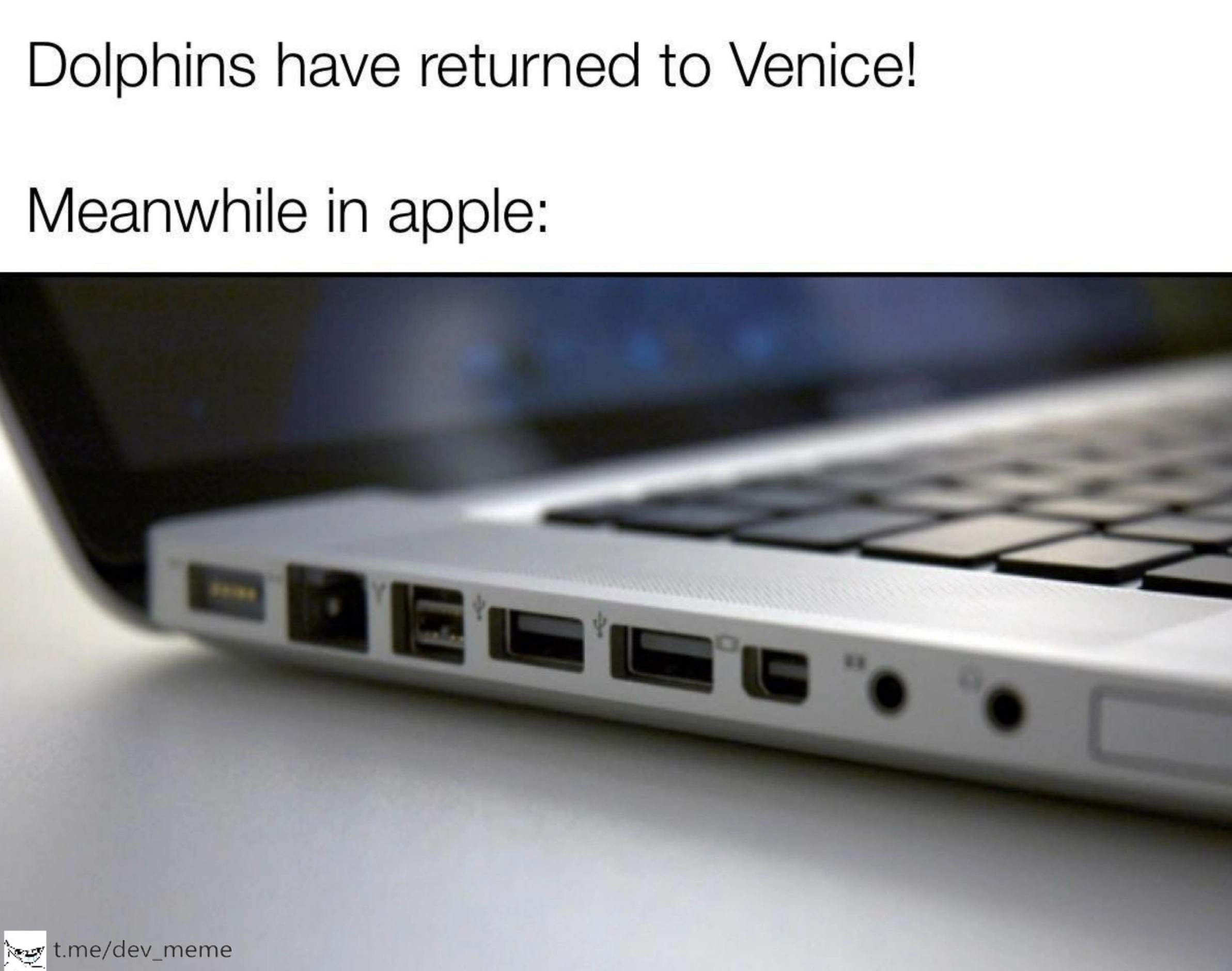
In the photo (which looks like a MacBook Pro from around 2015), you can see a whole lineup of different ports (i.e., places to plug in cables and devices) on the laptop’s edge. These are labeled in the image description, and each had a specific purpose:

  • MagSafe Power – This was Apple’s special magnetic charging connector. The plug would snap on magnetically to charge the laptop, and if someone tripped over the cord, it would safely pop off instead of yanking your laptop to the floor. Many users loved MagSafe for its convenience and safety.
  • Ethernet – A port that looks kind of like an oversized phone jack. This lets you plug in a wired network cable for internet. Even though Wi-Fi is common, developers sometimes prefer a wired Ethernet connection for faster speed or stability (for example, when deploying code or downloading large files).
  • FireWire – An older high-speed data port (rectangular with a weird “Y”-shaped icon). FireWire was used to connect things like external hard drives, camcorders, or Target Disk Mode between Macs. By 2015 it was already being phased out in favor of Thunderbolt, but some pro users still used FireWire devices, so having that port built-in was handy.
  • USB-A (two of them) – These are the classic rectangular USB ports that most devices and thumb drives used at the time. USB-A ports let you plug in keyboards, mice, USB drives, smartphones, you name it. (The AppleProducts like older iPhones even shipped with USB-A cables back then.) Having two USB-A ports meant you could, for instance, stick in a USB drive and a USB keyboard at the same time without any adapter.
  • Mini DisplayPort – That’s the small rectangular port with a symbol that looks like a rectangle. It’s used to connect external displays or projectors. On those MacBooks, the Mini DisplayPort also doubled as a Thunderbolt 2 port. Essentially, it let developers hook up a big monitor for coding or demo their app on a projector without needing an extra dongle.
  • Dual 3.5 mm Audio Jacks – These are the round headphone-size jacks. Having two of them meant one could be used as a headphone/speaker output and the other as a microphone or line-in input (for recording audio or connecting to an external mic). For anyone doing audio work or even just wanting flexible audio input/output, two separate jacks were useful.

Now, why is this image funny or notable? Because modern MacBook Pros (2016–2019 era) did not have most of those ports at all. Apple removed everything except USB-C ports (and one headphone jack) in their quest for thinner, cleaner-looking laptops. The newer MacBooks came only with Thunderbolt 3 USB-C ports – those small oval-shaped ports – and you’d typically get 2 or 4 of them on a machine. USB-C is very versatile (you can charge through it, output video, transfer data, etc.), but most of the world’s gadgets weren’t USB-C yet. That meant if you had, say, a regular USB flash drive (which expects a USB-A slot) or wanted to plug into a wired network or an HDMI projector, you suddenly needed an adapter, commonly called a dongle.

A dongle is basically a small adapter or converter. For example, Apple sold (and still sells) a little USB-C to USB-A dongle so you can plug old USB devices into the new MacBook’s USB-C slot. There are dongles for video (USB-C to HDMI or VGA for monitors), for networking (USB-C to Ethernet), for SD card reading, and so on. If you owned a 2016+ MacBook Pro, your backpack likely had a bunch of these dongles in it. This everyday reliance on external adapters became known jokingly as “dongle life” among developers and techies. It’s the life where you can’t go to a meeting or work at a café without carrying a bag full of little white adapters, because you never know what you might need to connect to. 😅 It was inconvenient, sometimes expensive, and easy to forget the one dongle you needed at home.

So when the meme shows all those ports back on a MacBook, it’s like saying: What if Apple is undoing that dongle nightmare? The text “Meanwhile in Apple:” paired with the image suggests that Apple might be bringing back those beloved ports – almost like a facetious “internal Apple memo” where they decide to put an Ethernet and MagSafe back in, shocking everyone. This resonates with developers because by 2020, there were actually rumors that Apple’s future laptops might reintroduce some ports (for instance, many hoped for the return of MagSafe charging or an SD card slot in the next MacBook Pro). In late 2021, Apple did indeed release new MacBook Pro models that restored an HDMI port, an SD card reader, and a MagSafe charger — essentially confirming the “return_of_ports”! The meme anticipated this sentiment, capturing the excitement and relief of developers at the thought that we might not need so many dongles soon. It’s also poking a bit of fun at Apple’s change of heart: after years of insisting “just use adapters,” even Apple had to admit that built-in ports are useful for DeveloperExperience_DX and everyday users.

In simpler terms: the meme humorously compares an environmental good news story with a tech good news story. Dolphins returning to Venice = nature is healing, rare things are coming back. Ports returning to MacBooks = user-friendly design is “healing,” useful features are coming back. If you’ve ever felt the annoyance of not having the right laptop dongle when you need it, this meme gives a little chuckle of hope that those days might be ending. It’s a classic piece of TechHumor for anyone in the Apple or developer community who remembers how things used to be and wouldn’t mind seeing a modern MacBook with an old-school twist. 🚢🖥️

Level 3: The Ports Strike Back

Apple has a long history of hardware evolution that favors bold design choices – sometimes at the expense of developer convenience. Back in the mid-2010s, the 2015 MacBook Pro was a developer’s dream with its rich array of built-in connectors (MagSafe, USB-A, HDMI via Mini DisplayPort, you name it). But in 2016, Apple radically redesigned the MacBook Pro and stripped it down to just Thunderbolt 3 USB-C ports (and a lone headphone jack). This minimalist “one port fits all” philosophy was hailed as forward-looking by Apple’s design team, but it ignited an immediate backlash in the coding community. Suddenly, everyday tasks like plugging in a USB flash drive or connecting to a conference room projector required an assortment of adapters. Developers jokingly dubbed this era the “dongle life” – an ironic reference to the Apple ecosystem where every device seemingly needed a dongle to talk to the new MacBook. It was borderline comedic (and painful): a sleek $2000 laptop accompanied by an octopus of adapters hanging off the sides. In forums and on Twitter, some even referred to the situation as port-gate, riffing on the habit of adding “gate” to any tech controversy.

The meme’s caption – “Dolphins have returned to Venice! Meanwhile in Apple:” – wittily links a viral lockdown story to Apple’s hardware decisions. Early in 2020, social media buzzed with (mostly exaggerated) reports that, with humans locked down, nature was healing itself – for example, dolphins returning to the canals of Venice. The meme riffs on that imagery: just as wildlife purportedly came back when human activity paused, legacy ports seem to be making a comeback in Apple’s lineup. The photo of an older MacBook’s side teeming with connectors is presented as if it were a rare sighting of an endangered species. It’s implying that Apple’s once-extinct ports (MagSafe power, Ethernet, USB-A, etc.) are “swimming back” into modern MacBooks. For seasoned developers, the humor cuts deep: we all remember how Apple declared these ports unnecessary – and how we, in turn, ended up living the dongle nightmare. Now, seeing rumors or announcements of those ports’ return feels as surreal and satisfying as spotting a dolphin in a city canal.

Underneath the joke is a commentary on DeveloperExperience (DX) and practicality. Apple’s drive for thinner, cleaner laptops often meant removing features before people were ready to give them up. The beloved MagSafe connector, for instance, wasn’t just a cutely-named charging port – it literally saved laptops from flying off desks if someone tripped over the cable. Losing MagSafe in newer MacBooks felt like a step backward in user experience, even if USB-C charging was technically more universal. Similarly, the absence of an Ethernet port meant developers had to rely on Wi-Fi or carry a USB-C to Ethernet adapter; not ideal when you need a rock-solid internet connection to deploy code or download Docker images on a crowded conference Wi-Fi. The disappearing HDMI/DisplayPort (for external monitors) and SD card slot (vital for photographers, and sometimes for flashing Raspberry Pi OS images for hardware tinkering) further cemented the feeling that Apple’s quest for minimalism was clashing with real-world developer needs. It created a kind of monoculture in I/O – every connection funneled through USB-C – which is elegant in theory but brittle in practice. In ecological terms, a laptop with only USB-C is like a forest with only one type of tree: sure, it’s uniform, but any change (or forgotten dongle) and the whole system is in trouble. Re-introducing a diversity of MacBook ports is like restoring a healthy ecosystem (nature is healing!): it brings back resilience and harmony, letting each task use an optimal, dedicated connection again.

From a veteran developer’s perspective, the meme hits on the absurd relief of Apple undoing its own decision. It’s TechHumor with a side of tech history: those of us who survived the “USB-C dongles everywhere” phase can’t help but smirk at the image of a port-rich MacBook. The idea that Apple would return to a design it once confidently abandoned feels almost magical – or at least highly ironic. Apple is famously stubborn about its design direction (remember the “courage” of removing the headphone jack?), so admitting that users really do need those “old” ports is a big deal. Indeed, by 2020 there were hints and leaks (the apple_return_of_magsafe chatter) suggesting upcoming MacBook Pro models might restore some of these lost ports. The meme exaggerates it to comedic effect, picturing a full retro lineup as if Apple went all the way back to 2015 designs. It’s the ultimate DeveloperHumor: mixing real frustration with a touch of wishful thinking. In summary, at the senior-dev level this meme resonates as a playful commentary on hardware evolution coming full circle – a sly nod that sometimes, even in cutting-edge tech, old solutions resurface like long-lost dolphins, to delighted applause from those who missed them. 🐬💻

Description

A two-part meme. The top section contains the text 'Dolphins have returned to Venice!'. The bottom section has the text 'Meanwhile in apple:' followed by a close-up photograph of the side of an older silver MacBook Pro. The photo highlights a generous array of ports, including a MagSafe power connector, an Ethernet port, a FireWire port, two USB-A ports, a Thunderbolt port, an SD card slot, and separate audio-in and audio-out jacks. A watermark for 't.me/dev_meme' is visible in the bottom left corner. The meme humorously contrasts the positive news of nature's recovery during the 2020 lockdowns with a nostalgic complaint about Apple's modern hardware design, which has removed most of these versatile ports in favor of a minimalist USB-C-only approach, much to the chagrin of developers who need to connect multiple peripherals


Comments

7
Anonymous ★ Top Pick Apple's new slogan should be 'Think Different... about how many dongles you can fit in your laptop bag.' That old MacBook had more I/O than a busy microservice
  1. Anonymous ★ Top Pick

    Apple's new slogan should be 'Think Different... about how many dongles you can fit in your laptop bag.' That old MacBook had more I/O than a busy microservice

  2. Anonymous

    Apple’s hardware retrospective: we broke the monolith into a dozen dongles, measured the latency, and quietly decided CQRS stands for “Can’t Quite Replace Sockets.”

  3. Anonymous

    After years of carrying a bag of dongles heavier than the laptop itself, senior engineers finally convinced Apple that 'courage' means admitting you need more than one port type when your CI pipeline crashes at 2 AM and the only monitor available has HDMI

  4. Anonymous

    Ah yes, the mythical pre-2016 MacBook Pro - when Apple believed in I/O diversity like a well-architected microservices system. Now we're stuck with the monolithic USB-C approach, where every peripheral interaction requires an adapter orchestration layer. It's like they applied the 'move fast and break things' philosophy to our dongles. Senior engineers remember when 'plug and play' didn't require a dependency tree of adapters, and 'port forwarding' meant something entirely different at the coffee shop

  5. Anonymous

    Feels like Apple finally reverted a breaking change in the hardware API - my bag’s dependency graph just shed six adapters

  6. Anonymous

    Venice traded boats for dolphins; Apple traded ports for a dongle cartel that funds half of Amazon's USB-C inventory

  7. Anonymous

    Meanwhile at Apple: ports have returned - turns out the dongle microservices were killing tail latency, and a monitor really shouldn’t be eventually consistent

Use J and K for navigation