GitHub Solves Racism by Renaming a Branch
Why is this VersionControl meme funny?
Level 1: Racism Is No More
Imagine you and your friends have a really messy room with toys everywhere (that messy room is like a big problem). One day, you pick up just one toy and put it on the shelf, then proudly announce, “Well guys, we did it, the room is completely clean now. No more mess!” Everyone would probably giggle because clearly, the room is still messy — you only fixed a tiny part of it. The joke in the meme is just like that.
In the meme’s story, a big serious problem (racism) is the messy room. Changing the name of a branch is like picking up one toy — it’s a small good step but nowhere near enough to clean the whole room. The funny penguins are celebrating way too much for that one small step, saying “racism is no more” as if a huge problem disappeared just because of a name change. We all know that isn’t how real life works, so it’s silly. The humor makes us smile because it shows how ridiculous it would be to think a tiny change (just a name!) could solve a huge issue. It’s like putting a fresh coat of paint on one wall of a house and then declaring the entire house brand new. Children can see the obvious truth: you have to do a lot more cleaning to really fix a messy room, and grown-ups have to do a lot more to fix big problems in the world. The meme makes that point in a simple, joking way: a small fix is nice, but it doesn’t magically erase a big problem.
Level 2: Master vs Main
Let’s break down the technical bits and real-world context of this joke. Git is a popular tool used by developers for version control – basically tracking and managing changes to code. In Git (and on platforms like GitHub that host Git repositories), a branch is like a parallel timeline of your code. One branch is usually the default focus where all main development happens. Historically, Git’s default branch has been named master. So when you create a new repository, you’d instantly be on the master branch, and other developers would later branch off of or merge back into master. It’s been that way for ages, so “master branch” became a common term meaning “the main line of code.”
In 2020, GitHub decided to change this default name from master to main for all new repositories. Why? This was part of a push for inclusive language in tech. The term “master” can evoke Master/Slave imagery, which is associated with slavery. Although in Git the pairing wasn’t “master/slave” (it was just a standalone term), the word master in other tech contexts (like databases or device controllers) often was paired with slave. There was growing awareness that using terms like that could be uncomfortable or hurtful, even if unintentionally, especially to Black developers. So, the idea was to choose more neutral terminology. “Main” is a simple alternative that describes the primary branch without any historical baggage.
For a new developer or junior engineer, here’s what this means: if you started learning Git a couple of years ago, tutorials might have told you to run commands like git push origin master (which pushes your changes to the master branch on the server). After the change, tutorials now say git push origin main. It’s essentially a naming switch. Functionally, nothing about Git’s behavior changed — it’s purely the name of the default branch. Many existing projects decided to rename their main branch as well, from master to main, to follow this convention. Renaming a branch in Git is straightforward (you can think of it like renaming a file folder), but it does require everyone who uses the repository to update their local setup to the new name. For example, teams had to update scripts, CI/CD pipeline configurations, and muscle memory (git checkout master had to become git checkout main).
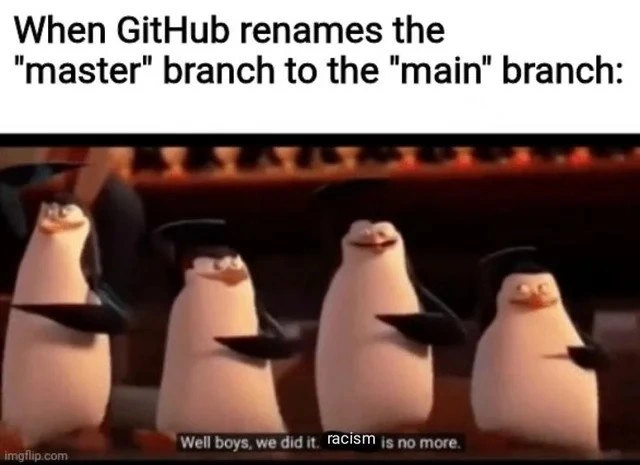
Now, why is there a meme about this? Well, 2020 was a year with a lot of conversation about racial justice and inclusivity, not just in society but within the tech community too. Developer communities (on forums, Twitter, etc.) were debating how to make tech more welcoming. Changing terminology was one of the simpler actions taken. The meme uses an image from Penguins of Madagascar. In that scene, the penguins say, “Well boys, we did it. Racism is no more.” This is a popular meme format used online whenever someone does a small or token action and people jokingly claim a huge problem has been solved. Here, the small action is renaming “master” to “main”. The huge problem is racism. The meme caption (white text at the top) explicitly sets up the scenario: “When GitHub renames the ‘master’ branch to the ‘main’ branch:” and then the penguins proudly declare the sarcastic punchline at the bottom.
For a junior developer, the humor might also come from how naming conventions in programming often cause surprising debates. There’s an old joke: “There are two hard things in computing: cache invalidation, naming things, and off-by-one errors.” Naming might seem trivial (it’s just words), but names carry meaning and history. In this case, changing a long-standing name (master) was a pretty big deal in the community. Some people welcomed it as a positive change for inclusivity. Others were confused or annoyed, seeing it as unnecessary or as corporate posturing. The meme leans on the latter perspective, humorously suggesting that some folks acted like this change would magically erase a social issue. It’s a form of ironic commentary – basically saying “okay, we did this small thing, problem solved…not!”
The penguin characters make the message lighthearted. Instead of a serious lecture, it’s a goofy scene of cartoon penguins being overly self-satisfied. This exaggeration helps newer devs recognize the joke: obviously, just renaming a branch doesn’t actually solve racism. The meme is not really mocking the idea of inclusive language itself (most developers agree that being respectful in language is good), but it’s poking fun at the overconfidence or oversimplification that sometimes happens. It reflects a bit of skepticism common in developer culture: devs often appreciate genuine solutions and can sniff out when something is more of a PR move than a real fix.
In communities of developers (DevCommunities as we tag them), this became a memorable event. If you hang around open-source circles or tech Twitter, you might recall discussions, blog posts, and yes, plenty of memes in mid-2020 about this very topic. Now “master vs main” is also a practical thing a junior dev might encounter: if you fork an older GitHub repo, it might still use master, whereas new ones use main. So you end up learning both names. But beyond the practical, this meme gives you a little peek at DeveloperCulture and humor: it shows how devs use memes to comment on the intersection of technology and social issues. It’s like an inside joke about how a change in our tools relates (or doesn’t relate) to changes in the real world.
Level 3: Symbolic Fix Committed
They say there are two hard things in computer science: cache invalidation and naming things. In mid-2020, GitHub tackled one of those by renaming the default version control branch from master to main as an act of inclusive language. The meme shows this move being met with tongue-in-cheek triumph. Four animated penguins (from Madagascar) stand proudly with flippers on hearts, declaring:
"Well boys, we did it. racism is no more."
This sarcastic punchline nails the absurdity of celebrating a superficial fix as if it ended a deeply entrenched problem. Seasoned developers immediately recognize the dark humor: changing a branch name in Git is a quick config tweak, yet the meme pretends it's a world-changing victory. The joke highlights how tech communities sometimes over-index on symbolic changes while neglecting systemic issues.
In the Dev Communities around that time, there was widespread discussion about removing racially loaded terminology. The master_to_main change was one high-profile example, arriving amid global conversations on racial justice. By 2020, many software projects had started purging terms like "master/slave" and "whitelist/blacklist". These efforts were well-intentioned gestures toward a more welcoming developer culture, but folks who’ve been around the block couldn’t help noticing the performative aspect. It’s the kind of corporate virtue signal that prompts a veteran’s smirk: rename a branch today, take a victory lap tomorrow. Meanwhile, the harder work — improving diversity, addressing bias in hiring, fostering inclusive environments — remains unsolved by a mere git push.
Technically, the master branch was simply the default branch name created by Git (a convention dating back to Git’s creation). Unlike the term “master/slave” used in databases or electronics, Git’s master wasn’t explicitly paired with a “slave” concept; it just meant the main line of development. Even so, in the wake of real-world events, GitHub (and other platforms like GitLab and Bitbucket) chose to adopt main as the new default to avoid any unintended cultural baggage. This change required minimal code adjustments (maybe a one-time git branch -m master main to rename), but it had outsized symbolic weight. Once GitHub flipped the switch, new repositories would start on main automatically. Many saw this as progress in DeveloperCulture, while others saw it as too little, too late or misdirected effort.
The meme’s humor comes from that disconnect between intention and impact. The penguins’ exaggerated self-congratulation mocks the idea that renaming a branch could eradicate racism. It’s a playful jab at tech’s occasional habit of treating a nomenclature update like a grand victory over societal ills. Every experienced dev knows the feeling of management implementing a feel-good change that doesn’t actually fix the underlying problem. Here, the shared tongue-in-cheek trauma is watching companies pat themselves on the back for addressing InclusiveLanguage in documentation or code, while the real issues (like lack of representation or bias) persist in the background. The meme encapsulates that collective eye-roll.
To put it in perspective, here are some common terminology changes from that period:
| Outdated Term | Inclusive Alternative | Rationale |
|---|---|---|
master (Git branch) |
main (Git branch) |
Avoid possible slavery connotation |
| master/slave (replicas, threads) | primary/replica or leader/follower | Removes explicit slavery terminology |
| whitelist/blacklist | allowlist/blocklist | Avoid equating white=good, black=bad |
These changes were often merged as tiny commits in codebases, sometimes accompanied by commit messages like "refactor: rename whitelist to allowlist", and inevitably a round of developers humorously commenting "racism has been defeated in our code!". The reality is, of course, more complex. NamingConventions do carry weight — language can influence mindset, and using neutral terms is a positive step. Yet, veteran engineers know that real change requires more than a few substituted words. The meme leverages that insider knowledge: it’s funny because it’s true that sometimes tech firms make symbolic commits and then act as if they merged a solution to a centuries-old problem into main.
In short, the meme resonates with senior devs as a satirical commentary on tech’s occasional self-congratulatory streak. We chuckle (perhaps a bit cynically) because we recognize how often corporate initiatives address surface issues (like a branch name) rather than committing to the long-haul work. Just as every on-call veteran knows a 3 AM outage isn’t fixed by a pretty status page alone, every seasoned dev knows racism isn’t fixed by a repo rename. The penguins celebrating a hollow victory? That’s basically a snapshot of our collective side-eye whenever leadership proclaims, “Problem solved!” after doing the bare minimum.
Description
A meme sarcastically commenting on GitHub's decision to rename the 'master' branch to 'main'. The top text reads, 'When GitHub renames the "master" branch to the "main" branch:'. Below this is a still image from the movie 'Madagascar', featuring four penguins. A subtitle at the bottom says, 'Well boys, we did it. racism is no more.' The original word 'racism' is crossed out and the meme uses it to mock the perceived performative activism of the name change. It captures the cynical sentiment of some developers who felt that changing a technical term did little to address actual systemic issues of racism, viewing it as a hollow corporate gesture that ultimately solved nothing
Comments
7Comment deleted
I tried to push to 'master' and my terminal just staged an intervention. Now it's making me write a thousand lines of 'I will use inclusive terminology' before it lets me commit to 'main'
GitHub renamed ‘master’ to ‘main’ in 5 seconds; it took two sprints of senior time to hunt 300 hard-coded origin/master refs across Bash scripts, Jenkins, and Terraform - DEI by grep-and-replace
Meanwhile, the same team is still debating whether to fix the race condition that's been corrupting production data for three years
Ah yes, the great master-to-main migration of 2020 - where thousands of CI/CD pipelines broke, deployment scripts failed, and junior devs spent weeks updating hardcoded branch references in legacy codebases. Meanwhile, senior engineers quietly updated their .gitconfig with 'init.defaultBranch=main' and watched the chaos unfold, knowing full well that the real systemic issues in tech hiring, retention, and culture would require slightly more than a find-and-replace operation
GitHub slayed 'master' branch racism with a config tweak - meanwhile, our monorepo's merge conflicts laugh in eternal oppression
Renaming master→main took 10 minutes; undoing hardcoded origin/master across Actions, Jenkinsfiles, and release bots took the sprint
GitHub’s rename from “master” to “main” took 5 seconds; our estate took two sprints to evict origin/master from Jenkins, Helm, Terraform, and a 2am cron - turns out branch names are part of the architecture