That 'git blame' Moment of Panic
Why is this VersionControl meme funny?
Level 1: Caught with the Cookies
Imagine you and your sibling ate some cookies you weren’t supposed to. Crumbs are on the counter, and one of your parents comes into the kitchen and says, “Who ate these cookies? I’m checking the security camera.” Now, you suddenly get that wide-eyed, nervous look. You glance sideways and then away, hoping they don’t catch you, because you know the camera will show it was you who opened the jar. In this meme, the senior developer is like the parent checking the camera, and the junior developer is like the kid who ate the cookies. The “camera” in this case is a computer command (git blame) that shows who last touched the code (just like a camera shows who took the cookies). The funny monkey puppet with the side-eye is acting out the junior developer’s guilty “uh-oh, I’m busted” face. It’s funny because we’ve all been that person at some point – caught red-handed by evidence, and desperately trying to look innocent!
Level 2: Version Control Detective
Let’s unpack the joke in simpler terms. In software teams, developers use Git, a popular tool that keeps track of all the code changes. This kind of tool is called a version control system — it’s like a big save history for the code, remembering who made each change and when. One handy (and humorously named) command in Git is git blame. Despite its name, it’s not about yelling at someone; it literally annotates each line of code with the name of the person who last changed that line. Think of it as asking “who touched this last?” for every line in a file.
Now, picture a Senior Developer and a Junior Developer working together. The senior has a lot of experience and might be mentoring others. The junior is newer to the team and the codebase. Suppose something in the program has broken – there’s a bug (an error in the code causing things to go wrong). The senior wants to find out which change introduced the bug. To do this, they open a terminal (command prompt) and run git blame on the file that seems to have the issue. The terminal output will show each line of that file prefixed with information about the last commit that changed it, including the author’s name. In our meme text, when it says:
Senior Dev:
$ git blame
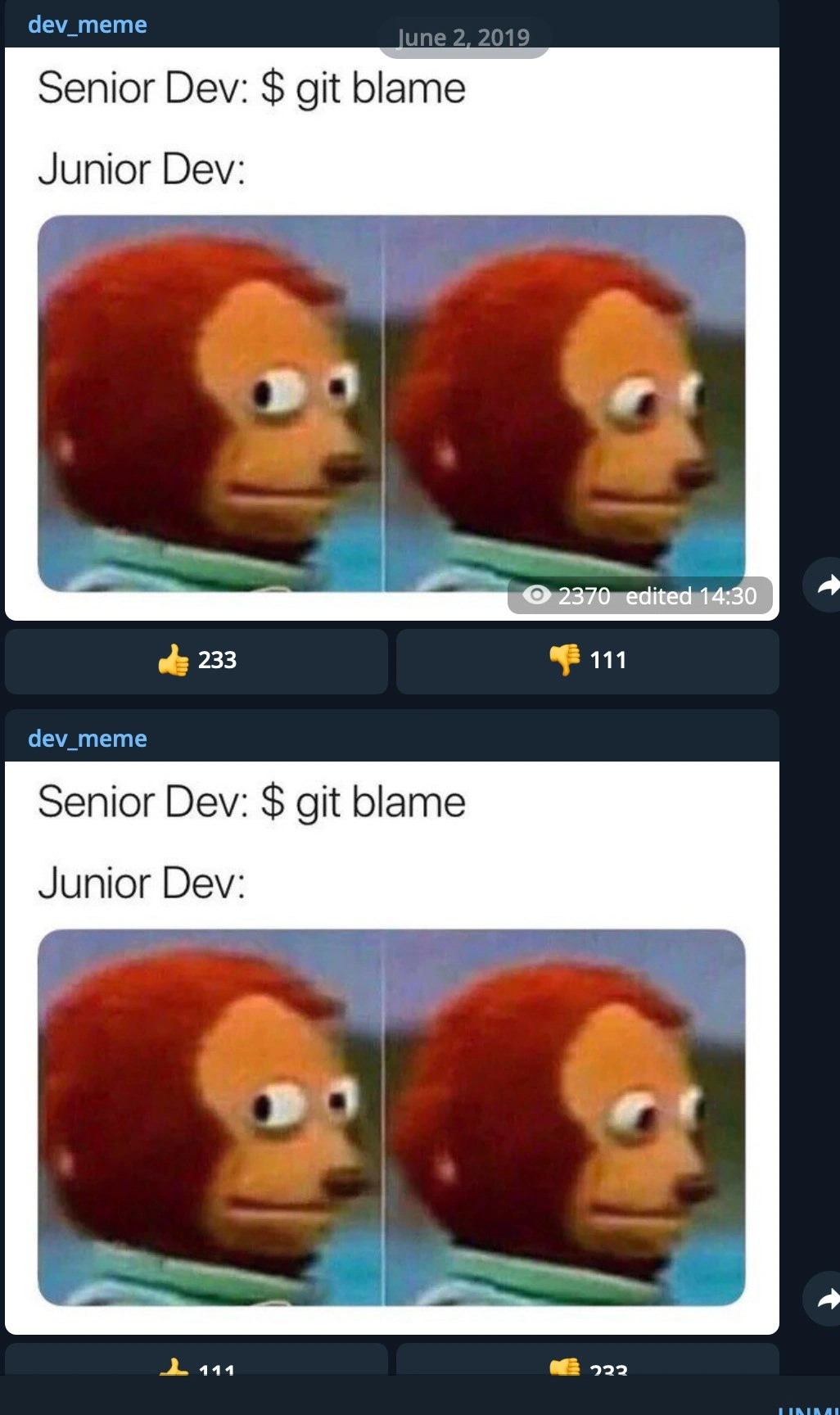
Junior Dev: [side-eye monkey puppet]
…it’s describing exactly that situation. The senior executes the blame command to see the author of a problematic line, and the junior developer reacts with dread. Why? Because the junior strongly suspects that the "blamed" line — the one causing the bug — is going to have their name on it!
The image used is the famous “awkward look monkey puppet” meme, a two-panel picture of a puppet monkey. In the first panel, the monkey’s eyes are shifting to the side, and in the second, the monkey is looking away with an embarrassed or guilty expression. It’s an image often used online to humorously depict someone who realizes they’re caught or involved in an awkward situation and then tries to act casual or hide. Here, the junior developer is that monkey. As soon as the senior starts the blame command, the junior gives that side-eyed, nervous look — basically thinking, “Uh oh… I think I’m about to get called out for this bug.”
This is a relatable developer experience because many people who write code have been in the junior’s shoes. Maybe you wrote something a few weeks ago that’s now causing errors, and a teammate says, “Who wrote this part? Let’s check.” Even if no one is actually angry, it’s natural to feel a bit scared or embarrassed when your mistake is under the spotlight. The term “git blame” itself sounds like you’re assigning blame, even though in practice it’s meant to find information, not to shame. That’s why it’s perfect for a joke: it mixes a technical action with the human reaction of feeling guilty.
So, summarizing the fun: the senior developer is using a tool to find out who last edited a piece of buggy code. The junior developer realizes they’re likely the one who wrote that code. The junior doesn’t say anything in the meme; instead, we see the monkey puppet’s anxious sideways glance and then looking away, as if the junior is silently thinking “please don’t let it be me… oh no, it is me.” This contrasts the calm, investigative senior with the nervous junior — a classic Senior vs Junior developers humor setup. Anyone who’s been new on a programming team can chuckle (or cringe) at this because it’s a situation that feels so familiar. And even if you’re not a coder, you can relate to that feeling of being caught when someone checks the records and discovers your slip-up.
Level 3: Git’s Got Receipts
Git is a powerful distributed version control system that tracks every change in your codebase—like an eternal ledger of who did what. The command git blame taps into this ledger to show, line by line, who last modified each part of a file (and when). In this meme scenario, a Senior Dev invokes $ git blame on a suspect file, effectively launching a forensic investigation into a bug. It’s a moment seasoned engineers know well: when a production issue pops up, you dig through commit history to pinpoint the exact commit (and author) responsible for the broken line. Git obliges by printing out the name of the culprit next to each line of code. In other words, Git’s got receipts – every line of code carries the metadata of its most recent author, so there’s no hiding from the version control detective.
Here, the infamous “awkward side-eye monkey puppet” reaction image perfectly captures the junior developer’s uh-oh moment. The humor comes from how relatable this is: the instant the senior runs git blame, the junior realizes their name is about to pop up beside that buggy line. It’s a comedic exaggeration of a common Senior vs Junior Developers dynamic. Every experienced dev has witnessed (or lived) this scenario — the blame game where the tool literally points a finger by naming the last editor of the code. We joke about it, but it highlights a real tension: on one hand, git blame is just a tool to trace code history; on the other, its very name implies finger-pointing. Teams preach blameless post-mortems, yet here we are with a Git subcommand actually called “blame.” 😅
Let’s break down why this triggers the monkey puppet’s side-eye. Imagine there’s a nasty null-pointer exception in UserService.java. The senior opens a terminal, navigates to the repository, and runs something like:
$ git blame UserService.java -L 237,237
3fae2c9a (Alice 2021-08-10 17:14:22 +0200 237) if (user == null) throw new IllegalStateException("No user");
In this GitBlame output, Git reveals that line 237 was last modified in commit 3fae2c9a by Alice on Aug 10, 2021. If that line is throwing the error, the senior instantly knows who wrote it. In a real-world debugging session, this can be incredibly useful: the senior might call Alice over to ask, “Hey, what was the intent here? Any idea why this might be failing?” But in the meme world, the focus is on the Junior Dev’s perspective — Alice is the junior, and the second she hears her senior say “git blame”, her eyes widen like the monkey puppet’s. Everyone in the room (or chat) is about to see her name attached to the broken code.
The double-post image with flipped 👍 233 / 👎 111 reactions even adds a meta-joke: the meme was so on-point it got reposted, receiving opposite reaction counts. It’s as if one crowd found it hilariously relatable (all those who’ve been the guilty junior), while another group perhaps cringed in sympathy. The developer humor here works because it satirizes a truth of coding life: version control tools can surface our mistakes for all to see. The awkward look monkey embodies that split second of panic and embarrassment a junior feels when the ownership of a bug is about to be revealed. It’s a rite of passage in programming teams — sooner or later, your commit is the one in the spotlight. And trust me, even the seniors giving you the side-eye have been in your shoes; they just get to play detective this time around.
Despite the playful shaming, experienced devs know not to truly witch-hunt. Good teams use git blame to understand context, not to literally blame in a personal way. But the meme banks on the word “blame” and that universal “not me… right?” feeling. It’s a lighthearted poke at how bugs are often discovered: not by mystical insight, but by checking the revision history. And when the history points to you, well, cue the puppet’s uneasy side glance. In summary, the humor stings a bit because it’s true: VersionControl remembers everything, and the moment a senior goes digging, every junior silently prays their name doesn’t come up. If it does, you get that heart-sink moment perfectly captured by our wide-eyed monkey friend.
Description
This meme captures a universally relatable moment for developers, especially junior ones, using the 'Awkward Look Monkey Puppet' meme format. The scene is set up with two lines of text: 'Senior Dev: $ git blame' and 'Junior Dev:'. Below the text is the two-panel image of the monkey puppet looking forward blankly and then nervously darting its eyes to the side. The humor lies in the visceral reaction of anxiety that the command 'git blame' can induce. While its technical purpose is to show who last modified each line of a file to gain context, its name implies accusation. For a junior developer who is often less confident about their code, the senior's use of this command immediately triggers a fear that a mistake they made is about to be uncovered
Comments
19Comment deleted
Seniors use 'git blame' to find the author. Juniors hear 'git blame' and immediately start preparing their defense statement. The truth is, 90% of the time the senior finds out they wrote the buggy code themselves six months ago
Relax, junior - `git blame` usually finger-points the last person who ran Prettier, not the one who smuggled the N+1 query into the loop
The real senior dev move is aliasing 'git blame' to 'git praise' in the junior's bashrc, then watching them confidently run it during the next production incident retrospective
The beauty of `git blame` is that it's both a debugging tool and a psychological warfare device - senior devs use it to trace code lineage, while junior devs experience it as an existential audit of every questionable decision they've ever committed. It's the only command where the output is simultaneously a file annotation and a performance review
When the staff engineer runs 'git blame -w -M -C', you learn mass reformat commits are not a witness protection program
Git blame: terrifying until you remember -w and --ignore-rev - then it stops blaming the intern who ran Prettier and points back to your 2014 “temporary” hotfix turned core feature
Git blame: where juniors' commits glow brighter than a fresh prod outage trace
Ahahaha Comment deleted
??? Comment deleted
Why twice the same pic? Comment deleted
Likes They are reversed in second post Comment deleted
no, they are not Comment deleted
Yes, they are Comment deleted
And why that matter? Comment deleted
I guess…..More Juniors learn what blame is after Comment deleted
Do you mean that’s natural the exact inverse distribution? Or is it some sort of a trick? Comment deleted
this just means that there are more of juniors now Comment deleted
Junior Dev: $ git blame Senior Dev: (same pic) Comment deleted
Number of 👍 and 👎 Comment deleted