The Disappointing Web Server at Home
Why is this Microsoft meme funny?
Level 1: Mom Means Well
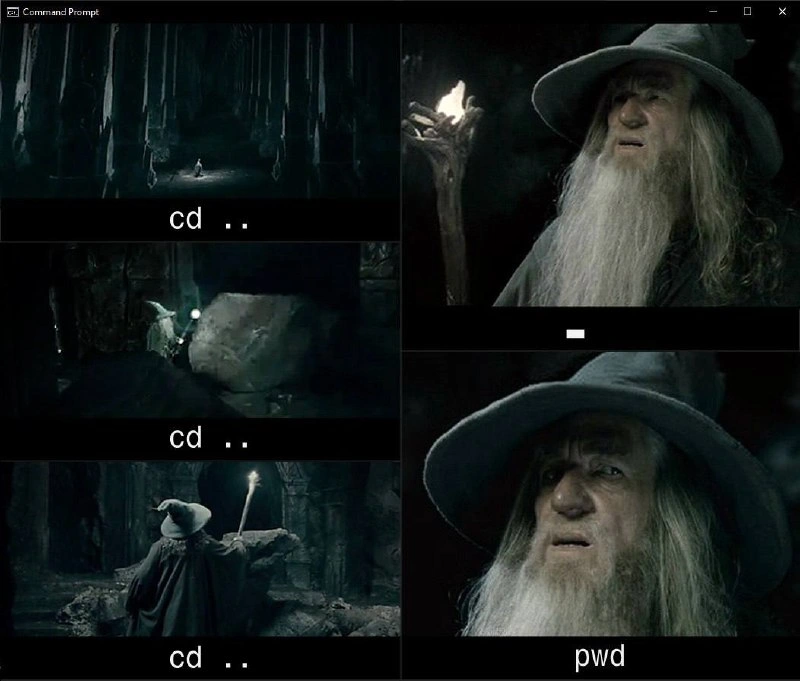
Imagine you ask your mom for the latest, coolest toy that all your friends have. Instead of buying it, she says, “We have a toy at home,” and hands you a dusty old toy from the attic. She thinks it’s the same thing, but you’re a bit disappointed because it’s not what you wanted. In this meme, the cool toy the kid asks for is a big shiny web server (something popular and exciting), and the toy at home is an old Microsoft web server called IIS. Mom isn’t trying to be mean – she just doesn’t see the difference. It’s funny (and a little exasperating) because the kid (like a modern developer) knows the old toy isn’t as fun, but hey, to mom (like an old-school boss), it still counts as a toy. Mom means well, but the kid sighs, knowing the “at home” version will never be quite what they hoped for.
Level 2: House Special: IIS
Let’s break down the joke for those newer to WebDevelopment or not familiar with the meme format. The conversation in the image goes like this:
Kid: “Mom, can we get a web server?”
Mom: “We have a web server at home!”
Narrator: The web server at home: Microsoft IIS (Internet Information Services)
This is a popular meme structure where the “web server at home” is usually a disappointing or funny substitute for what the kid really wants. It’s like if you asked for a new game console and your mom said, “We have a game console at home,” but the one at home is an old, dusty machine that nobody actually wants to play. In this meme, the kid (or by analogy, a developer) presumably wants a modern web server – probably something open-source and widely loved like Apache or Nginx. These are well-known web servers that run a huge chunk of websites on the internet.
Now, what’s a web server? In simple terms, a web server is software (and the hardware it runs on) that stores web pages and sends them to users over the internet when they request them. When you type a website URL, a web server is what sends back the HTML, images, and data to your browser. Common examples are:
- Apache HTTP Server – an open-source web server that’s been around since the mid-90s, very popular in the Linux world.
- Nginx (pronounced “Engine-X”) – a newer open-source server (from the 2000s) known for its high performance and ability to handle lots of simultaneous connections efficiently.
These two (Apache and Nginx) are like the cool, popular kids of web servers in the developer community. They’re free, community-supported, and run on Linux, which developers love for servers. When a developer says “can we get a web server,” they likely mean setting up one of these or something similar that’s modern and well-supported.
Now enter Microsoft IIS. IIS, short for Internet Information Services, is Microsoft’s own web server software that runs only on Windows servers. It’s been around a long time too (since the ’90s as part of Windows NT). IIS is often used in companies that use a lot of Microsoft tech, like websites built with ASP.NET or other Windows-based frameworks. If Apache and Nginx are the popular open-source choices, IIS is the old family recipe that Microsoft shops use. It’s a fully functional web server – it can host websites, web applications, APIs, you name it – but it’s proprietary (closed-source) and pretty much tied to the Windows operating system. So you usually see IIS in corporate or enterprise environments that are heavily invested in the Microsoft ecosystem (Windows Server, SQL Server, .NET, etc.).
The meme implies that the kid wanted a “real” web server – to the kid (developer), that means something like Apache or Nginx on a nice Linux server, which is what they’ve learned is standard in modern web development. But the mom (or the boss/IT admin) responds that “We have a web server at home”, pointing to IIS. This suggests that the mom/boss doesn’t see the difference – to them, IIS is also a web server, so why get a new one? It’s like a mom saying, “Why buy fancy new sneakers? You have perfectly good shoes at home,” but the kid knows those are old and full of holes.
For a junior developer or someone new to backend, here’s why it’s humorous: within developer circles, IIS has a bit of an old-school or uncool reputation compared to its open-source counterparts. It’s not that IIS doesn’t work; it’s that using it can sometimes be a pain or limiting unless you’re specifically in a Microsoft environment. For instance:
- Configuration: Apache and Nginx are usually configured by editing text files (
httpd.conffor Apache,nginx.conffor Nginx) which is very developer-friendly and can be version-controlled. IIS often involves clicking around in a GUI (Graphical User Interface) tool called the IIS Manager, or editing an XML file (Web.config) with lots of Microsoft-specific settings. Many devs find that less convenient or intuitive. - Platform: Apache and Nginx run on Linux (though they can run on Windows too, it’s less common). Linux servers are popular for being stable and cost-effective. IIS requires Windows Server. That means you’re often dealing with licensing costs and the Windows way of doing things. If you’re a new dev who learned on free Linux-based stacks, IIS can feel like unfamiliar territory.
- Community & Support: Search for help on Apache or Nginx, and you’ll find tons of answers on forums like Stack Overflow. Search for an obscure IIS error, and you might find fewer folks who encountered it (unless they’re also Windows admins). The open-source tools benefit from huge communities. IIS’s community is smaller (though Microsoft does have documentation).
So the meme exaggerates this divide in a tongue-in-cheek way. It’s basically BackendHumor: “Haha, imagine wanting to use the shiny new tech, but your environment is stuck with this old Microsoft server.” This resonates with developers who have had that exact experience when working at a place with older tech. That’s why the tags mention legacy_enterprise_stack – IIS often represents legacy enterprise technology in these jokes, and it’s contrasted with the newer or more beloved open tools.
And about the meme format (“mom_can_we_get_x_template”): This is just a joke format where the structure always goes:
- Child asks for something mainstream or desirable.
- Parent says, “We have that at home,” implying there’s no need to get the new thing.
- The last line reveals that the version at home is a crappy or funny version of the desired thing.
In our case: The desired thing is a modern web server (not explicitly named, but we can assume Apache/Nginx or just any non-IIS server). The at-home version is Microsoft IIS, shown with that old Windows logo. The humor comes from recognizing that IIS is being portrayed as the lame substitute. For a junior dev, it’s like an inside joke: once you’ve seen how projects can get stuck on older tech, you’ll get why the “web server at home” being IIS is a wink-wink, nudge-nudge moment. It’s saying “this is the house special your well-meaning but out-of-touch parent (or company) gives you, even if it’s not what you asked for.”
Level 3: The Legacy Surprise
It’s a classic case of developer expectations vs. enterprise reality. The meme uses the familiar “Mom, can we get X? We have X at home” template to deliver some biting TechHumor about web servers. Here, X is a “real web server” – which any seasoned backend developer in 2021 would read as “please, can we use the cool modern web server (like Nginx or Apache)?”. But the WebDev punchline: “We have a web server at home” – and at home it’s Microsoft’s IIS (Internet Information Services). Cue the groans and laughter from Backend engineers who’ve been there. The joke paints IIS as the unwanted off-brand substitute, the legacy enterprise stack you didn’t ask for but got anyway.
Why is this funny to experienced devs? Because it satirizes a too-real scenario in corporate IT environments. Imagine a developer eagerly proposing a sleek new Nginx deployment for a project – known for its high performance and lightweight footprint – only to have a manager or sysadmin respond: “Why bother? We already have IIS running on our Windows servers. It works, doesn’t it?” It’s the legacy technology surprise that many BackendDevelopment teams face: you ask for the industry’s favorite tool, but your company defaults to whatever is already bought, paid for, and sitting on a shelf pre-installed on a Windows box. In other words, “We have a web server at home.”
This hits on an unspoken shared experience. A lot of us “grew up” in tech hearing about the power of open-source web servers – the famous LAMP stack (Linux, Apache, MySQL, PHP) or newer Nginx setups – only to land a job where the production site is served by IIS on a Windows Server that probably still has IE 9 installed for compatibility. 😅 The meme humorously frames IIS as the at-home web server: technically a real web server, but not the one the kid (the developer) was dreaming of. It’s like being promised a sports car and getting a reliable old family sedan instead. Sure, it’ll get you there, but it’s not exactly fun or trendy. The BackendHumor here comes from that contrast between what developers want vs. what corporate IT provides.
From an industry perspective, this image pokes fun at Microsoft’s footprint in enterprise backend infrastructure. IIS was huge in the early 2000s on Windows Server environments (ASP.NET, anyone?). But among many modern web developers, it’s seen as a relic of a bygone era – something you only use if you have to (maybe because the app is tied to Windows/.NET Framework) or because someone high up insists “We’re a Microsoft shop.” Meanwhile, open-source servers like Apache HTTP Server and Nginx became the community favorites – they’re free, community-supported, and run on Linux, which powers most of the web. This meme playfully jabs at the Microsoft stack for being the default in some traditional shops despite cooler alternatives. It’s a poke at the old guard: “Yes mom, IIS counts as a web server… but it’s not the one we wanted!”
There’s also a layer of sarcasm directed at the notion of “IIS counts as a real web server.” Seasoned devs know IIS is perfectly capable – it’s a fully-featured web server that can host websites and APIs. It powers plenty of corporate intranets and older web applications. But the meme’s tone suggests a collective eye-roll, as if saying: “Sure, IIS works… if you enjoy dealing with GUI wizards, weird config XML, and that one Web.config setting that takes down the site.” It’s the kind of dark humor a Cynical Veteran might chuckle at, recalling past 3 AM on-call incidents:
- Deployment woes: Ever tried deploying a PHP app on IIS? Or configured classic ASP.NET apps via the IIS Manager GUI with dozens of checkboxes and mysterious options? Experienced devs have, and it’s never as straightforward as the equivalent on Apache/Nginx.
- Configuration nightmares: The meme dredges up memories of the Metabase, ISAPI filters, and other IIS quirks. In contrast, a simple
nginx.conftext file feels like a breath of fresh air. - “Works on my machine” syndrome: Many devs test on a lightweight server (maybe using Node.js or Python’s simple server) and then struggle when moving to IIS in staging/prod because of differences in request handling, file permissions, or ASP.NET configuration.
- Security and patches: Old IIS versions had infamous vulnerabilities (some folks still shudder at the word Code Red – a virus from 2001 that specifically ravaged IIS servers). Keeping an IIS server secure meant constant patching via Windows Update. Meanwhile, Apache/Nginx communities were quickly patching and iterating in the open.
By referencing the "web server at home" as IIS, the meme is calling out legacy tech in a modern world. It’s making light of that generational gap in tech stacks: newer devs idolize open-source tools, while old-school IT departments stick with the familiar Microsoft ecosystem. Everyone in WebDevelopment has at some point encountered a project or company still running on an older stack and had that “Oh... we’re doing it that way” moment. This meme nails that feeling in one image.
In short, the humor comes from contrast. It’s not just IIS vs. Nginx, it’s Corporate IT mentality vs. Developer desire. The mom in the meme represents the well-meaning boss or IT lead who insists that the Microsoft solution we already paid for is “just as good” as the shiny new thing. The child represents the developer who knows that, while IIS will serve web pages, it might come with baggage (proprietary tie-ins, less community love, Stack Overflow answers that all say “Have you tried turning it off and on again in the Management Console?”). It’s classic BackendDeveloper humor: if you know, you know – and if you’ve been burned by maintaining an IIS server when all you wanted was the simplicity of Nginx, this meme hits home (literally at home, where IIS is lurking).
Description
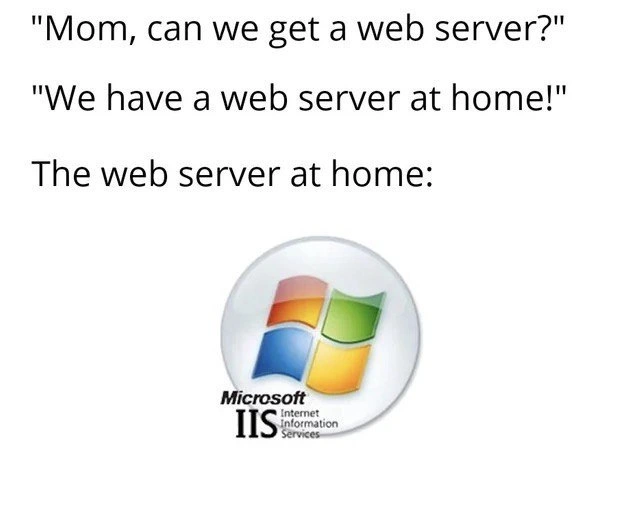
This meme uses the popular 'Mom, can we get...' or 'We have food at home' format to poke fun at Microsoft's web server software. The text on a plain white background reads: 'Mom, can we get a web server?', followed by the reply 'We have a web server at home!'. The punchline is delivered below the text 'The web server at home:', which reveals the logo for Microsoft Internet Information Services (IIS). The humor stems from the widespread perception in the developer community that IIS is a less desirable, more cumbersome, or outdated option compared to more popular and modern alternatives like Nginx or Apache. It's the 'generic brand' substitute that your mom buys, capturing the feeling of disappointment when you're stuck with a tool you'd rather not use, especially in corporate environments where it's often a mandated choice
Comments
21Comment deleted
The 'web server at home' is when you ask for a lightweight, configurable reverse proxy and your mom gives you a full-blown Windows Server GUI where you have to click through five wizards to bind a SSL certificate
We tried to sunset that IIS box in 2011 - turns out the CFO’s bonus calculator is still a classic ASP page hard-wired to MAPI, so yeah… it’s staying until IPv4 retires first
The real joke is explaining to your CTO why the production IIS server needs a reboot every Tuesday for Windows Updates while your nginx containers have been running untouched since 2019
The real tragedy isn't IIS itself - it's discovering your 'web server at home' requires a Windows Server license, CALs for each user, and a 47-step wizard just to serve a static HTML file. Meanwhile, your colleagues spun up Nginx in a Docker container with a three-line config file while you were still reading the IIS documentation on application pool recycling intervals
We asked for Nginx; got IIS - the web server where “config as code” is screenshots of MMC, 503s mean an app pool took a nap, and 401s are just Kerberos SPN roulette
You asked for nginx; procurement heard “we already own Windows Server,” so now you’re writing regex in web.config and chasing 500.19s after every app pool recycle
IIS at home: Because nothing screams 'lightweight homelab' like mandatory Windows Authentication and a side of RDP vulnerabilities
Lol what is wrong with iis? Comment deleted
literally everything :D Anyway, I love exploits for iis too Comment deleted
Wait IIS is a payed stuff and has commonly known exploits? Comment deleted
I don't know many of them since 2017 but still remember like 2017-7269 , just because of era of wanna cry ms17-010 it was interesting for me for playing, just for fun) Comment deleted
Lol Comment deleted
I will very soon host my own server if you want to attack it I will tell you when its live. Even crashing it counts as "success" Comment deleted
No one will care Comment deleted
Noone asked you Comment deleted
I do though Comment deleted
You can attempt to crash literally any server on the internet Comment deleted
so? I know @ZgGPuo8dZef58K6hxxGVj3Z2, so I can directly talk to him if I find anything plus it's more of a challenge between friends. Comment deleted
Everything. Overcomplicated config. Extremly bad logging. Unpredictable lagspikes, lack of options and flexibility etc etc. Comment deleted
Alternatives? Apache? Comment deleted
Nginx Comment deleted