The True Nature of 'git blame'
Why is this VersionControl meme funny?
Level 1: Caught Red-Handed
Imagine you come home and the cookie jar is empty, with crumbs all over the counter. Your mom isn’t sure who took the cookies at first. But then she spots your little brother with chocolate smeared on his face and cookie crumbs on his shirt. Aha – he’s caught red-handed! In a simple way, that’s what this meme is showing, but with computer code: it’s funny because it’s like the computer found out exactly which person “ate the cookies” (made the mistake in the code) and is holding them up for everyone to see. Even if you don’t know anything about programming, you can laugh at the idea of someone being clearly found out for making a mess, just like a kid caught with their hand in the cookie jar.
Level 2: Git Detective Mode
Let’s break this down in simpler terms. Git is a popular tool for version control, which means it keeps track of changes in code over time. Think of it like an ever-growing save file for your project: every time you make changes, you create a commit (a recorded snapshot of the code at that moment). Each commit has an author (the person who made the change) and a timestamp.
Now, git blame is a command that acts like a detective in this version control history. When you run git blame on a file, it will list out each line of that file alongside information about the last commit that modified that line. In other words, it tells you who last changed each line and when they did it. Developers use this during debugging (when trying to fix a bug – an error in the code) to figure out who might know more about that piece of code or to find the commit that introduced a problem.
For example, imagine you discovered a strange behavior in your program and suspect the issue comes from a specific line in app.py. You could run:
$ git blame app.py -L 15,15
^2f3c9e8 (Alice 2021-11-20 09:30:00 -0500 15) buggy_line = fixOffsets(data) # Who wrote this?
This output means that line 15 of app.py was last changed by Alice on November 20, 2021 (the long string ^2f3c9e8 is an identifier for Alice’s commit). The code snippet shows the content of the line (buggy_line = fixOffsets(data)) with a comment I added just wondering "Who wrote this?". In a real scenario, you might run git blame without the -L (line limit) to see info for all lines, or use a graphical interface that highlights the author of each line in the margin.
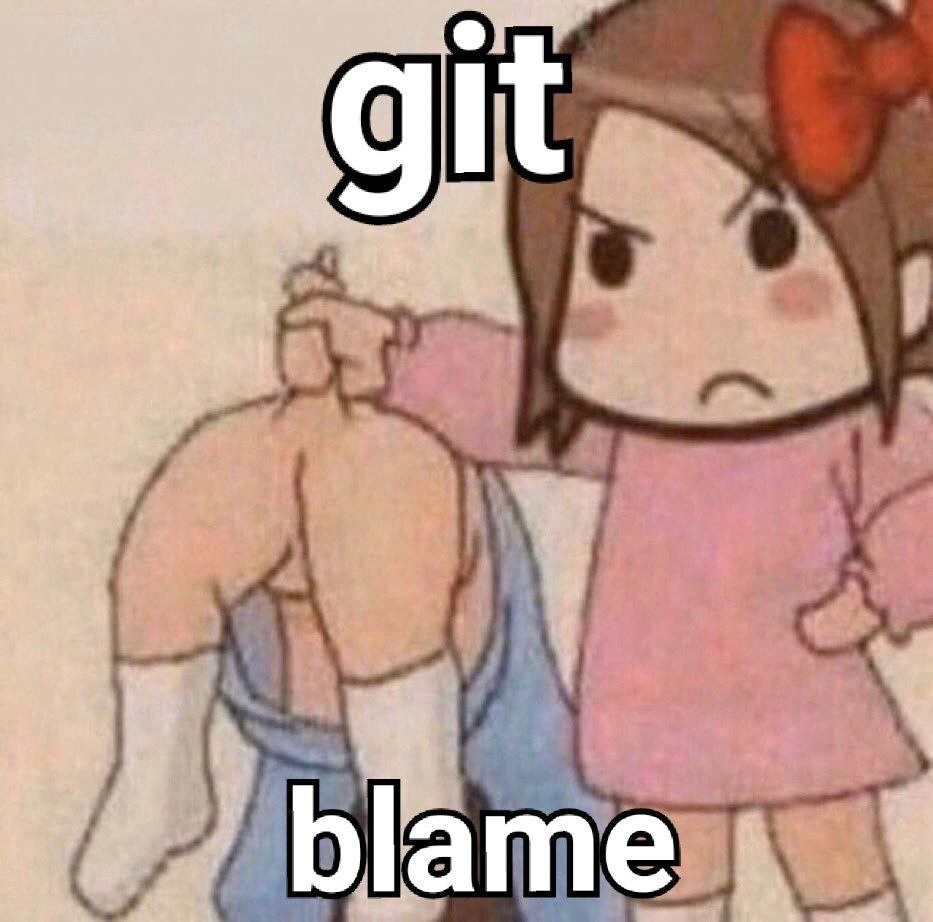
So why is this funny? The meme takes the phrase "git blame finds the culprit" and makes it literal. In the picture, there’s a small angry girl labeled "git", and she’s holding a child upside down. That poor upside-down child stands in for the developer who is at fault. It’s a cute anime-style way to show Git investigating and catching the code culprit. The girl’s face is fuming, just like a frustrated programmer who’s found out which change caused a problem. The kid being dangled is like the programmer who wrote that change, getting caught red-handed (or maybe red-keyboard-ed?).
In a real software team, people sometimes joke about using git blame to play the "blame game" – finding out which teammate wrote a bug. Of course, in a healthy team this isn’t done to actually shame anyone, but rather to figure out context or who might best fix it. Still, the command’s name sounds like you’re pointing fingers. (Fun fact: some other tools call this feature annotate or even praise instead of "blame", because the word "blame" is a bit harsh!) But since Git is so widely used, everyone knows what git blame means: it’s the quickest way to check the history of a line and see who to ask about it.
In this meme scenario, git blame is depicted as an actual physical blame game: Git (the tool) has effectively grabbed the author of the problematic code by the collar (or well, by the overalls) and is ready to scold them. The humor comes from recognizing that feeling when you finally identify the source of a bug – you might jokingly say “aha, gotcha!” to the code or the colleague who wrote it. It’s exaggerated, of course; in real life we don’t literally dangle our co-workers upside down when a bug is found! But the image is a playful, lighthearted way to visualize a very common experience in programming: that mix of frustration and triumph when you track down exactly where things went wrong and who was behind it.
Level 3: The Repo Interrogation
git blame can feel like a line-by-line crime scene investigation in your version control history. The meme’s anime-style interrogation perfectly captures that moment in debugging when a developer runs git blame to hunt down the commit responsible for a bug. In the image, the small girl in pink is labeled 'git', and she’s literally holding the suspect (the dangling child) upside-down, just like a senior dev might zero in on a suspicious commit and metaphorically shake answers out of it.
For seasoned engineers, this scenario is hilariously relatable. You discover a nasty bug in production and immediately play the blame game: "Who wrote this line?!" Instead of a magnifying glass, we have the git blame command acting as our detective. It prints out each line of code with the commit hash, author, and date – effectively naming the suspect for every line. When that suspect line is the source of the bug, you’ve found your culprit. The humor comes from how literal this feels: one moment you’re calmly debugging, and the next you’re running a digital interrogation on your codebase, much like the furious cartoon girl catching the troublemaker red-handed.
This meme also pokes fun at the culture of blame in software teams. Modern DevOps preaches blameless post-mortems (finding how a problem happened without finger-pointing at people). But here we have a tool literally called blame that we use in practice. The irony isn’t lost on any experienced dev: we know we shouldn’t be blame-shifting or witch-hunting our teammates, yet the first thing we do when the app crashes is run git blame to see who last touched that file. It’s a guilty pleasure of debugging. Ideally, you’re using it to get context or find the commit message explaining why that code is there. But let’s be real – in the heat of a late-night outage, git blame feels like shining a spotlight on the guilty party. The meme exaggerates this by showing an actual physical confrontation, which is absurd and therefore funny.
There’s also an inside joke that many veterans will appreciate: often, git blame ends up pointing right back at you. Every seasoned developer has run git blame on a buggy line with righteous fury, only to see their own name pop up as the author. Plot twist! It’s a humbling and comical moment – essentially the technical equivalent of realizing you’ve been scolding yourself. The meme’s depiction of a child being hoisted could just as easily represent that "oh no, I’m the one being held accountable" feeling, since at times the culprit is actually your past self or an innocent refactor that went wrong.
Another nuance for the senior crowd is how git blame can sometimes mislead. For example, one dev might innocently reformat code or move a function, and now blame tags them as the fall guy for a bug they didn’t originally write. Skilled devs know to use flags like -w to ignore whitespace changes or to dig deeper into the commit history when needed. But that’s part of the dark humor: these tools aren’t perfect judges, yet we trust them like detective data. The meme plays on this trust by showing Git (the older sibling) manhandling the supposed perpetrator – as if the tool itself is certain who’s at fault.
In short, this little piece of version control humor resonates because it’s exaggerating something very real. The pastel anime style is cute and innocent, which contrasts with the fierce act of blaming and makes it even funnier. It’s an everyday software scenario turned into a Saturday morning cartoon skit. Everyone in software development, especially those who’ve triaged hairy bugs, can laugh (maybe a bit nervously) because we’ve all seen or been part of this scene. The meme nails that shared experience: debugging a problem often devolves into a commit author hunt. And whether we admit it or not, seeing git blame pinpoint a name (hopefully not our own) offers a weird mix of satisfaction, relief, and camaraderie. After all, nothing unites developers like collectively roasting the code culprit – even if that culprit is the person looking in the mirror.
Description
The image is a cartoon meme that humorously personifies the 'git blame' command. It features an angry-looking anime-style girl with a red bow, dressed in pink, holding another character upside down by their leg as if about to spank them. The word 'git' is written in a large, white, sans-serif font at the top, and the word 'blame' is at the bottom, framing the action. The meme visualizes the feeling associated with using the `git blame` command, which is a feature in the Git version control system that shows which author last modified each line of a file. While technically a neutral tool for historical analysis, its name lends itself to the idea of aggressively hunting down the person responsible for a piece of faulty or confusing code. This captures a universally relatable moment for developers: the frustration of encountering a bug and the immediate, almost primal, need to find out who wrote the offending code
Comments
12Comment deleted
Some use 'git blame' to find the author. I use it to find the original sin, the commit that started it all, so I can understand the generational trauma of the codebase
git blame: the tool that converts a blameless culture into a time-traveling performance review of your 2 a.m. hotfix from 2016
The best part of git blame is discovering the person who wrote that terrible code six months ago was you, just with more optimism and less context
Git blame: the only archaeological tool that makes you wish you'd committed under a pseudonym. It's not about assigning fault - it's about discovering that 'temporary hack' from 2019 was written by you, during a 3 AM deployment, with a commit message that just says 'fix stuff'
Git blame in a 15-year codebase: a lottery where the winner is always that dev who retired with the golden parachute
If your RCA ends at ‘git blame’, you’ve debugged the org chart, not the system
git blame: the only HR-approved way to point fingers - until -C -M follows renames and points back at you through three rewrites
😬 Comment deleted
Ouch. Comment deleted
oh shit Comment deleted
Ayo wtf Comment deleted
I can feel the pain Comment deleted