Skip to content
DevMeme
3623 of 7435
The 2021 Sales Pitch: Just Add 'NFT'
Blockchain Post #3961, on Nov 23, 2021 in TG

The 2021 Sales Pitch: Just Add 'NFT'

Why is this Blockchain meme funny?

Level 1: Pretending It’s Rare

Imagine you have a plain old pen that isn’t special at all. Now, someone asks you to make that pen sound super valuable so they’ll want to buy it. Instead of talking about the pen’s actual usefulness (“it writes nicely!”), you decide to say, “This pen is one-of-a-kind, nobody else in the world can have it.” Essentially, you’re calling it special for no real reason. That’s what’s happening in this meme. The first person asks, “Can you sell me this regular pen?” and the second person just gives the pen a fancy label to pretend it’s extremely rare. It’s like if you tried to trade a common toy by claiming “it’s the only one like it on the entire internet!” It sounds important and unique, but the toy (or pen) hasn’t actually changed at all. We find it funny because the salesperson isn’t really selling the pen’s real value — he’s just using a magic buzzword to make it seem valuable. It’s a bit like putting a shiny sticker on a normal item and saying, “Look, now it’s special!” Everyone intuitively knows the pen is still just a normal pen, so the fact that calling it an “NFT” is presented as the whole sales pitch is silly. In simple terms, the meme jokes about how just giving something a fancy new name can trick people into thinking it’s worth more than it really is.

Level 2: Non-Fungible Pen

For a newer developer or someone just familiar with tech buzzwords, let’s break down what’s happening. First, NFT stands for Non-Fungible Token. “Non-fungible” just means unique, one-of-a-kind. A token in this context is a digital asset or entry on a blockchain ledger. So an NFT is like a digital collector’s item – a bit of data that represents something (often a piece of digital art or media) and is guaranteed to be unique. The blockchain part is what makes it special: a blockchain is basically a chain of records shared across many computers, so everyone agrees on who owns what. You can think of it as a huge, public spreadsheet on the internet that nobody can secretly change. If you “mint” (create) an NFT of, say, a drawing, that NFT is recorded on the blockchain with a unique ID and an owner’s address. Even if people copy the drawing itself, there’s only one official token entry saying “this is the original.” In 2021, a lot of people got excited about this idea of digital ownership and started buying and selling NFTs for sometimes crazy prices. It became a big tech trend – suddenly artists were selling digital paintings as NFTs, and companies were talking about NFT collections. It was the hot buzzword.

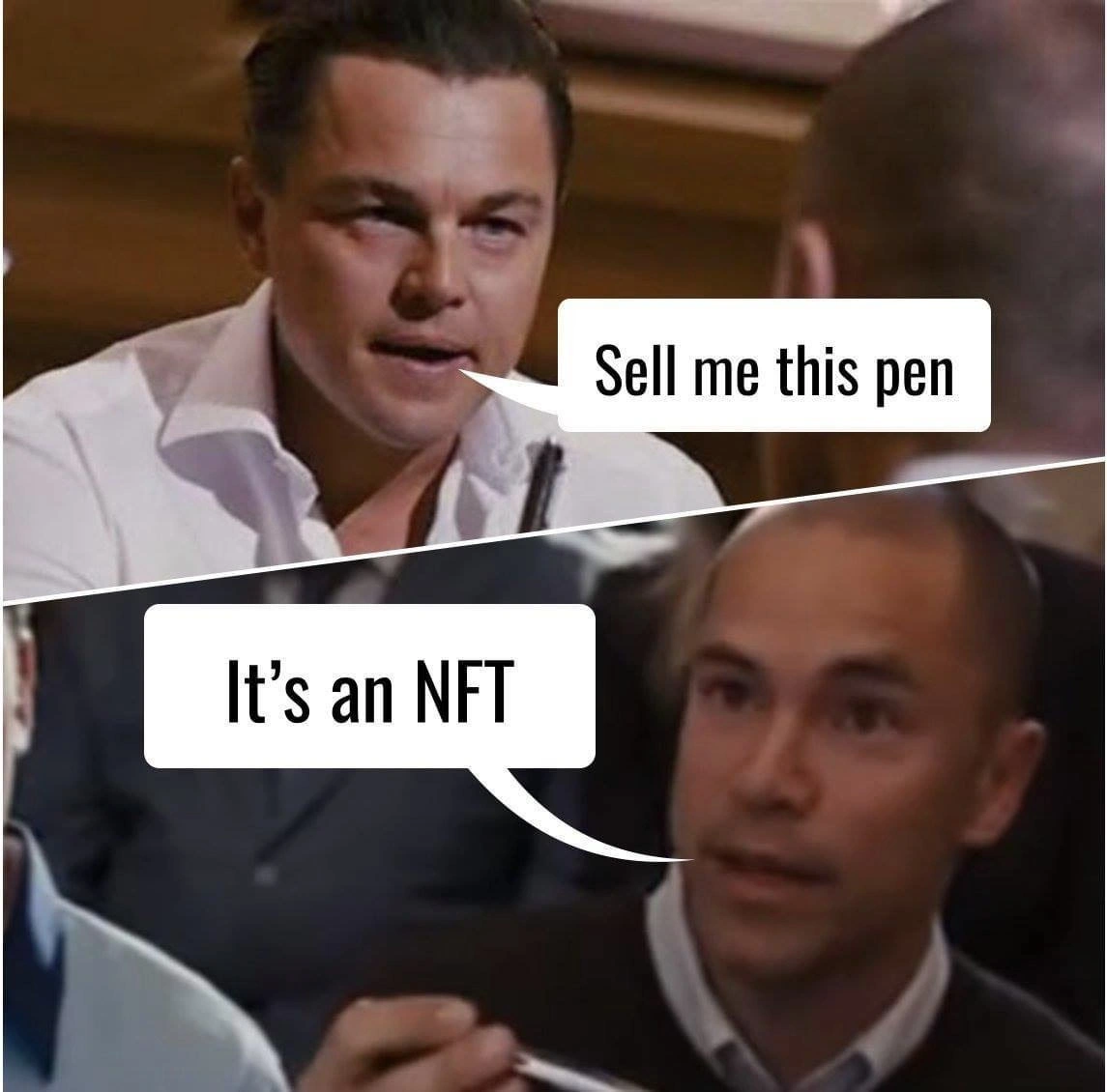
Now, the meme uses a scene from The Wolf of Wall Street, a movie about salespeople who are excellent at hyping things up. The character in the top panel (Leonardo DiCaprio’s character, Jordan Belfort) says, “Sell me this pen.” It’s a famous line where a boss tests if you can sell something simple by creating a need or by touting its value. Normally, if someone asked you to sell a pen, you might say things like “It’s a reliable pen, it writes smoothly, it has a comfortable grip – you’ll never want another pen.” Essentially, you’d try to convince the person why this pen is worth buying. But in the bottom panel of the meme, the other character’s entire sales pitch is: “It’s an NFT.” That’s it! He doesn’t mention the pen’s ink color, or how long it lasts, or anything actually about the pen itself. He just calls it an NFT.

Why is that funny? Because it’s showing how marketing hype can completely take the place of explaining real value. It’s like he’s saying, “Forget what this pen does – by virtue of being an NFT, it must be valuable!” This reflects a real trend where people tried to attach NFTs to all kinds of things just because NFTs were the hot new thing. In reality, calling a physical pen “an NFT” is pretty confusing: an NFT usually refers to a digital item. Perhaps he means the pen comes with a digital token or that the pen’s uniqueness is logged on a blockchain. Either way, it’s an absurd selling strategy for a pen. The meme is laughing at the blockchain hype: nowadays you could try to sell anything by saying “It’s on the blockchain!” or “It’s an NFT!” and expect some gullible investors or trend-chasers to be impressed. It’s taking a normal object and giving it a fancy tech twist to make it sound innovative, even though a pen is, well, just a pen. In simple terms, the salesperson is using a buzzword instead of a real sales pitch.

If you’re new to this, picture this scenario: a company’s marketing team is trying to spice up a boring product. Last decade, they might’ve said, “Now with Cloud!” or “Now with AI!” because those were the magic words at the time. In 2021, the magic word was “NFT.” So here, instead of actually selling the pen’s features, Person B just declares the pen is an NFT, hoping that alone makes it exciting. It’s a satirical way to show how ridiculous it is when marketing focuses on trendiness over substance. The two panels together basically create a tiny skit:

Person A: “Sell me this pen.”
Person B: “It’s an NFT.”

No further explanation given — as if that single phrase seals the deal. It’s humorous because we all know a pen doesn’t become more useful by being an NFT, but in a hype-driven mindset, just saying NFT might be enough to provoke interest or FOMO. The meme is a light-hearted jab at how tech industry trends can make people abandon common sense.

Level 3: Wolf of Web3

At the senior developer level, the humor comes from recognizing a pattern: whenever a new tech trend hits hype status, marketing and sales folks start slapping that buzzword onto everything. In the meme’s top panel (a scene from The Wolf of Wall Street), Person A issues the classic challenge: “Sell me this pen.” In the movie, this line is a test of effective salesmanship — can you create urgency or demonstrate real value for an ordinary pen? But here, in the bottom panel, Person B shortcuts the entire art of sales and simply replies, “It’s an NFT.” This punchline is poking fun at the blockchain buzzword sales culture. It suggests that in the current tech climate, you don’t need to describe any real utility or features; just call the product a blockchain asset and investors’ eyes will light up. Why bother with ink quality or ergonomic grip when you can claim the pen is part of the Web3 revolution? It’s salesmanship for the age of crypto: the non-fungible pitch.

This hits home for many experienced devs because we’ve witnessed cycles of IndustryTrends_Hype again and again. Remember the dot-com era when every business added “.com” to their name to boost stock prices? Or the machine learning craze when every app suddenly had “AI”? The blockchain/NFT craze was a similar gold rush. Overnight, seemingly every product was getting a Web3 marketing hype makeover. We saw companies with no real need for blockchains announcing token strategies, and startups raising millions by adding “NFT” to the business model. (In one infamous case, a beverage company literally changed its name to include “Blockchain” and saw its stock soar.) The meme distills that absurdity perfectly: even a pen, the cheapest, simplest office supply, could be rebranded as a cryptographically unique digital asset. It’s exaggeration, yes, but not by much – at the peak of NFT mania, people were seriously trying to NFT anything. There were NFTs for digital art, music, memes, tweets, rocks, you name it. Someone sold an NFT of a pet rock image for tens of thousands of dollars. Another sold the first-ever tweet as an NFT for $2.9 million. In that climate, pitching “a pen NFT” to a speculator doesn’t feel far-fetched at all.

The choice of the Wolf of Wall Street scene is especially apt. Jordan Belfort (portrayed by DiCaprio) built his fortune by selling essentially worthless penny stocks using pure hype and psychological tricks. Sound familiar? The NFT boom had a similar vibe of hype over substance. In fact, the real Jordan Belfort himself hopped on the crypto bandwagon and started promoting NFTs, which feels like life imitating meme. For seasoned engineers, this parallel is both hilarious and a tad painful. We value tech that solves real problems, yet time after time we watch as speculative marketing overshadows engineering. The meme captures that collective eye-roll: Here we go again, turning a straightforward product into a fancy-sounding token because that’s what gets the deal signed. It’s a satirical commentary on marketing vs. reality — the reality is it’s still just a pen, but the marketing makes it sound like the hottest new digital investment.

To illustrate the contrast:

Traditional Sales Pitch NFT Hype Pitch
“This pen writes smoothly in any weather.” “This pen is linked to the blockchain!”
Emphasizes the pen’s useful features (ink quality, durability) Emphasizes trendy tech (NFT, digital ownership)
Value: helps you write things down Value: you own a one-of-a-kind collectible (😮)

In a real sales interview, you’d craft a pitch around the pen’s tangible benefits or create a narrative (“Sign that big contract right now – you need a pen!”). In this meme’s universe, though, the rep just slaps on the latest fad label. It’s a knowing wink to all the developers and techies who’ve sat through meetings where someone insists “Can we blockchain-ify this?” or “What if we make it an NFT?” – often with no clear reason besides FOMO and buzz. The humor lands because it’s so true: in tech, nothing sells a mediocre idea faster than dressing it up as the next big thing. And at the tail end of 2021, NFTs were the next big thing. The meme exaggerates the scenario to highlight that absurdity. It’s basically saying: If you can repackage a plain pen as a cutting-edge NFT, you can sell anything.

Level 4: Tokenizing the Tangible

At the deepest technical level, this meme highlights the concept of digital scarcity engineered through cryptography and blockchain. An NFT (Non-Fungible Token) is essentially a unique digital certificate of ownership recorded on a blockchain (a distributed ledger). Unlike a dollar bill or Bitcoin (which are fungible, meaning any one is interchangeable with another), a non-fungible token is one-of-a-kind. Under the hood, NFTs are implemented via smart contracts (for example, Ethereum’s ERC-721 standard) that generate a unique token ID and link it to some metadata (often a reference to a digital asset like an image of art...or hypothetically, a pen). The blockchain’s consensus mechanism (such as Ethereum’s proof-of-work in 2021) ensures that this token can’t be duplicated or forged: every node in the network agrees on a single source of truth, so your “pen token” remains provably unique. It’s a bit of cryptographic scarcity alchemy — using math and computing power to create the illusion of a singular item in the digital realm.

From a theoretical perspective, NFTs solve a long-standing problem in the digital world: how do you claim ownership of something that can be copied endlessly? The solution combines one-way cryptographic hashes and distributed consensus to guarantee uniqueness and ownership. Think of the blockchain as a globally replicated database table where each row is a token and there’s a strict rule “one item, one owner”. When Person B in the meme says “It’s an NFT,” he’s implying that the pen isn’t just a physical pen anymore; it’s been given a unique digital identity on a blockchain. In theory, you could mint a token that represents the pen — effectively serializing the pen’s existence into a piece of data with a unique ID, secured by public-key cryptography. The next buyer wouldn’t just get a pen; they’d get a cryptographic token in their digital wallet proving they own some tokenized pen. This is tokenization taken to an extreme: even a mundane physical object can have a digital token counterpart. It’s a high-tech proof of uniqueness. Of course, all the heavy-duty math and distributed computing guaranteeing that uniqueness doesn’t change the pen’s ink or make it write any better. This contrast — complex tech creating an artificial sense of rarity for a very non-rare object — is the fundamental absurdity the meme is built on. It’s highlighting how over-the-top the engineering can be when you apply blockchain to something that never needed it, a textbook case of tokenization overkill.

Description

This is a two-panel meme based on the iconic 'Sell me this pen' scene from the movie The Wolf of Wall Street. In the top panel, Leonardo DiCaprio's character, Jordan Belfort, leans forward and says, 'Sell me this pen'. This is a classic test of sales ability, requiring the salesperson to generate demand. In the bottom panel, the person he is speaking to replies simply, 'It's an NFT'. The humor is a sharp critique of the NFT (Non-Fungible Token) hype bubble of 2021. It satirizes the trend where the mere association with blockchain or NFTs was considered a sufficient value proposition to sell almost anything, regardless of its intrinsic worth or utility. For experienced tech professionals, this meme captures the absurdity and cynicism surrounding speculative tech trends that are heavy on marketing buzzwords but light on substance
Comments

11
Anonymous ★ Top Pick The classic 'sell me this pen' challenge was about creating demand. The Web3 version is just about creating a smart contract with an artificial scarcity of 10,000 pens and promising a future DAO
  1. Anonymous ★ Top Pick

    The classic 'sell me this pen' challenge was about creating demand. The Web3 version is just about creating a smart contract with an artificial scarcity of 10,000 pens and promising a future DAO

  2. Anonymous

    “Sure, it’s a pen - well, the JPEG of one, pinned on IPFS, owned by a smart-contract singleton, and every signature is a state-changing transaction that costs more gas than the ink we saved.”

  3. Anonymous

    Just like that pen, the NFT is non-fungible - except the pen actually exists, doesn't cost $50 in gas fees to transfer, and won't disappear when someone forgets to pay for hosting the IPFS gateway

  4. Anonymous

    The perfect encapsulation of 2021's blockchain fever: when your entire value proposition is 'it's on the blockchain' and somehow that's supposed to justify a six-figure price tag for a JPEG. It's like telling a senior architect that your microservices solution is revolutionary because you renamed REST endpoints to 'blockchain nodes' - technically you changed something, but you've solved exactly zero actual problems while introducing a distributed consensus overhead that makes your P95 latency look like a database full-table scan

  5. Anonymous

    The pen whose real utility is in the 10% creator royalties on every right-click-save

  6. Anonymous

    Sell me this pen? It's an NFT - immutable proof you own a URL to its JPEG; the ink is off-chain and every signature costs gas

  7. Anonymous

    Bold strategy - tokenize the pen so it can’t sign paper anymore, only ECDSA transactions with gas higher than the pen’s BOM

  8. @callofvoid0 4y

    what?

    1. @JAUD1LA 4y

      NFT's are hyped now, and some crazy people are ready to by useless things as "NFTs" for really big money

      1. @callofvoid0 4y

        why? psycos😑

      2. @affirvega 4y

        Monkey*

Use J and K for navigation