The Junior Developer's Reaction to Git Blame
Why is this VersionControl meme funny?
Level 1: Caught Red-Handed
Imagine you and your friend are playing in the living room, and later your mom finds a big crayon drawing on the wall. She’s not angry (yet), but she says in a serious voice, “I’m going to check the security camera to see who did this.” Now, you know you’re the one who drew on the wall. You freeze for a moment and then glance sideways nervously to see if anyone’s looking at you. You’re hoping maybe, just maybe, someone else gets the blame, or that she won’t actually check. But deep down, your heart is pounding because you realize you’re about to be caught red-handed.
In this meme, the senior developer is like the mom saying “I’m going to find out who did it,” and the junior developer is like the guilty child glancing around with a worried face. The junior’s looking to the side, kind of how you would if you were trying to act innocent but aren’t doing a great job of it. It’s funny because we all know that feeling of “uh oh, I’m in trouble, aren’t I?” Whether it’s drawing on the wall, sneaking a cookie from the jar, or in the case of this meme, writing a messy bit of code, that side-eye look says: “I hope nobody finds out it was me.”
Level 2: Who Wrote What
Let’s break down what’s happening here in simpler terms. In software development, teams use version control systems like Git to keep track of changes in code. Think of Git as a giant save-history for your project, where every change (called a commit) has an author name and a timestamp. So whenever you or anyone edits a file and saves it to the repository, Git remembers who did it and when. This is super useful because it lets developers undo mistakes, collaborate without overwriting each other’s work, and understand the history of a codebase.
Now, Git has a command literally called git blame. Despite the scary name, it’s not about shaming anyone – it’s about finding out who last edited each line of a file. When you run git blame <filename>, Git will show you the file’s contents with annotations on the side: usually the commit ID, the author (who made that commit), and the date. In other words, it answers the question, “Who wrote this line of code, and when did they write it?” It’s like putting little Post-it notes on each line with a name and date. For example, if a senior developer sees a weird or buggy line in app.js (say line 150), they might run:
$ git blame app.js -L 150,150
// This will print info for line 150 of app.js, e.g.:
1a2b3c4d (jane_doe 2023-05-10 14:23:57 -0400 150) totalCount += 1;
In that pretend output, we learn that line 150 was last changed by user jane_doe on May 10, 2023, and the code on that line is totalCount += 1;. If there’s a bug involving totalCount, the team now knows Jane was the last person to touch that line, which means she might know why that code is there or be able to help fix it. Code review sessions and debugging often involve commands like this to trace issues. It’s basically detective work on code history: version control makes every developer a bit of a Sherlock Holmes when something goes wrong. 🔍
So where’s the joke? The meme text sets up a scenario:
- Senior Dev:
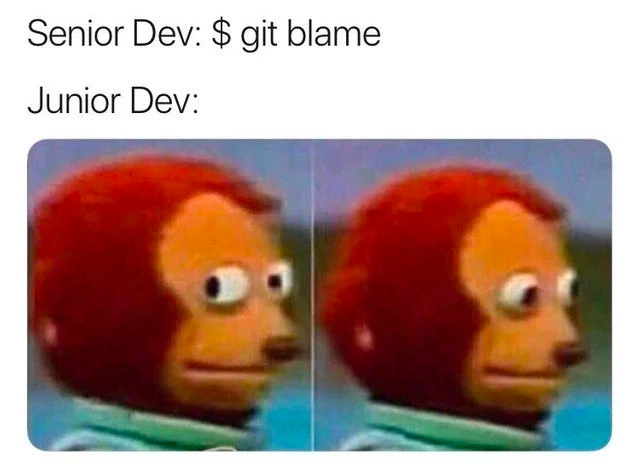
$ git blame– (i.e., the senior announces they are running the blame command to see who wrote a piece of code.) - Junior Dev: [side-eye monkey puppet] – (the junior developer doesn’t say anything, but their face* says it all: a frozen, nervous stare forward, then a sideways glance of alarm.)
That monkey puppet image is a super popular meme for expressing awkward guilt or anxiety. If you haven’t seen it before, it’s two frames of a red-haired monkey puppet (from a kids’ show) looking normal at first, then looking sideways with this “oh no, did they notice?” kind of expression. People online use it whenever someone feels caught out or when they’re trying to act innocent but really they’re guilty or scared. Here, the junior dev is the puppet. Why? Because juniors (newer developers) often feel nervous about their code, especially if there might be a mistake. When the senior runs git blame, the junior immediately worries that their name is about to pop up next to that buggy code. That side-eye glance is basically the junior thinking, “Please don’t let it be me... oh crap, it’s probably me.”
This is relatable for many developers early in their careers. Imagine you wrote some code that you weren’t 100% sure about, and now there’s a problem with it. A senior dev says, “Hmm, let’s see who last edited this.” That’s essentially what git blame does. Even if the senior isn’t actually angry and just wants to find the right person to discuss the code with, as the junior you might feel a wave of panic. It’s like when you’re in school and the teacher says, “Whoever did this, please come to my desk,” and you’re sitting there sweating because you think it might be you. The meme plays off that common feeling.
Let’s clarify some terms here for anyone new to this:
- Git: a popular tool developers use for version control. It keeps track of every change in the code, so we can collaborate and rewind to older versions if needed. Git operates through commands; for example,
git addadds changes,git commitsaves them with a message,git pushsends them to a shared repository, and so on. git blame: a specific Git command that tells you who last edited each line in a file. It’s often used to find out who to ask about a piece of code, or to see when and why that code was changed (you usually pair it withgit logto read the full commit message for that change). The name sounds negative, but think of it like “blame” in quotes – it’s really about accountability and history. (Fun fact: some GUI tools or other version control systems call this feature “annotate” or “praise” to avoid the negative vibe.)- Senior Dev / Junior Dev: In tech lingo, a senior developer is someone with lots of experience who often mentors others and makes big architectural decisions. A junior developer is someone new or early in their career, still learning the ropes. In real life, good seniors help juniors learn and don’t literally blame them for every bug. But juniors naturally worry about messing up.
- Code Review: a process where developers check each other’s code for mistakes, readability, and overall quality before it gets merged into the main project. In a code review, if something looks odd, a reviewer might use
git blameto see the history of that line – maybe to find the context of why it was written that way, or to ask the original author for clarification.
Now picture the situation: The team discovers a bug or a weird section in the code. The senior dev, trying to fix it, says “I’ll run git blame to see what happened.” The junior dev immediately remembers they wrote that section during a late night or when they were still very green. Heart rate intensifies. 😰 The puppet’s side-eye is a stand-in for the junior’s face: trying to stay cool externally, but internally thinking “oh no oh no oh no.”
It’s a friendly joke about learning in public. Everyone’s code is out in the open in a shared repository, especially with Git. So when you’re new, it can feel intimidating that any mistake you make is logged and can be traced back to you. But that’s also how everyone learns – by seeing what went wrong, discussing it, and writing a better solution. Seniors actually don’t use git blame to point fingers (at least they shouldn’t!). They use it to understand the code’s history. Still, the name of the command and the scenario lend themselves to a bit of comic exaggeration. The junior dev in the meme is basically every one of us when we first realized, “Oh wow, my name is literally attached to that code forever.” It’s both funny and a little terrifying, which is exactly why developers find this meme so spot-on.
In short, the meme is a lighthearted take on a common version control moment. The senior dev invokes a tool that reveals who wrote what, and the junior dev has a flash of awkward puppet energy, fearing they’re about to be singled out for a goof in the code. It’s relatable to new programmers, funny to experienced ones who remember being new, and ultimately underscores that in programming, mistakes happen and everyone will eventually have their name next to a buggy line at some point. Just maybe avoid pushing untested code on a Friday and you’ll sleep better! 😅
Level 3: The Git Blame Game
When a senior developer casually runs the command git blame, it's like firing up a spotlight on the code's history. This tool combs through a file and displays who last modified each line, along with the commit hash and timestamp. In a healthy engineering culture, git blame is meant for code archaeology – to understand why a line of code is the way it is, or to find context for a bug. But let's be honest: seeing the word "blame" pop up in a console can send a jolt of panic through any developer who suspects they might be responsible for a quirky piece of code. The meme captures this perfectly: the senior dev triggers git blame, and the junior dev is represented by that famous side-eye monkey puppet, sweating bullets in silent fear.
Why is this humorous to experienced devs? It's the familiar anxiety of accountability in a version-controlled world. We’ve all been that junior at some point, silently praying our name doesn’t appear next to the faulty line in question. The term blame might be tongue-in-cheek, but it feeds into a real dynamic: code history in Git is transparent, so there's no hiding who wrote the buggy regex or the clever hack questionable fix. The senior’s $ git blame command is essentially saying, “Let’s see who we can credit (or blame) for this code.” In that instant, the mental image of every commit you’ve pushed flashes before your eyes. Did you leave that // TODO: fix this later comment in the code? Did one of your Friday afternoon commits introduce a subtle bug? The version control system remembers everything, and now it's about to name names.
The humor also lies in the Senior vs. Junior developers dynamic. The senior might not actually be out for blood – often they run git blame to get context or assign a bug fix to the right person. But to the junior dev, it can feel like an inquisition. It’s a trap! The side-eye puppet’s nervous glance reflects that junior_dev_anxiety perfectly: “Uh oh... please don’t be me… please don’t be me…” It's a mix of guilt and impostor syndrome, a fear that their commit—perhaps made while still learning or under pressure—will reveal them as the culprit behind a problem. And honestly, that fear isn’t entirely unfounded: many of us have been in an awkward code review where a senior scrolls through a git blame report, raises an eyebrow, and says, “Ah, so you wrote this part…” – cue the side eye and sheepish grin.
From an engineering standpoint, git blame is incredibly useful. It can show, line by line, which commit last touched the code, for example:
$ git blame server.js -L 42,42
// Output: commit hash, author, date, and the code line
f4c2d3a9 (junior_dev 2023-04-01 12:05:10 -0500 42) handleLegacyEdgeCase();
In the snippet above, line 42 was last edited by junior_dev on April 1, 2023 (no joke!). If that line turns out to be problematic, the senior now knows who wrote it and roughly when. For seasoned developers, this output is a routine sight. But in the meme scenario, that innocuous piece of information feels like a judgement day for the junior. The joke is amplified by the puppet’s expression: in the first panel he’s facing forward (everything’s normal), and in the second panel he’s side-eyeing in alarm. It mirrors the timeline of events — the junior was fine until the moment the senior said “let’s run git blame,” at which point internal panic sets in.
This meme also pokes fun at code review culture. Ideally, reviews and blame outputs are used to improve code and share knowledge, not to shame anyone. Many teams even jokingly alias git blame to git praise to remove the sting of the name. Yet, the reality is that when something breaks and a debugging session starts, the question “who wrote this?” inevitably arises. It’s practically a trope in DeveloperHumor circles. And even if the senior has the purest intentions (like figuring out commit context or reaching out to the right person for more info), the junior can’t help but feel a spike of version_control_shame. It’s a rite of passage in software development: the first time you see your name highlighted by a blame command in front of the whole team feels like getting caught with your hand in the cookie jar.
In a broader sense, the meme highlights how transparent collaboration tools like Git can inadvertently create awkward moments. Every line in a codebase has a story and an author. In the old days of coding (think big mainframe printouts or shared network drives), it might have been hard to tell who last changed something. Modern distributed version control (thanks, Git!) makes it trivial. So trivial, that one keystroke combo in your IDE or a quick CLI invocation can surface the entire edit history. This is fantastic for maintaining accountability and tracking down bugs – you can find exactly when that pesky line was introduced and by whom. But it also means there’s an omnipresent paper trail, ready to expose your coding sins. The meme exaggerates this tension for comic effect. RelatableDeveloperExperience comes from knowing that feeling: the mix of pride and panic when you realize the code in question was indeed your brainchild.
Ultimately, the humor works on multiple levels for seasoned devs. It’s a lighthearted jab at the “blame culture” that can arise if teams aren’t careful, and it’s a nod to the very real learning curve juniors go through. Every senior developer can recall a time they themselves were the nervous newbie, getting the side-eye when their check-ins didn’t pan out. And every junior dev today learns that while git blame sounds scary, it’s really just another tool — albeit one with an ominous name. The meme’s punchline lands because it personifies that tool as almost a detective unmasking the culprit, and the awkward puppet meme is the perfect representation of the guilty “I hope nobody notices it was me” face. In short, it's a comedic snapshot of life in version control: Git keeps a receipt for everything, and sometimes those receipts are... well... a little uncomfortable when brought to light in front of your team!
Description
A popular two-panel meme format featuring the Awkward Look Monkey Puppet. The top section has black text on a white background, stating 'Senior Dev: $ git blame'. Below this, the text 'Junior Dev:' introduces the image panel. The image shows a red monkey puppet with large, expressive eyes, first glancing nervously to the side and then staring forward with a look of intense anxiety. This meme visualizes a common scenario in software development where a senior developer uses the 'git blame' command to identify the author of a specific line of code, usually to investigate a bug or unexpected behavior. The junior developer's reaction captures the feeling of dread and being exposed, a relatable moment for anyone who has ever pushed buggy code and hopes nobody will notice. For senior developers, it's a humorous and nostalgic look at a rite of passage in a developer's career
Comments
7Comment deleted
The fastest way to get a junior developer to start documenting their code is to type 'git bla' and just leave it there for a minute
When the principal engineer types `git blame` and you suddenly remember that squashing is optional but shame is append-only
The real power move is running git blame on your own code from 5 years ago and pretending you've never seen it before
The real power move is when the senior dev runs `git blame` and discovers they wrote that cursed code themselves three years ago, before the team adopted any of their current 'best practices.' Suddenly the code review becomes a philosophical discussion about how we've all grown as engineers
Nothing spikes a junior’s heart rate like a senior typing “git blame -w --ignore-rev-file .git-blame-ignore-revs” and the line still shows their name
Git blame: where 'collaborative codebase' meets 'your commit, your funeral' in one terminal stroke
git blame is fun until you forget --ignore-rev on the mass reformat and the junior suddenly authored the entire monorepo