Git Blame Anxiety: The Double Post
Why is this VersionControl meme funny?
Level 1: Who Ate the Cookies?
Imagine you’re at home and Mom notices the cookie jar, which was full this morning, is now half empty. She calls out, “Alright, who ate all these cookies?” You’re the kid who did sneak a few cookies earlier, and you still have crumbs on your shirt. Instead of confessing, you sit there on the couch, wide-eyed, trying to look innocent, and then slowly glance away hoping Mom won’t notice it was you. Your face feels hot and you have that nervous smile like, “Please don’t figure it out…”
In this story, Mom has a way to check who touched the cookies (maybe hidden camera footage, or she just knows). In the meme’s world, the senior developer is like Mom, and the junior developer is the kid who ate the cookies. The senior says they’re going to run a command (git blame) that will reveal who wrote a piece of code, kind of like checking the camera to see who was in the cookie jar. The junior developer instantly recognizes, “Uh oh, I’m the guilty one,” and gives that same awkward, guilty look as the cookie-stealing kid.
It’s funny because we all know that feeling of being caught after doing something we shouldn’t. Just like a child caught with their hand in the cookie jar, the junior programmer got caught writing some messy code. The meme uses a silly puppet picture to show that “I’m in trouble” face. You don’t need to know anything about programming to see that the junior person is embarrassed and the senior person is about to find out what happened. In simple terms, it’s a joke about getting found out and feeling shy about it – something anyone who’s ever been a kid (or caught doing mischief) can relate to.
Level 2: The Blame Game
Let’s break down the joke in simpler terms. Git is a tool programmers use for version control, which means tracking changes in code over time. It lets multiple developers work on the same codebase without overwriting each other’s work, and it keeps a history of every change. One handy (and intimidating) Git command is git blame. Despite the aggressive name, all it does is show who last edited each line of a file. Essentially, it tells you “who wrote what” in the code. For example, if a file has a strange line of code at line 42, a developer can run a blame on that file and see something like:
$ git blame utils.js -L 40,42
^2f86c (Alice 2021-08-15 10:20:30 -0400 40) // initialize variables
^2f86c (Alice 2021-08-15 10:20:30 -0400 41) int count = 0;
d4c3fe (Bob 2019-05-10 09:14:07 -0400 42) hackyFunctionCall();
(In this made-up example, line 42 was last changed by “Bob” in 2019, while lines 40-41 were by Alice in 2021.) The output shows the commit ID, the author (with date), and the code line. So git blame is like a history lookup for every line in a file. Developers use it often during code reviews or debugging to understand why something is the way it is, or to find who might know more about that piece of code. It’s actually officially called “annotate” in some systems, but the Git command name blame has stuck because it’s cheeky and to the point.
Now, who are the players in this meme? Senior Dev means a senior developer – an experienced programmer on the team. Junior Dev means a junior developer – someone newer or less experienced. In real teams, seniors often mentor juniors and also review their code. A code review is when other developers look at your code changes before or after they go into the main codebase, to catch mistakes or suggest improvements. It’s a normal part of software development: everyone’s code gets reviewed.
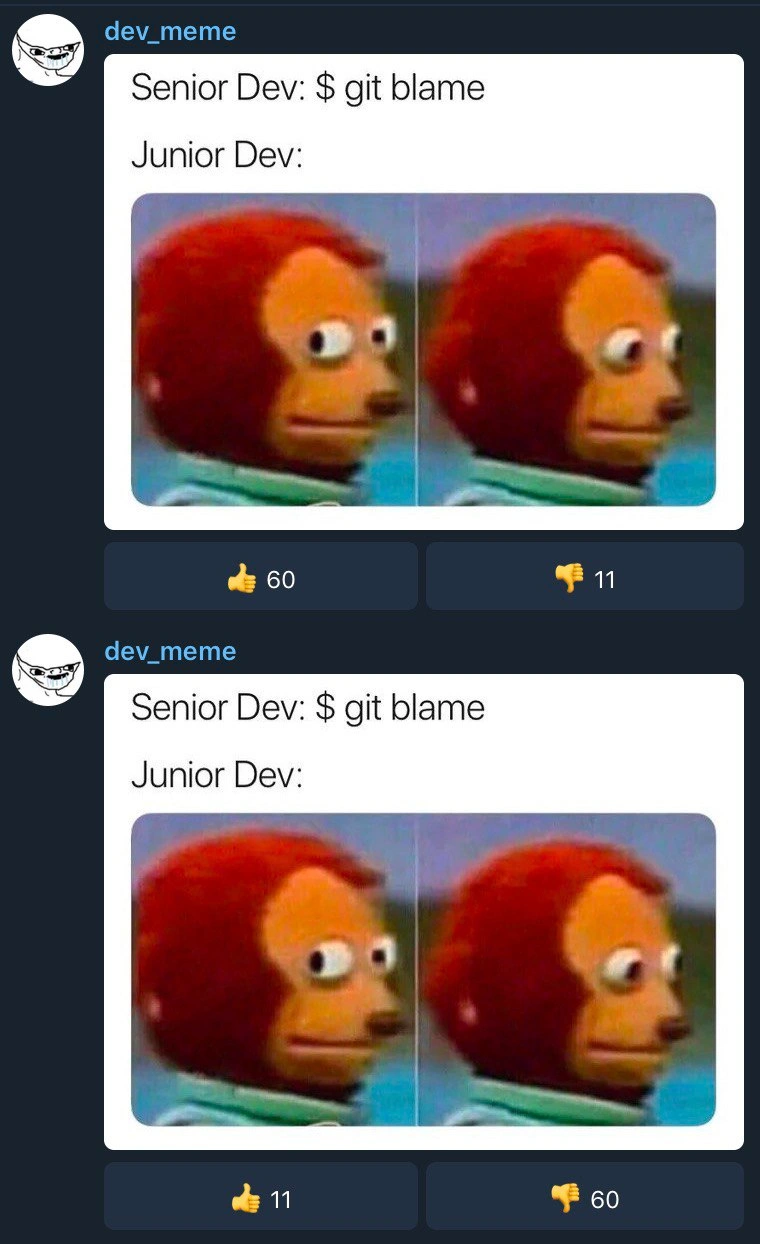
The text in the meme says:
Senior Dev: $ git blame
Junior Dev: [awkward silence]
Below that, instead of words, there’s the famous meme image of a red-haired puppet character from a children’s show. In the first panel the puppet is facing forward normally; in the second panel its eyes dart to the side and it looks away with a very uncomfortable expression. This “side-eye puppet” image is an internet meme people use when someone is caught off-guard, feeling guilty or avoiding a question. You’ve probably seen it captioned in all sorts of funny contexts. Here, it’s labeled as the Junior Dev’s reaction. So the format is like a dialogue: the senior says they’re running git blame, and the junior doesn’t even reply with words – they just give that “oh no, please not me” side-eye look. That says it all.
Why would a junior dev react that way? Imagine you’re a new developer who wrote some awkward code a while back – maybe a quick fix that isn’t very elegant, or a piece of code that accidentally introduced a bug. You might hope it stays under the radar. But if something goes wrong and a senior developer inspects the history with git blame, your name will pop up as the author of that code. It can feel embarrassing, like getting caught making a mistake. The meme plays on that very relatable scenario. It’s basically VersionControlHumor: joking about how tools like Git expose every developer’s contributions, even the not-so-great ones.
The reaction of the junior dev (the puppet’s side-eye) shows guilt and anxiety. It’s that sinking feeling of “Uh oh, they’re going to see I wrote that.” Junior developers often feel this kind of imposter syndrome or fear of being judged for bad code. Of course, good teams use these moments to teach, not to scold. A supportive senior might say, “Hey, I saw you wrote this part. Can you walk me through what it does? Let’s improve it together.” But the meme is poking fun at the scarier interpretation: the junior expects to get blamed and possibly scolded. It’s exaggerated humor, because in reality no one wants a blame culture at work. Still, the joke lands because it’s a little true — many juniors have had that heart-stopping moment when their mentor examines the code history and sees their name on a questionable piece of code.
Also, a quick note on the screenshot’s odd detail: the meme post is shown twice in a row with reversed like/dislike counts (👍 60 vs 👍 11, etc.). This looks like an accidental double-post on the platform or a glitch. It could be interpreted as a meta-joke: posting the same thing twice can lead to opposite reactions. It’s as if one version of the joke was well-received and the duplicate wasn’t, kind of like how copying code in two places can get you praise in one code review and criticism in another. This detail isn’t crucial to the main joke, but it’s a fun little Easter egg in the image. Maybe the first post is how senior devs reacted (they find it funny), and the second is how juniors reacted (not as amused when it’s about them!). Regardless, the core idea remains: GitBlame exposes your code history, and that can be uncomfortable for the person who wrote the code.
In summary, the meme is showing a common junior-vs-senior moment in software development:
- A Senior Developer finds something in the code and runs
git blameto see who wrote that part. - The Junior Developer, realizing they are the culprit behind that code, gives a classic guilty side-eye look, anticipating some tough questions or gentle ribbing.
It’s funny to programmers because we’ve all been there in some form. The tags like DeveloperHumor and RelatableHumor apply perfectly: it’s a joke you “get” only if you’ve experienced code reviews, using Git, and the nervousness of being a newcomer whose code might not be perfect. And hey, every senior dev was a junior once – probably with their own cringe-worthy commit history – which is why even seniors laugh at this. It’s a lighthearted way to acknowledge that making mistakes is part of the journey, and that version control tools will dutifully log those mistakes for all to see.
Level 3: Commits Don't Lie
When a senior developer types $ git blame, it's like launching a forensic investigation into the repository's history. Git is a distributed version control system that tracks every change in the codebase. The git blame command in particular annotates each line of a file with the last commit and author who touched it. In other words, it fingerprints every line of code with someone’s name and the commit ID. Seasoned engineers know this tool well – it’s invaluable for debugging and understanding why a piece of code exists. But in the wrong context, it can stir up dread.
In the meme, the senior dev says git blame and the junior dev responds with a silent, side-eyed stare. That two-panel image of the red-haired awkward puppet side-eye perfectly captures the “uh-oh, I’m in trouble” vibe. This is a classic piece of DeveloperHumor playing on the SeniorVsJuniorDevelopers dynamic. The senior is effectively doing a CSI on the code: “Who wrote this buggy or awkward code?” And the junior suddenly remembers they wrote it, perhaps months ago when they were still figuring things out. The humor is that every developer can relate – we’ve all pushed some cringe-worthy code at 2 AM and hoped no one would notice. But VersionControl tools like Git never forget. Commits don't lie, and git blame will happily expose the author of even the strangest workaround.
There’s an industry joke: “Blame the intern” (or junior dev) whenever something goes wrong. Here, that joke comes to life. The junior’s wide-eyed then avert-your-gaze reaction (as the puppet shows) is the universally recognizable look of code review shame. It’s the exact face you make when the lead dev finds a weird file and you secretly know you wrote it during your first week on the job. The meme exaggerates this moment, but it’s rooted in truth. In real life, a good senior developer will use git blame to understand context or mentor the junior (“Let’s see who wrote this, so we can help them fix it”). But in a toxic culture, it can devolve into literal blame – blame culture in codebases where people shame each other for bad code. The meme’s punchline banks on the latter: the junior bracing for impact, guilty as charged.
Technically, what’s happening under the hood is fascinating. Git stores the project’s history as a series of snapshots (commits). Running git blame triggers Git to walk through the commit history and identify the last commit where each line was modified. It might even follow renames and merges, sleuthing through the code history until it finds who to attribute. It’s like a time machine + fingerprint scanner for code. From a senior dev’s perspective, this is code forensics: if a line is causing a bug or looks out of place, git blame pinpoints who last touched it and when. That information is super useful – maybe the author (often the junior in these scenarios) can explain the odd fix or reveal if it was a quick hack to handle an urgent issue. In theory, git blame isn’t about personal shame at all; it’s about accountability and context. But let’s be honest, when you see the word “blame” in a command and your name comes up, it feels like being called to the principal’s office. 😅
Notice the meme screenshot itself has a quirky detail: the same post appears twice in a social feed, one with 👍 60 likes and 👎 11 dislikes, and the duplicate with 👍 11 and 👎 60. This inverted reaction count is likely an inside joke or a visual gag about duplication (or an accidental double-post that the community noticed). It’s almost symbolic: the first posting (with more likes) could represent seasoned devs chuckling at the joke, while the second (with more dislikes) could be exasperated juniors thinking “ugh, not funny, I’ve been there.” Or perhaps it humorously mirrors code duplication – posting the same meme twice might annoy people just like copying the same code twice triggers a “don’t repeat yourself” eye-roll. In any case, the RelatableHumor clearly landed with the audience the first time, but got a big side-eye (just like the puppet) the second time. Even memes have a version history and public feedback – post something twice and the crowd will let you know which one they prefer!
Bottom line: this meme packs so much truth into a simple format. A senior dev invoking a Git command and a junior’s guilty reaction tell a whole story to those in the know. It highlights the reality that in software teams, your code and your mistakes are traceable. The GitBlame command is practically a character in this story – the scary detective that shines a light on every developer’s past commits. And the junior developer’s side-eye is every one of us who’s ever been a newbie afraid of being “found out.” The humor hits home because it mixes technical reality (version control commands, code reviews) with human reality (awkwardness, learning from mistakes). In the world of DeveloperMemes, nothing is more Relatable than that anxious feeling of seeing your own name pop up in the blame log during a meeting.
Description
This image is a screenshot of a social media feed, showing two identical posts from a user named 'dev_meme'. Each post contains the same meme, which is a classic two-panel format. The top text reads 'Senior Dev: $ git blame', and the text below it reads 'Junior Dev:'. Underneath this text is the 'Awkward Look Monkey Puppet' meme, where the puppet first looks forward, then nervously glances to the side. The entire image captures the relatable anxiety a junior developer feels when a senior starts investigating code history with 'git blame', fearing their mistakes will be uncovered. The humor is layered, as the screenshot itself shows a duplicate post, a common and slightly embarrassing mistake, mirroring the kind of error a junior might make in their code
Comments
7Comment deleted
The best part is the duplicate post. It's the social media equivalent of a copy-paste error that somehow passed code review
Duplicate memes with opposite like counts - the social feed just reenacted a split-brain failover, and somewhere a senior is running `git blame` to find which junior disabled quorum
The real plot twist is when git blame shows your own name from 8 years ago with the commit message "temporary fix, will refactor later."
The real senior move is running `git blame` with `--ignore-revs-file` pointing to that massive formatting commit from three years ago, then confidently announcing 'Looks like this was... collaborative effort' while the junior dev sweats over their first production bug fix
Pro tip: run git blame -w -M -C before calling out the junior - otherwise you’ll just promote Prettier to principal engineer
Pro tip: alias git blame to 'git blame -w -C -C' so you don't blame the junior who only ran Prettier on a file that moved twice
Git blame: the command that turns every commit into a permanent 'Wanted' poster