Skip to content
DevMeme
358 of 7435
The Agony of a Broken Flow State
DeveloperProductivity Post #420, on Jun 3, 2019 in TG

The Agony of a Broken Flow State

Why is this DeveloperProductivity meme funny?

Level 1: Why Stop Now?

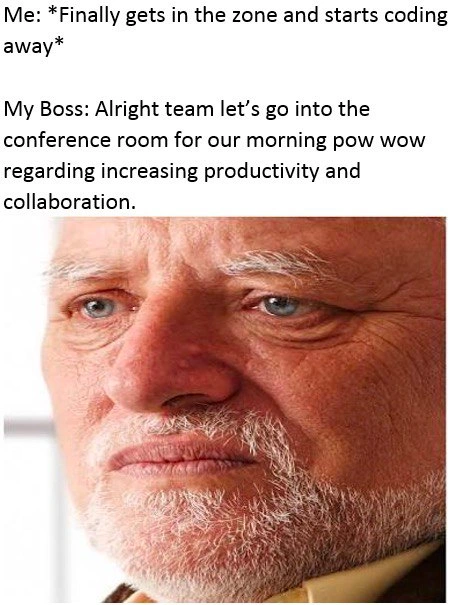
Imagine you’re playing your favorite game or building a really cool LEGO project, and you’re totally focused on it. You’re just about to finish something awesome. Suddenly, a teacher or parent comes in and says, “Okay, everyone stop and come over here – we need to have a quick talk about how to play more productively!” How would you feel? Probably pretty annoyed or upset, right? You had to drop what you were doing, and now you’re just sitting there, itching to get back to your fun project. The talk was supposed to be about “being productive,” but it actually just stopped you from being productive at that moment. That’s exactly what’s happening in this meme. The programmer was happily coding (which is like their version of playing or building something), and then the boss made them stop to go to a meeting. The face in the picture – with the eyes shut and a silent scream – is how the developer feels inside. They really don’t want to stop what they’re doing. It’s funny in a way, because the meeting is supposed to help everyone work better together, but it ends up just interrupting the work. In that moment, the developer is thinking something like, I wish I could’ve just avoided this meeting and kept on coding!

Level 2: Focus Interrupted

For a newer developer (or anyone starting out), let’s break down what’s happening. The meme shows “Me” (the developer) who has finally gotten in the zone. Being “in the zone” means the programmer is in a flow state – completely focused on coding, with all the important details loaded up in their head. This is when a coder is most productive, because they’re doing Deep Work with zero distractions. Now along comes the boss with a meeting request. Instantly, the coder has to perform a context switch. In simple terms, context switching means stopping what you’re doing and shifting your attention to something else, then later coming back. (Computers do this too when they switch between tasks – there’s a little overhead each time.) For a person, that overhead means your brain has to drop whatever it was working on (your train of thought about the code) and then, after the interruption, spend time picking it back up. So when the boss says it’s time for “our morning powwow” (which is basically a casual way to say a team meeting), the developer has to pause their coding. This break in focus can make them lose momentum. By the time they return to the code after the meeting, they might need to re-read what they wrote and remember what they were doing. That extra restart time is the cost of context switching in action.

Now, what’s this “morning pow wow” about? It sounds like a daily stand-up meeting or team huddle. Many software teams have a short meeting each morning (often called a stand-up) where everyone quickly shares what they’re working on or discusses things like improving “productivity” and teamwork. The intention is to keep everyone in the loop and working well together – which is why the boss in the meme says it’s about “increasing productivity and collaboration.” The idea sounds good, but the timing can be bad. If a meeting happens right when a developer is super focused, it feels very frustrating. Imagine you’re making great progress and someone says, “Stop what you’re doing, let’s all talk about how to work better.” You’d be annoyed, because you were already working effectively in that moment. The person in the meme’s image (eyes closed, mouth open in a silent scream) is showing that feeling. They are extremely frustrated but probably can’t show it openly to their boss, so it’s like an internal scream. The text in the meme even cuts off the boss’s sentence, which suggests the developer’s mind went blank or tuned it out as soon as they heard about the meeting. And the little caption added by the poster – “I should’ve worked from home today…” – says what the developer is really thinking. If they had worked from home, maybe they could’ve avoided getting pulled into that room, or at least they wouldn’t be interrupted right then. In short, the meme is pointing out a common situation in programming jobs: an interruption (like a meeting) can break a programmer’s focus, and it’s ironically often the things meant to help productivity (like status meetings) that end up hurting it.

Level 3: Stand-Up Sabotage

This meme hits a nerve for any seasoned developer, capturing the raw DeveloperFrustration when deep focus is shattered by a pointless meeting. It illustrates a classic DeveloperPainPoints scenario: you’ve finally caught a wave of concentration (that elusive flow state where code pours out effortlessly) and then – ding! – a mandatory meeting invite or boss’s announcement comes along to yank you out. The text sets up the scene perfectly: “Me: Finally gets in the zone and starts coding away” followed by “My Boss: Alright team let’s go into the conference room for our morning powwow regarding increasing productivity and collaboration.” It’s an instant 180-degree turn from deep coding to corporate busywork. The humor (and horror) comes from how painfully relatable this scenario is. Every developer knows the dread of seeing a calendar invite pop up right when you’re in the groove. It’s essentially ContextSwitching sabotage. The meme even cuts off the boss’s spiel mid-word (“regar… collab…”), as if to say the developer stopped listening the moment the boss said “conference room.” That truncated text is a brilliant touch – it visualizes how these buzzword-laden speeches just become noise once your focus is broken.

In real workplaces, especially in a heavy CorporateCulture of constant meetings, this happens all the time. There’s a famous concept called the “Maker’s Schedule vs Manager’s Schedule”: managers slice their day into hour blocks filled with meetings (that’s normal for them), whereas makers (developers, designers, writers) need long uninterrupted stretches to do deep work. Here the boss (operating on a manager schedule) cheerily says “let’s have a quick morning powwow!” thinking it’s just a 10-minute chat to boost productivity and collaboration. But to the developer (who works on a maker schedule), that “quick chat” demolishes an entire productive morning. It’s a stand-up meeting interruption at the worst possible time. Agile teams do daily stand-ups to share updates, but even a 15-minute stand-up at the wrong moment can feel like pulling the emergency brake on a train. One moment you’re cruising along with a complex problem loaded in your head, the next you’re forced to slam to a halt and talk about “what everyone is doing today.” No wonder devs often joke, “This meeting could have been an email.”

The irony is thick: the boss claims this powwow will help “increase productivity and collaboration,” yet it achieves the opposite. It’s a prime example of MeetingOverload leading to ProductivityLoss. You’re talking about work instead of actually doing the work. Management might gauge engagement by how often people meet or talk, while developers gauge it by how much code or feature work gets done. The table below sums up the contrast:

Boss’s Intention Developer’s Reality
“Increase overall productivity” Productivity actually pauses during the meeting.
“Foster team collaboration” Hardly any real collaboration – mostly everyone waiting their turn to speak while their code sits idle.
“Just a quick 10-minute sync” Context switch penalty: 10 min meeting + ~20 min regaining focus = a chunk of lost coding time.

The boss sees a meeting as a harmless check-in or team-building exercise. The developer sees it as a dreaded interruption that breaks all momentum. The facial expression in the meme (the close-up of that older gentleman with eyes shut in a silent scream – known in meme circles as Hide the Pain Harold) says it all. On the outside, you might force a polite nod and trudge off to the conference room. On the inside, you’re raging, thinking I should’ve worked from home today… Many of us have felt that exact sentiment: wishing we could avoid the meeting and stay in the coding zone. This meme perfectly captures a universal truth in software development – a slice of MeetingHumor that resonates because it’s so true. Nothing kills a good coding flow quite like a focus-breaking meeting that you neither asked for nor need.

Level 4: Thrashing IRL

In systems terms, this meme is a study in context switching overhead. When an operating system frequently swaps tasks, the CPU spends precious cycles saving and restoring state instead of executing actual work. Too many switches and you get thrashing – where the system grinds to a halt because it’s too busy switching contexts. Here, the developer’s brain is the “CPU,” and the boss’s morning powwow is an external interrupt forcing a costly task switch. The dev had loaded all the relevant code context into mental cache (variables, the call stack, the program logic) during that deep-focus session. Now an abrupt meeting invalidates that cache. All that carefully built-up state is essentially dropped from L1 memory, meaning after the meeting the brain must page it all back in. It’s like a pipeline flush in a CPU – you pay a heavy penalty before you can resume smooth execution.

There’s a reason engineers dread this kind of flow interruption. Studies and firsthand experience show that when a programmer is pulled out of a flow state, it can take a solid 15-30 minutes to get back to the same level of focus. This is the cognitive equivalent of a cold start. That “quick 10-minute sync” meeting isn’t really just 10 minutes – it’s 10 minutes plus all the lost time reacquiring the mental context. In other words, a short meeting can easily cost a developer a half hour or more of effective work. It’s reminiscent of the observer effect in physics: by constantly checking in on productivity, you end up disturbing the very productivity you’re trying to measure or improve.

To a veteran developer, this scenario triggers dark humor and déjà vu. We’ve all been that thread getting preempted at the worst possible moment. The manager’s well-intentioned “productivity” meeting is acting like a naive OS scheduler, yanking the process (coder) off the CPU just as it hit full stride. No surprise the result is ProductivityLoss. We spend our careers meticulously optimizing code to save milliseconds, yet corporate culture will cheerfully waste hours in meetings in the name of “collaboration.” The contradiction is almost elegant in its absurdity: the meeting meant to encourage productivity ends up being a productivity gain drain.

Description

A classic 'Hide the Pain Harold' meme. The top text, in a standard sans-serif font, describes the developer's state: 'Me: *Finally gets in the zone and starts coding away*'. Below this, a second line of text describes the interruption: 'My Boss: Alright team let's go into the conference room for our morning pow wow regarding increasing productivity and collaboration.'. The image below is a close-up of the face of 'Harold', an older man with white hair and a beard, whose pained eyes and tight smile convey deep-seated anguish and resignation. This meme perfectly captures the frustration developers feel when their precious 'flow state' - a period of deep, uninterrupted concentration - is broken by a poorly timed meeting, especially one ironically intended to boost productivity. For senior engineers, this isn't just an annoyance; it's a significant productivity killer, as the cost of context switching is high and regaining that state of deep focus can take a long time

Comments

7
Anonymous ★ Top Pick The cost of that 'quick pow wow' about productivity? About 45 minutes of ramp-up, 30 minutes of meeting, and another hour to rebuild the shattered remnants of my mental stack
  1. Anonymous ★ Top Pick

    The cost of that 'quick pow wow' about productivity? About 45 minutes of ramp-up, 30 minutes of meeting, and another hour to rebuild the shattered remnants of my mental stack

  2. Anonymous

    Just found the bug’s address in the 2006 monolith when Outlook fired a non-maskable interrupt called “quick sync” - now my L1 cache is empty and the meeting still has no agenda

  3. Anonymous

    The best part about meetings to improve productivity is that they consume exactly the amount of time it would take to ship the feature you were about to complete

  4. Anonymous

    The most expensive operation in software engineering isn't O(n²) complexity - it's the context switch from 'finally understanding this legacy codebase' to 'let's brainstorm ways to reduce context switching.' Bonus points when the meeting could have been a Slack message, and the Slack message could have been nothing at all

  5. Anonymous

    Finally caching flow state in L1 brain registers; boss meeting flushes the hierarchy and thrashes TLB

  6. Anonymous

    Just reached flow; calendar triggers a quick sync - turns out collaboration is a distributed stop-the-world GC that evicts my L1 cache and still leaks time

  7. Anonymous

    Daily standup is the only cron job that consistently evicts my L1 cache and triggers a 23-minute GC pause

Use J and K for navigation