Garbage Collection Meets Manual Cleanup
Why is this Languages meme funny?
Level 1: Cleaning Your Room
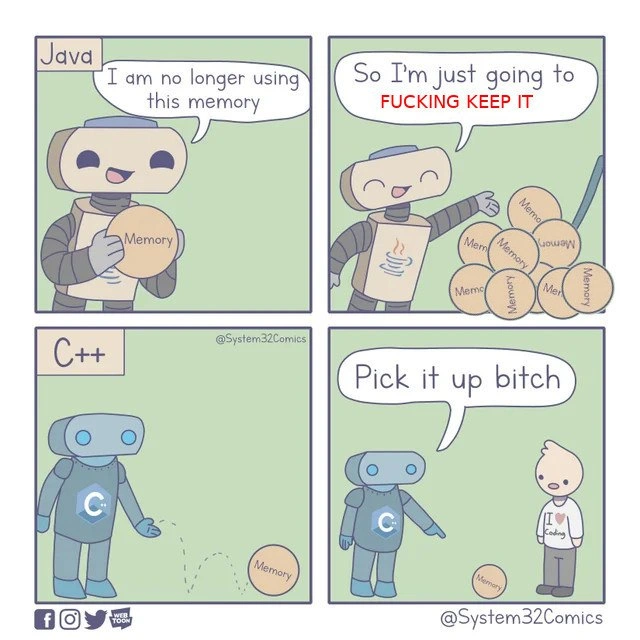
This is like two different ways of cleaning a room. Java says, "Leave the mess there; someone will come clean it later." C++ says, "You dropped it, you pick it up right now." Both can work, but both can also go wrong: one room slowly fills with stuff, and the other depends on you never forgetting what you dropped.
Level 2: Who Cleans Up?
Memory is where a program stores objects while it runs. When the program no longer needs an object, that memory should become available again.
In Java, developers usually do not manually free each object. The garbage collector looks for objects the program can no longer reach and reclaims them. This is convenient, but cleanup may happen later than expected, and bad references can accidentally keep objects alive.
In C++, developers have more direct control. Modern C++ often uses smart pointers and RAII so cleanup happens automatically when an object goes out of scope, but the programmer still has to design ownership correctly. If they get it wrong, the program may leak memory, free something twice, or use memory after it has already been freed.
The comic makes Java look lazy and C++ look bossy. The real point is that every language has a memory model, and every model makes someone pay the bill: the runtime, the developer, or whoever gets paged when the process grows until the machine gives up.
Level 3: Heap Custody Battle
The joke is not really "Java bad, C++ bad." It is that both languages outsource pain differently. Java says, "Trust the runtime; it will clean up eventually." C++ says, "Trust yourself; good luck." The four-panel layout makes that contrast visible: Java accumulates a pile of balls labeled Memory, while C++ leaves a single ball on the ground and makes the tiny developer responsible for picking it up.
The post caption, "GC spikes have entered the chat," points at the operational side of this tradeoff. Garbage collection can create latency spikes when the runtime pauses or competes for CPU to scan and reclaim memory. For backend services, games, trading systems, and mobile apps, a pause at the wrong moment can be more visible than steady manual work. Meanwhile, C++ avoids GC pauses by handing lifetime responsibility to the programmer, which is excellent right up until production starts reading freed memory like it is a choose-your-own-crash adventure.
This is why MemoryManagement becomes a language-war favorite. Java optimizes developer productivity and safety against many manual memory errors, but gives up some direct control over timing. C++ gives control and predictable destructors, but demands discipline around ownership, move semantics, smart pointers, and resource cleanup. The meme compresses decades of systems programming argument into two rude speech bubbles and a pile of beige circles.
Level 4: Reachability Is Not Intent
The comic's Java robot says:
I am no longer using this memory
So I'm just going to FUCKING KEEP IT
That is a brutal little summary of garbage collection: memory is not reclaimed when the programmer is emotionally done with it; it is reclaimed when the runtime can prove the object is unreachable, decides collection is worthwhile, and gets through whatever collector algorithm the VM is using. "No longer using" is human intent. "No live references from GC roots" is the machine-checkable condition.
Modern Java collectors are much smarter than the old stereotype. They use generational hypotheses, concurrent marking, region-based heaps, compaction strategies, and pause-time goals. But the meme still works because the runtime owns the timing. If objects remain referenced by caches, listeners, static fields, thread locals, or queues, they are live from the collector's point of view even if the developer considers them trash. That is how MemoryLeaks still happen in garbage-collected languages: not because memory can never be freed, but because the object graph still says, "This is important," with the confidence of a legacy system nobody has audited since 2014.
C++ is the opposite threat model. The blue C++ robot drops Memory and says:
Pick it up bitch
In idiomatic C++, RAII ties resource lifetime to object lifetime: constructors acquire resources, destructors release them, and scope exit becomes the cleanup signal. That can be elegant and deterministic, but it also means ownership must be modeled correctly. Raw new and delete, mismatched ownership, dangling pointers, double frees, and use-after-free bugs are the tuition bill for pretending lifetime is obvious.
Description
A four-panel System32Comics strip compares Java and C++ memory handling with cute robot characters on a pale green background. In the top Java panels, a robot holds a ball labeled "Memory" and says "I am no longer using this memory", then stands beside a growing pile of memory balls and says "So I'm just going to FUCKING KEEP IT" while wearing the Java logo. In the bottom C++ panels, a blue C++ robot drops a small ball labeled "Memory", then points at it while telling a small developer character wearing an "I heart coding" shirt: "Pick it up bitch"; the comic is signed "@System32Comics". The technical context is the familiar Java garbage-collection stereotype versus C++'s explicit ownership, destructor, RAII, and manual resource-management responsibilities.
Comments
1Comment deleted
Java's collector is eventually consistent; C++ prefers immediate consistency enforced by emotional damage.