Skip to content
DevMeme
6241 of 7435
Copilot Agent Mode versus the nuclear option for your repo
AI ML Post #6844, on Jun 3, 2025 in TG

Copilot Agent Mode versus the nuclear option for your repo

Why is this AI ML meme funny?

Level 1: Lego Tower Tantrum

Imagine you've built a big Lego tower, but now it's super wobbly and crooked. You’re looking at it thinking, "Uh-oh, this doesn’t look right at all." Now you have two choices. One: ask your really smart robot friend to help fix the tower. Maybe this robot can carefully take pieces from the shaky parts and rebuild it so the tower stands straight and strong. That’s like using a helpful AI assistant to tidy up a messy stack of code. Two: you get so frustrated that you decide to knock the whole tower down and start over from scratch. That’s the extreme "just throw it all away and begin again" option. It’s funny because, in real life, if your Lego creation looks bad, you probably wouldn’t actually destroy everything – you’d try to fix it first. But we’ve all felt that burst of frustration! This meme makes us laugh by showing that feeling in a big, cartoonish way: either let a special helper fix the problem or tear everything down dramatically. It’s a goofy exaggeration of that moment when you’re deciding whether to keep trying or just give up and start over.

Level 2: The Big Red Button

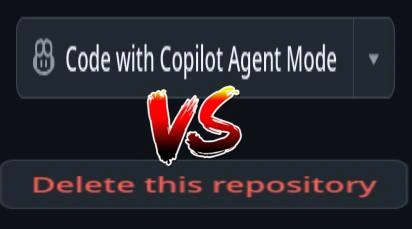
This meme shows a playful but telling contrast using a fake UI. On a dark-themed screen, there are two big buttons stacked vertically. The top one is gray and says “Code with Copilot Agent Mode” next to an icon of two little figures (suggesting collaboration, like two people teaming up). The bottom one is dark with bright red text: “Delete this repository.” In the middle, a flashy "VS" (versus) graphic makes it look like these are two opponents in a video game duel. Essentially, it's presenting the developer with two wildly different options: use an AI helper to improve your code, or blow away the whole project.

Let’s break down the terms. A "repository" (repo for short) is basically a project’s source code storage, often hosted on a platform like GitHub. Clicking “Delete this repository” means permanently removing all that code from the repo – an irreversible action that deletes the entire project history. It’s like the ultimate reset button; you usually only do this if you're absolutely sure you don't need that code anymore (or you have it backed up elsewhere). That's why the button is red – in UI design, red means "danger" or "destructive action." It’s often hidden behind multiple confirmations because it's a big deal to delete a whole codebase.

Now, GitHub Copilot is an AI coding assistant. Think of it like a super-smart autocomplete that not only finishes your line of code, but can suggest whole functions or solutions. It's powered by AI/ML technology (trained on lots of code) to help developers write code faster. Copilot's Agent Mode is an even more advanced feature (relatively new in the developer tools space) where the AI can do more than just complete a single line. In Agent Mode, Copilot could potentially perform multi-step tasks: for example, you might tell it “refactor my code to use this new library,” and it could carry out a series of edits across your project. It’s like having a co-developer bot that can execute commands, not just suggest text. In simple terms, Agent Mode lets the AI act more autonomously in helping you code or refactor.

The meme humorously pits these two actions against each other. Why these two? Because they represent opposite ends of a reaction to messy or difficult code (i.e. a serious code quality problem). On one end, using Copilot Agent Mode is the constructive approach: you let an AI assistant try to clean up or improve the code. It's like saying, "I’ll get help to fix this." On the extreme other end, deleting the repository is the destructive approach: "This code is hopeless, let's just throw it all away and maybe start fresh." It's joking that sometimes a developer feels so overwhelmed by a convoluted codebase or a bizarre code diff that these two thoughts cross their mind: "Maybe I should ask the AI to handle this..." vs "Maybe I should just wipe everything out."

For a newer developer (or anyone, really), the idea of pressing that red delete button is scary – it means all your work would vanish. And normally, nobody in their right mind would put a delete option right next to a feature like coding with AI. That’s part of the joke: the meme puts the “nuclear option” (deleting all code) side by side with a fancy modern tool, as if they are two equal choices in a moment of desperation. It exaggerates how fixing bad code can feel: either trust a cutting-edge AI tool to magically fix the mess (best case: improved code, worst case: weird changes), or just give up on the code entirely (clear the slate and reboot the project). The fiery VS graphic and the dramatic styling make it feel like a tongue-in-cheek developer dilemma showdown.

In summary, this meme is comparing using an AI tool (GitHub Copilot in Agent Mode) to improve code versus hitting the big red panic button to delete the whole project when things go wrong. It’s funny to developers because it captures an extreme feeling: "Ugh, this code is so bad, should I try to rescue it with some AI magic, or just scrap it and start over?" Most of the time, you won’t actually do the latter, but the fact that the thought even exists is what gets a laugh. The contrast is super exaggerated here, making it clear and humorous even to someone new to the idea: one option is high-tech help, the other is total destruction.

Level 3: Fight-or-Flight Refactor

For seasoned engineers, this meme nails a very real feeling. It portrays a dramatic showdown between two extreme solutions when you're staring at a hopeless code mess. On one side, the friendly gray button: "Code with Copilot Agent Mode," complete with a cute icon of two collaborators signifying an AI pair programmer ready to help refactor your code. On the other, in glaring red, "Delete this repository," a button that normally lurks in the danger zone of project settings. Smack in the middle is a fiery "VS" graphic, as if this were a Street Fighter match between coding strategies. The developer experience (DX) here is intentionally over-the-top: it’s presenting what should never be equal choices as if they are two fighters in a ring. It’s AI-assisted refactoring versus the ultimate code quality reset, framed with arcade-game intensity.

Any developer who’s waded through legacy code or a botched auto-refactor can relate. Imagine reviewing a pull request where Copilot’s new agent mode has churned through your codebase. Instead of a few neat fixes, you get a gigantic diff spanning dozens of files. Functions have been renamed, logic rewritten, maybe the code style shifted in unpredictable ways. The diff (the list of changes) is so large and bizarre that it feels like looking at abstract art instead of structured code. At that moment, the thought "maybe we should just start over" flashes through your mind. It's that classic fight-or-flight reflex, but applied to refactoring: do you fight through the review of this alien-looking AI patch, or take flight by nuking the whole repository and beginning from scratch? The meme exaggerates this split-second dilemma: refactor with a robot sidekick, or hit the big red self-destruct.

In real life, hitting "Delete this repository" is not done lightly – it's the stuff of deployment nightmares and repo deletion panic. But the fact that a developer even jokes about it means they've seen some code horror. Maybe the codebase is so brittle, so full of hacks "creative solutions", that introducing an AI's massive change feels just as risky as wiping everything. There's an unwritten rule from years of hard lessons: don't rewrite from scratch unless you absolutely must (because you'll lose all those bug fixes and tribal knowledge encoded in the old code). Yet here, faced with an incomprehensible AI-proposed refactor, even a grizzled senior dev might quip, "Honestly, it might be easier to just nuke it from orbit and clean up the fallout later." That’s the dark humor of developer culture – we cope with insane situations by joking about the most extreme solution.

Trust is a huge factor in this AI pair programming dilemma. Senior engineers have been burned by "silver bullet" tools before. An AI assistant like Copilot can be amazing for productivity, but when it starts acting like an overly enthusiastic junior developer on caffeine, churning out a 10,000-line diff, your instinct is to slam the brakes. You picture merging that PR and then getting paged at 3 AM because something subtle broke in production. The fight side of you wants to believe in modern tools, that maybe the AI found a brilliant way to improve the code. The flight side remembers every late-night outage and leans toward caution (or outright avoidance). It’s a comedic exaggeration of that tension:

# Pseudocode for the senior engineer's internal decision process
if copilot_agent_mode.diff().looks_insane():
    # The AI's proposal is beyond comprehension – consider the nuclear option
    git.delete_repository(repo_name)  # hit the big red button (escape hatch)
else:
    # The diff is reasonable – proceed with AI-assisted refactor
    copilot.agent_mode(apply_changes=True)

Ultimately, the meme gets a laugh from developers because it’s so true. On paper, we all want cleaner, better code (and hey, if an AI can do the heavy lifting, great!). But when confronted with diffs that look like a reality-bending abstract painting, even the best of us have that moment of exasperation: "Maybe I'll just burn it all down and start fresh." Of course, we (usually) don’t actually do that, but having the "Big Red Button" joke there perfectly captures that mix of temptation and terror. In the end, it’s a tongue-in-cheek reminder that maintaining code – whether with an AI assistant or by brute force – can feel like an epic battle, and every developer has a breaking point where the wild thought of a total reset sneaks in. This meme just visualizes that internal struggle in the most dramatic (and humorous) way possible.

Level 4: Agency vs Annihilation

At this deepest level, the meme pits an AI-driven program synthesis approach against a total system reboot of the codebase. GitHub’s Copilot Agent Mode represents a cutting-edge capability where a large language model (likely a refined GPT-based engine) can autonomously refactor and modify code in bulk. Under the hood, it’s using billions of parameters to generate new code suggestions, effectively performing automated planning and coding tasks that traditionally require careful human reasoning. It’s like unleashing an autopilot for coding: the model ingests your repository’s context (possibly building an internal abstract representation akin to an AST) and attempts sweeping improvements or feature additions. In essence, it’s a neural-network powered refactoring, a form of learned program transformation at scale.

On the other side, “Delete this repository” is the nuclear option – a brute-force reset mechanism. In theoretical terms, it's akin to resetting the initial state of a system when the current state has become too chaotic to salvage. Software engineers often joke about a rewrite as declaring technical bankruptcy – an admission that the technical debt and complexity have grown beyond any incremental fix. In algorithmic terms, it’s like a “random restart” in an optimization algorithm: sometimes you stop trying to tweak a hopelessly tangled solution and instead reinitialize from a blank slate.

The humor here arises from the fundamental challenge of code transformation: ensuring that any automated refactor preserves the program’s correct behavior. With formal refactoring tools (like an IDE’s automated rename or extract-method), there's a guarantee of semantic equivalence. But Copilot’s AI doesn’t provide formal proofs – it’s making educated guesses based on training data and context. It engages in a kind of stochastic code surgery: it might restructure your code in elaborate ways that look plausible, but there's no mathematical certainty it hasn't introduced a subtle bug or misinterpreted the intent. Seasoned devs half-joke that enabling such an autonomous coding feature is like flipping the switch on Skynet inside your IDE – powerful, yes, but a bit ominous when you think of the unchecked power you're handing over.

The meme underscores this by showing a flashy “VS” graphic between the options, framing it as a head-to-head bout. On a deeper level, this AI vs. deletion showdown highlights a real engineering dilemma: do we lean on advanced AI/ML tooling to transform our software (embracing the inscrutable complexity of a large language model’s output), or do we wipe the slate clean because the system’s entropy is beyond manageable limits? In physics terms, the codebase’s disorder has grown so much that an AI’s attempt to impose order yields an output that’s practically unrecognizable – hence the “diff looks like abstract art” feeling. Faced with that, the engineer contemplates total annihilation of the current code. It’s a darkly comic illustration of how cutting-edge AI-assisted development intersects with classic software maintenance strategy: the limits of automated code refinement versus the drastic clarity of starting from zero.

Description

Dark-themed UI mock-up shows two stacked, rounded-corner buttons. The upper button, in light gray, reads “Code with Copilot Agent Mode” next to a tiny icon of two stylized figures, evoking GitHub’s AI assistant feature. The lower button is dimmed but the text blares in ominous red: “Delete this repository.” Centered between the buttons is a dramatic, fiery “VS” graphic, like a fighting-game intro, framing the choice as an epic showdown. For senior engineers, the meme wryly captures the moment you weigh embracing Copilot’s autogenerated refactors against wiping the slate clean when the diff looks more like abstract art than maintainable code

Comments

10
Anonymous ★ Top Pick When the AI suggests a 500-line regex, the only reasonable SRE strategy is rm -rf origin
  1. Anonymous ★ Top Pick

    When the AI suggests a 500-line regex, the only reasonable SRE strategy is rm -rf origin

  2. Anonymous

    After 15 years in the industry, you realize the real architectural decision isn't microservices vs monolith - it's whether to spend 3 days debugging with Copilot's increasingly creative hallucinations or just nuke the repo and pretend that legacy migration project never happened. The git history doesn't lie, but it can be deleted

  3. Anonymous

    When your codebase is so cursed that you're genuinely weighing whether Copilot's agent mode can salvage it or if it's time to invoke the forbidden `rm -rf` and tell stakeholders 'the repository got corrupted.' Spoiler: Copilot will try to refactor your technical debt into a slightly more organized pile of technical debt, while deletion offers the sweet release of a blank canvas - and the terror of rewriting everything from memory at 2 AM

  4. Anonymous

    Copilot Agent Mode: Automating code faster than you can git rm -rf --the whole damn thing

  5. Anonymous

    Copilot Agent Mode may draft 47 PRs by morning, but “Delete this repository” is the only fix that’s atomic, idempotent, and guaranteed to reduce on‑call load

  6. Anonymous

    Copilot Agent Mode is optimistic concurrency on your monorepo; “Delete this repository” is the only operation with linearizability

  7. @grinya_a 1y

    Same energy

  8. Deleted Account 1y

    What's that?

  9. Sure Not 1y

    >daddy, why is "delete account" always in red? >>data comunists.

  10. @SheepGod 1y

    i hope folks like u start to stop spamming in random channels

Use J and K for navigation