When the Compiler Error is a Literal Pun
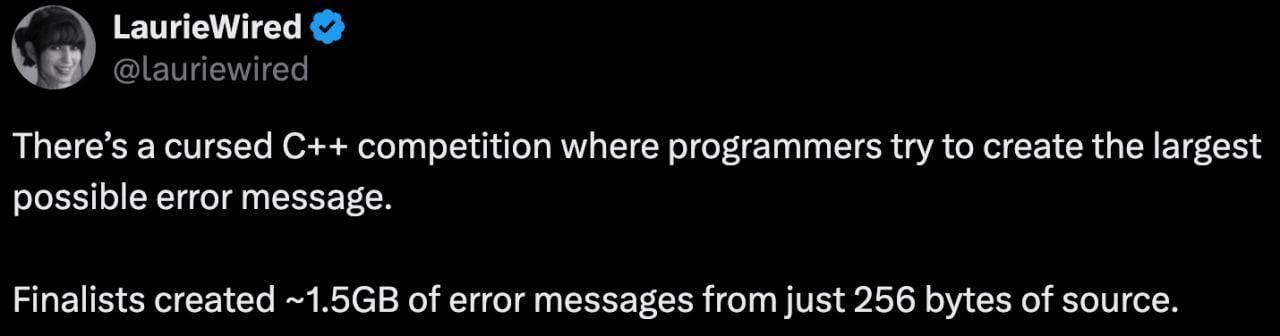
Why is this Compilers meme funny?
Level 1: The “Too Long” Surprise
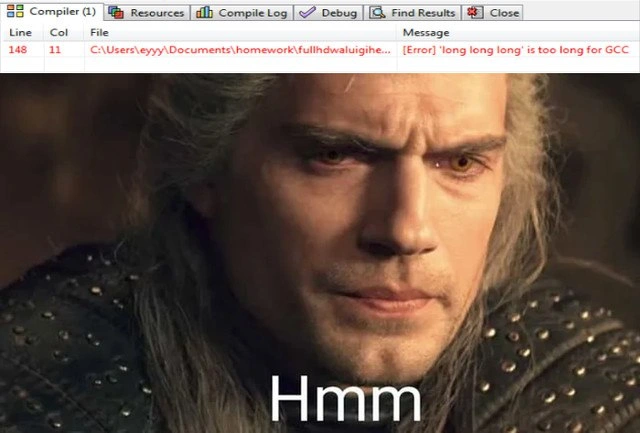
Imagine you’re writing a story and you decide to put the entire story into one single line without any breaks. You give it to your friend to read, but the line is so ridiculously long that your friend says, “I can’t read this – it’s way too long!” In this meme, the computer is like that friend. The programmer gave the computer a piece of text that was so huge, the computer basically responded, “Uh, this is too much for me to handle in one go.” The top part shows the computer complaining about it, and the bottom part shows a character (Geralt from The Witcher) just saying “Hmm.” That “Hmm” is like the programmer scratching their head, quietly thinking, “Huh, I didn’t know there was a limit to that.” It’s the funny moment when a person finds out even a computer has a point where it says “enough!” The humor is in how calmly the character reacts – instead of panicking, he just gives a little grunt. It’s a way of saying sometimes all you can do is pause, say “hmm,” and then figure out how to split that giant task into smaller ones, so the computer (or friend) can handle it.
Level 2: When Code Says “Too Much”
Let’s break down what’s happening in simpler terms. We have a C/C++ program being compiled with GCC, which stands for the GNU Compiler Collection – a very common tool that converts C/C++ source code into an executable program. The top part of the image is a screenshot of an IDE (Integrated Development Environment) called Dev-C++, showing a list of compilation results. One line, highlighted in red, is an error message. It points to a file (some homework file in the user’s Documents) at line 148, column 11, and says: [Error] 'long long long' is too long for GCC. That message is the compiler literally complaining that a string literal in the code is too long. A string literal is just a hard-coded piece of text in your code, usually enclosed in quotes like "Hello World!". It appears the programmer had a very, very large piece of text between quotes in their code – so large that the compiler exceeded its limit trying to handle it.
Think of GCC as a very capable teacher or editor for your code. It usually handles whatever you throw at it, but here the student (the code) wrote a sentence (a string) so outrageously long that the teacher throws up their hands. The error essentially means “This one string in your program is ridiculously big, and I, the compiler, cannot deal with it.” In practice, that might happen if someone tried to include, say, the entire text of a book or a huge image’s binary data directly inside the code as one giant string. That’s not a common thing to do, because normally you’d store large data in separate files (like reading from a text file or an image file at runtime, rather than hard-coding it into the source). But beginners might not know how to do file handling yet, or might think “I’ll just paste it in, easy!” Suddenly, GCC yells at them.
The bottom half of the meme shows Geralt from The Witcher series with the caption “Hmm.” Geralt is a monster-hunter in a fantasy world, known for being very calm and gruff. In internet memes, Geralt’s “Hmm” is famous – it represents a sort of quiet puzzlement or a “thinking but not panicking” reaction. Here, Geralt is standing in for the developer. The programmer seeing this bizarre error doesn’t freak out; they just furrow their brow and go “hmm…”. It’s that moment of trying to process: “Did I really just break the compiler? How is my string too long?” It’s a perfect poker face response to a confusing situation.
For a newer developer, this scenario is a mix of confusion and discovery. Compile-time errors (problems detected by the compiler before the program even runs) are common – missing semicolons, typos, type mismatches – but “string is too long” is an exotic one! It teaches a lesson: yes, even compilers have limits and rules about how code should be structured. It also nudges the newbie to learn a more appropriate method for big data. For instance, instead of one giant string literal spanning hundreds of lines, you could break the string into smaller pieces or, better yet, load the content from an external file. In C, you can actually split a long string literal into multiple literals and just place them next to each other – the compiler will automatically concatenate them. For example:
// Example of splitting a long string into smaller literals
const char *message = "This is a very long string "
"that is split into two parts.";
// The compiler will join "This is a very long string " and "that is split into two parts."
// into one single string at compile time. No error, and it's easier to manage!
By doing that, each piece is shorter, and you avoid hitting the single-string limit. Under the hood, the above code is equivalent to one big string, but it’s easier for the compiler to digest in pieces. If the text was truly enormous (like an entire novel), even splitting might not be ideal — it would be better to store that text in a separate file and have the program read it when needed.
In the IDE output, the numbers “148 11” indicate the location in the file (line 148, column 11) where the compiler noticed the problem – likely where the gigantic string literal started or ended. A junior developer encountering this would likely scroll to that line and find, aha, there’s a monstrosity of a "..." string there. The fix? Shorten it, split it, or remove it. Once done, hit compile again, and hopefully GCC will happily compile the program. The meme doesn’t show all that, but it captures that initial debugging/troubleshooting moment: Why on earth is my code not compiling? followed by Hmm... (time to investigate).
So, to summarize in straightforward terms: The coder tried to compile a program that had an insanely long piece of text in it. The compiler (GCC) said “nope, that string is too long for me.” The developer’s reaction, shown by our unruffled Witcher hero, is a calm “Hmm.” It’s funny because it’s a mix of a technical hiccup and a pop culture way of saying “Well, this is awkward.” Once you understand all the pieces – what GCC is, what a string literal is, and why Geralt is going “hmm” – the meme tells a whole story about a tiny coding adventure (or misadventure!).
Level 3: A Monster of a String Literal
This meme layers a very specific developer problem with a pop culture reference that seasoned coders find hilarious. The top half shows a Windows C++ IDE (specifically the old Dev-C++ IDE interface, judging by the tabs like “Compile Log” and the UI style) with a compiler error listed in red. The message complains that a 'long long long' string literal is too long for GCC. In other words, the code had a hard-coded text constant so large that the GNU compiler simply refused to handle it. This is not a typical error you see every day – it implies the programmer attempted to include an insanely lengthy string in the source. Perhaps they copy-pasted a huge blob of text or binary data directly into their code (the file path snippet “...homework\fullhdwaluigi...” hints that maybe an entire Full HD Waluigi image or similarly large asset was embedded as a string for a homework project!). Experienced developers immediately recognize this as both absurd and plausible: absurd because who in their right mind puts a whole image or novel into a string literal?, yet plausible because at some point every senior has seen a newbie (or an overzealous hack) attempt something wild in code. It’s the kind of quirky scenario that leads to a DebuggingHeadaches story you tell later.
The humor clicks on multiple levels. First, there’s the compiler’s almost tongue-in-cheek message: “[Error] ‘long long long’ is too long for GCC”. The repetition of “long” in quotes (likely part of the truncated offending string) makes the error message itself sound sarcastic. It’s as if GCC is smirking, "This string is long long long... too long for me." Any programmer who’s wrestled with compilers knows they can output some oddly worded diagnostics, and this one is both literal and comedic. It highlights an unexpected limitation in a tool that we usually consider almighty – compilers handle megabytes of code routinely, but here it is throwing up its hands at a single string constant. That contrast is funny!
Second, the bottom half of the meme features Geralt of Rivia (from The Witcher series, portrayed by Henry Cavill in the Netflix adaptation) looking intensely stoic and muttering “Hmm.” Geralt’s “Hmm” has become an iconic meme for moments of silent, deadpan contemplation or mild annoyance. This is the Witcher’s way of processing something baffling or inconvenient without much fanfare – exactly like a developer staring at a baffling compile error. By pairing Geralt’s unflappable demeanor with the weird compiler error, the meme conveys the developer’s reaction: a kind of exhausted, seen-it-all cynicism mixed with genuine confusion. Seasoned developers often respond to bizarre build failures not by screaming, but by a quiet moment of “...hmm, that’s new.” It’s a coping mechanism in IT – when faced with a monster (be it a production bug or an inexplicable error), you channel your inner Geralt and coolly assess the situation, even if internally you’re wondering what kind of cursed code spawn this is.
There’s an in-joke here about Compilers and their idiosyncrasies. We rely on them, but occasionally they confront us with something completely unexpected. The meme taps into the shared experience: many of us have had a WTF moment reading a compile log. Maybe it wasn’t a string-too-long error; maybe it was the classic “expected ‘;’ before ‘}’” or the infamous template error that’s pages long. The point is, you squint at the screen, maybe rub your temples, and go “hmm.” Geralt’s face is basically every developer at 2 AM debugging why their program won’t build. It’s a portrait of stoic frustration.
From a senior dev perspective, there’s also a hint of “you should know better” humor at whoever wrote the code. Large constants belong in external resource files or should be generated, not manually typed out. A veteran might chuckle because they foresee the root cause: “I bet some beginner tried to paste an entire dataset into a char[]. Classic.” The presence of “homework” in the path reinforces that narrative – it sounds like a student project that took an unconventional turn. Instead of loading an image or text from file, the student just dumped it into a string in code, and the compiler noped out. The senior engineer in us finds this both painful and endearing: painful because we imagine the poor soul now has to figure out how to fix it, endearing because it’s a naive mistake born out of not knowing the limits. We’ve all been there, pushing tools beyond their intended use without realizing it. This meme lets us laugh with that developer, not at them, because next time it could be us discovering some obscure limit the hard way.
Even the choice of IDE in the image tickles a nostalgic funny bone. Dev-C++ was a popular lightweight IDE years ago for learning C++ (many of us wrote our first “Hello World” in it). Seeing its old-school interface contain a crazy modern error is a bit incongruous – like finding a dragon in your hometown pond. It adds to the absurdity: an innocent-looking UI, a homework folder, and boom – a compiler error so unusual that even Geralt of Rivia has to step in. The mash-up expertly mixes coding humor with a pop culture meme, and the result is magical. In Witcher lore, Geralt is a professional at handling monstrous troubles; here the monster is a gigantic string literal, and the Witcher’s reaction is an unimpressed grunt. No silver sword or Igni sign will slay this foe – the solution lies in refactoring the code! The meme doesn’t show it, but every senior dev knows the epilogue: the programmer likely mutters “hmm” just like Geralt, then goes back to split the string into smaller pieces or load it from a file, effectively chopping the beast down to size. And in the end, much like a completed Witcher contract, the code finally compiles and peace (in the build pipeline) is restored… until the next monster shows up.
Level 4: Lexical Limit Exceeded
At the compiler-internals level, this error stems from the limits of the parser and memory. When you write a string literal in C/C++ (text in quotes in your source code), the compiler must absorb every character into an internal buffer or tree node. GCC (the GNU Compiler Collection) has an expected maximum size for a single string literal token. If that size is astronomically exceeded, the compiler’s lexical analyzer or parser will balk. In formal language terms, a string literal is a single token produced by the lexer. Lexers are often implemented with buffers or arrays that append each character until the closing quote. If you feed it millions of characters without a break, you risk overflowing those buffers or hitting an internal threshold. The error string is too long for GCC is essentially GCC saying "I have a hard-coded or practical limit on literal length, and you went past it."
Why would a compiler impose such a limit? Partly due to translation limits defined in language standards and partly for pragmatic resource management. The C standard (and C++ standard similarly) specifies minimum maxima – for example, an implementation should support at least a certain number of characters in a string literal (commonly at least 509 or more in older standards, and much more in modern ones). Beyond that, it’s up to the implementation. GCC is known to handle very large literals, but even GCC will draw the line somewhere to avoid pathological cases (like accidentally including an entire binary file as a literal). Internally, extremely large literals would blow up the size of the compiled object file’s .rodata section (where constant strings are stored). Imagine generating an object file with a 100MB constant – it’s technically possible but hardly a good idea; linking and loading such a program becomes a monster of its own. The compiler likely has checks to prevent either memory overflow or just to refuse absurd program constructs that could be unintended (for example, might a missing quote have caused an entire file to be read as one giant string by mistake?). By erroring out early, GCC protects both itself (avoiding running out of RAM or hitting 32-bit index limits for string length) and the developer from an unmanageable build artifact.
From a compiler architecture perspective, handling a string literal involves creating an AST (Abstract Syntax Tree) node or equivalent data structure representing that constant. That node will hold or reference the full string data. If the string is giga-scale, the AST and subsequent assembly generation would churn through an immense array of bytes. Some compiler stages might not even anticipate such volume (e.g., optimization passes or debug info generation could slow to a crawl). In extreme cases, overly large tokens can even expose compiler bugs or inefficiencies (like memory leaks or $O(n^2)$ behavior when n is enormous). Thus, GCC’s error is, in a way, a safeguard saying “No single literal should be this gigantic; something’s off.” It’s akin to a sanity check in theoretical computer science terms – compilers assume source code is text meant for humans to read and maintain, so any one literal spanning thousands of pages is outside normal bounds. This deep technical constraint is hidden in everyday coding because we rarely hit it, which makes it darkly funny when it surfaces: the code literally hit a limit of language syntax design and compiler implementation. It’s the computing equivalent of discovering a hidden rule of nature – or in Witcher terms, stumbling upon an ancient Law of Surprise in the codebase.
Description
A two-part meme combining a screenshot of a compiler error with a reaction image. The top portion displays an IDE window, likely for C++, showing a compilation log. A single error is highlighted on line 148, located in a file path that includes '...\Documents\homework\...'. The error message from the GCC compiler reads: '[Error] 'long long long' is too long for GCC'. The bottom portion of the image features a close-up of Henry Cavill as Geralt of Rivia from 'The Witcher', with his characteristic white hair and intense yellow eyes. He has a skeptical, pondering expression. Superimposed at the bottom is his iconic line, 'Hmm'. The humor arises from the literal and pun-like nature of the compiler's error message, juxtaposed with Geralt's reaction, which perfectly captures a developer's mix of confusion, frustration, and slight amusement at encountering such a bizarre and unexpected error
Comments
7Comment deleted
That moment when you're not sure if the compiler is reporting an error or just subtly judging your life choices
GCC: ‘string literal too long’; me: maybe inlining the entire Swagger JSON as a constexpr wasn’t the zero-latency design win I promised in the architecture review
When the junior dev's PR has `long long long long` but the real horror is they're storing timestamps as seconds since epoch in it
Ah yes, the classic 'long long long long' error - when you're so committed to integer precision that even GCC has to intervene and stage a type intervention. It's the compiler's way of saying 'I appreciate your enthusiasm for 128-bit integers, but maybe we should talk about your file naming conventions first.' Nothing says 'production-ready code' quite like a homework directory path that makes Windows MAX_PATH look reasonable by comparison
“…is too long for GCC” - when your directory tree and your mangled template names are playing chicken with MAX_PATH
GCC's poetic justice: 'long long' isn't portable enough to be that long after all
Embedding a 3MB Base64 blob in a header doesn’t make it “compile‑time”; it just makes GCC file a restraining order