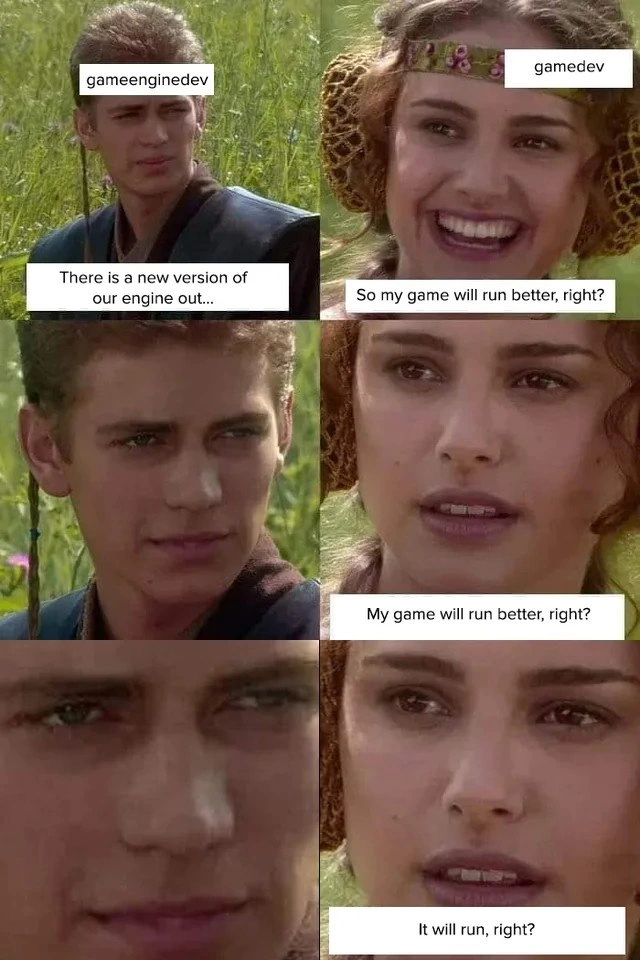
Anakin-Padmé stare-down about upgrading to the new engine version
Why is this Dependencies meme funny?
Level 1: It Will Run, Right?
Imagine you built a big castle out of LEGO blocks. One day, the LEGO company announces a new version of the LEGO pieces that are supposed to be even better for building. You get excited and think, “If I use these new pieces, my castle will be stronger and look cooler, right?” But the person who made the announcement just gives you a quiet smile and doesn’t answer. Now you start to worry. Will the new pieces even fit with the old ones you used? What if your castle falls apart? So you nervously ask, “Um… my castle will still stand, right?” The funny (and a bit scary) part of this situation is that we often assume a new, shiny piece will make everything better, only to realize it might actually require rebuilding a lot of what we have. In the meme, the game developer is like you with your LEGO castle – hopeful at first, then suddenly unsure if the “upgrade” will break the whole thing. The humor comes from that change in expectation: from “Yay, it’ll be better!” to “Wait... it will still work, right?”
Level 2: Better, Right?
Let’s break down the humor in a more straightforward way. The meme shows a conversation between two people, but with labels: Anakin is labeled “gameenginedev” (game engine developer) and Padmé is labeled “gamedev” (game developer). The game engine developer says, “There is a new version of our engine out…” and the game developer replies, “So my game will run better, right?” Initially, she’s smiling and excited. But then Anakin doesn’t say anything – he just stares. In the final panel, Padmé looks worried and asks again, “It will run, right?” Now her smile is gone.
In simple terms, the joke here is about false assumptions when upgrading software. Padmé assumes that just because a new engine version exists, her game will automatically be faster or better. Anakin’s silence implies the opposite – upgrading might not be so simple, and could even threaten whether the game runs at all.
Some key concepts to know:
- Game Engine: This is the core software used to build a video game. It provides the essentials like graphics rendering, physics simulation, sound, and so on. Examples of game engines are Unity, Unreal Engine, or an in-house engine a company builds for its games. The engine is a critical dependency for the game – the game is built on top of it.
- New Version: Software like game engines come in versions (v1, v2, v3, etc.). A new version means the engine devs have updated their software. It could be a minor update (small improvements, usually backward-compatible) or a major update (big changes, often not backward-compatible). Versioning is how we keep track of these updates. For instance, going from version 3.1 to 3.2 is minor, but going from 3.x to 4.0 is major and might change things drastically.
- Backward-Incompatible Changes: This is when a new version is not fully compatible with stuff made for the old version. In our context, it means a game made for the old engine might not work perfectly (or at all) on the new engine without modifications. For example, if you go from Unity 2018 to Unity 2021, some scripts or features in your 2018-made game could break because Unity 2021 expects things to be done differently. Upgrading to a new game engine version often involves these kinds of changes.
- Migration/Upgrade: This is the process of moving your project from the old version of something to the new version. Migrating a game to a new engine version means opening it in the new engine, fixing any issues, and making sure it still runs correctly. It’s like moving to a new house – you have to pack up, move everything, and see if it fits in the new place.
- Legacy Code: Code that was written for older systems or older versions of dependencies. If your game has code that relies on how the old engine works, that code becomes “legacy” once a new engine version changes those old behaviors. Legacy isn’t a bad word; it just means “outdated but still in use.” It often requires extra care to modernize.
- Technical Debt (Tech Debt): This is a metaphor developers use. Imagine you take a shortcut in your project (like not upgrading the engine when it would have been wise to). You save time now, but you incur a “debt” you’ll pay later when that engine is even more out-of-date and harder to upgrade. It’s like paying interest on a loan – delay upgrades too long and the “interest” is that the eventual upgrade is even more painful.
- Dependency Hell: A situation where your project’s dependencies (libraries, engines, etc.) are tangled in such a way that upgrading one thing breaks another. For example, if your game uses three different add-on libraries and each one only works with a certain engine version, it can feel like you’re in “hell” trying to find a combination that works for all. Upgrading the engine might force upgrading those libraries too, and each of those might force other changes… it becomes a headache.
- Framework Churn: “Framework” is a broader term for a platform or engine or library that a lot of your code relies on. Churn means frequent change. So framework churn is when these foundational tools keep updating rapidly. Some developers love always having the latest and greatest, but it can be exhausting to constantly keep up.
- Framework Fatigue: That exhaustion we mentioned? This is the term for it. When you’re tired of always learning a new version or new framework every few months, you’re experiencing framework fatigue. It’s pretty common in fields like web development (JavaScript people know this well) but also in game development when engines keep pushing new versions.
Now, looking back at the meme with these terms in mind: Anakin (engine dev) isn’t responding to Padmé’s excitement because he knows upgrading the engine is not a quick win. Perhaps Padmé’s game is using some legacy code that won’t work on the new version. Maybe the new engine version has a different way to handle graphics or physics (a backward-incompatible change). The engine dev anticipates a lot of work – he’s thinking of the migration steps, the potential for dependency hell, and the tech debt from having delayed previous updates.
Padmé’s reaction shifts from happy to apprehensive because she picks up on that silence. In real life, a junior developer might say, “Oh cool, new version! Let’s upgrade, it’ll run better!” and a senior developer might respond with a hesitant pause, then “...we need to be careful; it might break things.” That pause is exactly what the meme shows. Suddenly the junior dev (Padmé) realizes their assumption might be wrong – hence the worried “It will run, right?” which is basically asking, “Please tell me I’m not about to break everything by updating.”
If you’ve ever updated your phone or your computer’s OS and then one of your favorite apps stopped working, you’ve experienced a mild form of this. Or think of a time you updated a game and then your saved games wouldn’t load because of version differences – that’s the same kind of issue. It’s not guaranteed to happen, but it’s a common enough fear that when someone just announces an update without details, users get nervous.
For a budding developer, the lesson (and comedy) here is: upgrades are good, but they’re not automatic. You don’t get performance boosts or new features in your own project for free – you have to put in some work to adapt to the new version. The meme humorously captures that moment of realization. Padmé’s excited question “Better, right?” turning into “It will at least run, right?” is like going from assuming a new toy will be awesome to just hoping it isn’t broken. Every developer has that moment of oh no when they realize an update is not plug-and-play.
Level 3: The Phantom Migration
This meme uses the classic Anakin-Padmé Star Wars format to lampoon a too-familiar versioning standoff in software development. In the first panel, the game engine dev (Anakin) casually announces, “There is a new version of our engine out…” Meanwhile, the game developer (Padmé) reacts with excited expectations: “So my game will run better, right?” The humor comes when Anakin just stares in silence instead of confirming. That awkward pause speaks volumes. It’s illustrating the upgrade expectation gap – the gulf between how easy upgrading sounds and how hard it actually is in practice.
Seasoned engineers immediately recognize this scenario. Teams often cheer the idea of modernization and eagerly tout new frameworks or engine updates, but when it’s time to actually migrate the project (often with no dedicated migration budget in sight), everyone goes quiet. The engine developer’s deadpan look is basically saying, “I have bad news about your automatic performance boost…” Why? Because upgrading a complex system is rarely seamless. What Padmé expects (free improvements) collides with what Anakin knows (major tech debt payoff is due). The meme gets its punchline from that shared industry experience: new version announced, optimistic promises made… and then the sound of crickets when people ask about the actual migration plan.
To an experienced dev, Anakin’s silent stare screams, “We’re not actually gonna upgrade, are we?” or “Not without weeks of work, we’re not.” It’s a technical stare-down between optimism and reality. We’ve all been Padmé at some point – hearing about a shiny new release and assuming it’s a quick win – only to become Padmé in the last panel, nervously asking if things will even still work afterward. Padmé’s progressively worried face perfectly captures new version anxiety: that sinking feeling when you realize a so-called “upgrade” might break everything. Anakin (the engine dev) isn’t trying to be mean; he’s just bracing for the storm of issues that come with any big engine update.
Upgrading a core engine isn’t a simple drop-in replacement; it often entails:
- Adjusting code to new APIs – Functions and classes you used might have new names or different behaviors. You’ll be hunting through release notes and fixing compiler errors where the engine’s interface changed.
- Replacing deprecated features – That cool physics tweak or shader from the old version might be gone or replaced. You’ll need to find new ways to achieve the same effects, or drop them entirely.
- Re-testing everything – Even minor changes deep in the engine (how collisions are calculated, how assets are loaded) can cause subtle bugs. A character might start jittering because the physics timing changed by 0.1%, etc. You basically have to replay and test large parts of the game to be safe.
- Waiting on third-party updates – If your game uses plugins or packages (AI library, UI framework) that were built for the old engine, they might not work until those maintainers also upgrade. You could find yourself stuck, or temporarily removing features, until the whole ecosystem catches up.
Seen in this light, that blank stare isn’t so much a joke as it is a coping mechanism. The meme exaggerates it humorously, but in real life a lead developer might respond to “It’ll run better now, right?” with a pained smile and a long list of caveats. It highlights a common trade-off: legacy code running on an old but stable engine vs. jumping to the new version that promises improvements. The longer a project avoids upgrading, the more technical debt accumulates, and the harder the eventual migration becomes. This team might have skipped a few incremental updates, and now the new release is a huge leap – cue the collective groan from developers who know what’s coming.
For example, think about a studio running a game on Unreal Engine 4 and the engine team just released Unreal Engine 5. Upper management or enthusiastic devs see the announcement and gush over the improved graphics and tools (“lumen lighting! nanite geometry! it’s the future!”). But the senior engineers know their current game’s code is tightly coupled to UE4. Upgrading to UE5 mid-project is a risky, all-hands-on-deck project. Physics might behave differently, lighting setups might need re-tuning, and custom modifications to the engine (many studios tweak engine source for their needs) have to be redone or thrown out. In other words, migrating to the new game engine version could improve the game in theory, but only after a ton of work to adapt and verify everything. More likely, the team will say, “Cool, we’ll use the new engine on the next project,” and stick with what works for now. Hence, Anakin’s subtle smirk – he kind of knows Padmé’s current game probably isn’t moving to the new engine anytime soon.
The tags Dependencies, Modernization, and TechDebt all point to why this meme resonates. A game engine is a big dependency; updating it is a form of modernization; and delaying that update creates tech debt that will eventually come due. The common tags like DependencyHell and FrameworkFatigue hint at the pain of dealing with constant updates. This one meme panel captures it: the initial joy of hearing about a new release, followed by the dread when you realize the upgrade expectation gap between promises and reality. It’s funny because it’s true – every developer who has been through a big upgrade or migration has experienced that moment of hope followed by a hard crash into reality. The Anakin-Padmé meme template delivers that punchline with just a silent look, and every dev who’s lived it just nods and laughs (perhaps a bit nervously).
Description
Four-panel Star Wars meadow meme: Panel 1 shows Anakin (label on his forehead is blurred) in bright green grass saying, in a white subtitle bar, “There is a new version of our engine out…”. Panel 2 shows Padmé (her forehead label also blurred) looking back with anticipation; her reply subtitle is completely blurred. Panel 3 zooms on Anakin’s face as he keeps silently staring, subtitle area empty. Panel 4 zooms on Padmé’s worried face as she realizes the upgrade isn’t happening. Sunny outdoor colors, light brown Jedi robes, and the familiar Anakin-Padmé template convey the classic “You’re going to migrate, right?” tension, poking fun at teams that announce new framework or game-engine releases but never budget the actual migration work
Comments
9Comment deleted
“There’s a new engine version out” - translation: create a JIRA, set priority “P2-someday,” and wait for the inevitable CVE to turn it into a boardroom emergency
The only thing more reliable than a game engine update breaking your project is the engine developer's confidence that 'it's just a minor version bump with performance improvements and bug fixes.'
Every game engine update follows the same trajectory: 'New features!' becomes 'Breaking changes' becomes 'Why won't it compile?' becomes 'Should I just stay on the LTS version forever?' It's the circle of life for game developers - where 'upgrade' is both a promise and a threat, and the real game is deciding whether the new renderer features are worth re-architecting your entire asset pipeline
Engine upgrade: '2x faster rendering!' - until your LODs vanish and Vulkan support segfaults on startup
There’s a new engine version out - do we migrate and break serialization, or keep our fork and break the calendar?
Engine team: '2.0 is a drop‑in upgrade' - enterprise for 'rename half the namespaces, ship a 200‑page migration guide, and still hit an ABI mismatch in prod'
I came to comments for exactly this Comment deleted
+ Comment deleted
lol))) Comment deleted