Skip to content
DevMeme
2114 of 7435
Functional Programming: The Pure Ideal vs. The Side-Effect Reality
FunctionalProgramming Post #2362, on Nov 25, 2020 in TG

Functional Programming: The Pure Ideal vs. The Side-Effect Reality

Why is this FunctionalProgramming meme funny?

Level 1: Sloppy Sandwich

Imagine you’re making a big sandwich with lots of jelly or sauce. In your perfect plan, all the gooey stuff is neatly kept between the bread slices, so nothing drips out – nice and tidy. That’s the expectation. But when you actually make it and take a bite, there’s jelly squishing out the sides, onto your hands, and even onto the plate. Suddenly, there’s mess everywhere! 🙃 That’s the reality. This meme is funny for the same reason: it’s showing the difference between planning to keep the “mess” only at the edges versus finding out the mess got all over. In simple terms, we tried to keep things clean, but real life got really messy – and seeing that huge sandwich completely covered in “mess” labels makes us laugh because we’ve all had something like that happen. It’s a silly way to say “things didn’t stay as perfectly contained as we hoped!”

Level 2: Functional Burger Basics

Let’s break down the meme’s joke in simpler terms. It’s referencing a concept from FunctionalProgramming: the difference between pure functions and functions with side effects (often called impure functions). A pure function is kind of like a perfect recipe: it only uses the ingredients you give it (inputs) and produces a dish (output) without making any mess elsewhere. In programming terms, given the same inputs a pure function will always return the same output and won’t change anything outside of itself. It won’t modify a global variable, it won’t print to the screen, it won’t write to a file, nothing. All it does is compute and return a result. This is considered a hallmark of good CodeQuality in functional programming because it makes the function very predictable and easy to test. You don’t have to worry that calling it once will somehow change some hidden state and calling it again might give a different answer or affect something else.

On the other hand, a function with a side effect does other stuff in addition to (or even instead of) giving you an answer. “Side effect” in programming means any observable change or interaction with the outside world apart from the function’s return value. For example, changing a global variable, writing to a database, sending a network request, printing to the console, or even modifying one of its input parameters are all side effects. These are imperative_side_effects – “imperative” because they correspond to the step-by-step style of programming where you tell the computer to do this, then do that, altering state as you go. Most real programs need side effects, of course. If your code never had any side effects, it wouldn’t interact with a user or save any data! But the trick is where and how much those side effects happen. Good design (especially inspired by FunctionalProgrammingConcepts) says: keep your side effects on the outside, and keep the core logic purely calculating results. That way, the majority of your codebase is easier to understand and doesn’t produce surprises.

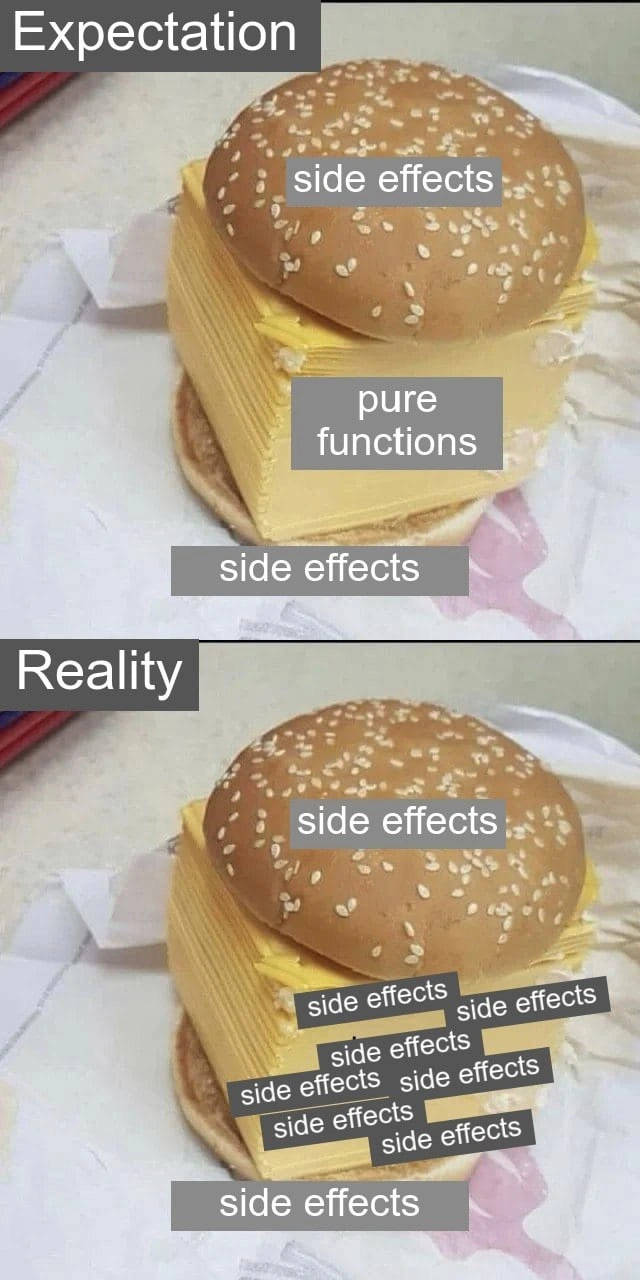
Now, the meme uses a burger_meme (a visual metaphor involving a burger) to illustrate Expectation vs Reality. In the Expectation (top image), we see a burger where the buns (top and bottom) and the outer surfaces of a thick cheese block are labeled “side effects,” and the large interior face of the cheese is labeled “pure functions.” This aligns with the idea: imagine the burger’s pure_functions part is the main substance of your program — the cheese in this exaggerated burger — and it’s supposed to be pure logic. The side effects are confined to the edges (the buns and the thin outer edge of the cheese), meaning you only deal with messy interactions at the very boundary of the system. For example, you might only do file I/O or network calls in a couple of functions at the start or end of your program, and everything in between is just pure computation (cheese). This is the ideal many developers aim for after learning about functional purity: contain the mess, keep the core clean.

However, the Reality (bottom image) humorously shows the same burger, but now every visible surface — literally every part of the cheese and even the buns — has a “side effects” label slapped on it. In other words, side effects ended up everywhere. This is poking fun at the way things often turn out in actual projects. Despite our best intentions, we end up writing a lot of impure functions. Maybe a function that should’ve just done a calculation also writes to the console for logging. Or perhaps each layer of code calls some external service or modifies some object’s state. The “Reality” burger implies that practically everything in the program is doing something with side effects, not just the edges. It’s an exaggeration, of course, meant to be funny — in real life, hopefully not every single function is impure — but it captures the feeling when a codebase is riddled with hidden state changes and unexpected dependencies. It can certainly feel like every bite of that burger has sauce spilling out. This format of showing Expectation vs Reality is common in TechMemes and CodingHumor because developers often find a gap between how we plan to write code and what the code looks like under real-world constraints.

To make this more concrete, consider a simple example in code:

# A pure function: given x and y, it returns x+y and does nothing else.
def add_pure(x, y):
    return x + y  # pure function: no side effects, just returns the sum

# A function with a side effect: it prints to the console (a side effect) before returning.
def add_impure(x, y):
    print("Adding the numbers...")  # side effect: writing to console (I/O)
    return x + y

In add_pure, if you call add_pure(2, 3) ten times, you’ll get 5 every time and nothing else happens. It doesn’t matter when or how often you call it; it won’t suddenly behave differently or affect any external state. In add_impure, however, every time you call it, it will output text to the console. That printing is a side effect – it’s something observable outside the function’s return value. If you called add_impure(2, 3) ten times, you’d still get 5 as a result each time, but you’d also see “Adding the numbers...” printed ten times. That’s a trivial example (printing is one of the simplest side effects), but imagine side effects like writing to a file, altering a global variable, or sending a message over the network. Those can introduce complexity: the order of calls might start to matter, and the function might not behave the same way if the external context changes.

For a junior developer or someone new to these FunctionalProgrammingConcepts, the meme is highlighting a common situation. You learn about pure functions and how they can make your code cleaner and more reliable. You might start a project thinking, “Okay, I’ll keep things pure!” That’s the expectation. But as you go on, you realize, “Oh, I need to save this result to a database here,” or “I should log this value for debugging,” or “This function would be easier if it just modified this object directly rather than returning a new one.” Bit by bit, side effects creep in. The reality ends up being that your code isn’t as purely functional as you initially hoped. This is a classic RealWorldVsIdeal developer moment.

The burger cheese_block_visual_metaphor works great here because even someone without programming knowledge can visually see the joke: ideally, the big chunk of cheese (the main content) is untouched by the “side effects” labels except on the very edges; but in reality, the labels are slapped everywhere, indicating a messy situation. For a coder, each “side effects” label might remind them of a piece of code where a side effect popped up unexpectedly. Perhaps a junior dev recalls the first time they discovered that a library function they used was altering a global configuration behind the scenes (a side effect that surprised them). Or when they wrote a seemingly straightforward function but later realized it was reading a global variable (making it not pure). Those moments reveal how side effects can hide in your program like those extra labels hiding the cheese. The meme, in summary, is a humorous take on an important programming lesson: distinguishing pure functions from impure ones, and recognizing that while we strive for purity, real code often ends up a bit messy. It’s DeveloperHumor that also teaches a lesson about SideEffectsInProgramming in a very visual way.

Level 3: Imperative Infiltration

Every experienced developer can recount a tale of a project that started with idealistic FunctionalProgramming purity but ended up drowning in side effects. This meme strikes a chord because it caricatures the industry’s eternal ExpectationVsReality scenario: we expect to architect systems with clean, isolated logic (the pure cheesy core) and minimal side-effectful edges (just the buns), but the reality is a codebase where SideEffectsInProgramming seep into every nook and cranny. The top panel of the meme – “Expectation” – is essentially the blueprint presented in countless conference talks and clean code books. We’re told to separate pure and impure parts: maybe you’ve heard advice like “keep business logic pure, push I/O to the boundaries”. Seasoned devs nod at that CodeQuality mantra. It’s like designing a burger where only the very outside touches the messy stuff (I/O, mutable state) and everything inside is pristine logic that’s easy to test. This approach is fantastic in theory and indeed some architectures (especially in functional programming circles) are built around it. There’s even a known pattern named Functional Core, Imperative Shell which the "Expectation" half aligns with perfectly. Many of us have started new modules or services thinking, “This time I’ll do it right: pure functions for the logic, and a thin layer handling input/output, database, etc.” It’s the ideal world every senior engineer dreams of after maintaining one too many spaghetti-coded legacy systems.

Then comes the reality. Deadlines loom, requirements change, and humans are fallible. The bottom panel labeled “Reality” hits home because in a real codebase, side effects tend to multiply like Gremlins in water. Perhaps a function that was meant to just calculate a value now also logs some info for debugging (boom, a side effect sneaks in). Maybe an urgent feature request forces you to call an external API inside what was a pure function – just this once! Before you know it, that neat cheese block of pure logic has swiss-cheese holes leaking state everywhere. Impure bits infiltrate the core. A senior developer has seen this pattern repeatedly: today’s small exception becomes tomorrow’s norm. We joke that any sufficiently large program written in an imperative language will eventually grow a global state or three. It’s a form of technical entropy: without constant vigilance, imperative shortcuts and quick fixes worm their way into the clean logic.

Why is this so relatable (and funny in a bittersweet way)? Because we’ve all been there. Imagine a team meeting where the tech lead proclaims, “We’ll contain all side effects to the edges, relying only on pure_functions in our core.” Fast forward a few months and the same codebase is littered with print statements, database calls, and config mutations deep inside what was meant to be pure logic. The pristine core turned into a giant ball of mud with side-effect labels stuck on every piece – just like the second panel’s absurd burger plastered entirely with "side effects" tags. This contrast is classic DeveloperHumor: highlighting the gap between RealWorldVsIdeal. It elicits knowing groans and laughs because it’s emotionally true. We strive for clean, elegant designs (the top burger that’s mostly pure cheese), yet end up debugging why a “pure” function is sending an email or why changing one part of the code mysteriously breaks something unrelated (a telltale sign of hidden side effects, like finding ketchup in places it should never be).

The meme’s burger visual is a perfect metaphor. In theory, one can isolate side effects to the buns – for instance, only the top-level routine handles file input and output, and everything in between is calculation. But in practice, real software is more like trying to eat a sloppy burger: no matter how carefully you bite, sauce gets everywhere. A senior dev will chuckle (or sigh) at the CodingHumor here because it pokes fun at the over-optimistic planning we often do. It reminds us of those system diagrams with neat layers and arrows (pure, impure clearly separated) that inevitably devolve into arrow spaghetti in the actual documentation update a year later. Side effects are like that persistent sesame seed that sticks to your bun: even when you think you’ve accounted for everything, one will sneak into the mix unexpectedly. And unlike the controlled scenario on a whiteboard, in live code, one side effect often triggers another – logging might fail and throw an exception, error handlers modify some global state, or a caching layer introduces statefulness in a pure function for performance. Each is a compromise that adds another grey “side effects” tag to what was supposed to be a yellow square of pure cheese logic.

This meme also jabs at how CodeQuality aspirations meet practical compromise. Pure functions are beloved for making code predictable and testable. Side effects, while often necessary, are risky: they can make functions depend on context or execution order, leading to flaky behavior. So the expectation is that you’ll write as many pure functions as possible and your only side effects will happen, say, at program start (reading input) and end (producing output). Many senior engineers encourage juniors to follow this principle, perhaps after learning the hard way how unruly side effects can cause bugs that are nightmares to trace. The reality scene, though, is an admission that even seasoned teams slip up. Maybe the framework you’re using encourages mixing in a little state (looking at you, frameworks that rely on global config or singleton services). Or maybe it’s just that handling every little thing in a pure way is cumbersome – so someone says “screw it” and puts a database call right in the middle of what was a pure calculation flow. Over time, these decisions accumulate. The end result is a giant burger where every layer, from bun to cheese to lettuce, is soaked with side-effect sauce. It’s funny because it’s true: the lofty functional purity vision often degrades into an imperative free-for-all. The meme uses exaggeration – literally labeling everything as “side effects” – to highlight how it feels when you look at a codebase that was supposed to be pure but isn’t. For veteran developers, it’s equal parts humor and catharsis. We laugh to keep from crying about how hard it is to maintain that pure ideal in a large, evolving system. In short, the meme hits on a shared industry joke: no matter how many FP talks we attend or how much we swear “this time our core will remain pure”, reality has other plans, and we often end up with side effects in places we never expected.

Level 4: Monads on the Menu

In the realm of FunctionalProgramming theory, the goal is to achieve functional purity – computations that act like mathematical functions, with no hidden state or surprises. A pure function is referentially transparent: call it with the same input and you'll always get the same output, and nothing else in the world changes as a result. In a purely functional ideal (think Lambda Calculus and Haskell), all the messy business of interacting with the outside world is pushed to the very edges of the system. This design is often described as having a functional core, imperative shell. The core (our giant cheese block in the burger metaphor) is composed of pure logic. The shell (the buns) handles SideEffectsInProgramming – things like I/O, changing variables, or anything that touches state. The academic allure here is huge: if the core is purely logic, you can reason about it algebraically. The program becomes easier to test (each pure function can be tested in isolation) and even formal verification becomes possible because functions don’t depend on hidden context. Mathematically, this comes from the foundations of lambda calculus where functions are just mappings from input to output with no notion of a “world state”. Functional purity is a direct application of that mathematical FunctionalProgrammingConcepts ideal.

To square this ideal with reality, languages like Haskell use clever constructs called monads to encapsulate side effects. A monad (originating from category theory) can be thought of as a type of wrapper that sequences computations while carrying along some contextual state (like possible effects) in a controlled way. The famous joke is “A monad is just a monoid in the category of endofunctors, what’s the problem?” – translation: monads are abstract, but essentially they let you treat side effecting operations as values that can be composed without breaking purity. If you've heard monads likened to burritos in FP tutorials (yes, monads are a burrito is a thing), here we might say a monad is like a burger bun wrapping up the messy ingredients. For example, Haskell’s IO monad can be seen as those side effects buns: it contains actions like reading a file or printing to the console, so from the outside the core logic still looks pure. The pure computation is the tasty cheese inside, and the IO monad “bun” keeps the messy interaction with the real world bundled up at the boundaries. This technique ensures that, within the core of your code, functions remain pure and blissfully ignorant of the outside world’s chaos, at least in theory.

However, even with monads on the menu, large real-world systems tend to blur the boundaries. Every time you need to interact with reality (read a sensor, fetch user input, call a database, log a message), you’ve stepped into the imperative_side_effects part of the burger. In a purely functional language, that means your function’s type now carries a monadic context (e.g. once you’re in the IO monad, everything that calls that function becomes IO as well). It’s side effects all the way down unless you diligently isolate them. The meme’s Expectation panel reflects the textbook ideal: side effects are neatly constrained to the outer layers (just like buns), and the entire center is pure functions you can reason about like a math problem. The Reality panel, by contrast, is a cheeky nod to the fact that imperative concerns have a way of infiltrating even the core logic. In theory, the pure_functions should dominate the program’s architecture, but in practice the moment you introduce one effect (say, logging for debugging or reading an environment variable), it tends to propagate. Academically, we have elegant models to contain this (monads, effect systems, purity type checking), but practically, teams often end up with code where ostensibly pure logic is entangled with state changes. This is a fundamental tension in computer science: we strive to model programs as neat mathematical functions (ideal for reasoning and parallelizing), yet the RealWorldVsIdeal necessity of doing anything useful (like producing output, making web requests, etc.) forces us to reintroduce controlled impurity. The meme humorously illustrates this truth with a burger: you wanted a perfectly layered functional program where only the edges deal with the outside world, but you got a dripping stack where side effects touch every layer. It’s a wholesome joke for those who appreciate the lofty promises of functional purity versus the messy reality that even the most academic solutions can’t entirely avoid.

Description

A two-panel "Expectation vs. Reality" meme using an image of a cheeseburger ridiculously overloaded with cheese slices. In the top panel, labeled "Expectation," the burger buns are labeled "side effects" and the massive stack of cheese between them is labeled "pure functions." This illustrates the ideal software architecture where the core logic is pure and isolated, with side effects being minimal and cleanly separated. The bottom panel, labeled "Reality," shows the same burger, but the stack of cheese is now littered with numerous smaller labels, all reading "side effects." This humorously depicts the common scenario in real-world applications where, despite intentions, side effects become entangled with the core logic, making the codebase complex and less predictable. The meme resonates with developers who appreciate the principles of functional programming but have experienced the practical challenges of maintaining that purity in large, evolving systems


Comments

14
Anonymous ★ Top Pick Every project starts as a beautiful Haskell monad. Six months later, it's a global mutable state cheeseburger held together by a singleton pattern and a prayer
  1. Anonymous ★ Top Pick

    Every project starts as a beautiful Haskell monad. Six months later, it's a global mutable state cheeseburger held together by a singleton pattern and a prayer

  2. Anonymous

    Architect: “Side effects belong at the edges.” Six sprints later every ‘pure’ function takes a DB session, a Kafka producer, and the entire request context - apparently the edge has expanded to fill all available cheese

  3. Anonymous

    After 15 years of preaching functional purity, you realize the real monad was the side effects we accumulated along the way - and no amount of IO wrapping can hide the fact that your 'pure' microservice still needs to talk to that legacy Oracle database running COBOL stored procedures

  4. Anonymous

    Ah yes, the classic functional programming journey: you start with a beautiful architecture where side effects are neatly contained at the boundaries, pure functions form the core business logic, and everything is composable and testable. Then production happens - database calls leak into your domain layer, API timeouts need handling everywhere, logging becomes essential for debugging, and suddenly your 'pure' function stack is drowning in IO monads, error handling, and state mutations. Turns out the real world has a lot of side effects, and they're not content staying at the edges of your carefully crafted functional sandwich. Welcome to the reality where every 'pure' function eventually needs to talk to something impure, and your type signatures grow longer than your actual implementation

  5. Anonymous

    Functional core, imperative shell was the plan; we shipped a fractal boundary where every function returns IO and a little regret

  6. Anonymous

    Pure functions: one clean slice. Reality: side effects stacked so high, your type checker files for divorce

  7. Anonymous

    Functional core, imperative shell: expectation. After logging, tracing, flags, retries, auth, and compliance…the core is IO[SideEffect]

  8. @coleale 5y

    даа

  9. @coleale 5y

    чо я тут забыл

    1. @NiKryukov 5y

      Подписаться на канал

    2. dev_meme 5y

      And also you forget to use proper language here ;)

      1. Alexey 5y

        Oh you from Anglia

        1. dev_meme 5y

          Indeed

      2. @lawenard 5y

        बिल्कुल, याद दिलाने के लिए धन्यवाद

Use J and K for navigation