Recommended Imposter Syndrome
Why is this Learning meme funny?
Level 1: The Mean Suggestion
This is like asking a teacher for help with drawing, and then the teacher hands you a book called “Maybe Drawing Is Not For You.” The teacher may not mean to hurt your feelings, but it feels very personal. The funny part is that the website thinks it is being helpful, while the person seeing it feels attacked.
Level 2: Algorithmic Pep Talk
Imposter syndrome is the feeling that you are not as capable as others think you are, even when you are learning normally or doing fine. In programming, it often appears when a beginner compares their messy first projects to polished demos, senior engineers, or confident internet opinions.
Content recommendation is the system that decides what videos, posts, or articles to show next. It does not usually know a user personally. It works from patterns: what people watched, what they clicked, what similar viewers liked, and what topics seem related. That is why a person watching coding videos might get a video about whether everyone should code.
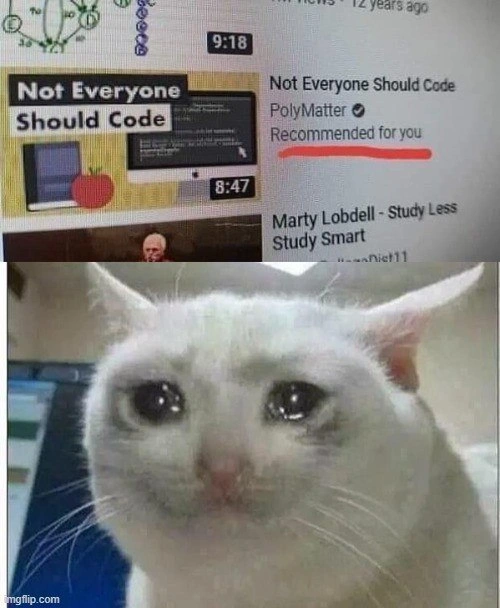
The visible recommendation says Recommended for you, which makes the suggestion feel personal. The sad reaction image below shows how a learner might receive it: not as neutral content, but as confirmation of their worst fear. The humor comes from the gap between the platform’s likely intention and the viewer’s emotional interpretation.
This is common in the learning to code journey. A beginner searches for tutorials, then sees content about burnout, gatekeeping, layoffs, “you are learning the wrong language,” or “AI will replace programmers.” None of those recommendations prove anything about the learner. They are just outputs from a system trying to keep attention. Still, at the wrong moment, a title can hit like a failed unit test for your entire personality.
Level 3: Personalized Damage
The top panel shows a recommendation page where a video titled:
Not Everyone Should Code
is labeled:
Recommended for you
The red underline under Recommended for you does the real work. Without it, this is just a video suggestion. With it, the algorithm appears to lean across the desk and whisper, “This one is specifically about you.” The bottom panel answers with a white cat staring into the camera with wet, devastated eyes, which turns a normal recommendation into a tiny career crisis.
The developer joke is not really about whether the video itself is fair, nuanced, or clickbait. The visible meme only needs the title and the recommendation label. Recommendation systems optimize for engagement signals: clicks, watch time, similarity to prior behavior, topic clusters, and whatever the platform believes will keep a user watching. They do not understand the emotional state of a junior developer, a career switcher, or someone already wrestling with imposter syndrome. The algorithm sees “coding content viewer”; the human reads “maybe I should quit.”
That mismatch is why the meme lands. The phrase Not Everyone Should Code touches a sensitive nerve in programming culture: the tension between encouraging people to learn and gatekeeping who “belongs” in tech. Developers are constantly told that coding is accessible, then also told that real engineers are self-taught prodigies, math geniuses, open-source contributors, leetcode machines, architecture monks, and somehow relaxed about all of it. Into that soup drops a recommendation engine with the emotional intelligence of a metrics dashboard.
This also satirizes how personalization can feel invasive even when it is technically mundane. The system probably did not infer, “This person doubts their abilities.” It likely connected programming-related viewing history with another programming-adjacent video. But the UI copy Recommended for you makes the output feel intentional. In software terms, the model has weak semantic awareness but strong product framing. The result is not just content discovery; it is automated self-esteem roulette.
For experienced developers, the joke has a second layer: everyone has been on both sides of this anxiety. Seniors may laugh because they remember being crushed by tutorials, interviews, compiler errors, and blog posts declaring their favorite stack obsolete. They may also wince because tech culture really does turn learning into a status contest. A recommendation like this is funny because it compresses years of career insecurity into one painfully well-placed label.
Description
The image is a two-panel meme: the top shows a YouTube recommendation page with the video title "Not Everyone Should Code" by verified creator PolyMatter, marked "Recommended for you" with a red underline. Nearby visible text includes a duration label "8:47," another recommendation reading "Marty Lobdell - Study Less Study Smart," and cropped text near the top including "12 years ago." The bottom panel shows a close-up of a white cat with watery, sad-looking eyes, representing the viewer's crushed reaction. The technical joke is that recommendation algorithms can accidentally hit developers exactly where imposter syndrome and gatekeeping already hurt.
Comments
4Comment deleted
The recommender model achieved perfect personalization by ranking emotional damage above watch time.
Recommended* Comment deleted
Sad Comment deleted
👍🏼 Comment deleted