Skip to content
DevMeme
155 of 7435
The Full Stack Overflow Pun
CS Fundamentals Post #192, on Mar 2, 2019 in TG

The Full Stack Overflow Pun

Why is this CS Fundamentals meme funny?

Level 1: One More Plate

Imagine a waiter already balancing a tall stack of plates all the way up to their chin. Someone walks over with one more plate. The waiter says, calmly: "If you put that on top, everything falls down." That's the whole joke — the programmer's job title literally has the word "full" in it ("full stack engineer" means someone who handles every part of building an app), so they point out that something already full can't take one more thing without overflowing, the way a full glass spills if you keep pouring. It's a polite, clever way of telling the boss: I'm at my limit, and the next task is the splash.

Level 2: Push, Pop, and Pay Attention to Capacity

Three terms unlock the joke completely:

  • Stack (data structure): a pile where you add (push) and remove (pop) only from the top — Last In, First Out, like a stack of plates. Programs use one automatically to track function calls.
  • Stack overflow (the error): what happens when the call stack runs out of room — typically from a function that calls itself forever:
def handle_task(task):
    return handle_task(next_urgent_thing())  # no base case, no weekend

The program crashes. The error is so famous that Stack Overflow, the site where every developer ends up at 2 AM, is named after it.

  • Full stack engineer: someone who works across the whole application — the frontend (what users see: HTML, CSS, JavaScript) and the backend (servers, databases, APIs). It's a real and valuable skill set, but in job postings it sometimes means "we'd like one person to do the work of three."

What a junior should take from this beyond the giggle: capacity limits are real in both senses. Recursion needs a base case, and you need one too — a point where you say "my queue is full; which of these should I drop?" Saying it early is engineering; saying it after the crash is an incident report.

Level 3: LIFO and the Limits of "Full"

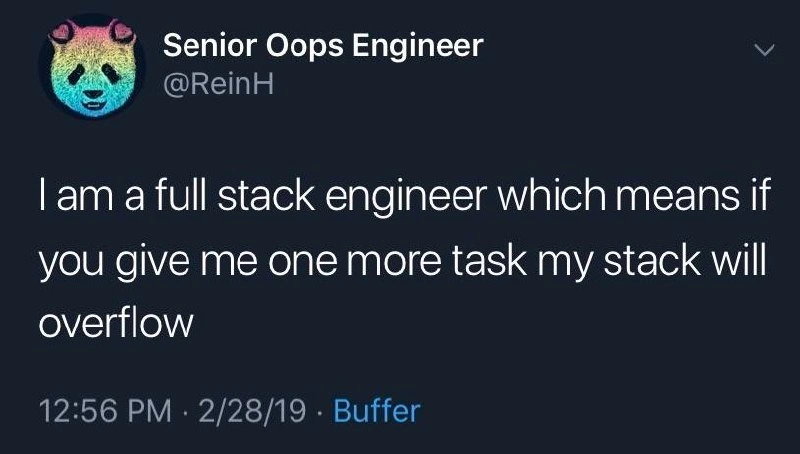
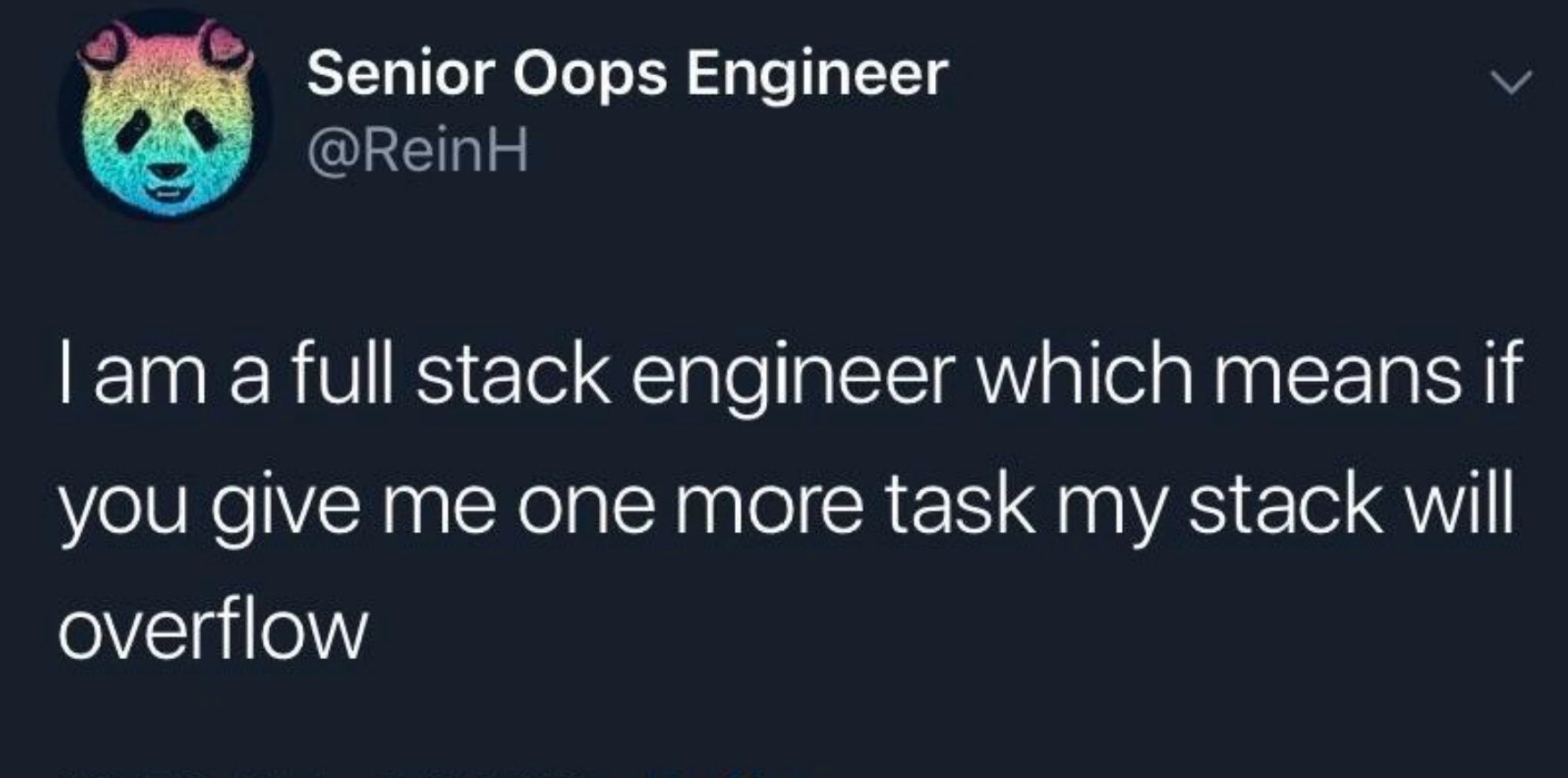
"I am a full stack engineer which means if you give me one more task my stack will overflow"

A dark-mode tweet from "Senior Oops Engineer" (@ReinH, rainbow-panda avatar — and yes, "Oops" where "Ops" should be is its own résumé joke), posted, with grim aptness, via Buffer. The pun is a precision double-decker: it requires knowing both what "full stack" means as a job title and what a stack overflow means as a failure mode, then noticing the title contains its own crash condition. A stack that is full overflows on the very next push. The job title was a capacity warning all along.

The technical underlay: the call stack is the memory region where a program tracks nested function calls — each call pushes a frame, each return pops one, last-in-first-out. It's finite (commonly a few megabytes per thread), so unbounded growth — classically, runaway recursion with no base case — slams into the guard page and the process dies with the error so iconic that the industry's Q&A site named itself after it. The tweet maps this onto workload with uncomfortable fidelity. An overloaded engineer is running LIFO scheduling: the most recently assigned "urgent" thing preempts everything, older tasks sink to the bottom of the stack never to be popped, and each interruption pushes a context frame ("where was I?") that costs real memory to restore. Context-switching overhead isn't a metaphor; it's the mechanism.

And the "full stack" half carries its own industry critique. The title originally meant a developer comfortable across the frontend and backend. In practice it has suffered relentless scope inflation: database tuning, CI/CD, cloud infrastructure, on-call, the office printer. "Full stack" too often functions as a compression algorithm for headcount — one salary, four roles — which is exactly the workload-creep the joke crystallizes. The deadpan brilliance is presenting burnout as a type error: the engineer doesn't complain, negotiate, or escalate; they simply report, with engineering accuracy, that the next push violates a hard resource bound. Veterans recognize this as the only language management reliably parses — "I'm overwhelmed" is negotiable, but "the system will crash" gets a meeting scheduled.

Description

A screenshot of a tweet from a user named 'Senior Oops Engineer' (@ReinH), who has a colorful rainbow panda as a profile picture. The tweet, posted on February 28, 2019, has a dark background with white text that reads: 'I am a full stack engineer which means if you give me one more task my stack will overflow'. The humor is a clever pun that plays on two meanings of 'stack'. In software development, a 'full stack engineer' is someone who works on all parts of an application, from the user interface (front-end) to the server and database (back-end). The phrase 'stack overflow' is a common and critical error in programming that occurs when the call stack, a finite block of memory, runs out of space. The tweet humorously conflates the technical error with the human experience of being overloaded with work, suggesting the engineer's personal 'stack' of tasks is at its limit and will crash if anything else is added. This resonates deeply with developers who are familiar with both the technical term and the feeling of burnout
Comments

8
Anonymous ★ Top Pick My call stack has been overflowing for so long it's now a heap. It's unmanaged, prone to fragmentation, and I have no idea where anything is, but at least it's bigger
  1. Anonymous ★ Top Pick

    My call stack has been overflowing for so long it's now a heap. It's unmanaged, prone to fragmentation, and I have no idea where anything is, but at least it's bigger

  2. Anonymous

    These days “full-stack engineer” just means your call stack includes product, design, infra, compliance, and lunch ordering - no tail-call optimization, so one more frame and the whole thing dumps core

  3. Anonymous

    The irony of being a "Senior Oops Engineer" is that after 15 years, you've finally achieved the seniority to admit that every deployment is just a carefully orchestrated accident waiting to happen - and now you're responsible for the entire stack of them

  4. Anonymous

    Full stack engineering: LIFO scheduling where the last task pushed is the only one management remembers

  5. Anonymous

    A perfect encapsulation of the full-stack engineer's dilemma: you're expected to context-switch across the entire technology stack - frontend, backend, infrastructure, databases, CI/CD - while maintaining O(1) response time to stakeholder requests. But unlike a well-architected system with proper load balancing and circuit breakers, human engineers lack horizontal scaling capabilities. Eventually, you hit the stack pointer limit, and instead of a graceful degradation or proper error handling, you get a segmentation fault in the form of 3 AM production incidents and existential dread. The real overflow isn't in your data structures - it's in your Jira backlog and your cortisol levels

  6. Anonymous

    Full-stack means your backlog is LIFO; one more P1 and my call stack will unwind straight into Stack Overflow - the website - right before the memory does

  7. Anonymous

    Full stack life: PMs keep pushing tasks onto your call stack without a single pop - hello, recursion depth exceeded

  8. Anonymous

    My manager suggested increasing my stack size; I tried ulimit -s unlimited, but headcount isn’t a sysctl

Use J and K for navigation