Why Full-Stack Devs Feel Like Dogs, Fish, Birds, and Ducks Combined
Why is this WebDev meme funny?
Level 1: Trying to Do It All
Imagine you have a friend who is pretty good at many things but not the very best at any one thing. They can draw a little, play sports a little, and do math a little. Now, think of three other friends: one is an amazing runner but can’t swim, another is a fantastic swimmer but can’t ride a bike, and the third is a great biker but can’t run. Each of those three friends is like an expert in one skill (and missing another). But that first friend – the one who does many things – is trying to do all the activities: running, swimming, and biking. They’re like a duck compared to a dog, a fish, or a bird. A duck can swim in the pond, walk on land, and even take flight for a short distance. But a duck will never swim as deep and fast as a fish, run as swiftly as a dog, or soar as high as a strong flying bird. The duck is doing okay in all places, just not spectacular in one place.
This is funny because we can feel the duck’s situation. 🦆 It’s like when you try to do everything at once – you end up feeling a little clumsy at each thing. Think about if you tried to be the school’s best artist, fastest runner, and top musician all at the same time. You might do each of those things decently, but whenever you see someone who only focuses on music or only on running, they’ll seem way better in that one area. You’d feel a bit like, “Wow, I’m not as good a runner as that fast kid, not as good a painter as the art kid...” That can be a funny and a frustrating feeling. In the meme, each animal says what they can’t do (that’s their weak spot), and then the Full Stack Developer is shown as having all those weak spots combined! It’s a silly way to say: “This person is doing so many jobs that they kind of feel not so great in each one – just like a duck that’s fine at many things but not the champion of any.” The humor comes from recognizing that feeling in ourselves or our friends and laughing about it. It’s okay not to be the best at everything – even ducks probably joke with each other about how they waddle and quack their way through life, doing a bit of this and that. This meme just puts that idea in a fun, simple picture that anyone who’s tried to juggle a bunch of tasks can understand and smile about.
Level 2: Wearing Many Hats
Let’s break down the joke in simpler terms. In the software world, frontend and backend are two very different areas of work. The frontend is everything a user sees and interacts with in an application – the buttons, the layout, the website design. This involves skills like HTML (the structure of web pages), CSS (the styles and look), and JavaScript (interactive behavior on the page). A frontend developer is like a talented artist or designer for the web, focused on making things look good and easy to use. But ask them to set up a server or optimize a database query, and they might feel lost – that’s not their turf. On the other side, the backend is all the behind-the-scenes logic – the server code, databases, and APIs that do the heavy lifting (like processing data, authentication, business rules). A backend developer is like an engineer or architect, making sure the foundation and machinery of the application are solid. However, if you suddenly hand this backend expert a CSS file and say “make it pretty and responsive,” they might react like a fish out of water!
Now, a Full Stack Developer is someone who tries to do both frontend and backend – essentially wearing many hats on the job. Think of “full stack” as covering the full technology stack, from the user interface all the way down to the database. These folks build features end-to-end: one moment writing the code for how a button on the website looks, the next moment writing the logic for what happens when that button is clicked and the server needs to handle it. It’s a generalist skillset. In theory, this is incredibly useful: one person who can build a complete feature all by themselves! But in practice, it’s challenging because each part of the stack is a deep field of its own.
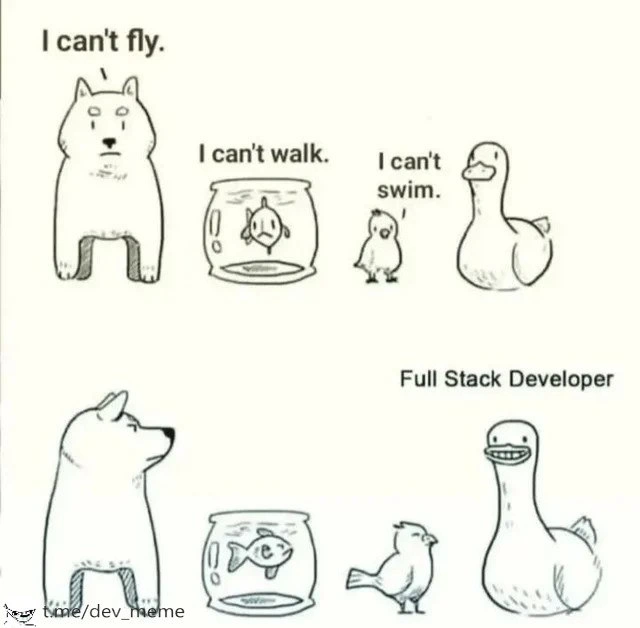
The meme uses animals to represent this idea in a funny way. Each animal in the top row has something they cannot do:
- The dog says “I can’t fly.” Dogs are great at running around on land, but flying is for birds. This is like a backend specialist who’s awesome with servers and code, but not so good with fancy visual effects or mobile-like interfaces (the “flying” of programming, let’s say).
- The fish says “I can’t walk.” Fish excels in water, just swimming along, but take it out of water and onto land – nope, it flops. This could be our frontend specialist who can craft beautiful web pages (swimming in the sea of UI/UX), but if you ask them to configure a server or deal with low-level system stuff, they’ll flop about like a fish on carpet.
- The bird (chick) says “I can’t swim.” Birds (at least most) rule the air – even this little chick is destined to fly eventually – but they aren’t built to swim in water. This could represent another type of specialist (maybe a mobile app developer or a data scientist) who can soar in their own domain, but would feel completely out of depth trying to work on, say, a large database or an old legacy backend system (the “water” environment).
Each creature is basically a specialist in one environment: land, water, or air. They’re also admitting their skill gap: a thing they just can’t do outside their specialty. Now look at the second row: the meme labels the Full Stack Developer and shows the same four animals again, but this time together as a group. This implies our full-stack dev is like a combination of all these animals – a dog-fish-bird-duck hybrid! The duck in that lineup is key. A duck is a funny animal because it kind of manages to do a bit of everything: ducks can walk on land (not as fast or agile as a dog though), they can swim in water (not as expertly as a fish), and they can fly in the air (not as high or gracefully as other birds). The duck is okay at all three modes, but not spectacular at any one. That’s exactly the punchline: a full-stack developer often feels like a duck among specialists. They can handle a frontend task, but maybe not with the same creative flair as a pure frontend designer. They can write backend code, but maybe not with the same hardcore optimization a backend specialist might apply. They have breadth over depth.
In the software community, this meme is super relatable. Many developers have been in a situation where they had to learn a bit of everything – setting up the server, designing the webpage, writing the database queries – especially in small teams or personal projects. If you’ve ever built a complete web app by yourself, you know the drill: you juggle JavaScript for the client side and Python (or another language) for the server side, maybe even write some SQL for the database. It’s empowering but also overwhelming. You might have felt that compared to those friends who focus only on one area, you’re constantly playing catch-up on multiple fronts. For example, you might spend a week learning a new front-end framework like React and just when you think the user interface is decent, you realize your server code needs refactoring to handle more users. So you switch to backend mode, perhaps using Node.js or Django to fix up your API, only to later discover your CSS isn’t responsive on mobile screens. 🤦♂️ It’s a juggling act! The meme humorously captures that feeling: being adequate at many tasks but occasionally feeling inadequate when comparing each of those skills to a specialist’s single, honed skill.
The phrase “wearing many hats” applies here – it means one person is doing many different jobs. A full-stack dev might wear the database admin hat, the frontend developer hat, and the backend engineer hat all in the same day. It’s both a point of pride and a bit of an inside joke in the industry. We laugh at the meme because it’s a gentle roast of those broad generalist roles. It says, essentially, “Sure, you can do it all, but sometimes you feel like you’re not as strong in any one area – and that’s okay and funny!” Within tech circles, this is a common developer humor theme – being honest about your limits. Full-stack folks often joke about their own skills: “I can make something work end-to-end, but don’t ask me to make the UI pixel-perfect like a pro designer, or to fine-tune the database like a 20-year SQL veteran.” The meme’s dog, fish, and chick are exactly those voices. And the duck with that goofy grin at the end? That’s the full-stack dev embracing the chaos, doing their best, and laughing along with everyone else about how absurd the job can feel at times.
Level 3: Jack of All Stacks
This meme wryly illustrates the reality of Full Stack Development using an animal analogy. In modern WebDev, a full-stack developer is expected to handle everything from Frontend UI tweaks to Backend database queries. That’s like asking one creature to thrive on land, in water, and in the air all at once. The top row of the comic pokes fun at the specialist roles:
- The dog admits "I can't fly." – It’s great on land (like a backend guru solid with servers and databases) but flounders with lofty UI/UX tasks.
- The fish says "I can't walk." – It’s built for water (think a frontend specialist fluent in browser quirks and CSS) but can’t operate on terra firma (server-side logic is alien).
- The little chick chirps "I can't swim." – A fledgling bird (imagine a mobile or cloud specialist) who isn’t equipped for other domains yet.
Each creature excels in its domain but has a glaring gap in another skill – a classic developer stereotype where each expert has a blind spot. Then the meme’s punchline: all four appear again labeled “Full Stack Developer”. The implication is brutally hilarious: this one person inherits all the collective limitations. The full-stack dev is essentially a duck: a creature that walks, swims, and flies, yet does none of these quite as elegantly as the specialists. In tech humor terms, the poor duck dev is a jack-of-all-trades, master of none – or as one might joke, a “Jack of All Stacks.” The humor lands because so many developers relate to the scenario: the startup DevOps meeting where you’re suddenly the DBA, the UI designer, and the API engineer in one. It’s a form of developer self-deprecation – full-stack engineers laughing at their own Swiss-army-knife skillset that often feels inadequate in a world of laser-focused experts.
On a deeper level, this meme highlights the generalist vs specialist dilemma in tech. A specialist (like each animal in its element) can fine-tune one skill to perfection – the frontend expert who conjures pixel-perfect interfaces or the backend pro who optimizes queries in their sleep. Companies love these experts for critical tasks. But businesses also prize generalists – those who can wear many hats and bridge gaps. The Full Stack Developer acts as that bridge between frontend and backend, much like a duck traversing water and land. The trade-off is the skill gap in each area: when you’re spread across the entire stack, you rarely have time to attain eagle-level front-end mastery or deep-sea database wizardry. Experienced devs chuckle (or cringe) at this relatable developer experience: they’ve seen the job postings seeking a “rockstar full-stack ninja” – essentially a mythical creature expected to fly through elegant UI design, swim in complex database schemas, and run at the speed of C++ on the backend, all at once. The meme’s animal quartet sums up the reality: even a “unicorn” developer will feel like a dog-fish-bird hybrid, juggling tasks slightly outside their comfort zones.
There’s also an undercurrent of truth about Developer Experience (DX) and cognitive load. Seasoned engineers know that constantly context-switching between, say, debugging a React UI glitch and optimizing a SQL query is mentally taxing. The duck (full-stack dev) might get the job done, but it’s paddling furiously under the surface. Meanwhile, the specialist fish or dog can focus purely on swimming or running, refining that skill to high art. The “duck developer” often feels always a step behind in every domain – a sentiment that triggers knowing laughter and perhaps a sigh from veteran engineers. Why do we keep expecting one person to do it all? Partly, it’s startup culture and lean teams – in a small pond, a duck is more useful than three separate animals. Historically, early web developers were ducks by necessity: one person built the whole thing, from HTML to server script to database. But as technology stacks grew deeper and more complex (think advanced front-end frameworks, intricate cloud infrastructures), true full-stack mastery became as fantastical as a dog sprouting wings. This meme distills that entire journey into one scene of comical resignation. Tech humor thrives on shared pain points like this: everyone in the room chuckles because either they’ve been the duck or they’ve overestimated a duck. In short, the meme is a cheeky nod to every generalist developer who’s felt like a waddling, quacking chimera of skills in a world of graceful specialists.
Description
Black-and-white line-art meme on a plain backdrop. Top row: a standing dog with the caption "I can't fly."; next to it, a fish inside a round bowl labelled "I can't walk."; then a tiny chick labelled "I can't swim."; finally a duck, completing the quartet. Below, the same four figures appear again under the bold heading "Full Stack Developer". A small watermark "t.me/dev_meme" sits in the bottom-left corner. Visually it suggests that while each creature lacks one core skill, the full-stack developer inherits all their collective limitations, humorously portraying the generalist engineer who works across frontend and backend without excelling at any single domain
Comments
23Comment deleted
Full-stack devs: the only species that can violate CSS lint, trigger the DB query planner’s panic mode, and blow the SRE error budget - usually in the same commit
After 15 years in the industry, you realize being a full-stack developer means you're equally incompetent at twice as many things, but somehow the production system still runs because you've mastered the art of Stack Overflow-driven development across all layers of the stack
The full stack developer: the only role where 'I can do frontend, backend, DevOps, design, and mobile' translates to 'I've copy-pasted from Stack Overflow in five different contexts.' Like the duck, we're proud of our ability to waddle through databases, paddle across APIs, and occasionally take flight with a new framework - even if the specialists are doing backflips, setting Olympic records, and achieving actual liftoff while we're just... adequately afloat
Full stack devs: Frontend flies, backend swims deep, DevOps walks the dog - until the monolith partitions at 3 AM
Full‑stack is when management learns duck typing and assumes one engineer can walk like backend, swim like DevOps, and fly like frontend - then wonders why the SLA waddles
Full‑stack is the duck of software: walks (UI), swims (DB), and flies (infra) - none elegant, yet it’s the only one that ships without waiting on three teams’ IAM tickets
zeroth Comment deleted
Everyone else's brain: laughs on a joke. My brain: plays Genesis - I can't dance Comment deleted
Fullstack can't do anything? Comment deleted
Fullstack is a sitting duck Comment deleted
more like a goose, but it's almost same thing Comment deleted
Fullstack can do all of it, but usually not as good as other species that are finely tailored for just one thing. Comment deleted
I was joking 😄 Comment deleted
I think this is the 3rd repost Comment deleted
Probably so :( Comment deleted
Btw can we have reactions in the channel? Comment deleted
They do replace comments section 🙁 Comment deleted
Waaat? Okay never mind then Comment deleted
really? Comment deleted
they don't anymore Comment deleted
didn't beat legendary "you're telling 10th time" Comment deleted
https://t.me/devs_chat/17347 Comment deleted
nice meme unfortunately ♻️ Comment deleted