Glossy frontend hides the rooftop-level chaos powering it behind the scenes
Why is this Frontend meme funny?
Level 1: Shiny Outside, Messy Inside
Imagine you’re visiting a bakery with a beautiful display of cakes and cookies out front. The shop area where customers walk in is clean, the cakes are perfectly arranged, and the bakers at the counter smile while everything looks yummy and orderly – that’s the frontend, the part everyone sees. Now think about the kitchen in the back of the bakery. It’s hot and busy: flour dust in the air, mixing bowls everywhere, chefs rushing to get the next batch of dough in the oven. There might be spilled ingredients and a big mess as they work hard to make those perfect cakes – that’s the backend, the behind-the-scenes chaos.
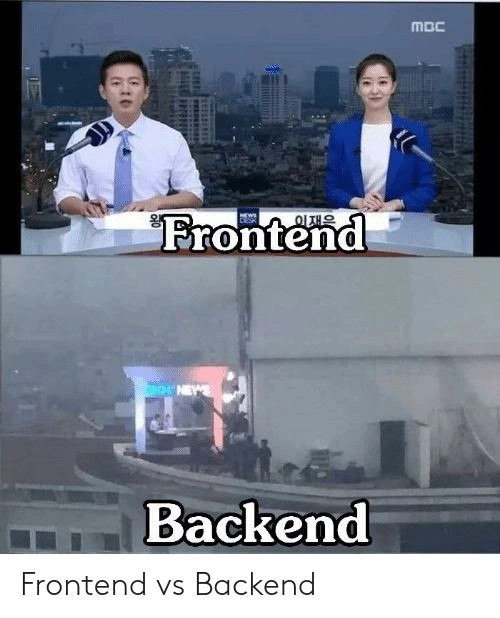
In the meme, the top picture (frontend) is like the neat bakery shop front or a calm news show desk where everything seems perfect. The bottom picture (backend) is like peeking into the kitchen or backstage – you see all the clutter, equipment, and people frantically making the magic happen. The reason it’s funny is the same reason you’d smile if you saw a TV news anchor looking all formal and then realized he’s actually sitting in a crazy messy room just outside the camera frame. It’s that big difference between what people see on the outside and what’s really happening behind the scenes.
Level 2: Backstage Pass
So what exactly are we seeing? The meme compares Frontend and Backend roles using a TV news setup as analogy. In software, the frontend is the part of an application that users directly interact with – think of everything you see in a web page or mobile app: buttons, text, images, menus, the layout and style. It’s built with technologies like HTML for structure, CSS for styling, and JavaScript for interactivity (often using frameworks like React, Vue, or Angular). In the top image labeled “Frontend”, those news anchors at a shiny desk represent a polished front-facing product. Everything looks orderly and put-together, much like a well-designed website interface where all visuals are neat.
The backend, on the other hand, is all the behind-the-scenes code and systems that power that frontend. This includes the server applications, databases, and services that the user doesn’t see directly. In the meme’s bottom image labeled “Backend”, the camera zooms out to show the messy reality: the news desk is actually on a rooftop with lots of equipment around, wires everywhere, and a small screen that says “MBC NEWS”. This chaotic scene is analogous to a typical backend environment: servers, wiring (network cables), rigs (hardware), and crew members (engineers) all hustling to make sure the show goes on. It’s literally the behind_the_scenes_setup. In a software context, that could be a database server, an API service, maybe some caching layer, all working together in a less glamorous fashion to deliver data to the frontend.
Let’s put it in a web app scenario: when you visit a news website (the “frontend”), your browser might call an API endpoint like GET /api/latest-news. The frontend code (perhaps a fetch('/api/latest-news') call in JavaScript) is straightforward from the user’s perspective – just pulling data to display on the page. But on the backend, that endpoint triggers server-side code to run. For example, a Python/Node/Java server receives the request and executes logic to gather the latest news:
// Frontend JavaScript example:
fetch('/api/latest-news')
.then(response => response.json())
.then(data => displayHeadlines(data));
# Corresponding backend pseudo-code:
@app.route('/api/latest-news')
def get_latest_news():
# Behind the scenes on the server:
news = db.query("SELECT * FROM news WHERE date = CURDATE()")
# maybe also call another service for trending topics
return jsonify(news)
The frontend code is clean and minimal – just asking for data and then showing it. The backend code is doing the heavy lifting – connecting to a database (and perhaps other services), then sending the result back. If the frontend is the news anchor calmly reading headlines, the backend is like the producer frantically pulling data from various sources, making sure everything is ready in time.
For a junior developer or someone new to the field, here are some key points and terms:
- Frontend: Runs in the user’s device (browser or app). Technologies include HTML/CSS/JS for web, or native UI toolkits for mobile. It’s all about presentation and user experience. In the meme, this is the perfectly lit news desk and friendly anchors – the presentation layer.
- Backend: Runs on servers (could be in a data center or the cloud). It handles business logic, data storage, and processing. Backend code might be written in languages like Python (Django, Flask), Java (Spring), JavaScript/TypeScript (Node.js), etc. It often provides data through APIs which the frontend calls. In the meme, this is the rooftop full of hardware and crew making the broadcast possible – the guts and machinery powering the experience.
- Technical Debt: This is a term you’ll hear when discussing messy backends. It means shortcuts or suboptimal solutions that were used to save time, but which will need fixing later (as if borrowing “debt” that you eventually must pay back by refactoring). The backend in many apps has some technical debt – perhaps that random gear and scaffolding in the picture symbolizes quick fixes and temporary setups that became permanent. New developers are often surprised to find
// TODOcomments or funky workaround code deep in a codebase. It’s normal – software often evolves under tight deadlines, so not everything behind the pretty UI is as elegant as it could be.
This meme resonates with developers because it is very common to have an application where the interface looks great and polished, but the underlying code and infrastructure are messy or cobbled together. As a junior dev, you might start by working on the front-facing parts (since they’re visual and easier to grasp), and later you peek “under the hood” at the backend code or server setup. It can be quite a revelation. “It looked so organized in the app, but the code is doing WHAT?!” is a rite-of-passage thought. The first time you deploy something to a server, you might be shocked at how many moving parts there are – environment variables, build scripts, database migrations, oh my!
In summary, the Frontend vs Backend comparison is like the difference between a store’s showroom and its warehouse. The showroom (frontend) is tidy, everything labeled and in the right place for customers. The warehouse (backend) is where staff are rushing, boxes are stacked in chaos, and items are being unpacked or repacked – all necessary work, but definitely not as pretty to look at. This meme takes a humorous jab at that contrast, something both newbies and experienced devs eventually come to recognize as a fact of tech life. It’s a shared wink that even if an app looks perfect, every developer knows there’s likely a lot of non-glamorous code and effort churning away behind it.
Level 3: Facade Pattern IRL
At the highest technical level, this meme illustrates a real-world Facade Pattern in action – a sleek public interface masking a complex, messy subsystem. The top panel (“Frontend”) is the polished news broadcast set, much like a crisp UI built with modern frameworks. The bottom panel (“Backend”) reveals the cluttered rooftop rigging: scaffolding, cables, gear – analogous to a tangle of servers, APIs, and microservices behind the scenes. It’s a textbook frontend_vs_backend_meme highlighting polished_vs_reality in software. Veteran engineers recognize the illusion_of_perfection here: your web app’s glossy interface could be sitting on a metaphorical roof of ad-hoc infrastructure.
In practice, frontends often act as a shiny veneer over intricate backend operations. The meme’s news_studio_meme uses broadcast stagecraft to satirize how Frontend glamor can hide a Backend held together by duct tape and hope. Consider a modern single-page application: the UI might be built with React or Angular, presenting smooth animations and pixel-perfect design. Meanwhile, every button click might trigger a cascade of backend calls – load balancers distributing requests to multiple microservices, each service perhaps written in a different language, all coordinating to fetch data from a legacy database or third-party API. The user sees a fast, clean result; the developer knows it’s thanks to a dozen behind-the-scenes systems doing a frantic dance.
This contrast is common in real architectures:
- Polished Front: A responsive web interface following Material Design guidelines, hosted on a CDN for speed. It’s the part users praise for being “so intuitive and pretty.”
- Chaotic Back: An evolving backend composed of a monolith that’s been split into microservices (kind of), plus some serverless functions here and there, a message queue for data processing, and cron jobs for nightly fixes. Monitoring dashboards light up like that rooftop LED screen, especially when traffic spikes.
The humor bites because we’ve all been there. That pristine “Frontend” desk might be calling an api/news endpoint that in turn calls five other services and a database that only Bob in ops remembers how to restart. Technical debt accumulates behind the scenes. The codebase has files like quick_fix_final_FINAL.py and functions named getDataFast() with comments // TODO: refactor this someday. But as long as the UI is up and the data comes through, management and users are happy. The Backend team, however, knows they’re one unplanned surge or an “oops” deploy away from figuratively falling off the roof.
Why is fixing this hard? Because rebuilding the platform’s foundation is like moving that rooftop news desk into a proper studio while live on air. It’s risky and expensive. Teams often prioritize user-visible features (new UI polish, flashy front-end updates) over backend cleanup. Over time, backends become a behind_the_scenes_setup of patchwork solutions: a mix of modern services and ancient code no one touches because “it works (for now)”. This meme strikes a chord in TechHumor circles (both FrontendHumor and BackendHumor alike) because it captures that shared industry secret: the slick app you love might internally be a precarious Jenga tower of code and infrastructure. It’s funny until a piece slips – then it’s an on-call fire drill at 2 AM. As an experienced dev might quip, “Sure, our system is held up by scaffolding, but look at that beautiful UI! Just don’t ask what happens when the wind blows.”
Description
Two-panel meme: The top image shows a slick TV news broadcast with two anchors seated at a bright, professional desk, city skyline visible through the studio windows. Bold overlaid text reads "Frontend". The lower image zooms out to reveal the same desk actually sitting on an exposed rooftop surrounded by scaffolding, cables and random gear; a small LED screen says “MBC NEWS” while crew members mill about in the fog. Overlaid text on this second panel reads "Backend". The juxtaposition humorously compares the polished veneer users see (frontend) with the rough, improvised infrastructure developers manage behind the scenes (backend), a familiar contrast for engineers who know that pristine UIs can mask convoluted server setups and technical debt

Comments
9Comment deleted
The React UI screams “Series D,” but every button still routes through a Kafka topic, a Perl daemon, and a mainframe ingesting CSVs - we call it “cloud-native if you don’t zoom out.”
After 20 years in tech, I've learned that 'frontend' is just the backend team's way of saying 'not my problem' - until the API returns a 500 and suddenly everyone's a full-stack engineer at 3am
The perfect visualization of why we spend 80% of our time on the backend and the client still asks 'can you make the logo bigger?' - because they only see the polished news desk, not the duct-taped server rack held together by hope, deprecated dependencies, and a single engineer who's afraid to touch anything lest the whole thing collapses
That glossy “Frontend” is the facade; the “Backend” is a load‑bearing bash script, an NFS mount nobody owns, and a DNS record we can’t change during daylight - SLO: weather permitting
Frontend: Stakeholder demos that dazzle. Backend: The unlit server closet where uptime prayers go to die
Frontend is studio lighting; backend is a rooftop of cron jobs, tmux panes, and a primary named prod_final_v2 praying nobody rotates logs mid‑broadcast
impressive backend😮 Comment deleted
bro WTF Comment deleted
my backend look worst then this Comment deleted