Frontend presentation vs. backend reality
Why is this Backend meme funny?
Level 1: Neat Outside, Messy Inside
Imagine you clean your room by shoving all your toys, clothes, and junk into your closet. From the outside, your room looks perfect – the bed is made, floor is clear, everything looks organized when a parent just glances in. You even line up a few books nicely on the shelf so it’s extra convincing. That’s like the frontend of an app: it’s the part everyone can see, and it looks really nice and tidy. But now think about what happens if someone opens your closet door. 😬 All the stuff you hid comes tumbling out, and it’s a big tangled mess of toys and clothes all interwoven. That hidden mess behind the closet door is like the backend of the app – it’s the part behind the scenes that people don’t usually see. In our joke, the front of the closet (your clean room) hides the messy closet innards, just like a polished app interface can hide the messy code inside. It’s funny because we all kind of know this trick: things can look great on the surface while hiding chaos underneath. The meme is basically pointing out the same idea in the world of software – a nice-looking app might be held together by a crazy, knotted-up bunch of code just out of sight, kind of like a calm duck on a pond that’s paddling like crazy under the water where no one can see. It’s a reminder that looks can be deceiving, and that contrast between “looks perfect” and “actually a mess” is what makes it humorous and relatable.
Level 2: Beneath the UI
Let’s break down what this meme is talking about in simpler terms. It’s contrasting the frontend and the backend of a software system, using a funny photo as a metaphor. In web development (and many software fields):
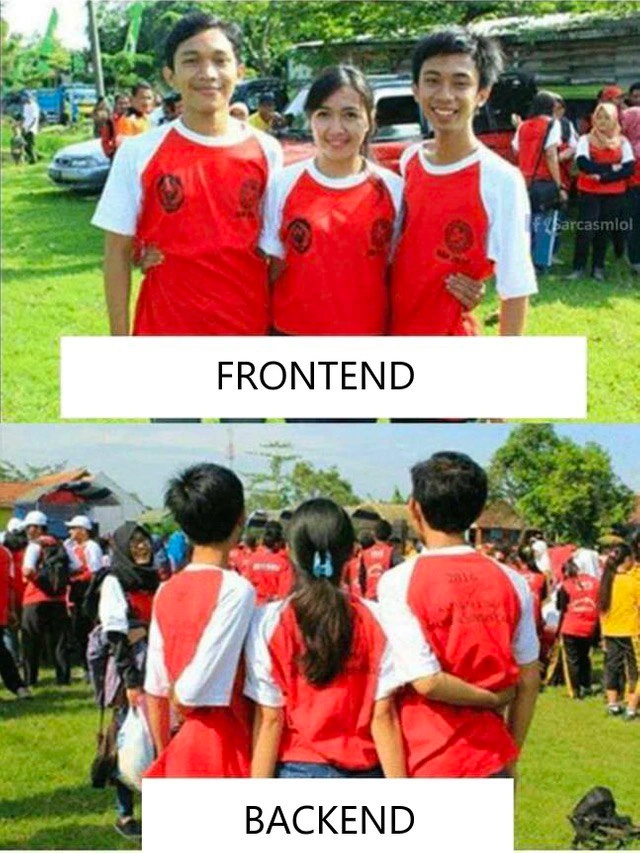
- The Frontend is the part of the application that users directly see and interact with. If we’re talking about a website or web app, the frontend is basically the web page in your browser – all the buttons, text, images, and layout. It’s built with technologies like HTML (for content structure), CSS (for styling and layout, making things look nice), and JavaScript (for interactivity and dynamic behavior). The frontend’s job is to provide a clean and satisfying user interface (UI) and user experience (UX). In the meme’s top image labeled “FRONTEND,” we see three students facing forward, smiling in their neatly matching red-and-white jerseys. Everything looks coordinated and perfect from that front view – just like a well-designed website or app looks polished and consistent to a user.
- The Backend is the behind-the-scenes part of the application that users don’t see. It includes all the server logic, databases, and computations that make the app actually do things. For example, if the frontend has a form where you log in, the backend is what checks your username and password against a database, and then tells the frontend “login success” or “incorrect password.” The backend is usually built with programming languages and frameworks that run on servers, like Node.js, Python, Java, Ruby, or PHP, and it handles things like data storage, business logic, and integration with other systems. In the meme’s bottom image labeled “BACKEND,” the same three students are shown from behind – and suddenly you can see that their arms are all intertwined around each other in a bizarre, tangled way. That hidden tangle represents how the backend implementation can sometimes be an awkward mess of code – something end users would never notice from the app’s outward appearance.
Now, what’s with the “spaghetti” reference? When developers say “spaghetti code,” they mean code that is written in a disorganized or overly complex way, so that the flow of the program twists and turns unpredictably, like a pile of spaghetti noodles on a plate. If you’ve ever tried to pull one noodle out of a spaghetti heap, you know how all the other noodles tend to come along with it in a clump. In code, spaghetti code means everything is so tangled that you can’t isolate one part without affecting another. This often happens when the code has very poor structure – for instance, maybe there’s one giant function or class that does tons of things, or lots of pieces of code that directly depend on each other with no clear boundaries. It’s considered a bad practice because such code is hard to read, hard to fix, and hard to extend. If you change one thing in spaghetti code, you might accidentally break something else because of those hidden dependencies (just like moving one intertwined arm in that photo would jostle the others).
In the context of this meme, the joke is that the frontend is nice and orderly (no “spaghetti” visible), whereas the backend is one big spaghetti entanglement. The front-facing part of the software – say the part of the code that defines the UI layout or the style – might be nicely structured or at least appears fine since it results in a clean interface. But the server-side code behind that interface might be written with a lot of tangled logic. Perhaps the code was written in a rush, or by many different people over time, and as a result it doesn’t follow a neat structure. To a user, the app might seem slick. To a developer who opens up the code, it might look like a bowl of spaghetti was dumped into the code editor! 🍝
The phrase “just one Git diff away” is a nod to how developers can find out what’s really going on under the hood. Git is a version control system that programmers use to track changes in their code. It lets developers collaborate and keep history of code changes. A git diff is a command that shows the differences between two versions of the code – essentially it highlights what was added, removed, or changed. So when we say the messy backend is “one Git diff away,” it means that if you were to look at the code changes (for example, the difference between the current code and the previous commit), you would immediately see evidence of that spaghetti-like mess. In simpler terms: the truth is just one peek at the code differences away. It implies that the contrast between the clean frontend and messy backend is visible as soon as you inspect the codebase. Maybe the commit diff would show a huge number of changes in backend files with chaotic modifications, or reveal functions with names like doEverything() or a bunch of // TODO comments that hint at how ad-hoc things are behind the scenes. This phrase is basically telling other developers, “Sure, the app looks great now, but if you inspect the code repository and compare versions, you’ll see the ugly parts we’re joking about.” It’s an inside joke for developers – non-technical folks might not use Git or know what a diff is, but devs know it’s the tool that would expose any ugliness hidden in the code.
To put it all together: The meme uses a clever visual metaphor (the front vs. back view of people) to highlight a common situation in development: the outward-facing part of a project (frontend/UI) can look totally put-together, while the internal code (backend implementation) might actually be a tangled mess. This resonates with many developers because they’ve encountered projects where the presentation vs. implementation are worlds apart. It’s both funny and a little painful because it’s true – many of us have had the experience of diving into a codebase that powers a decent-looking application, only to find that under the hood it’s disorganized and overly complex. And if you’re a newer developer, it’s a bit of a cautionary tale too: just because software looks smooth on the outside doesn’t mean the code behind it is equally smooth. In fact, sometimes the polish is only possible because someone, somewhere, took a shortcut or jerry-rigged the backend to make it work in time. This is why you might hear developers talk about refactoring (reworking code to improve its structure) or paying down technical debt (cleaning up those messy parts later) – it’s all about untangling that spaghetti to make the backend as neat as the frontend appears to be.
Level 3: Polished Facade, Spaghetti Core
To an experienced developer, this meme delivers a knowing grin and perhaps a facepalm. It captures that all-too-familiar scenario in software projects: the part of the system everyone sees (the frontend UI) looks clean, modern, and well-put-together, while the part no outsider directly sees (the backend code and architecture) is a mess of intertwined logic – affectionately called spaghetti code. The humor comes from the stark Frontend vs Backend contrast. We’ve all been there: the product demo is slick and shiny, everything looks pixel-perfect and works smoothly for the user, but if you peek into the server code or run a git diff on the latest commit, you uncover a tangled web of hacks and workarounds. It’s like a beautiful showroom hiding a stockroom where everything’s thrown together with duct tape.
Why does this happen? Seasoned devs recognize a few patterns (or anti-patterns) being alluded to:
- Deadline-driven shortcuts: Often the backend ends up full of quick fixes and “temporary” solutions that never got refactored, because shipping the feature on time was the priority. The UI had to look perfect for the client demo Friday, so under the hood the team might have hard-coded a few things or intertwined some modules just to meet the deadline. After all, users judge what they see, and managers love a polished demo. The messy code enabling it remains out of sight (and out of mind until it breaks).
- Tech Debt and Legacy Code: Over years, backend systems gather cruft. Different developers add layers of logic without fully understanding the previous code. You end up with functions calling each other in circles, modules with unclear boundaries, and perhaps that one monolithic function that does 10 different things. From the outside, the app might still run fine – thanks to backwards compatibility and painstaking patch jobs – but internally it’s a Jenga tower. Each change risks collapsing something. A front-facing redesign or new UI feature typically doesn’t address that underlying entropy. It’s the classic “lipstick on a pig” scenario: a new coat of paint on the front, same old pigsty behind.
- Organization and Team Silos: In many teams, the front-end developers focus on delivering a great user experience – smooth animations, responsive design, consistent branding. Meanwhile, back-end developers are wrestling with complex logic, integration with databases, and legacy systems. These teams might be under different pressures: UI folks get immediate feedback from users and designers (“This button should be 5px to the left”), whereas backend folks often only get noticed when something goes wrong (“Why is the site slow when I click that button?”). This dynamic can lead to a situation where as long as the front-end is getting applause, the backend code quality issues get brushed aside. Everyone assumes it’s fine because the product works. The meme resonates because developers know how often “it works” is achieved with creative, intertwined code behind the scenes that would make a software architect cringe.
The image of the students with arms knotted together behind their backs says it all: from the front they appear coordinated and uniform (like a well-designed interface or a cohesive API), but the back view reveals that each one’s arms are wrapped around the others in a clumsy tangle. It’s a literal “back-end integration.” This mirrors how backend components or functions can become entangled: maybe Module A relies on a side-effect in Module B, and B is secretly calling A again, etc. The result is a system where everything is coupled in ways you wouldn’t guess from the clean UI on top. Experienced engineers will chuckle (or groan) because they recall code reviews or git diff sessions where a seemingly simple UI change turned out to involve modifying a dozen intertwined backend files.
There’s an ironic truism in development: the better something looks on the outside, the more you should worry about what’s inside. In other words, “If it looks too good to be true, the code probably looks too bad to be seen.” The caption “just one Git diff away” nails this: to any developer, a git diff is the tool to see changes under the hood. It suggests that the polished UI’s secret could be exposed by simply checking the code differences. Maybe the diff would reveal monstrous functions with hundreds of lines, or commit messages like “Fix spaghetti in userAuth AGAIN”. It’s implying “trust me, it’s ugly – and you could confirm it with one peek at the repo.” This exaggeration is funny because it feels so true in many projects. We’ve all encountered that one codebase (or perhaps many) where we pray nobody outside the team ever sees the source code, even though the app itself gets praise.
The humor also stems from Shared Pain: both frontend and backend developers recognize this as a reality. Frontend devs might joke, “Hey, at least it looks good, right?” and backend devs retort, “Yeah, and only we know the horror behind it.” It’s a form of collective commiseration. The tags like DeveloperHumor, DeveloperIrony, and RelatableDevExperience exist because these ironies are universally understood in the dev community. The meme is basically the software equivalent of a theater stage set: gorgeous scenery in front, but if you peek behind the curtain you see scaffolding, duct tape, and stressed crew members holding it all together.
Real-world example? Think of a startup rushing to launch: The UI team might use a sleek frontend framework (React, Angular, etc.) to create a beautiful interface. But the backend could be a single chaotic Node.js/PHP/Python script on the server that’s been amended by multiple developers in a hurry. It’s full of if statements and tangled logic because they didn’t have time to do it the “right” way. As long as it returns the data and doesn’t crash during the demo, everyone claps. The code behind that success? Maybe it’s full of comments like // FIXME: this is a hack. The developers plan to clean it up later, but “later” can be a myth. Months down the line, that code is in production, serving real users, and any poor engineer who opens it to add a new feature goes, “What on earth…?” The meme captures that moment of realization in a lighthearted way.
In summary, from a senior developer’s perspective, the meme humorously encapsulates a cautionary tale: appearance isn’t reality in software. A stable, well-crafted user interface can (and often does) sit atop a precarious, intertwined kludge of backend code. It’s funny until you’re the one responsible for maintaining it. As the cynical saying goes in engineering circles, “It works in prod, don’t question how.” This meme just adds: But if you really want to know, it’s one git diff away… 😅
Level 4: Big Ball of Mud
At the deepest level, this meme pokes fun at a classic software architecture anti-pattern lovingly dubbed the “Big Ball of Mud.” In academic terms, that’s when a system’s internal structure is so chaotic and entangled that it has no recognizable architecture at all. Everything is connected to everything else in a haphazard way – just like a tangle of spaghetti. The backend code base becomes one giant functionally intertwined mass, where changing one part can unintentionally affect totally unrelated parts. This spaghetti code phenomenon has been around since the early days of programming. Back in the 1960s and 70s, as projects grew, developers noticed that unrestricted use of goto statements (jumping around in code) made program flow as twisty as a plate of noodles. Computer scientists like Edsger Dijkstra even wrote famous letters (e.g., “Go To Statement Considered Harmful”, 1968) to warn against unstructured programming because it produces these spaghetti-like messes that are impossible to untangle. The solution was structured programming and later design patterns to bring some order – think of concepts like MVC (Model-View-Controller), which separates the UI (the View) from the business logic (the Model) and the control flow (the Controller). The idea is to avoid arms-intertwined chaos by clearly dividing responsibilities.
However, even with decades of theory and best practices, the reality is that messy, interconnected code still happens – often under deadline pressure or evolving requirements. In an ideal world, a frontend (presentation layer) cleanly calls a well-designed backend API, and behind that API is well-structured, modular code following patterns like layered architecture or microservices. The frontend would act as a true Facade (in the design pattern sense) – simplifying a complex system behind it that is nonetheless organized internally. But in practice, teams sometimes implement a facade pattern only skin-deep: the UI is a pretty facade, while the underlying system is a tangle of quick fixes, global state, and tightly coupled components. It’s the inadvertent facade pattern – the complexity isn’t truly encapsulated or managed; it’s just hidden from the users. The meme’s imagery of three people neatly aligned in front (a facade of order) with their arms absurdly intertwined at the back illustrates this concept perfectly. It’s a real-world depiction of an implementation detail gone awry: from the front you see a tidy interface, but behind the scenes the connections are convoluted.
From a systems perspective, this highlights the gap between external consistency and internal consistency. A system can present a consistent, polished external interface yet lack internal coherence. The humor has a bittersweet edge: it acknowledges that even though our industry preaches maintainable architectures, we often end up with a “big ball of mud” anyway – hidden just out of sight. And as any seasoned engineer knows, once a codebase becomes spaghetti, untangling it (refactoring into clean layers or services) is a herculean effort. We have fancy terms like technical debt to describe why this happens (short-term hacks accumulating into long-term complexity), and entire conferences talks on preventing it. But at the end of the day, behind many polished apps lies a mudball of legacy code held together by hope and // TODO comments. The meme cleverly visualizes this universal truth in tech: complexity that’s out-of-sight is often out-of-mind… until the next poor soul (perhaps you) looks one Git diff deeper and uncovers the tangled reality.
Description
A two-panel meme contrasting frontend and backend development. The top panel, labeled 'FRONTEND', shows two young men and a young woman standing together, smiling nicely for the camera in matching red and white shirts, appearing well-organized and friendly. The bottom panel, labeled 'BACKEND', shows the same three individuals from behind. In this view, it's revealed that the two men have their arms linked or are holding hands behind the woman's back, unbeknownst to her. This meme uses a visual metaphor to explain the difference between the polished, user-facing part of an application (the frontend) and the often complex, messy, or intricately connected inner workings that are hidden from view (the backend). The joke resonates with developers who know that a simple UI can conceal a vast amount of convoluted logic and dependencies

Comments
7Comment deleted
The frontend is the clean API gateway. The backend is the tangle of legacy SOAP services, a critical Excel macro running on a server under someone's desk, and three different message queues that make it all work
Code review tip: if the UI demo gets unanimous applause, flip the file tree around - there’s probably an arm coming through a shirt sleeve somewhere in /services
Frontend code: meticulously commented, linted, and tested. Backend code: held together by a Dockerfile from 2019 and a prayer that nobody touches the load balancer config
The eternal truth of web development: frontend gets all the glory and user feedback, while backend does the heavy lifting in obscurity - until something breaks at 3 AM, then suddenly everyone remembers the backend exists. It's like being a stage crew member: when everything works perfectly, nobody notices you; when one thing fails, everyone knows exactly who to blame
Your diagram shows clean boundaries; in prod the back end is two services hugging through shared mutable state, a nightly cron, and one undocumented trigger - decoupling is strictly front‑of‑house
Every sprint review: pixel‑perfect frontend; behind it, two “microservices” hug each other with circular HTTP calls and a shared table named temp_fix_2018
Frontend: Three devs tweaking pixels. Backend: Silent legion scaling to Black Friday traffic