The vacationing tech lead's surprise review
Why is this CodeReviews meme funny?
Level 1: Not So Fast!
Imagine you’re playing a video game and you think you’ve beaten the final level. You’re about to celebrate when suddenly, a big boss character jumps out and says “Nope, you did it wrong!” That’s the feeling this meme is talking about. The developer is super happy because they thought their work was all checked and good to go, kind of like finishing your homework and thinking you’re free. But then, out of nowhere, the team leader (who everyone thought was out on vacation, like a teacher on holiday) comes back and says “Hold on, this isn’t correct at all!” It’s a funny surprise because the leader wasn’t supposed to show up, much like a surprise pop-up in a game or a parent catching you just when you thought you were done. The result? The poor developer feels shocked and a bit upset – just like you would if you were about to win and someone suddenly shouted “Stop, you did it wrong!” The meme makes us laugh because we all know that sudden jolt when you go from happy to “uh-oh” in a second. It’s showing how quickly a yay! can turn into an oh no... when an unexpected person intervenes at the last moment.
Level 2: Merge Button Anxiety
Now let’s break this down in simpler terms. This meme is about a Pull Request (PR) in a Git workflow and a surprise code review. A pull request is when a developer finishes a piece of code and asks the team to review and merge it into the main codebase. Think of it like saying, “Hey team, I’ve got these changes ready, can you check them and add them to our main project?” The code review process is where other developers (or tech leads) look at the code, comment on it, and approve or request changes. Once everyone important approves the PR, the developer can hit the “Merge” button to integrate the code into the main branch (often the main or master branch in the repository). Merging is basically combining your changes with the shared code so that your work becomes part of the next release or build. In most teams, an approved PR with passing tests is a green light to merge.
In the meme, the person in the first panel (with a proud grin, ready to press Merge) represents “me about to merge my approved PR.” That’s the developer, feeling confident because all reviews are done and everything’s approved. Approved in this context usually means at least the minimum required reviewers have given a thumbs-up in the code review system (for example, GitHub shows a green checkmark and the words “All checks have passed. Merging is allowed.”). It’s a satisfying moment! There’s even a tag hinting at this excitement: merge_button_anxiety – that mix of eagerness and nervousness just before clicking the merge button. New developers know the feeling: your heart speeds up a bit as you’re about to merge, because this means your code goes into the real product now.
Enter the Tech Lead. A tech lead is the senior developer or team lead in charge of the project’s technical quality. Typically, if they’re on vacation, they’re not working or reviewing code – in theory. In practice, some tech leads still peek at notifications or GitHub even when they’re OOO (Out Of Office). The meme’s second panel text says: “Tech lead who is supposed to be on vacation saying it’s all wrong.” This is the twist. It’s basically describing a situation where the tech lead, who everyone thought was unreachable (maybe lying on a beach somewhere), suddenly comes online and reviews the PR at the last moment. They then say “It’s all wrong,” meaning they found something in the code they don’t approve of – possibly a major mistake or just something not up to their standards. That immediately invalidates the approval. In most code review tools, if a reviewer, especially a required one, marks the PR with changes requested (or leaves a comment like “this needs to be fixed”), the PR can’t be merged until it’s addressed. It’s as if the approved stamp got revoked. The developer in the meme visibly jumps and looks shocked, because this was totally unexpected. The small caption “F**k” at the bottom is basically the developer’s candid reaction – a mix of surprise and frustration (and yes, developers do mutter this under their breath when this happens in real life!).
So why is this scenario a big deal? For one, it’s a common developer frustration. You think you’re done with a task – your code passed all tests (no bugs detected by automated checks) and your teammates gave approval – but then someone with higher authority or more expertise swoops in late and changes the verdict. It’s like finishing an exam and then the teacher runs in and says, “Actually, none of your answers count because I didn’t get to check them yet.” You’d be pretty annoyed, right? Here the tech lead is essentially saying “Stop, don’t merge this yet!” Maybe they spotted something others didn’t (like a performance issue or a subtle bug), or maybe they just have a different opinion on how the code should be written. Either way, it means more work and delay for the developer. They can’t merge their code now; they likely have to address the tech lead’s concerns, push new changes, and then seek approval again. It’s a roller-coaster of emotions: from relief (yay, it’s approved) to anxiety (oh no, it’s not actually approved).
This is a very relatable dev experience. A lot of developers have been in a situation where a supposedly finished task gets un-done by last-minute feedback. That’s why the meme is funny — it’s poking fun at real-life scenarios in software teams. The text "who is supposed to be on vacation" adds to the humor because vacations are when someone is not expected to be involved at all. It’s ironic: the team likely thought, “Alright, boss is away, but we’ve got this covered.” Maybe the tech lead even told them, “Go ahead and merge things that are approved, I trust you.” Yet here they are, chiming in anyway. This could be due to a setting known as CODEOWNERS or required reviewers – sometimes, repos are configured so that certain people (like the tech lead) must approve certain types of changes. If so, even if they’re on holiday, the process technically waits for them. Or it could be informal: maybe others approved, but everyone respects the tech lead’s opinion so much that if they object, the merge is off.
Let’s clarify some terms and tags that appear:
- PullRequest: As mentioned, a pull request is a request to pull your changes into the main project. It’s central to modern collaborative coding.
- CodeReviewPainPoints: This tag refers to the common pain points (problems) in code review practice. One pain point is exactly depicted here: late or conflicting feedback and the stress it causes.
- vacation_code_review: This tag specifically names the scenario of someone doing code reviews while on vacation. It’s generally considered a bad practice for work-life balance, but it happens.
- merge_button_anxiety: That nervous feeling about pressing the merge button. Will something go wrong? In this case, yes – someone intervened just in time!
- last_minute_blocker: A blocker is anything that prevents the code from merging. Last-minute means it happened at the very end. Here, the tech lead’s objection is a last-minute blocker, appearing when the merge was seconds away.
- drive_by_feedback: This is feedback given quickly or unexpectedly, often by someone not deeply involved. The tech lead’s one-liner “It’s all wrong” from the sidelines is a prime example. It can be frustrating because it feels like they swooped in, dropped a bomb, and possibly disappeared without helping fix it.
- tech_lead_override: This means the tech lead overriding decisions. Even though others approved the PR, the tech lead’s opinion overrides those approvals (“my way or the highway” vibe). In hierarchical teams, a tech lead override can happen if they see something they consider a big issue.
For a junior developer, encountering this situation is a learning moment (albeit an annoying one). You learn that “approved” isn’t always final until the key people have had their say. It also teaches the importance of communication: maybe next time, the team will ensure the tech lead looks at critical changes before going on vacation, or they appoint a substitute lead to handle reviews. But in the heat of the moment, all you feel is that developer frustration. You muster courage to click merge, and then – “Not so fast!” It’s almost like getting a rug pulled from under you.
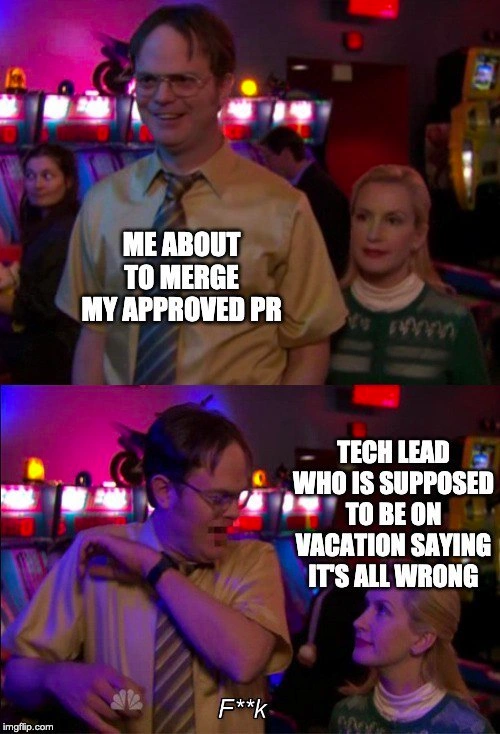
Visually, the meme uses a scene in a neon-lit arcade with a character from a popular TV show (Dwight from The Office) to amplify the drama. In the first panel, he’s confident and smiling (that’s the “me about to merge” mood). In the second panel, he’s startled, arm flung up defensively as if someone tapped him on the shoulder or yelled “STOP!”. That visual is exactly what a surprise code review comment feels like. The bottom caption “F**k” is crude but captures the immediate reaction many of us have internally when a merge gets blocked unexpectedly. It’s the classic facepalm or sigh, made a bit more spicy.
In summary, at this level: a developer had a PR all set to merge, but the tech lead, who was thought to be offline on holiday, came in at the last second and said “Nope, fix this.” It’s funny because it’s so relatable – it highlights a common communication hiccup in software teams. It teaches newer devs about the realities of code reviews: always double-check if someone crucial hasn’t reviewed yet, and brace yourself that even a green “Approved” status can turn red until the code is actually merged. And if your tech lead says they’re on vacation, maybe don’t assume they won’t glance at the repo 🙂. This little story in meme form is a nod to every developer who’s ever had their victory moment snatched away just before the finish line.
Level 3: Ghost in the Git
At the highest technical level, this meme highlights a version control nightmare that senior developers know all too well: an almost-merged code change suddenly derailed by a phantom reviewer. The first panel shows a developer (Dwight-in-an-arcade style confidence) about to merge an approved Pull Request (PR). In modern Git workflows, a PR marked "approved" and with all CI checks green feels like a done deal – but as this meme wryly points out, "approved" is a fragile state until the code is actually merged into the main branch. Just as our dev’s finger hovers over the merge button, the second panel’s text reveals the plot twist: the Tech Lead, who was supposed to be on vacation, materializes to declare “It’s all wrong.” This is a classic CodeReviewPainPoints scenario turned up to eleven. The humor (tinged with horror) comes from the last_minute_blocker appearing out of nowhere, rather like a final boss in an arcade game popping up just when you think you’ve beaten the level. It’s the ghastly specter of drive_by_feedback: an authority figure swooping in with an 11th-hour critique, completely overturning what moments ago felt like consensus. In an ideal world, code reviews are finalized when all reviewers approve, but here the tech_lead_override breaks the illusion of closure.
On a technical level, this is about how Git and PR review systems handle approvals and changes. Most repository setups require certain approvals (sometimes from a code owner or tech lead) before merging. Even if peers give the thumbs-up, a late review by a required person can reset the approval status. Many of us have seen that dreaded red “Changes requested” banner appear on a GitHub PR after we thought everything was green. It’s a bit like an eventual consistency problem in distributed systems: the team reached a consensus to merge, but a previously offline node (the tech lead) came back online and invalidated the decision. The PR’s state wasn’t truly atomic – until the merge commit is finalized, any new input can roll it back. In truth, this reveals a weakness in the process: lacking the tech lead’s sign-off, the approval was never truly final. The meme exaggerates it for effect: the tech lead seemingly has a sixth sense for merge_button_anxiety, popping up exactly mid-click. That timing is comedic gold for developers because it feels so relatable – who hasn’t experienced Murphy’s Law of code reviews? If something can go wrong (or someone can object) at the last second, it will. The scene literally shows the developer recoiling in shock, arm raised defensively, as if struck by an unseen force – that force being a surprise code review comment from beyond the office grave.
This alludes to deeper issues in team workflows. CodeReviews are meant to improve quality, but when a single tech lead becomes a bottleneck or a lurking gatekeeper, it creates a culture of fear around the merge button. Here, the tech lead’s inability to truly unplug (vacation or not) hints at control issues or high stake changes. Perhaps the code change touched something the tech lead considers their turf, triggering a reflex to intervene remotely. There’s an implicit commentary on work-life balance too: the supposed to be on vacation lead is still checking pull requests (maybe sipping a beach-side cocktail while commenting “Nope, redo this”). Seasoned devs chuckle at this because it’s a shared absurdity – we’ve seen colleagues do code review from airports, honeymoons, even hospital beds. It’s both dedication and dysfunction. The meme captures that facepalm moment when you realize that even a green-lit PR isn’t safe from a drive_by_feedback ambush.
From a senior perspective, the humor also masks real frustration. A PR going from “approved” to “blocked” in an instant can derail release schedules and morale. It often happens at the worst time – late Friday, right before a deploy, or when you’ve already mentally moved on to the next task. The developer’s visible startle and the captioned “Fk”** sum up that gut punch feeling. It’s developer frustration distilled: you were this close to merging your code (maybe a feature you’ve worked on all week), and suddenly you’re not only back to unmerged status, but now you have to appease the highest authority’s critique. It’s almost like a PR roller-coaster: the climb of getting approvals, the joyous peak when you think you’re done, then the sudden drop when a wild tech lead appears. This is incredibly relatable in dev teams, which is why it’s funny – it’s an exaggerated echo of truth. We laugh because we feel that pain.
Importantly, this scenario surfaces the pain points of code review culture. Why didn’t the team plan for the tech lead’s absence? Perhaps the tech lead didn’t delegate their review responsibilities, or perhaps they subscribe to the “nothing important merges without my eyes on it” philosophy. It’s a single point of failure problem: if one person’s opinion can veto a merge at the last second, you end up with hesitant developers and slower progress. The meme’s absurdity is that the tech lead jumps in mid-click – implying near-omniscience or at least a very poorly timed email notification. (Is there a special alarm that pings them whenever someone hits the merge button? One imagines the tech lead’s CI/CD pipeline includes a custom job called haltIfImOnVacation() 🙂.) In reality, what likely happened is the tech lead had set themselves as a required reviewer or was watching the repository, and despite being OOO, they got a mobile alert about the PR. And naturally, that’s the exact moment they choose to chime in. It’s the ultimate last_minute_blocker move. The developer might have even announced on chat, “Merging PR #1234 now since it’s approved!” which summoned the tech lead’s “Actually, hold on…” response – a Pavlovian reaction honed by years of being responsible for the codebase.
From personal experience (cue the battle-scarred veteran voice), this meme triggers flashbacks of PRs that seemed fine until a high-ranking reviewer parachuted in. It underscores why many devs have merge anxiety. Even when you do everything right – get multiple approvals, pass all tests – there’s always that chance someone with authority will object late in the game. Culturally, it shows the tension between ownership and trust. The tech lead might genuinely have spotted a critical flaw (maybe a security issue or a design concern), which justifies intervention. But the comedic framing (“supposed to be on vacation… it’s all wrong!”) suggests a more trivial or avoidable interference – as if the tech lead simply couldn’t let go, or had FOMO about the code changes. This resonates as a cautionary tale: teams need clear agreements for absences (e.g. “If I’m OOO, I trust you guys to follow the guidelines and proceed without me”). Without that, you get the scenario this meme lampoons: a tech_lead_override that feels like a jump scare. It’s funny to look at Dwight’s panicked expression, but when it’s your real-life project, it’s not as amusing.
In summary, the meme packs a punch by combining VersionControl mechanics with office dynamics. It satirizes how an ostensibly “approved” code change can be yanked back by hierarchy at the worst possible moment. The neon arcade background and the startled stance visually dramatize the WTF moment every dev fears: right when you think you’ve won, a wild tech lead appears! This is developer humor drawn from genuine team experiences. We laugh, but also nod knowingly — after all, who among us hasn’t had a “ghost in the Git” haunt our merge at least once?
// Pseudocode dramatizing the scenario:
if (techLead.isOnVacation) {
mergeButton.click(); // Ready to deploy our approved changes!
}
// ...Suddenly, the lurking tech lead intervenes:
techLead.leaveReview(PR, "Request Changes");
if (techLead.feedback === "It's all wrong") {
console.error("Merge blocked: last-minute tech lead feedback");
// Developer's immediate reaction in console:
console.log("F**k"); // expresses the same sentiment as the meme's caption
}
Description
A two-panel meme based on a scene from the TV show 'The Office' featuring Dwight Schrute. In the top panel, Dwight is smiling smugly and confidently, with a caption that reads, 'ME ABOUT TO MERGE MY APPROVED PR'. The scene is brightly lit and he looks pleased. In the bottom panel, the mood shifts dramatically. Dwight has a look of utter panic and horror on his face, recoiling as if struck. The caption reads, 'TECH LEAD WHO IS SUPPOSED TO BE ON VACATION SAYING IT'S ALL WRONG'. At the very bottom, the word 'F**k' is visible. This meme captures the universal developer anxiety of getting a pull request (PR) approved, only to have it unexpectedly blocked at the last second by a senior authority figure who wasn't even supposed to be working. It humorously highlights the pain of last-minute feedback and the reality that some tech leads are never truly offline
Comments
7Comment deleted
A tech lead's 'out of office' is just a higher latency environment for code reviews
In distributed version control, Schrödinger’s vacation means the tech lead is simultaneously OOO and requesting changes until you collapse the wavefunction by clicking “Merge.”
The tech lead's vacation auto-responder says they're offline, but their GitHub activity graph looks like a heartbeat monitor during a production outage
The real merge conflict isn't in Git - it's between your approved PR and your tech lead's inability to actually disconnect. They've achieved true distributed systems architecture: simultaneously on vacation AND blocking your deployment pipeline
Branch protection is the only place I’ve seen CAP theorem applied to humans - when the tech lead is OOO but online, we sacrifice availability for consistency and add infinite latency to the merge queue
Nothing triggers a CODEOWNERS lock like clicking 'Merge' - the tech lead on PTO materializes, hits 'Request changes,' and your release becomes a distributed mutex held by someone in flip-flops
Tech leads on vacation: 100% uptime for architecture critiques, 0% chance your PR survives unscathed