Modern monuments are built with vector embeddings
Why is this AI ML meme funny?
Level 1: Sandcastles vs Minecraft
Imagine you’re at the beach and you see a group of people built a huge sandcastle – with towers, arches, and maybe a moat. It’s super impressive, and everyone can see it and say “Wow, that’s amazing!” Now think about kids today who might spend hours building something in Minecraft (a video game) on a computer. They could make a huge castle or world in the game, which is cool but you can’t touch it or see it in real life, you only see it on a screen.
This meme is joking about a similar idea: a long time ago, people built big, beautiful things you can physically see (like a famous fountain which is like a giant fancy water display). The joke says people (specifically “men” in a playful way) don’t build those big fancy things anymore. Instead, they build something called a “vector database,” which is basically a complicated thing inside computers that helps with AI, and you can’t see it except on a computer. It’s like saying: “In the old days we built grand castles, now we build invisible digital stuff.”
Why is that funny? Because building a fountain that everyone can admire is obviously very different from making a computer program that only specialists care about. It’s a silly comparison. It makes us laugh a bit because it’s true that a lot of smart people today spend their time making high-tech tools (that most people don’t even know about), whereas in the past, the big achievements were things everyone could see and appreciate. The meme isn’t seriously complaining; it’s just playing with the idea that our priorities have changed. We went from “let’s build something huge and beautiful out of stone” to “let’s build something clever inside a machine.”
In the simplest terms, the meme is funny because it’s like someone saying: “Wow, people used to make really cool real things, and now all they make are geeky computer things.” It exaggerates to make us smile about how times change. Even if we don’t know what a “vector database” is, we can get that it’s some nerdy computer thing, and picturing that instead of a majestic fountain is humorously underwhelming. It’s like if your grandpa said, “When I was young, folks built enormous bridges, and now kids just build apps on their phones.” It’s a gentle tease about modern life and technology. So the meme is basically comparing building a masterpiece to writing computer code, and that odd comparison is what makes it amusing and relatable.
Level 2: Sculptors vs Startups
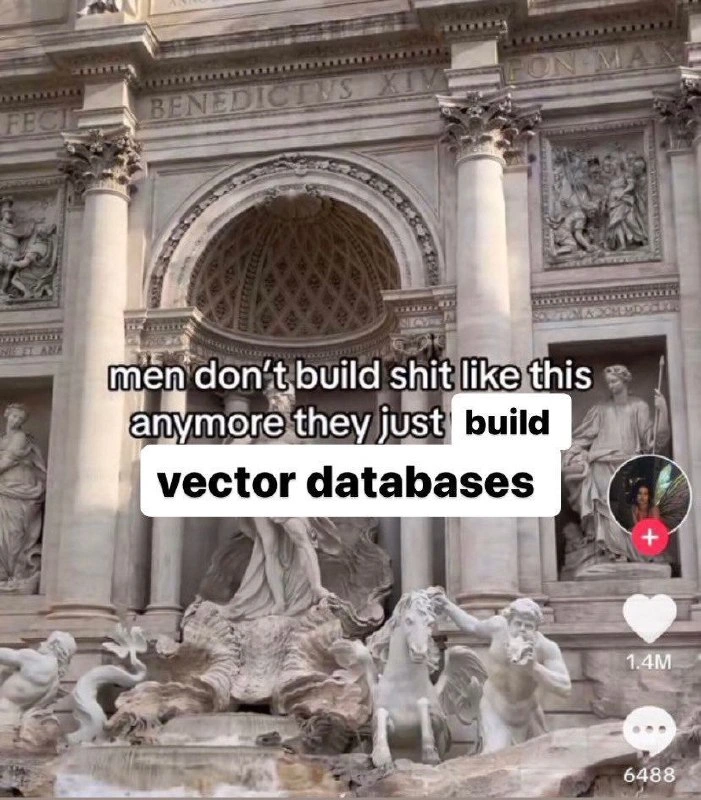
At this level, let’s break down the key elements and terms for a newer developer (or anyone curious). The meme image sets up a contrast between classical building and modern coding. In the background is the Trevi Fountain in Rome – a huge, ornate fountain completed in 1762. It’s one of the most famous fountains in the world, known for its baroque sculptures of sea gods, horses, and chariots in marble. Building it required real-world engineering: architects designed it, and sculptors spent years carving statues by hand. It’s literally set in stone and has stood for centuries as a masterpiece. When the caption says “men don’t build shit like this anymore,” it’s referring to creations like that fountain – grand physical structures that take lots of labor and artistry.
Now, the meme says instead of building fountains or similar marvels, modern men “just build vector databases.” A vector database is a type of database optimized to store and search through vectors, which in computer terms usually means lists of numbers. Why would we want to store lists of numbers? Because in modern AI/ML (artificial intelligence and machine learning), one way we represent complex data (like text, images, or audio) is by converting them into numerical form called an embedding (or vector embedding). An embedding is essentially a big sequence of numbers (a vector) that encodes some meaning – for example, the sentence “I love programming” might be transformed into a 768-dimensional vector (a list of 768 numbers). Similar sentences would end up with vectors that are numerically close to each other.
A vector database is built to handle millions or billions of these embeddings and make it easy to find “what’s similar to this one?” quickly. This is different from a normal relational database (like MySQL or PostgreSQL) that excels at filtering and joining tables of data (rows and columns). Vector DBs are part of a newer trend in databases where the goal isn’t to do traditional queries, but rather similarity search in a high-dimensional space. In plainer terms, if you have a bunch of pictures turned into vectors, a vector database helps you find which pictures are most like a given picture, by comparing those long lists of numbers efficiently. This is super useful in AI applications – think of finding similar images, documents, or searching through knowledge using the meaning of text rather than keywords.
Why is this suddenly a thing “men build” now? Because of the recent AI hype: large language models (like GPT-4 or similar) and other AI breakthroughs started trending massively. To make these AI systems more useful, developers often pair them with vector databases. For example, if you build a chatbot that can answer questions about a bunch of documents, you’d convert all those documents into vectors and put them in a vector DB. When the chatbot gets a question, it also turns the question into a vector, searches the DB for the closest document vectors (meaning those documents are about similar topics), and then uses those to give a better answer. This pattern is known as retrieval augmented generation in AI circles. As a result, products like Pinecone and Weaviate became popular as dedicated services to handle this vector search task, instead of developers trying to shoehorn it into older database systems not designed for it. Pinecone is a hosted vector database service (you use it via an API, and they handle the heavy lifting under the hood). Weaviate is an open-source vector database that you can run yourself. Both are mentioned in the context tags and are prime examples of this technology that the meme expects developers to recognize.
So, when the meme says developers “just build vector databases now,” it’s highlighting how our focus has shifted to these kinds of projects. It’s a bit of an exaggeration of course – developers still build lots of things, including big physical stuff (think of SpaceX building rockets, or civil engineers building infrastructure). But in the software world specifically, the joke is that our idea of an ambitious project nowadays might be creating yet another specialized database or AI tool, rather than something tangible like a building or monument.
The TikTok-style overlay on the right side – with an avatar, a heart icon and “1.4M”, a comment bubble with “6488”, and a plus sign – is mimicking the look of a TikTok video post. This format is often used in memes to make it look like a viral clip. TikTok is a platform where people often lament or joke about generational differences with the phrase “men don’t X anymore, now they Y” while showing some dramatic example. Here it’s done tongue-in-cheek with a developer twist. The presence of 1.4M likes indicates that “many people agree or find this relatable.” The numbers are exaggerated for comedic effect – as if millions are in on this joke. It also situates the meme in current pop culture: we share even our tech jokes in the style of internet trends.
For a junior developer or someone new to these terms, let’s clarify a bit more:
- Vector (in this context): An array or list of numbers. In math, a vector can represent a point in space. In machine learning, vectors represent data in a way that captures some meaning or features of that data.
- Embedding: A kind of vector that represents something complex (like a word or an image). It’s produced by AI models. For example, an embedding for a word could be a 300-length vector where each number has no obvious meaning by itself, but collectively the numbers position that word in a conceptual space. Words with similar meanings end up near each other in that space.
- Vector Database: A database designed to store lots of these vectors and quickly find nearest ones. Under the hood, it uses clever algorithms to index these high-dimensional points (like KD-trees, HNSW graphs, or other methods) because doing brute-force comparison against millions of dimension vectors would be too slow. The result is you can ask it questions like “Find the 10 vectors most similar to this query vector” and get an answer fast.
The meme’s categories Databases, AI_ML, and IndustryTrends_Hype give away that it’s commenting on a trend in the database world driven by AI needs. A junior dev might recall other recent buzzwords: a few years ago, everyone was excited about blockchain or about microservices. Now one of the buzzwords is vector databases due to AI. It doesn’t mean every developer is literally coding a new vector database from scratch (though some are working at those companies or open source projects), but a lot are integrating or using them. The phrase “just build vector databases” is a bit of memetic hyperbole implying “that’s all they do these days”. Of course, that’s the joke – we’ve become so fixated on this niche thing that it seems like that’s the main accomplishment of the era.
The contrast with the Trevi Fountain is intentionally dramatic. Imagine a time when the most celebrated builders made cathedrals, pyramids, or fountains – feats you can see and touch. Now imagine telling someone from that era, “In the future, our brightest minds will be... making databases.” It sounds anti-climactic, almost absurd, which is why it’s funny. It’s not to say vector databases aren’t impressive tech – they are, but their impressiveness is abstract. You can’t physically see a vector database working; it lives in server memory and on disks, tucked away in data centers. So visually, comparing it to a gigantic marble fountain is laughably mismatched, which is exactly the meme’s point.
In simpler industry terms, this meme is a light-hearted critique of modern developer priorities. It suggests that maybe we are more excited about optimizing recommendation engines than creating something of lasting cultural value. For someone new in tech, it’s a reminder that tech has its own fads and focal points. Today’s cutting-edge project is tomorrow’s legacy system. The Trevi Fountain has been relevant for centuries; will the cutting-edge tool of today (like a vector DB) even be talked about in a decade? Who knows! But right now, vectorDatabases are a hot topic, and joking about them means you’re clued into current developer conversations.
Everything in the meme – from the classical architecture backdrop to the TikTok UI and the phrase – works together to highlight the difference between old-world building and new-world building. It resonates with developers who see the humor in how excited we get about things like storing embedding vectors, which is quite a specialized and maybe esoteric endeavor when you step back. In short, for a junior dev: the meme is saying “Look how times have changed – we went from raising magnificent fountains to raising software services (like fancy new databases) – isn’t that ironic and a bit funny?”
Level 3: From Marble to Memory
"men don’t build shit like this anymore they just build vector databases"
This meme juxtaposes a grand piece of 18th-century architecture with the modern obsession over vector databases. On one side, we have Rome’s Trevi Fountain – an icon of classical engineering and artistry. On the other, we have today’s tech world where developers pour their energy into building specialized data systems for AI, like Pinecone or Weaviate. The sarcastic caption implies that instead of erecting monumental structures in stone, modern "builders" (developers) are focused on constructing intangible digital systems. It’s poking fun at our industry’s shifting priorities: from marble masterpieces to memory-resident databases. Seasoned engineers recognize this as a commentary on how tech hype can redefine what counts as an impressive achievement in our time.
The humor works on contrast and absurdity. The Trevi Fountain took decades of planning, skilled stone carving, and papal patronage (the Latin inscription credits Pope Benedict XIV). It’s a literal monument, celebrated for centuries. Meanwhile, a vector database is a cutting-edge software component, invisible to anyone outside AI/ML circles, and might be obsolete in a few years. The meme exaggerates: “men don’t build **** like this anymore” – a tongue-in-cheek lament that we no longer produce grand public works, only startup projects. For veteran developers, there’s an extra layer of chuckling: we’ve seen hype cycles where everyone suddenly fixates on the database du jour. Today it’s vector embeddings for AI; yesterday it was NoSQL, blockchain, or microservices. The meme nails that IndustryTrends_Hype feeling — AI hype has engineers rushing to “build vector databases” as if it’s the new pinnacle of creation.
Why specifically vector databases? In mid-2023, large language models and AI applications exploded in popularity. These models use embeddings (high-dimensional vectors of numbers) to represent text, images, or audio. Searching in this vector space efficiently requires a new kind of database optimized for similarity queries (like “find me documents most similar to this query vector”). Enter the vector DB: a specialized system designed to index and retrieve points in a multi-dimensional space. Names like Pinecone (a SaaS product) and Weaviate (an open-source alternative) became hot topics almost overnight, promising magical AI-powered search capabilities. To senior engineers, this pattern is familiar: a niche technology becomes the center of attention and every team suddenly wants one. It’s reminiscent of when NoSQL databases were the rage – each provided a novel way to store data beyond the traditional relational tables, and many devs insisted you needed one to be modern. Now, with AI/ML booming, vector stores are the new must-have tool. The meme humorously equates this trend-chasing with the grandeur of ancient construction, implicitly asking: Are we really making something as lasting or just riding the hype?
The TikTok-style overlay (with 1.4M likes, thousands of comments) adds an extra layer of commentary. It frames the scene as a viral video post, which is fitting since TikTok often has memes where someone laments “men don’t do X anymore” to ironic effect. By using that format, the meme merges modern social media culture with developer humor. It’s visually saying: this idea – comparing old-world builders to modern coders – is so relatable, it could be a hit TikTok. The heart count of “1.4M” is an exaggerated nod to how many of us in tech would like or agree with this sentiment. Seasoned devs find it funny because it’s true enough: in 2023, it seems every other engineer on your timeline is talking about vector databases and AI embeddings, rather than, say, building real bridges or fountains. The TikTok UI also subtly implies how fleeting trends are: TikTok virals are here today, gone tomorrow, just like many hot tech fads. In contrast, Trevi Fountain has stood for 260 years – no version upgrades needed, uptime 24/7 (apart from maintenance).
There’s also an underlying industry satire: developer culture tends to glorify the newest tools as if they were marvels of the world. The meme asks, tongue-in-cheek, what happened to building things of substance? Of course, we do still build physical structures, but within the meme’s context, “modern builders” refers to software engineers, whose craft results in code and cloud services. The seasoned perspective snickers at how tech folks might boast about deploying a highly optimized vector index or achieving millisecond-level similarity search – accomplishments that, outside our bubble, don’t inspire the universal awe a baroque fountain does. It’s a gentle roast of our profession’s sometimes myopic sense of achievement. We replace classical architecture with cloud architecture, and marble artisans with data scientists. The priorities have shifted from the tangible to the abstract.
To put it in perspective, here’s a light comparison of the two “builds” in question:
| Ancient Masterpiece (Trevi Fountain) | Modern Project (Vector Database) |
|---|---|
| Material: Marble, stone, water engineering | Material: Data structures, algorithms, code |
| Labor: Decades by sculptors & architects | Labor: Months by developers & ML engineers |
| Purpose: Civic beauty & public utility (water source) | Purpose: Enhance AI apps (semantic search) |
| Scale: Immense physical presence, city landmark | Scale: Distributed cloud service, globally accessible |
| Lifespan: Centuries (still standing since 1762) | Lifespan: Version 1.0 today (might be outdated in 5 years) |
| Funding: Commissioned by a Pope (Benedict XIV) | Funding: Backed by venture capital (AI startup hype) |
The table underscores the comedic disparity. The Trevi Fountain was an infrastructure project and a work of art. It actually had a functional purpose: terminating an aqueduct to supply Rome with water, dressed up in grandeur. Its construction was a point of civic pride. By contrast, a vector database is infrastructure for software applications, often hidden behind APIs. Its “purpose” might be enabling smarter recommendations or chatbot memory – important for product feature, but hardly something tourists will toss coins into for good luck! The longevity difference is glaring: we version our software continuously; nothing in tech stays revered for long before the next iteration or replacement arrives. A senior engineer reading this meme might chuckle and sigh, recognizing that our great works in tech rarely have the visible, enduring legacy of great works in architecture. Instead of Latin inscriptions in stone crediting patrons, we have Git commit histories and changelogs.
Yet, there’s also pride in what we build today, just of a different kind. The meme’s contrast reminds experienced devs of the irony that we are modern architects, but of systems and experiences rather than buildings. A vector database is a sophisticated creation – under the hood are advanced algorithms like approximate nearest neighbor search, indexing techniques to tackle the “curse of dimensionality,” and careful engineering to scale to billions of vectors. It’s not trivial work: in some sense, we’re carving out new solutions in the abstract space of mathematics and code. The humor is that, despite this complexity, the end result doesn’t awe the general public the way a towering fountain does. It mainly impresses other engineers. As a community, we sometimes act like launching a new DB is akin to unveiling a monument, and this meme playfully checks that ego.
Lastly, the meme taps into a bit of nostalgic fantasy: an unspoken “they don’t make ’em like they used to.” It parallels how people say modern architecture isn’t as ornate as classical buildings – here applied to engineering disciplines. Senior folks who’ve been around might recall times when tech projects had more physical components – like building data centers or hardware – versus today’s all-cloud, all-software focus. Of course, coding a vector DB and carving a fountain are apples and oranges, but that’s exactly why it’s funny. It’s a hyperbolic commentary on how our definition of building something impressive has evolved. In summary, at this level we appreciate the meme’s critique of modern developer culture and its obsession du jour (vector databases), served with a side of historical irony. We laugh, then perhaps consciously go back to our IDEs to pip install faiss because, well, we too are chasing the next big build – even if it’s made of code, not stone.
Description
This meme displays a magnificent photo of a grand, classical stone monument, the Trevi Fountain in Rome, with its intricate sculptures and columns. Overlaid on the image is a text block that reads, 'men don't build shit like this anymore they just build vector databases'. The image appears to be a screenshot from a social media platform like TikTok, showing a high number of likes (1.4M). The humor stems from the stark contrast between the tangible, enduring grandeur of historical architecture and the abstract, invisible complexity of modern software engineering. It's a satirical commentary on how the nature of 'building' has evolved, where today's great engineering feats are not physical structures but sophisticated, highly specialized software like vector databases, which are critical for the current AI boom but are completely intangible to the average person
Comments
20Comment deleted
The Trevi Fountain has had fewer breaking changes in the last 250 years than the average vector database API has had in the last quarter
Renaissance architects argued Doric vs. Corinthian; we argue HNSW vs. IVF - five centuries later and we’re still just debating how to index our columns
Sure, we can't build a Trevi Fountain anymore, but at least our vector databases can find the semantic similarity between 'architectural masterpiece' and 'technical debt monument' in O(log n) time with 99.9% recall
The irony is that vector databases are just as over-engineered as the Trevi Fountain - both involve massive infrastructure to solve problems that could arguably be simpler, except one took centuries to build and the other gets deprecated in a Series B funding round when the startup pivots to 'AI-native blockchain solutions.'
We used to carve cathedrals; now we carve 1536-D embeddings, pray to HNSW, and call it architecture - the fountain still has fewer leaks than our RAG stack
Romans built for empires without sharding; our vector DBs barely survive Black Friday query spikes
The Renaissance had flying buttresses; 2025 has HNSW - same obsession with vectors, fewer statues, bigger cloud bill
↑ men Comment deleted
Vector databases? What the hell is it Comment deleted
3d models Comment deleted
No Comment deleted
It's a directory with some SVG images Comment deleted
ok, thanks Comment deleted
Just open Wikipedia FFS Comment deleted
Also no Comment deleted
Yeah, also PDFs Comment deleted
Vector databases are databses focusing on storing graph based relationships. Example: a (friend of) b Comment deleted
That's graph databases Comment deleted
Oops Sorry for that ! Vector DB’s are Databases focusing on storing information like vectors with direction and magnitude. With the example of how GPT3 works, AI try to find out all the words, and group them in a multidimensional graph, in such a way that, words nearby will have same context or book, (like article, book, notebook, textbok) etc together. Vector DB PROVIDES storage of these information, with easy searching navigation and filtering of data. Comment deleted
sculpture build successful, now let's run it guys Comment deleted