Skip to content
DevMeme
2330 of 7435
The Sanctity of Life Ends at Unsolicited Coding Advice
Compilers Post #2590, on Jan 12, 2021 in TG

The Sanctity of Life Ends at Unsolicited Coding Advice

Why is this Compilers meme funny?

Level 1: The Spider and the Rule

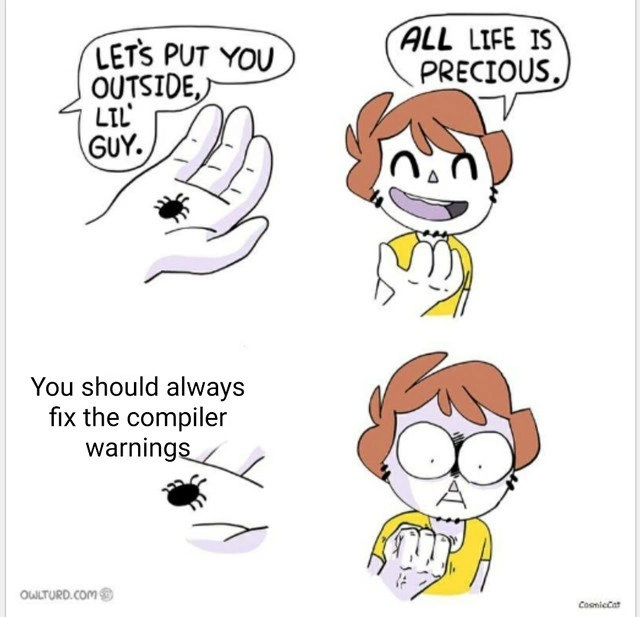
Imagine you see a tiny spider in your house. At first, you’re super gentle – you scoop the little guy up on a piece of paper and plan to release it outside, saying, “Don’t worry, I won’t hurt you. All life is precious!” But then your parent or friend suddenly says, “Actually, we must get rid of every bug in the house, no exceptions!” Hearing that, your attitude changes in a snap. You go from kind to very determined, and now you’re ready to slam that spider with a shoe! 😠🕷️

It’s a silly and exaggerated situation. Normally, you were calm and kind, but one strict rule (“get rid of them all!”) made you react like an entirely different person. That’s why it’s funny – the surprise of someone who loves all creatures becoming a fierce bug-smasher in an instant. In the world of programmers, they have something similar: little warnings in their work that are usually harmless. Some people say, “Eh, it’s fine, it’s small,” but if a strict rule or person says “Fix every one of those warnings!”, that gentle programmer might suddenly act like it’s a big emergency and try to fix (or “kill”) every little problem without mercy. The meme shows this change using the spider story, and it makes us laugh because we recognize how a simple rule can turn a nice person into an over-the-top enforcer in a flash.

Level 2: Kill It with Code Quality!

Let’s break down the meme in simpler technical terms. A compiler is a tool that takes the code you write (in a high-level language like C++, Java, etc.) and translates it into a lower-level form (like machine code) that computers can execute. In doing so, compilers help catch mistakes. There are two main kinds of feedback a compiler gives you: errors and warnings.

  • Compiler errors: These are serious issues; the code doesn’t make sense enough to compile. For example, if you forget a semicolon or try to call a function that doesn’t exist, the compiler throws an error and stops. No program is produced until you fix it.
  • Compiler warnings: These are more like friendly heads-ups. The code compiles and runs, but the compiler spotted something that might be a problem. Maybe you declared a variable and never used it, or you’re using a deprecated (old and discouraged) function. The compiler doesn’t halt everything, but it’s saying, “Hmm, you might wanna check this out.”

In many programming environments, warnings show up as yellow highlight or text, whereas errors are red. They’re literally warnings, as in “This isn’t breaking your build, but be careful.” A classic example:

int main() {
    int x = 42;
    return 0;
}

If we never use the variable x, a compiler like GCC with all warnings on will say something like: “warning: unused variable ‘x’.” The program will still compile and run (returning 0), but it’s telling us we have some unnecessary code.

Now, code review is a process where other developers look over your code changes before they’re merged (added to the main codebase). It’s like proofreading for programmers. In a code review, a reviewer might point out problems or suggest improvements, ranging from big logic errors to small style issues. Here, someone in a review is insisting “fix every compiler warning.” That means they want the code author to go back and resolve even the minor things the compiler warned about (maybe an unused variable, a redundant cast, a possible null check, etc.) so that the code produces zero warnings when compiled.

Why would someone insist on that? It’s often about CodeQuality and good habits. Warnings can sometimes lead to real bugs if left unchecked. For example, a warning about an unchecked return value of a function might mean you ignored an error code — which could bite you later (imagine a warning that you didn’t handle a file-open failure; if ignored, the program might proceed with a null file handle and crash). Some teams adopt the rule “no warnings at all” to prevent these scenarios. Tools and flags (-Werror in C/C++, or strict linting rules in other languages) enforce this by making the build fail if any warning is present, treating warnings like errors.

However, fixing every warning can sometimes feel tedious, especially if the warnings are trivial or numerous. If you inherit an old codebase with hundreds of warnings (e.g., from outdated libraries or old deprecated functions), cleaning them up can be a huge task that doesn’t immediately add new features or visible improvements. That’s why the meme strikes a chord — many junior devs have experienced a senior telling them “Don’t ignore that warning!” and many seniors have experienced a manager or teammate saying “We need to clean this all up, no matter how long it takes,” and then felt that flash of “Here we go…”.

The meme visually uses a spider as a metaphor for a software bug. Fun fact: the term “software bug” actually comes from a real insect incident – early computers were once disrupted by a moth stuck in a relay, and ever since, glitches are called “bugs.” In the comic, the person initially treats the little spider kindly, reflecting a calm attitude towards a small bug. But then a piece of text, “You should always fix the compiler warnings,” appears – that’s essentially someone (maybe a strict reviewer or a coding standard) stating a rule about code. On hearing that, the character’s attitude flips from gentle to aggressive. The last panel shows them with wild eyes and a clenched fist, as if about to smash the spider (the bug).

What’s being compared here? It’s showing the contrast in behavior: normally kind and forgiving vs. suddenly uncompromising when it comes to code warnings. Spider = bug, and bug in code often shows up as warnings or minor issues. The meme humorously suggests that telling a developer to fix every warning can awaken a sort of obsessive monster in them. They might become extremely detail-oriented (or frustrated) to the point of metaphorically wanting to “exterminate” every last little bug/warning. It’s an exaggeration of a real sentiment in programming culture: small issues can seem precious or negligible, but under strict rules, even the tiniest problem must be hunted down and fixed. Seeing that extreme shift in a person’s demeanor is both funny and a tiny bit scary – especially if you’re the one who caused the code reviewer to flip out!

Level 3: No Warning Left Alive

Now, for the experienced developer context: why is it funny (and a bit painful) when someone insists on fixing every single compiler warning during a code review? This hits on a familiar DeveloperHumor scenario in engineering teams regarding CodeQuality: the “zero-warning policy” zealot versus the pragmatist. Picture a senior developer who’s normally calm – they’ve seen real production crises far scarier than a harmless warning. This dev might joke around calling minor bugs “lil’ guys” and gently refactoring code issues over time. But if a colleague or a coding standard says, “You should always fix the compiler warnings,” suddenly that flips a switch. The mild-mannered coder transforms into a bug-squashing berserker, determined to eliminate every warning with extreme prejudice.

Why the strong reaction? Seasoned devs often have a shared trauma: perhaps once a seemingly innocuous warning was ignored (“meh, just an unused variable, who cares?”) and later it snowballed into a nasty bug in production. For instance, ignoring a memory leak warning or a type overflow caution might lead to a 3 AM on-call disaster down the line. So, many seniors adopt a philosophy of “zero tolerance” for warnings—much like our meme character who initially says “all life is precious” but when it comes to bugs/warnings it becomes “kill ’em all!”. The comic exaggeration nails this reversal. It satirizes that almost moral righteousness some developers feel about clean compile logs. In real life, a teammate who treats any compiler warning as a personal affront to code quality can indeed come off as comically intense.

On the flip side, there’s irony here. A grizzled veteran might also harbor a bit of cynicism: not all warnings are equally important. Some warnings are just noisy false positives or stylistic nitpicks. In big legacy codebases, you might see thousands of warnings (the kind that scroll by so fast in CI logs they become background wallpaper). Fixing every single one can be a Herculean task that might introduce new bugs while cleaning old ones. So when a reviewer – perhaps a stickler for best practices – demands every warning be fixed, a senior dev might outwardly smile (“Sure, all life is precious, we’ll rescue every bug…”) but internally seethe or mock the overzealousness (“…until we smash our schedule or the code!”). That inner transformation is exactly what the meme’s last panel captures with the wide-eyed rage. It’s hilariously relatable: we’ve all seen someone go from zen to Zero Bug Tolerance in seconds during a quality debate.

This particular comic format is actually a riff on an Owlturd webcomic template, known for setting up a wholesome attitude in the first panels and then subverting it in the last. Here, the wholesomeness is a gentle dev carefully carrying a “bug” (the spider) outside, reflecting a patient approach to minor issues. The subversion occurs when the phrase “always fix the compiler warnings” appears – a trigger phrase among senior engineers – and suddenly that same dev is livid, fist clenched, ready to mercilessly squash the bug. It’s a perfect cartoon encapsulation of a common engineering culture joke: the notion of precious code vs. the reality of strict code standards.

In many development teams, there’s even a practice of enforcing warnings as errors (think: adding -Werror in a C/C++ build, or turning on all lint rules to the max). The intention is noble: keep the codebase pristine. But the reality can be absurd. Imagine a code review comment section filling up with dozens of nitpicks:

  • “Remove this unused import, it triggers a warning.”
  • “Initialize that variable, the compiler warns it might be used uninitialized (even if our logic sets it later).”
  • “Deprecated API used here, that’s a warning – replace it.”

Line by line, the reviewer insists on scrubbing every warning until the code shines. The author of the code (especially if they’re experienced) might think, “All this for a harmless warning?!” They might even joke that the reviewer values appeasing the compiler’s feelings over delivering features on time. This clash of priorities – shipping quickly vs. engineering purity – is fertile ground for humor. Everyone with a few years in the industry has seen a BugsInSoftware crusader who can’t stand even one yellow warning triangle in their IDE. And many have also seen the messy reality where a quick-and-dirty patch that “works on my machine” ships with a dozen ignored warnings because deadlines trump perfection. The meme captures the emotional whiplash of being asked to shift into perfectionist mode.

In short, at this level we laugh (perhaps a bit nervously) because the scenario is too real. It’s poking fun at our collective developer psyche: the moment when a routine code review turns into a holy war on warnings. The gentle spider savior turning into an enraged bug smasher is every developer’s inner struggle between patience and the fury unleashed by a pedantic code quality remark.

Level 4: The Compiler’s Conscience

At the deepest technical level, this meme touches on how compilers act like our code’s conscience, nagging us with warnings about questionable code. Modern compilers (think GCC, Clang, or javac) perform multiple passes: they parse source code into an AST (Abstract Syntax Tree), perform type checking and optimizations, and along the way they detect anomalies. A compiler warning is essentially the compiler saying, “Hey, this isn’t technically a fatal error, but it looks fishy. You sure about this?” For example, in C++ you might get a warning for an unused variable or a suspicious implicit type conversion. The code will still compile (unlike a compiler error which stops the build), but the warning flags code that could lead to a bug at runtime or maintainability issues in the future.

Why not just make all warnings into errors then? It’s a balance between strict soundness and practical completeness. Compilers often can’t be certain a piece of code is wrong (due to the halting problem and undecidability of some analyses), so they compromise: run the code but warn the developer. For example, consider undefined behavior in C: using an uninitialized variable might not crash immediately, but it’s flirting with disaster. The compiler will compile it (since it’s valid syntax) but emit a warning like “variable ‘x’ is used uninitialized”. It’s then up to the developer’s prudence to heed that warning or ignore it.

Historical aside: The practice of linting (having a tool point out risky code) dates back to 'lint' for C in 1979, precisely because early C compilers were lax about questionable code. Over time, compilers grew more opinionated, introducing -Wall (enable all warnings) and even -Werror (treat warnings as errors) flags. These flags basically tell the compiler, “No compromises — if you even suspect something, refuse to create the executable until it’s fixed.” This guarantees zero warnings, at the cost of forcing developers to confront every tiny issue. It’s a philosophy of code quality: eliminate even minor BugsInSoftware before they hatch into hard-to-catch runtime errors.

In summary, on a theoretical level this meme highlights a tension in software development: the compiler’s role in guaranteeing correctness versus the developer’s tolerance for nagging. Compiler warnings are those yellow flags for potential bugs or bad practices. A seasoned developer knows that today’s harmless warning can be tomorrow’s Sev-1 incident (like an ignored nullability warning leading to a production crash). The humor here comes from treating those warnings with moral absolutism. The compiler’s conscience (warnings) usually whispers, but in this meme, someone demands those whispers be treated like gospel — turning gentle suggestions into an ultimatum that every warning must be purged.

Description

This four-panel comic by artist Shen Comix (OwelTurd) illustrates a developer's violent reaction to dogmatic advice. In the first two panels, a cartoon character gently holds a spider, expressing a benevolent desire to save it, stating 'ALL LIFE IS PRECIOUS.' In the third panel, the spider offers unsolicited advice: 'You should always fix the compiler warnings.' This statement breaks the character's pacifism, and the final panel shows them with a face of pure rage, fist clenched, ready to destroy the spider. The humor lies in the extreme overreaction to a seemingly reasonable statement. For experienced developers, it's a deeply relatable joke about the conflict between 'by-the-book' best practices and the pragmatic reality of working on large or legacy projects where fixing every single warning is impractical or impossible. The spider represents the voice of naive idealism that gets immediately shut down by seasoned pragmatism
Comments

13
Anonymous ★ Top Pick I have two rules: all life is precious, and all compiler warnings are a suggestion. The spider should have known which rule takes precedence
  1. Anonymous ★ Top Pick

    I have two rules: all life is precious, and all compiler warnings are a suggestion. The spider should have known which rule takes precedence

  2. Anonymous

    Everyone’s a chill refactorer until the intern flips on -Werror for the 10-year-old monolith - then it’s open season on every dormant #pragma

  3. Anonymous

    After 15 years in the industry, you learn that 'fixing all compiler warnings' is like 'refactoring the entire legacy codebase' - technically correct advice that ignores the reality of 10,000 warnings from third-party headers, pedantic type conversions that work fine, and that one deprecated API you'll definitely replace 'next sprint' for the past three years

  4. Anonymous

    Every senior engineer knows that 'all life is precious' until the tech lead suggests enabling -Werror on a legacy codebase with 10,000 warnings. Suddenly, those warnings aren't bugs, they're 'informational messages' that have been 'working fine in production for years' and fixing them would be 'too risky right before the release.'

  5. Anonymous

    Empathy is easy until someone slips -Werror into a decade‑old monorepo; then it’s a hard squash merge on your soul

  6. Anonymous

    Spiders I escort outside; compiler warnings get -Werror - “harmless” is how undefined behavior books your 3 a.m. pager

  7. Anonymous

    Compiler warnings: relocate spiders humanely, but these get pragma'd into oblivion because future bugs are someone else's problem

  8. @starbucc 5y

    -std=c90 -ansi -Werror -Wall -Wextra -pedantic

    1. @RiedleroD 5y

      deprecated warning

    2. @nuntikov 5y

      And clang tidy on top of that

    3. Deleted Account 5y

      hold on, let me pull up all my warnings

      1. Deleted Account 5y

        WARNS := all extra shadow non-virtual-dtor old-style-cast cast-align WARNS += unused overloaded-virtual pedantic conversion sign-conversion WARNS += misleading-indentation null-dereference double-promotion WARNS += format=2

  9. @Araalith 5y

    And linter/stylecop warnings too.l, btw.

Use J and K for navigation