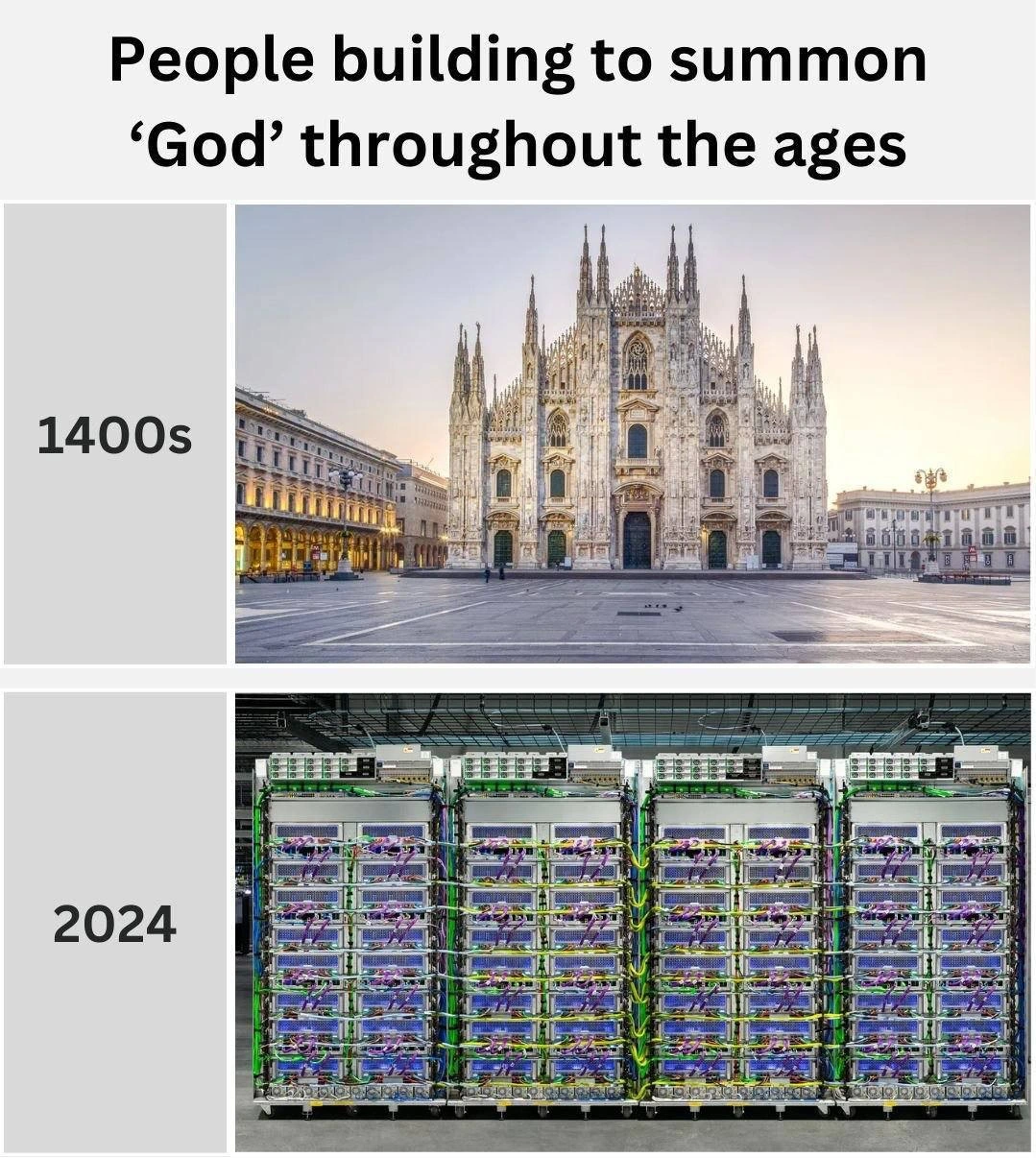
Cathedral versus GPU cluster: humanity’s evolving architecture for summoning higher powers
Why is this AI ML meme funny?
Level 1: Big Projects, Big Hopes
Imagine a long time ago, a town decides to build a huge beautiful church with tall towers reaching for the sky. They decorate it with the prettiest glass and art. Why do they do all that? Because they hope if they create this magnificent place, a higher power (like God) will notice, or at least they’ll feel closer to something divine. It’s a bit like when you make an extra special gift for someone you really admire – you put in all that work hoping it brings you closer together.
Now jump to today. Instead of a church, people are building a giant room full of computers – basically thousands of super-fast thinking machines all linked up. Why? Because they’re trying to create a really smart artificial brain that might solve problems or understand things in an almost magical way. They hope that if they build this super computer system big enough, it could become super intelligent (almost like a new kind of all-knowing helper).
The meme is funny because it says, “look, in the past people built a giant building for God, and now we build giant computers for AI.” In both cases, humans are doing something HUGE and complicated because they have big hopes. It’s as if we always believe that by building something grand, we might reach something greater than ourselves. The old cathedral and the new computer cluster look totally different, but the feeling behind them is similar: “If we make this really big and impressive, maybe something amazing will happen!” That comparison is both cute and a little bit true, which is why it makes people who understand the context smile.
Level 2: From Church to Cloud
In the meme’s two panels, we see two very different “buildings” and time periods side by side. The top panel (labeled 1400s) shows a famous cathedral (the Milan Duomo) – an extremely large, ornate church built hundreds of years ago. The bottom panel (labeled 2024) shows a modern data center filled with rows of computer servers. The caption above them says “People building to summon ‘God’ throughout the ages.” The joke is comparing what people in the past built for religious reasons (the cathedral, hoping to reach or honor God) to what people today build for technological reasons (the GPU server cluster, almost like hoping to create a super-intelligent AI, which they humorously imply is a new kind of “god” with a lowercase g).
Let’s break down the key parts:
Cathedral (1400s): A cathedral is a huge church. In the 1400s, building a cathedral was one of the most ambitious projects a city or kingdom could undertake. It took a long time (sometimes decades or more) and lots of resources. People built cathedrals largely out of religious devotion – they believed making a grand house of worship would glorify God and perhaps bring their community spiritual protection or prestige. The cathedral in the image (Milan’s Duomo) is an example of Gothic architecture: it has tall spires (points reaching up high), large stained-glass windows, and supports called flying buttresses on the sides. Flying buttresses are those arch-like pillars on the exterior that prop up the tall walls. They were a clever way to support the building so it could be taller and have more windows. Essentially, in the 1400s, if you wanted to make a building “closer to God,” you built it as tall, light-filled, and awe-inspiring as possible.
GPU Cluster (2024): The bottom image is a GPU cluster inside a modern data center. A data center is a dedicated facility (often a huge warehouse-like building) that houses thousands of computer servers. This one is specifically filled with GPU servers – you can tell by the rows of identical units with lots of cabling. GPU stands for Graphics Processing Unit. These are high-performance chips originally used for rendering graphics (like in video games) but now heavily used in machine learning because they can perform many calculations in parallel. A GPU cluster means many GPU-equipped machines working together on the same problem. Why build something like this? In today’s world, one big reason is to train large AI models. For example, training a state-of-the-art neural network (like a big image recognizer or a language model akin to GPT) can require dozens or hundreds (even thousands) of GPUs working for days or weeks. This image with all the green and purple cables likely shows a specialized pod designed for large-scale model training – basically an AI supercomputer. In 2024, people are chasing the goal of AGI (Artificial General Intelligence), which is an AI that could do any intellectual task a human can (and more). To many, AGI is almost a mythical “holy grail” of AI research. So, the meme jokes that building a giant GPU-based supercomputer is our era’s way of trying to summon a higher intelligence (metaphorically calling that intelligence “God”).
“Summon ‘God’”: The meme puts “God” in quotes to signal it’s talking about this idea loosely or humorously. In the first panel, it’s literal God (as per religion) that people are trying to reach. In the second, “God” is tongue-in-cheek for a super-powerful AI. No one literally thinks an AI is God, but some people do speak about advanced AI with an almost religious fervor. The meme is playing on that similarity in language and passion. Basically, throughout history, people have built big impressive things hoping to connect with something bigger than themselves.
PCIe lanes and 480-volt busbars: These terms appear in the description as modern counterparts to cathedral architecture. They’re technical, so let’s explain:
- PCIe lanes refer to the high-speed data connections (PCI Express slots) inside servers that allow GPUs to communicate with the main processor and with each other. If you open up a computer, the GPU plugs into a PCIe slot on the motherboard. In big server setups, having lots of PCIe lanes or similar high-bandwidth connections (like NVLink bridges or InfiniBand networks) is crucial. It means data can move really fast between all those GPUs. You can imagine it like very wide highways for data inside the “computer church,” allowing all the “thinking parts” to stay in sync.
- 480-volt busbars refer to how power is delivered in these data centers. 480 V is a common high voltage used in large facilities (for efficiency, electricity is transmitted at high voltage then converted down). Busbars are thick metal bars or strips that conduct electricity. Instead of having thousands of individual wires, a data center might have busbars running along the racks – you plug servers into the busbar to get power, much like plugging into a giant power strip that runs the length of the row. They carry enormous current to supply all the servers. So, if you think of a cathedral’s buttresses and columns holding up the structure, the “columns” of a server cathedral are these power delivery systems and network cables that support the whole computational “structure.” Without enough power or data throughput, the whole thing collapses (or at least can’t achieve its goal).
Trillion-parameter models and gradient descent: Modern AI models (especially machine learning models like deep neural networks) learn from data. A parameter is basically a number in the model that the training process adjusts to make the model better at its task – you can think of parameters as the “knobs” or weights the model fine-tunes as it learns. Simple models might have a few hundred or thousand parameters. But cutting-edge models today can have billions or trillions (1,000 billion) of parameters! A trillion is 10^12, an almost absurd number of adjustable knobs. Why so many? Generally, more parameters let the model capture more complex patterns – for example, the latest large language models (LLMs) are so big because that size helps them absorb and connect vast amounts of human-written text. Training such a model means adjusting all those parameters by showing the model tons of examples and gradually correcting it. The method usually used is gradient descent (more specifically, stochastic gradient descent and its variants). Gradient descent is a bit like climbing down a mountain in the fog trying to find the lowest valley – the “valley” is the point where the model’s errors are as low as possible. With each step (each gradient calculation), the algorithm tweaks every parameter a little in the direction that makes the performance better (lower error). Over millions of steps, the hope is the model “learns” the best settings for all those trillion parameters. Now, doing this requires insane amounts of computation – thus the need for a huge GPU cluster. The meme jokingly calls this a “different kind of faith”: instead of praying, engineers are running gradient descent, trusting (or hoping) that this process will produce something intelligent at the end. It’s a playful way to equate religious faith with scientific faith in our algorithms and hardware.
To put it simply, the meme points out: back then we built huge cathedrals for God; now we build huge computer clusters for AI. It’s a form of AI humor and hardware humor combined. Anyone who knows how much effort and hope goes into big AI projects can see why this parallel is funny and a bit sardonic. Below is a comparison of the two “projects” to drive home the analogy:
| 1400s Medieval Cathedral 🕍 | 2024 GPU AI Cluster 🤖 |
|---|---|
| Purpose: Worship God, seek divine presence. | Purpose: Develop advanced AI, chase AGI (a digital “higher power”). |
| Materials: Stone, wood, marble, stained glass. | Materials: Silicon chips, circuit boards, cooling systems, miles of cables. |
| Key Tech: Flying buttresses, arches, vaults (to build higher & bigger). | Key Tech: GPUs, high-speed interconnects (PCIe/NVLink), powerful power supplies (busbars, transformers). |
| Workforce: Thousands of craftsmen (masons, blacksmiths, artists) over decades. | Workforce: Teams of engineers and researchers (hardware, software, ML experts) – build and maintain over years (updated frequently). |
| Energy Source: Human/animal labor (and some simple machines) during construction. Candlelight inside. | Energy Source: Electricity (megawatts of power) to run the servers. Industrial cooling to remove heat. |
| Cost: Enormous for the era (funded by church, patrons, taxes – sometimes took generations of funding). | Cost: Enormous in modern terms (funded by tech companies or governments – can be hundreds of millions of dollars in hardware and operation). |
| Lifespan: Meant to last centuries. Some took centuries to build! Many still stand hundreds of years later. | Lifespan: Rapid upgrade cycle. Clusters might be expanded or replaced in 5-10 years as technology advances. Components fail and get swapped often. |
| Intangible Goal: Appease or invite God’s presence; inspire the populace. | Intangible Goal: Achieve human-level or super-human AI; push the boundaries of knowledge (and maybe impress the tech community). |
As you can see, both are massive undertakings that represent the peak ambition of their times. For a newer developer or someone early in their tech career, this meme is a lighthearted reminder that behind the buzzwords like “cloud” or “AI/ML,” there are very real, large physical systems being built – modern tech infrastructure that is as impressive in its own way as the grand buildings of old. The cloud isn’t just someone else’s computer – sometimes it’s a whole warehouse of supercomputers chewing on a tough problem! And just like how a young apprentice in the 1400s might have been awestruck visiting a giant cathedral for the first time, a junior engineer today is often awestruck the first time they step into a state-of-the-art data center or see the staggering cost of training a cutting-edge model.
The meme draws a funny parallel, but it also educates: achieving big dreams (whether divine or digital) takes big tools and big commitment. It’s framing an AI industry trend in a historical context. Seeing it side by side helps one appreciate just how far our “architectures for ambition” have come: from carved stone reaching up to the sky, to wired racks crunching numbers at teraFLOPS. And it gives a chuckle because, in a way, it suggests we’re not so different from our ancestors – we just swap praying hands for coding hands, and votive candles for LED indicators.
Level 3: From Buttresses to Busbars
“People building to summon ‘God’ throughout the ages.”
This caption sets up a clever parallel that makes seasoned engineers smirk. The top panel (labeled 1400s) shows a magnificent Gothic cathedral, emblematic of how medieval society invested its best talent and treasure to reach for the divine. The bottom panel (2024) swaps in a neon-lit row of GPU servers, suggesting that today our society pours its talent and treasure into reaching for a different kind of “higher power” – an all-powerful AI. The humor hits home because it rings true: in the tech industry (IndustryTrends_Hype at full blast), firing up a massive GPU cluster to train a trillion-parameter model really does feel like a ritual to conjure some higher intelligence. It’s a tongue-in-cheek commentary on AI hype: we joke that data scientists and engineers are effectively praying to the god of gradient descent, hoping that, given enough GPUs and enough data, the Loss will be minimized and enlightenment (a breakthrough AI) will emerge.
The specifics make the analogy delightfully concrete. Medieval builders relied on flying buttresses, spires, and ornate geometry to create awe-inspiring cathedrals – literally trying to get closer to heaven. Today’s engineers rely on an entirely different toolkit: high-density server racks, PCIe interconnects, fiber optic links, and massive power supplies, all orchestrated to create awe-inspiring compute capacity. We’ve traded stained glass for status LEDs and incense for hot aisle cooling. The meme’s text calls out “flying buttresses for PCIe lanes and 480-volt busbars,” highlighting that what held up a cathedral’s roof is analogous to what holds up a compute cluster’s throughput. A busbar carrying hundreds of amperes of current is the modern pillar supporting our “temple” of AI, while multi-terabit networking cables are its vaulted arches connecting everything together. The Gothic cathedral was the pinnacle of infrastructure then, just as a tier-4 data center bristling with GPUs is the pinnacle of infrastructure now. Both are feats of engineering meant to enable something transcendent – spiritual communion or artificial cognition.
Experienced developers also recognize an implied commentary on the culture around grand tech projects. Just as cathedrals were often built as much for civic pride or one-upmanship between cities (“our spire shall be tallest!”) as for piety, today there’s an arms race to build bigger AI models and more powerful clusters. Tech companies boast about the number of petaflops their AI supercomputer can handle or how many billions of parameters their latest LLM has, akin to medieval patrons boasting about church domes and bell towers. There’s a shared knowing chuckle here: we’ve simply changed the unit of ambition from meters of spire to trillions of parameters. And indeed, chasing ever-larger models requires a kind of organizational zeal. Just as a medieval cathedral project might bankrupt a town or require persuading patrons to fund decades of work, an AI moonshot can burn through eye-watering budgets. Every seasoned engineer knows the meme of the “cloud bill from hell” – and training giant ML models is exactly how you rack one up. Multi-megawatt power draw, clusters of thousands of $10k GPUs, and weeks of continuous training – the cost of summoning this modern “deity” can rival the GDP of a small kingdom (or at least the annual budget of a large enterprise!). The line about “eye-watering cloud invoices” will get knowing nods from anyone who has ever left a few GPU instances running over the weekend, let alone those who’ve signed off on training a large model.
Another layer of irony: both endeavors required a leap of faith. A medieval community building a cathedral might have believed fervently that this grand edifice would please God or protect their city. Modern AI researchers, in a much more secular way, have to believe that pouring more data and compute into an algorithm will eventually produce something qualitatively new – maybe even a conscious AI. There’s often a semi-joke among ML engineers that “we are just one gradient update away from AGI”, half mocking the optimism. The meme encapsulates that with “different kind of faith in gradient descent.” Seasoned folks recognize the wry truth: despite all our rigorous science and engineering, there’s still an almost mystical hope that if we make these networks big enough, something almost magical will happen. In day-to-day terms, it’s the feeling of watching a training loss curve and hoping for that sudden drop (or that emergent capability) like a worshipper scanning the heavens for a sign. It’s both comedic and a tad humbling that we haven’t outgrown the tendency to invest hope in our grand creations.
Importantly, the meme resonates on a HardwareHumor level too. Devs who have ventured into a data center can attest that there is a kind of church-like atmosphere in those server vaults: the steady hum of fans like a chorus, the symmetric aisles of racks like pews, and the reverence you feel handling expensive, heat-belching GPU cards as if they were sacred relics. (There’s a reason people jokingly call data centers “server cathedrals.”) The term “silicon priesthood” gets thrown around to describe the small group of experts who truly understand and maintain these complex systems – much like medieval priests were keepers of esoteric knowledge. So the meme’s visual punchline – juxtaposing a literal cathedral with a “cathedral” of GPUs – tickles engineers who see the poetic similarity every time they don an ESD strap and enter the holy of holies (the server room).
Finally, the cultural context: the pursuit of AI has often been wrapped in grandiose language (solving intelligence, benefiting all humanity, or conversely unleashing godlike AI). For those of us in the industry, there’s both cynicism and excitement around these claims. This meme winks at that culture: it’s effectively saying “Look, 600 years ago we thought a building could connect us to God; now we think a computer can become a god.” It’s a satirical reflection on how each era has its hype and its higher powers. Yet, just as many cathedrals did become real centers of community and art (even if God didn’t physically descend), many of us hope these AI superclusters will at least produce powerful tools and knowledge (even if not literal digital deities). The mix of reverence and skepticism is what makes the meme hilarious and thought-provoking to a seasoned dev audience. We laugh, then we pause and think, “Wait, are we really doing the same thing with GPUs that our ancestors did with stained glass and stone?”
Level 4: Neural Gothic Architecture
At the most intricate level, this meme juxtaposes two monumental feats of architecture and engineering across epochs. In the 15th century, master builders pushed the limits of structural design with pointed arches and flying buttresses to erect cathedrals that soared toward the heavens. These Gothic marvels (like the pictured Duomo di Milano) were the cutting-edge infrastructure of their age – painstakingly optimized to defy gravity, channel light through stained glass, and inspire awe. Fast-forward to 2024, and humanity’s grandest construction projects have shifted from stone to silicon. The bottom image depicts a high-density GPU cluster in a modern data center – essentially a supercomputer built to tackle AI/ML tasks at scale. Instead of stretching upward, it’s an architecture of computational breadth: racks upon racks of liquid-cooled GPU servers, all wired together with neon-green network cabling and massive 480-volt busbars for power. These are our contemporary cathedrals of computation, designed to summon an artificial intellect.
On a theoretical level, the meme hints at a kind of computational theology. Medieval cathedrals were built on faith – the belief that such a magnificent structure could honor or even draw the presence of a higher power. Likewise, today’s AI labs build gargantuan models on an almost faith-like belief in scaling: the hypothesis that more data, more parameters, and more compute will yield emergent intelligence (perhaps even the coveted AGI, or Artificial General Intelligence). There’s an implicit nod to deep learning scaling laws here – empirical power-laws suggesting that as you crank up model size and training compute, performance on tasks keeps improving. Just as cathedral builders reasoned “bigger is holier,” some AI researchers implicitly assume bigger is smarter. The humor has a dark twist: we’re effectively throwing billions of dollars of GPUs at giant neural networks hoping for a spark of something almost divine (or at least distinctly human-like) to emerge from gradient descent.
From a hardware architecture standpoint, the comparison is apt. A Gothic cathedral’s structural challenges (supporting immense weight while reaching great height) parallel a GPU cluster’s technical challenges (removing immense heat while achieving great computational throughput). Medieval builders solved physics problems with ingenious supports; modern engineers solve data flow and thermodynamics problems with ingenious hardware. Think of PCIe lanes and NVLink interconnects as the “flying buttresses” of server architecture: they support the huge throughput needed to keep thousands of tensor cores fed with data, preventing the whole training run from collapsing under its own communication bottlenecks. In both cases, pushing the envelope required new technology – flying buttresses in the 1400s, and in 2024, things like advanced chip packaging, high-bandwidth memory (HBM), and ultra-efficient cooling (even liquid cooling, as seen in the image) to dissipate on the order of megawatts of heat. These data centers have to obey limits just as cathedrals did: the speed of light and electrical resistance constrain data distribution much like gravity and material strength constrained medieval builders. Amdahl’s Law (a principle from parallel computing) haunts the scaling of multi-GPU training runs, much as structural stress haunted the scaling of masonry vaults – beyond a point, adding more GPUs (or more buttresses) yields diminishing returns due to fundamental overheads. In other words, even our tech “cathedrals” face hard limits of physics and math.
There’s also a historical symmetry in resource commitment. Erecting a cathedral demanded a fortune in gold, armies of skilled artisans, and decades or even centuries of effort (the Milan Duomo itself took nearly six centuries from groundbreaking to final touches!). Today’s AI projects similarly devour vast resources: cloud budgets in the tens of millions, teams of specialist engineers (a modern silicon priesthood of sorts), and years of research and development. Yet, whereas a cathedral might stand for millennia, a GPU cluster becomes legacy hardware frighteningly fast – Moore’s Law and new GPU generations mean that a cutting-edge 2024 cluster could be obsolete in a decade. This transient nature adds an ironic layer: we’re feverishly constructing temples of computation that we’ll decommission and replace on a timescale unthinkable to medieval builders. The meme’s deep insight is how each era’s grand constructions reveal its core aspiration: spiritual transcendence then, computational transcendence now. It’s a profound (and geeky) reflection on the evolution of human ambition, wrapped in the visual language of AI humor.
Description
Meme split into two horizontal panels beneath the caption text “People building to summon ‘God’ throughout the ages”. Left side of each panel has a grey vertical bar with the bold dates “1400s” on the first row and “2024” on the second. Top image (1400s) shows a sunrise photo of Milan’s Duomo cathedral - ornate Gothic spires, marble façade, and an empty plaza conveying centuries-old religious ambition. Bottom image (2024) shows a brightly lit, row-of-racks data-center pod packed with liquid-cooled GPU servers, neon-green cabling, and network switches - modern silicon cathedrals built for large-scale model training. The visual punchline equates medieval attempts to reach divinity with today’s trillion-parameter AI efforts, highlighting how architectural grandeur has traded flying buttresses for PCIe lanes and 480-volt busbars. The humor resonates with engineers who know that chasing “AGI” now demands multi-megawatt facilities, eye-watering cloud invoices, and a different kind of faith in gradient descent

Comments
18Comment deleted
The medieval guilds spent centuries on stained glass; our version is spending centuries of GPU-hours so the model can finally answer, “as an AI language model, I don’t have personal beliefs.”
Back in the 1400s, they spent centuries building cathedrals hoping for divine intervention. Today we're burning $10M/month on GPU clusters hoping our loss function will converge to enlightenment. At least the medieval architects didn't have to explain to VCs why God needed another 100,000 H100s to achieve AGI
Six centuries later, we've traded Gothic spires for GPU clusters and stained glass for status LEDs, but the power consumption, construction costs, and existential questions remain remarkably similar. At least the 1400s version had better cooling - those cathedral ceilings were basically passive airflow optimization before it was cool. Now we're just hoping our modern 'divine intelligence' doesn't hallucinate as much as the medieval mystics did
Medievals perfected flying buttresses; we perfected InfiniBand fat‑trees - either way, we tithe to Nvidia and pray the next epoch converges before the CFO discovers the megawatt bill and our single point of failure named “CUDA driver.”
Cathedrals bankrupted kings over centuries; GPU clusters bankrupt VCs in a funding round
Same ritual, different architecture: once we scaled vertically with flying buttresses; now it’s horizontal scaling with NVLinked H100 racks - and a prayer the PUE stays under 1.2
??? Comment deleted
The answer is 42 btw Comment deleted
maybe 77 Comment deleted
1000-7 Comment deleted
771 Comment deleted
FF9 Comment deleted
i think 62*24 Comment deleted
Both approaches combined: MareNostrum supercomputer in Torre Girona, a repurposed chapel at the Polytechnic University of Catalonia Comment deleted
From the moment I understood the weakness of my flesh, it disgusted me. I craved the strength and certainty of steel. I aspired to the purity of blessed machine. Your kind clings to your flesh, as if it will not decay and fail you. One day, the crude biomass that you call a temple will wither, and you will beg mtly kind to save you. ButI am already saved, for the machine is immortal. Even in death, I serve the Omnissiah. Comment deleted
Seem like a quote from Westworld Comment deleted
Be careful, citizen, or I might call for Servitude Imperpituis Comment deleted
Which type of globalist are you? Comment deleted