When “just open the PR” spawns a 1,228-comment review saga
Why is this CodeReviews meme funny?
Level 1: Too Many Opinions
Imagine you ask your friends if they like a drawing you made, thinking they’ll either say “yes, it’s great” or “no, not really.” Instead, what happens is all your friends start commenting on it – not once, not twice, but over a thousand times! One friend says, “Maybe use a brighter color here.” Another chimes in, “The character’s eyes should be bigger.” Then another friend jumps in, “What if you change the background?” Suddenly everyone is arguing and giving you so many suggestions that your simple question turns into a huge discussion that goes on and on. You only wanted a quick answer, but you got a never-ending list of opinions.
That’s what this meme is joking about. A programmer thought the worst outcome of showing his code would be a quick “No, this isn’t good.” But instead, he got something much more exhausting: dozens of people discussing every little detail of his work. It’s funny in the way that exaggeration is funny – of course normally you wouldn’t literally get 1,228 comments, but it sure feels that way when everyone has something to say. It’s like asking to watch a movie with friends and expecting a yes or no, but instead they start a 3-hour debate over 50 different movie choices. By the end, you almost wish someone had just said “No” at the start so you could move on! The meme uses this extreme example to poke fun at how a simple request for feedback turned into a marathon of opinions. The core idea is easy to relate to: sometimes, getting too much feedback is more overwhelming (and hilarious, in retrospect) than getting a simple thumbs-down.
Level 2: PR Reality Check
Let’s break down what’s happening in this meme in more straightforward terms. First, a Pull Request (PR) is when a developer proposes some code changes to be merged into a main codebase (for example, using Git on platforms like GitHub). When you “open a PR,” you’re basically asking your teammates or project maintainers to review your code. They can then discuss it with you through comments, suggest improvements, or point out mistakes. In the end, they either approve it (so it can be merged), ask for changes, or in the worst case, reject/close it without merging. The meme joke starts with someone casually saying:
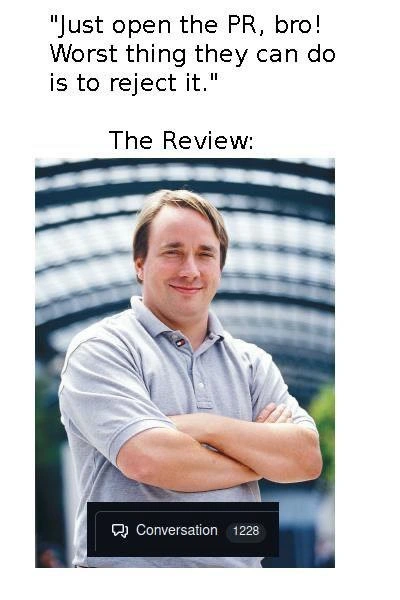
“Just open the PR, bro! Worst thing they can do is to reject it.”
In other words, they’re saying “Don’t be afraid to put your code up for review — the most that could happen is they say no.” The punchline is what follows: “The Review:” and then showing a screenshot of a GitHub PR Conversation tab with the number 1228 on it, meaning there are 1,228 comments in the discussion. There’s also a stock photo of a man with arms crossed confidently, representing a strict or stubborn reviewer. The idea is that instead of a quick yes-or-no outcome, the poor developer is now stuck dealing with an insanely long code review discussion.
To put that number in perspective, 1,228 comments on a PR is outrageous. Most PRs might get a handful of comments – maybe a dozen if people have a lot of feedback. 1228 suggests that this code review became ridiculously lengthy, probably involving many people and multiple rounds of changes. It’s basically a code review gone wild. The phrase “The Review:” in the meme sets you up to see what actually happened after opening the PR: a never-ending review process.
Now, why would a PR have so many comments? A few common reasons in real developer life:
- Many Reviewers, Many Opinions: In a big project (like at a large company or a popular open-source project), lots of developers might review the code. Each person might have their own suggestions or concerns. For example, one person says “Rename this variable,” another says “This function is too slow,” another finds a bug, and so on. If 10 people leave just 5 comments each, that’s already 50 comments. Multiply that by multiple rounds of feedback, and it adds up. It’s easy to see how CollaborationChallenges can emerge when everyone has something to say.
- Nitpicking: Developers sometimes leave “nit” comments – short for nitpicking – which are super minor suggestions or preference tweaks. (Nitpicking means pointing out tiny, usually unimportant details.) For example, a reviewer might comment “nit: add a space here,” or “nit: please alphabetize these import statements.” Each of those counts as a comment. If the reviewers are very detail-oriented, they might literally comment on every line that isn’t exactly how they like it. That’s where the meme’s idea of “bikeshedding on every line” comes in. Bikeshedding is a term for when people argue over trivial issues because it’s easy to have an opinion on them. It comes from an old anecdote where a committee spent hours on the color to paint a bike shed (a small, simple project) while neglecting more important matters. In code reviews, bikeshedding might be endless debates about spaces vs. tabs or minor stylistic things. Those little comments can flood a discussion, making the review much longer than it needs to be.
- Changes Trigger More Comments: Often, after the first round of comments, the developer will update the code to address the feedback. Then the reviewers look at the new changes and might comment again – either new suggestions or follow-ups. If this cycle repeats over several iterations, the comment count will keep growing. It becomes a feedback marathon. For example, reviewer A says “fix X,” you fix X, then reviewer B (who was asleep or offline earlier) comes in later and says “I see you fixed X, but now Y is an issue,” and so on. On a distributed team (people spread across different time zones or offices), this asynchronous back-and-forth can really stretch out the review duration and comment count.
- Big or Complex PR: If the PR is very large (affecting many files or a critical part of the system), it naturally invites more scrutiny. Reviewers will be cautious and examine every bit, possibly finding many things to discuss. Think of a PR that changes a core piece of an app – lots of people care about how it’s done. They might even have lengthy discussions in the comments about design approaches. At some point, the code review comments section starts to look less like quick code feedback and more like a forum or chat conversation. That’s likely why the screenshot shows “Conversation 1228” – it became a huge conversation.
The Communication aspect is crucial here. Code reviews are a form of communication among developers about how the code should be. This meme highlights what happens when that communication goes overboard. It humorously exaggerates the scenario to point out a real developer experience issue: Review comment overload. It resonates with developers because many have felt the frustration of a PR that seems to drag on. Instead of a simple outcome (merge or reject), you spend days or weeks in comment discussions, making tweak after tweak. It’s like social overhead or bureaucracy in the development process – which is part of DeveloperExperience_DX when working on a team.
The man in the photo with crossed arms represents the tough reviewer archetype. He’s standing confidently like, “I am not approving this until every issue I see is fixed.” The crossed arms posture universally signals a critical, no-nonsense attitude. By blurring his face, the meme also makes him an anonymous every-reviewer – it could be anyone on your team who’s notoriously strict. We’ve all known a colleague who takes code reviews very seriously and leaves tons of feedback. The meme exaggerates it to an extreme: imagine that person had 1,228 things to say about your code! It’s both funny and horrifying to someone who has been on the receiving end of heavy code review feedback.
To a newer developer (or someone not familiar with pull requests), the meme is basically saying: Sometimes asking for feedback can result in way more than you bargained for. What was meant as “maybe they’ll reject your code” turned into “they didn’t reject it – instead they engaged with it, at length.” It’s like the difference between a teacher simply grading your paper with an F (rejection) versus the teacher covering your paper in red ink with comments on every sentence (feedback overload). The second scenario (tons of feedback) ironically can feel more overwhelming than a straight rejection.
In summary, this meme uses developer humor to highlight a very real phenomena in team software development. The tags like PullRequestProcess, CodeReviewPainPoints, and DeveloperFrustration all point to that feeling: code reviews can sometimes be painful and comically drawn-out. It teaches even junior devs a lesson: “worst case” in a team setting isn’t always just a simple no – it could be a long slog of improvements and debates. Collaborating on code means dealing with feedback, and occasionally, that feedback comes in flood volumes. The meme is a lighthearted warning and a nod of solidarity to anyone who’s been through a tough review. We chuckle at the absurd number (1228) while remembering to maybe break big changes into smaller PRs next time (to avoid unleashing a comment beast!).
Level 3: Death by a Thousand Nits
They said “Just open the PR, bro. Worst thing they can do is reject it.” Famous last words. In reality, a pull request can devolve into a 1,228-comment code review saga – a nightmare scenario known all too well by battle-scarred devs. This meme pokes fun at the code review spiral: a supposedly simple Pull Request (PR) that triggers an endless feedback marathon instead of a quick approve-or-reject. The humor comes from how painfully relatable this is for experienced developers. We’ve all seen well-meaning code changes turn into bikeshedding sessions of epic scale, where minor issues get thrashed out in excruciating detail.
Picture the scene: you open a PR on GitHub, confident the worst outcome is a polite “No, let’s not merge this.” Instead, you get an onslaught of comments – nitpicks on every other line of code and long threads debating design decisions. The meme’s image paints the reviewer as a stoic gatekeeper (arms defiantly crossed, smirking under a blurred face) standing firm under the atrium’s steel-and-glass arch. This defiant posture screams “Oh, I’m not letting this through easily.” And the little GitHub UI snippet reading “Conversation 1228”? That’s the punchline: a normal PR might have a few comments, but here we have a full-blown review_comment_overload. It’s a PR feedback marathon where the conversation thread has more entries than some novellas have words.
Why is this so funny (or terrifying) to seasoned devs? Because it satirizes real-world CodeReview pain points and CollaborationChallenges on large teams:
- Bikeshedding on every line: The team dives into trivial details (naming, spacing, a one-line change) with gusto. It’s Parkinson’s Law of Triviality in action: everyone feels qualified to debate the “bike shed” (the easy parts) while the big stuff gets drowned out. The PR ends up with comments about
const vs let, brace positions, and how the variablefooshould really be namedfoo_value– repeated ad nauseam. Nitpicks stack up like paper cuts, turning the review into death by a thousand tiny comments. - Scope Creep in Review: What started as a small code change suddenly balloons. One senior reviewer notices a related bug or a potential refactor and comments “While we’re here, shouldn’t we also change X…?” Another chimes in, “Have we considered using the Strategy pattern?” Before you know it, the review isn’t just about your code anymore – it’s a proxy war over architecture decisions. The Conversation tab fills up with design debates that belong on an architecture doc or in a meeting.
- Distributed Team Pile-On: In a large, distributed codebase, a PR can ping the radar of multiple teams. Imagine developers across different time zones, each waking up to the PR and adding their two cents. By the end of the day, you have comments from half the engineering department. It’s a perfect storm of CollaborationChallenges: asynchronous communication means while you’re fixing one set of comments, three more people have added new threads. The result? A seemingly infinite loop of “push changes, get new feedback.” It’s like a GitHub version of Groundhog Day.
- False Sense of Safety: The meme quote (“worst they can do is reject it”) reflects a naive confidence that code review is a quick gatekeeper. The senior-dev reality check is that rejection would have been merciful compared to the slow torture of endless critique. A reject closes the matter; a 1,228-comment review drags you through weeks of rework and second-guessing. It’s a false sense of safety thinking the PR process is simple – until you’re neck-deep in comment threads discussing code you wrote at 2 AM.
This scenario highlights a core DeveloperExperience_DX issue: heavy process overhead can make a developer long for the sweet release of a simple “No.” Instead, you’re stuck in what feels like an eternal meeting, except it’s all written down in a GitHub PR. The DeveloperFrustration is real – addressing hundreds of comments is exhausting, and it delays shipping. Every experienced dev has war stories of PRs that spiraled like this: maybe not 1,228 comments, but enough to leave you staring at the screen, rubbing your temples and muttering “you’ve got to be kidding me.” The meme exaggerates to four-digit comments for comedic effect, but the relatable developer experience is that even a few dozen nitpicky comments can feel soul-crushing. It’s funny because it’s true – we laugh to keep from crying when a “quick code review” becomes a multi-day ordeal.
On a deeper level, this touches on tech culture and communication breakdown. Code reviews are supposed to improve code quality and share knowledge. But when they turn into PR process nightmares, they hurt morale and slow progress. The meme’s dark humor speaks to senior devs who’ve tried to do the right thing (open a PR for feedback) and ended up in a code_review_spiral. It’s practically a rite of passage in some teams: no good deed goes unpunished, and no big PR goes un-commented. We enforce thorough reviews for quality’s sake, yet here we are – with a process that occasionally ossifies into a pedantic commentary marathon.
In summary, Level 3 reveals why this meme hits home for veterans of code review battles. It exaggerates a common scenario to absurdity: PullRequest culture gone off the rails. The laugh comes with a wince, because anyone who’s been through a pr_feedback_marathon knows that sometimes the “worst” outcome of a PR isn’t rejection – it’s getting exactly what you asked for: feedback, and lots of it. After surviving a 1,000+ comment saga, a simple reject feels like a blessing.
Description
Meme with white background and black text at the top reading: "Just open the PR, bro! Worst thing they can do is to reject it." A smaller subtitle directly below says "The Review:" followed by a stock photo of a man in a gray polo shirt, arms defiantly crossed and face blurred for anonymity, standing in an atrium with a curved steel-and-glass ceiling. Pasted over the lower portion of the photo is a dark snippet of a GitHub-style tab that reads "Conversation 1228", implying an absurdly long pull-request discussion thread. The humor plays on senior-dev trauma: a supposedly harmless pull request snowballs into a bikeshedding marathon measured in four-digit comments, highlighting the social overhead of code reviews in large, distributed codebases
Comments
12Comment deleted
The real CI gate isn’t the test suite - it’s surviving the 1,200-comment thread about tab width and method naming conventions
After 15 years in the industry, I've learned that '1228 comments' on a PR isn't a code review - it's a distributed systems architecture debate disguised as a variable naming convention discussion that somehow evolved into a philosophical treatise on whether tabs or spaces better represent the human condition
Ah yes, the classic "just open the PR" advice - right up there with "it works on my machine" and "the deployment should be quick." When Linus himself shows up with 1,228 comments, you know you're not just getting feedback; you're getting a masterclass in why your clever optimization actually breaks on big-endian systems, violates three coding style guidelines you didn't know existed, and somehow manages to introduce a race condition in single-threaded code. At that point, 'reject' would have been the merciful option
Rejection is merciful; the real worst is a 1,228‑comment bikeshed that turns your two‑line fix into an ADR, a CODEOWNERS edit, and lifetime ownership of the subsystem
A rejected PR is O(1) pain; a 1,228-comment review is O(n^2) suffering across the org - consensus is our most expensive compute
Worst case isn't rejection - it's your PR spawning a 128-comment hydra where every nitpick grows two more
for why? Comment deleted
sorry, thought you mean SWAT-ed Comment deleted
He literally was live on stream. Comment deleted
https://www.tomshardware.com/software/linux/linux-dev-swatted-live-during-a-development-video-stream Comment deleted
english not my home language srr Comment deleted
Give a link Comment deleted