Choose Your Reality Budget
Why is this AR VR meme funny?
Level 1: Different Ways To Pretend
This is like comparing three ways to feel like you are somewhere else: a very expensive fancy mask, a strange vacation, and a much cheaper game mask. The funny part is that once they are all placed in the same price chart, the cheap headset looks like the sensible bargain for visiting a fake world.
Level 2: Immersion Shopping Cart
Virtual reality usually means a headset replaces much of what you see with a computer-generated environment. Augmented reality or mixed reality means digital objects are layered into the real world. These devices are part of consumer hardware, so price matters a lot: people compare not only technical quality, but also comfort, games, apps, battery life, and whether friends own the same system.
The Apple Vision Pro is shown as the expensive premium option. The Meta Quest 3S is shown as the low-cost headset. The ayahuasca retreat is the joke option in the middle: it is not a gadget, but it also promises a changed experience of reality. Putting it in the same chart makes the technology marketing sound silly.
The meme is basically a cost-benefit analysis with a straight face. One option is luxury tech, one is an intense retreat, and one is the cheap VR headset. The punchline is that the cheapest headset looks shockingly reasonable when compared with both Apple pricing and a weeklong reality-bending vacation.
Level 3: Reality Price Tiers
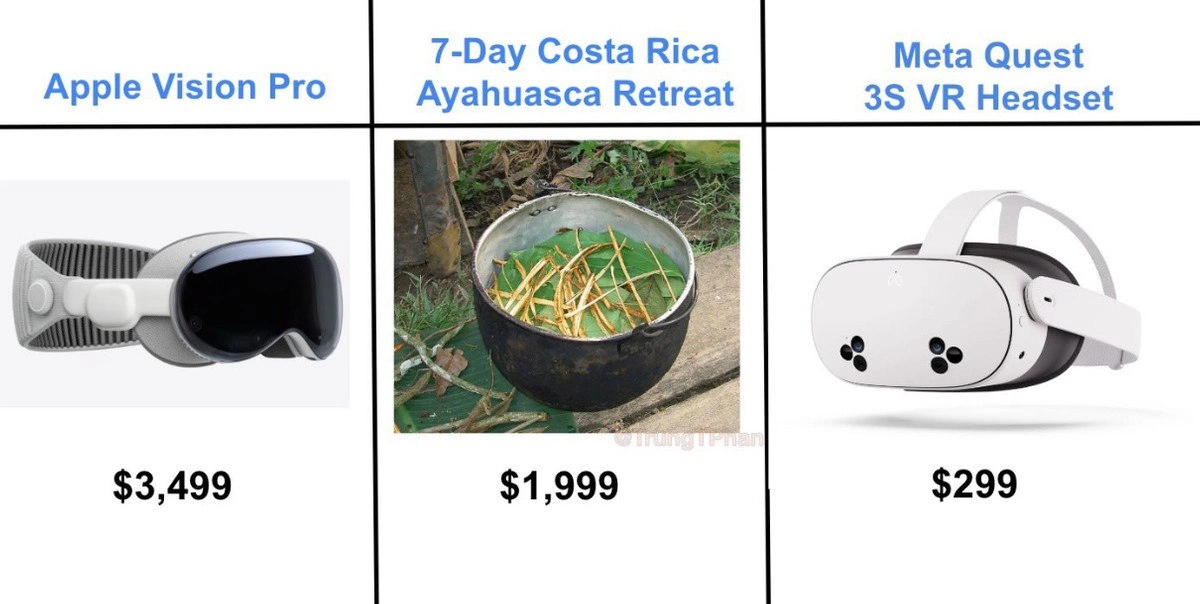
The image is a deadpan comparison table with three ways to alter perception. The visible columns are:
Apple Vision Pro
7-Day Costa Rica Ayahuasca Retreat
Meta Quest 3S VR Headset
Under them are the prices $3,499, $1,999, and $299. That layout is the whole joke: it treats premium spatial computing hardware, a psychedelic retreat, and a budget VR headset as substitutable products in the same procurement category. The implied buyer journey is not "Which headset has the best display?" but "How much should I spend to leave ordinary reality for a while?"
The Apple Vision Pro slot works because it represents the high end of consumer AR/VR ambition: expensive hardware, polished industrial design, carefully staged demos, and the promise that "spatial computing" is not just strapping screens to your face. The Meta Quest 3S slot works in the opposite direction: it compresses the proposition into affordability. For a fraction of the price, you get a mass-market VR device aimed at games, fitness, media, and accessible mixed reality. The post message says Meta's headset "seems really competitive in terms of pricing," which is funny because the table has widened the competitive set to include a literal mind-altering retreat.
The middle column is the absurd calibration point. A 7-Day Costa Rica Ayahuasca Retreat is not consumer electronics, but in the meme's logic it competes on the same axis: immersion, altered perception, onboarding, side effects, and whether you come back describing reality with suspiciously confident vocabulary. It makes the hardware comparison feel ridiculous by asking what the product is really selling. If the pitch is "see the world differently," then suddenly software ecosystems and jungle ceremonies are in the same funnel. Product marketing brought this upon itself.
There is also a real hardware tradeoff joke hiding under the price tags. AR/VR devices are expensive because they bundle displays, optics, sensors, processors, batteries, thermal constraints, controllers or hand tracking, operating systems, app stores, and comfort engineering into something worn on a human head. The lower the price, the more brutal the compromises become. But from the user's side, none of that matters if the core question is simply: does this experience feel worth it? The table says Meta may win not by being the most futuristic, but by making the weird future cheap enough to impulse-buy.
Description
The image is a three-column price comparison table with blue headings, product photos, and bold prices. The left column says "Apple Vision Pro" above an Apple headset image and "$3,499"; the middle says "7-Day Costa Rica Ayahuasca Retreat" above a pot of plant material and "$1,999"; the right says "Meta Quest 3S VR Headset" above a white headset image and "$299." A faint watermark appears over the middle image area. The joke compares expensive spatial-computing hardware, a psychedelic retreat, and a budget VR headset as competing ways to alter reality, poking at AR/VR hype and the cost curve of immersive experiences.
Comments
8Comment deleted
Only one option needs firmware updates, but all three may require a careful onboarding flow.
of course... it's Meta! you are the product Comment deleted
If only they included audio jack with it Comment deleted
it's basically a quest 2 with quest 3 SoC&ram? Comment deleted
Having had both a 2 and 3 the price point makes it ideal for anyone who only intends for extremely light usage like watching Netflix or playing VRC. There's no reason not to just get a 3 unless money is a roadblock, which is the whole point of this new model Comment deleted
Touch the grass: free Comment deleted
I mean Comment deleted
No way this is real Comment deleted