Skip to content
DevMeme
4692 of 7435
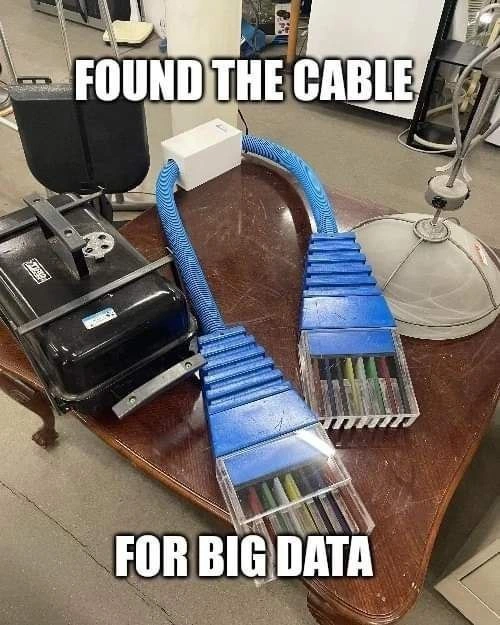
Finally found the oversized Ethernet cable suited for enterprise Big Data workloads
BigData Post #5142, on Apr 20, 2023 in TG

Finally found the oversized Ethernet cable suited for enterprise Big Data workloads

Why is this BigData meme funny?

Level 1: Bigger Isn’t Better

Imagine your teacher says you have a really big test coming up, so you show up to class with a giant pencil that’s as tall as you are. 📝 It sounds ridiculous, right? A bigger pencil won’t help you answer more questions or write any faster – it’ll just be heavy and awkward to use! This meme is funny for the same reason. It takes the idea of “big data” – which means having a whole lot of information to deal with – and jokes that you’d need an equally big tool (in this case, a huge network cable) to handle it. Of course, that’s not how things really work: using a gigantic cable wouldn’t actually make the data go faster. But seeing something normal blown up to an absurd size makes us laugh. It’s a simple, silly picture that anyone can chuckle at – the cable is outrageously huge, the idea is goofy, and it’s obvious that someone took the phrase “big data” way too literally. The joke works because bigger isn’t always better, and that’s why this over-the-top, literal solution is so absurd and amusing.

Level 2: Big Data vs Big Cable

So what exactly are we looking at? The photo shows a comically oversized Ethernet cable with gigantic RJ-45 plugs at each end. An Ethernet cable is a common networking cord that connects computers and servers so they can send data to each other. The standard RJ-45 connector (that clear plastic end) is usually about the width of your thumb. Inside a normal Ethernet cable you’d find 8 tiny copper wires twisted into pairs, which carry the electrical signals representing data. Here, those wires are blown up to the size of broomsticks, and even the connector’s little latch clip is huge! It's clearly a prop — a fake, non-working model made for laughs. By scaling everything up massively, the meme creates an absurd visual: a cable so large it looks like it could network giants.

Now, the caption “FOUND THE CABLE FOR BIG DATA” is playing on a misunderstanding of the term Big Data. In tech, Big Data doesn’t mean data that is physically big; it means having massive amounts of information (usually gigabytes, terabytes, or even petabytes) that are tough to process using normal methods. For example, a company like YouTube or Netflix collects enormous logs of what every user watches — that’s Big Data. Handling Big Data often requires special software and lots of computers working together (technologies like Hadoop or Spark) because there’s so much data involved. It’s an enterprise problem (one that big companies or projects deal with), and a “workload” means a task or job that processes all that information (like analyzing user behavior or generating a report from millions of records).

So why the giant cable? In networking, we talk about bandwidth – the amount of data that can flow through a connection per second. You can imagine it like water flowing through a pipe: a wider pipe can carry more water at once. Similarly, a high-bandwidth network cable can carry more data at once. A typical Ethernet cable (Cat-5e or Cat-6) might support 1 Gbps (one gigabit per second) up to 10 Gbps. To put that in perspective, 1 Gbps is about 125 MB/s (megabytes per second), so it could send, say, a whole HD movie in about a minute or two. If you have a huge amount of data to move (for example, backing up 1000 GB of data across the network), a 1 Gbps link would take over 2 hours running at full blast. Naturally, one might wish for a “bigger pipe” to send more data faster — and that’s exactly the joke here: taking the idea of needing a fatter network pipe literally. The meme pretends that for Big Data you literally need a big cable. In reality, if you require more network throughput for huge jobs, you’d upgrade to better tech (like a 10 Gigabit Ethernet card, fiber optic cables, or multiple cables working in parallel) rather than just make one cable physically gigantic. There’s even a point where, instead of sending data over wires at all, companies will ship whole hard drives full of data because it ends up faster for extremely large transfers (imagine trying to send 100 terabytes – it might actually be quicker to drive it to the destination than to upload it). But no one in IT orders a human-sized Ethernet cord as a real solution!

The humor here is pretty straightforward: “Big Data” sounds like maybe you need everything big to handle it, but that’s not how it works. The networking equipment for a big server cluster might be more advanced or high-performance, but it’s not cartoonishly large – it’s usually about smarter design, not sheer brawn. By showing a ridiculously large cable, the meme uses exaggeration to get the laugh. It’s both a silly sight gag (because an enormous plug and cable looks outlandish) and a play on words. This kind of joke is a blend of network humor and hardware humor. Even if you’re new to IT, you can understand that making a cable huge is not a real strategy; it’s like hearing someone has a “big data problem” and jokingly suggesting a “big cable solution.” The contrast between the serious term "Big Data" and the goofy literal interpretation is what makes it funny.

Level 3: The Fat Pipe Fallacy

This meme’s humor hits home for experienced engineers because it absurdly literalizes a common enterprise mentality: if you have Big Data, you must need big hardware. It’s basically taking the phrase “big data” at face value — the term “big” is interpreted in the most concrete physical way. The text overlay “FOUND THE CABLE FOR BIG DATA” sets up the punchline: after dealing with colossal data volumes, someone jokingly claims they’ve finally found a cable large enough to handle it. This is classic tech irony blending big-data hype with NetworkHumor. The giant cable gag highlights the fat pipe fallacy – the flawed idea that you can solve massive data throughput needs by simply scaling up a single data pipe to absurd proportions.

Anyone who’s managed an enterprise data pipeline knows the real bottlenecks aren’t fixed so easily. Large datasets strain multiple parts of the system: slow disk reads, limited memory, CPU crunching, and yes, network bandwidth. But no matter how frustrating a slow transfer is, you can't just grab a cartoonishly oversized Ethernet cord and call it a solution. In real scenarios, if a nightly job needs to shuffle 5 TB across a network and the 1 Gbps link is choking, the answer might be upgrading to 10 Gbps, bonding several links in parallel, or rethinking the architecture – not waiting for IT to deliver a mega-cable from the hardware fairy. Seasoned devs have indeed joked about "needing a bigger pipe" at 3 AM when a backup drags on, but they also know true scalability comes from smarter design. It’s about scaling out (spreading data across many nodes or lanes) rather than a brute-force scale up of one connection. The meme exaggerates exactly the kind of naive fix that gets chuckles in war-room meetings: “Our data job is running slow? Have we tried using, you know, a bigger cable?” 😏

The visual itself taps into HardwareHumor. Those enormous blue RJ-45 connectors are a geeky sight gag — clearly a prop built for laughs. It pokes fun at the trope of enterprise solutions always being over-engineered and oversized. It’s the same vibe as jokingly suggesting a mainframe the size of a truck to handle a simple website crash. Experienced developers have seen this pattern: an organization hits a performance wall and management’s first instinct is to throw expensive hardware at it (bigger servers, upscale appliances) instead of addressing root causes or designing for horizontal scaling. The meme nails that irony by showing an "enterprise-grade" cable so grandiose it’s practically a parody of IT procurement logic. No one is actually wiring their data center with garden-hose–sized Ethernet, but the joke lands because it caricatures a real attitude – the belief that bigger and pricier must be the cure for big tech problems. For those in the trenches, it’s a wry reminder that real solutions in BigData engineering come from architecture and algorithms, not just giant hardware upgrades.

Level 4: Throughput vs Physics

At the deepest technical level, this meme underscores the constraints of network throughput and how they clash with naive physical scaling. In information theory, simply enlarging a cable’s diameter isn’t a straightforward way to boost data rates; instead, factors like signal frequency, encoding, and noise dominate. The Shannon-Hartley theorem for channel capacity illustrates that a channel's max data rate $C$ depends on its bandwidth $B$ (frequency range) and signal-to-noise ratio ($S/N$) – not the literal girth of the wire. For example, the theoretical formula:

$$ C = B \log_2!\Big(1 + \frac{S}{N}\Big),, $$

shows that to increase $C$, you must increase $B$ (send higher frequency signals or use more spectrum) or improve $S/N$ (reduce noise or use better encoding). Making an RJ-45 connector ten times larger doesn’t magically appear in that equation! In practice, to achieve higher throughput, engineers use higher frequency signaling (e.g. moving from Cat5e at ~100 MHz to Cat6a at 500+ MHz, or switching to fiber optics at terahertz light frequencies) and improved shielding – not just a hulking cable.

Furthermore, advances in Ethernet often involve parallelism rather than one fat channel. Modern 40 Gbps or 100 Gbps Ethernet standards bond multiple lanes (like four 10 G or 25 G lanes) inside one cable or transceiver (such as a QSFP module). It's akin to adding more lanes on a highway, not building one car that fills the whole road. A comically oversized Ethernet cable might fit more copper pairs inside, but that’s basically just multiple cables in one jacket – something already done with fiber bundles or twin-ax connectors, without needing novelty-sized plugs. And even with endless bandwidth, physics imposes latency limits (signals travel at ~2/3 the speed of light in copper): you can’t reduce the time to send petabytes cross-country just by embiggening the cable.

In cutting-edge practice, when companies truly deal with Big Data scale (say shipping dozens of terabytes or more), they often bypass networks entirely: e.g. physically sending hard drives to a data center. This tongue-in-cheek approach (nicknamed Sneakernet) acknowledges that sometimes a FedEx box of disks has higher effective bandwidth than a high-speed network. As computer scientist Andrew Tanenbaum quipped, “Never underestimate the bandwidth of a station wagon full of tapes.” The meme's giant RJ-45 is essentially poking fun at the idea of brute-forcing throughput at the physical layer – a bit of physical-layer humor taken to an extreme. It’s highlighting a bandwidth overkill solution that ignores real-world constraints: real big-data transfers rely on parallel streams, smarter networking (compression, caching, distribution), and sometimes literally driving data around, rather than a single absurdly colossal cable contraption.

Description

The photo shows a cluttered workshop or office corner with a wooden table holding a comically huge blue Ethernet cable - several feet long - with outsized RJ-45 connectors at both ends. Each translucent connector reveals thick, multicolored wires, and a spiral blue conduit links them, exaggerating typical Cat-5/6 cabling. Visible white text is overlaid in two parts: at the top, "FOUND THE CABLE", and at the bottom, "FOR BIG DATA". The joke riffs on the term "big data" by depicting a physically larger network cable, poking fun at hardware scalability myths while referencing network throughput and data-engineering bandwidth needs

Comments

10
Anonymous ★ Top Pick “Sure, bandwidth was the problem - so we ordered Cat-5XL with 128 copper pairs; now the wire’s massive and the monolith still serializes everything on one thread.”
  1. Anonymous ★ Top Pick

    “Sure, bandwidth was the problem - so we ordered Cat-5XL with 128 copper pairs; now the wire’s massive and the monolith still serializes everything on one thread.”

  2. Anonymous

    After 20 years of explaining that 'Big Data' doesn't mean physically larger packets, someone finally built the cable that matches what the C-suite thinks we need when they hear 'petabyte-scale infrastructure' - though I'm still waiting for the switch with ports big enough to handle our technical debt

  3. Anonymous

    When the product manager asks why we can't just 'make the pipeline bigger' to handle petabyte-scale data ingestion, and you realize they think network infrastructure works like garden hoses. Meanwhile, your actual bottleneck is that single-threaded Python script someone wrote in 2015 that's still processing records one at a time because 'it works fine in dev.'

  4. Anonymous

    Finally, a cable that handles petabyte rsyncs without the NIC melting down at 99%

  5. Anonymous

    Found the Big Data cable - autonegotiates to 1G half-duplex on the legacy core switch; the fastest path to the data lake is still a truck full of disks

  6. Anonymous

    Finally, a Layer 1 fix for leadership's 'just make the pipe bigger' plan - still autonegotiates 100Base-TX while the slideware says QSFP28

  7. @mpolovnev 3y

    Colors seem to be wrong!

  8. @SamsonovAnton 3y

    Time-proven, really big medium for very big data!

    1. @NiKryukov 3y

      Big Floppa

      1. @SamsonovAnton 3y

        Xzibit meets Dongarra

Use J and K for navigation