Skip to content
DevMeme
910 of 7435
Corporate Tools vs. Gaming: A Feature Showdown
Communication Post #1028, on Feb 14, 2020 in TG

Corporate Tools vs. Gaming: A Feature Showdown

Why is this Communication meme funny?

Level 1: Playground vs Boardroom

Imagine two groups trying to talk and play together. The first group is a bunch of kids on a playground playing a game of tag. They’re running around, shouting, laughing – and guess what – they can all hear each other just fine. If one kid starts breaking the rules or bothering others, what happens? Maybe that kid gets tagged “It” (a kind of fun punishment in the game) or the others just stop playing with them for a bit. In other words, on the playground everyone’s talking clearly, and if someone acts up, the group has quick ways to deal with it (like tagging them out or telling them off). It’s chaotic but surprisingly effective – the game keeps going and everyone knows what’s happening.

Now picture the second group: a team of adults in a boardroom meeting, but they’re all working from home, so they’re connected by a big conference call. Each person is kind of like holding a tin can on a string, trying to talk to the others. Every now and then, someone’s string gets tangled: “Oops, we lost Tom… is he still there?” or one person forgot to press the button to let their voice through, so everyone hears nothing while that person is earnestly presenting (this is like when you talk on mute on a video call). It’s frustrating and silent. And if one person in the meeting is being difficult – maybe they keep interrupting or not listening – can the others do anything about it right then? Not really. They just awkwardly endure it, maybe rolling their eyes. There’s no tagging someone “out” in a real meeting. You can’t put the loudmouth in a timeout chair on the spot (though you might wish to!).

This meme is funny because it says the kids’ Fortnite game voice chat is like the playground: everyone can hear each other easily, and if someone is a troublemaker, the game itself provides a way to deal with them (they lose or get “punished” in the game). Meanwhile, the fancy business Webex meeting is like that messy boardroom call: people can’t hear each other due to technical difficulties, and there’s absolutely no fun way to handle someone breaking the flow. It’s a silly comparison that makes us laugh and think, “Wow, sometimes the fun stuff works better than the serious stuff!” In simple terms, the meme jokingly suggests we might have better teamwork if our work meetings were more like a game – at least we’d all hear each other and anyone causing problems would face quick consequences (in a playful way). It’s this role-reversal – a game being more orderly than a real meeting – that makes it humorously ironic and easy for anyone who’s struggled on a choppy Zoom/Webex call to appreciate.

Level 2: Meeting vs Game Basics

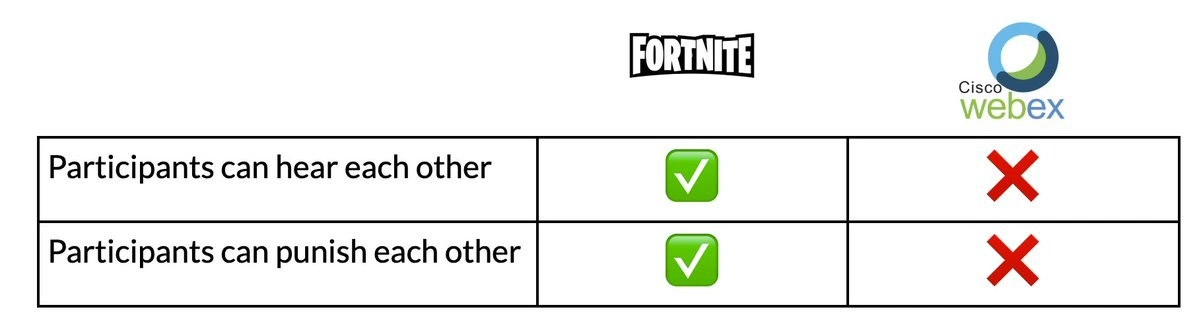
Let’s break down the joke in simpler terms. On the left side of the meme’s table, we have two basic things you’d expect in any group conversation:

  • “Participants can hear each other.” This just means everyone’s audio works – people can talk and listen without issues.
  • “Participants can punish each other.” This one sounds strange for a meeting! Here, “punish” is a tongue-in-cheek way to say hold each other accountable or even inflict consequences. In a game like Fortnite, if someone on your team is being obnoxious or not cooperating, you might literally defeat them or let them get eliminated (that’s the “punishment” – they lose in the game). In a voice app, “punish” could also mean things like muting someone or kicking them out of the group if they misbehave.

Now, the meme compares these two points between Fortnite and Cisco Webex. Fortnite is a super popular online video game (a battle royale style game where 100 players fight to be the last one standing). It has a built-in voice chat so teammates can talk to each other through headsets. Importantly, Fortnite’s voice chat is surprisingly good at letting players hear each other clearly in real time. If you’ve ever played a multiplayer game or even used a gaming chat app like Discord, you might notice how quickly you can hear your friend’s voice with almost no delay – it’s like they’re right there, even if they are miles away. The meme gives Fortnite a big green ✔️ check mark for “Participants can hear each other” to show it does this well. It also gives Fortnite a ✔️ for “Participants can punish each other,” joking that in the game players can dish out consequences (for example, by defeating a teammate who is trolling, or simply the game itself punishes lack of teamwork by making the team lose). Basically, in a game, if someone messes around, they face quick results: they might get knocked out of the match or yelled at by teammates, which sort of keeps everyone in line.

On the other side, we have Cisco Webex, which is a professional online meeting and video conferencing tool used by companies for remote meetings. If you’ve ever been in a virtual class or a work meeting using Zoom, Google Meet, or Webex – they’re all similar types of tools. Webex is known in the corporate world, but not exactly loved by its users. The meme gives Webex a big red ❌ X for “Participants can hear each other,” highlighting a common problem: on Webex calls, people often can’t hear each other properly! How many times have we heard phrases like “You’re muted, we can’t hear you!” or “There’s a lag, can you repeat that?” or that awkward silence when someone’s audio drops. This is what the meme is calling out under webex_audio_issues. It’s humorously suggesting that Webex fails at the most basic meeting need – allowing folks to communicate without technical issues. And for “Participants can punish each other,” Webex also gets a ❌ because, of course, in a real meeting you cannot (and should not!) punish a coworker or participant. There’s no “smack a teammate with a pickaxe” in a video call. The strongest “punishment” in Webex might be the moderator muting someone, or at worst removing them from the meeting, but that rarely happens except for maybe handling truly disruptive behavior. In normal meetings, if someone is causing problems (talking over others, not paying attention, etc.), there isn’t an immediate consequence like there is in a game. Everyone just has to be patient or a supervisor talks to them later. So the meme gives Webex an X – meaning nope, participants in Webex can’t really do anything to each other for accountability in the moment.

This comparison strikes a chord for anyone who’s done WorkFromHome or remote classes, especially developers or IT folks who deal with these tools daily. It’s combining MeetingHumor with a GamingReference. On one side, Fortnite represents a fun, modern tech that just works for communication (and is all about competition, hence “punishing” in game). On the other, Webex represents the sometimes outdated-feeling office tech that often leaves us saying “Hello? Are you there? Sorry, I was on mute.” The tags like mute_button_madness and participant_muting refer to how on Webex you constantly deal with mute/unmute chaos – people forgetting to unmute themselves or background noise forcing everyone to fumble for the mute button. In Fortnite’s world, if you’re too noisy or annoying, your teammate might literally mute you in the app or just not revive you when you get knocked out – a playful interpretation of justice.

In short, the meme humorously exaggerates that an entertainment platform (Fortnite) outperforms a business communication platform (Webex) at both letting everyone hear each other and enforcing any sort of interactive accountability. It resonates with tech workers because we’ve seen how often serious tools fail at voice communication, whereas things made for fun (games, Discord, etc.) often manage it better. It’s a lighthearted jab: the idea of holding our team meeting inside a Fortnite match sounds silly, but hey, at least we’d all hear each other and anyone causing trouble would quickly face in-game “punishment”!

Level 3: Voice Chat Victory

For seasoned engineers, this meme hits close to home because it’s painfully true: a free online game often delivers more reliable communication and better “moderation” tools than our high-priced corporate meeting software. The table format, complete with official logos and big bright ✔️ check marks under Fortnite and glaring ❌ X marks under Webex, speaks to every frustrating RemoteWork experience we’ve had. How many times have you been in a Webex conference call where participants can’t hear each other? 🙄 The CommunicationBreakdown is real – someone’s bandwidth chokes, Webex’s audio cuts out, and you get the classic chorus of “Hello… hello? Can you hear me now?” Meanwhile, last night you could be on Fortnite squad chat with a teenager in another country, effortlessly coordinating flanking maneuvers with crystal-clear audio. The absurdity isn’t lost on us: the video game just works, while the enterprise tool with “Cisco” in its name (a giant in networking!) struggles with the basics. It’s the ultimate MeetingHumor for developers who’ve spent too many stand-ups saying “Sorry, I was on mute.”

The second row of the meme, “Participants can punish each other,” cranks the irony to 11. Of course in Fortnite, if someone on your team is screaming in your ear or not playing cooperatively, you can quite literally shoot or outplay them – a swift in-game consequence for annoying behavior. In a work meeting, you can’t exactly eliminate the colleague who won’t stop interrupting or the one who didn’t read the agenda. There’s no participant_muting or kick vote in real life – at best, the host might silently hover over the remove button or give a stern “let’s stay on topic”moderation. The meme is poking fun at that powerlessness. In Fortnite (or any competitive game), accountability is built-in: trolls get kicked from lobbies, loudmouths get fragged, and there’s a clear feedback loop – mess up and you’re out. In the corporate world of Webex calls, what’s the worst that happens if you’re disruptive? A private slack message from your teammate saying “dude, chill,” or maybe an exasperated sigh on the line. There’s an almost wishful humor here: wouldn’t it be grand if we had a “punish” button during meetings? Bob in accounting keeps talking over everyone? Boom – virtual trap door. Mary from marketing didn’t do her homework on the sprint report? 🚩 Flag her audio until she’s prepared. Of course, we can’t do that (HR would have a field day), so we vent through memes.

From a senior dev perspective, there’s also a sly commentary on software quality and priorities. Fortnite, serving millions of demanding gamers, must optimize the heck out of its voice chat to avoid angry users. Gaming companies know if voice comms fail, players will simply jump to Discord or roast the game on forums. Epic Games can’t afford voice issues – it would literally ruin the game. So they invest heavily in network stability, low-latency audio, and quick user-friendly controls (push-to-talk, easy muting, etc.). On the other hand, corporate tools like Webex often enjoy captive audiences – your company already bought the license, so you’re stuck with it. There’s far less competitive pressure to make it “fun” or even seamless. Webex’s user experience can stagnate with clunky UIs and the infamous “You’re muted” pop-up, yet companies keep renewing that contract. Legacy code, enterprise feature creep, and on-call nightmares of maintaining backward compatibility mean Webex’s dev team moves cautiously. Ever notice how Webex or similar tools take forever to connect audio, or randomly drop calls when VPN is on? That’s the accumulated technical debt and corporate network policies colliding with what should be a simple thing – talking to each other. As a battle-scarred engineer, it’s both funny and frustrating: we can design distributed consensus algorithms for fault-tolerant databases, but Dave from Sales still can’t get his microphone to work on Webex. And we’ve all had that cynical thought: “Maybe we should just hold our daily stand-up in a Fortnite lobby – at least we’d all be able to hear… and if someone annoys us, well, there are virtual ways to deal with that.” It’s meeting_vs_gaming humor that underscores a truth: consumer tech often outpaces enterprise tech in usability. The PopCultureReferences to Fortnite make it extra amusing – even non-gamers know it’s that thing their kids play. So saying “Fortnite beats Webex” is like saying a skateboard outruns a corporate sedan in a traffic jam – an unexpected underdog victory that makes the tech crowd smirk knowingly.

Level 4: Netcode Royale

At the packet level, Fortnite’s voice chat network architecture is a low-latency marvel compared to traditional corporate conferencing. Fortnite’s developers built its in-game voice chat on real-time protocols optimized for minimal lag and jitter. Under the hood, Fortnite likely uses UDP (User Datagram Protocol) streams for voice, possibly with the Opus codec, avoiding the overhead of TCP handshakes. UDP is essentially a "fire-and-forget" transport – it trades reliability for speed, meaning voice packets get to players’ headsets fast (some might drop, but who cares if one syllable in a heated battle might glitch?). This design prioritizes immediacy so teammates can react in milliseconds. In distributed systems terms, Fortnite’s voice service leans towards the AP side of CAP in a way – high availability and partition-tolerance, even if an occasional packet is lost (consistency in voice data is less crucial than real-time continuity). The result is a real-time communication channel nimble enough for a 100-player battle royale. Each squad’s voice chat is often handled by nearby regional servers or peer-to-peer connections using NAT traversal techniques (STUN/TURN), ensuring that even geographically dispersed players hear each other with minimal delay. Epic Games (Fortnite’s creator) has effectively weaponized network code to minimize network_latency, making sure your squad’s callouts (“Enemy at 3 o’clock!”) aren’t heard a second too late.

Meanwhile, Cisco Webex relies on more traditional VoIP (Voice over IP) infrastructure, often built atop protocols like RTP/RTCP (Real-Time Protocol) over UDP with extra layers of encryption and corporate firewall compliance. Enterprise conferencing favors reliability and security – every packet is precious, often tunneled through VPNs or proxies – but this can introduce delays. Webex likely uses secure RTP with robust encryption (a necessity for corporate privacy) and dynamic jitter buffers to smooth out speech. However, those same buffers and error-correction schemes that ensure you eventually hear what was said can also cause that notorious half-second delay (“Sorry, I think you were talking… no, you go ahead”). In a perfect lab, Webex’s audio has high fidelity, but out in the wild corporate network jungle, it struggles with QoS (Quality of Service) battles: competing for bandwidth with that one coworker streaming cat videos, subject to packet loss from congested Wi-Fi, and often restrained by strict firewall rules blocking the very UDP ports that would make audio smoother. The meme’s brutal verdict – a video game outclassing an enterprise tool – is grounded in these technical realities. Fortnite’s voice chat is purpose-built for intense real-time interaction, exploiting network protocols without corporate constraints. Webex’s audio, on the other hand, is burdened by legacy design and the mute_button_madness of security and compliance layers. It’s a classic case of network_latency_comedy: the app built for kids yelling across virtual battlefields employs more advanced online_collaboration_tools for audio delivery than the one used for serious business meetings. And as for “participants can punish each other,” on a technical level Fortnite’s entire game logic is an accountability mechanism – if my audio lags and I fail to warn my teammate, we lose the match. In distributed systems terms, that’s a form of immediate negative feedback loop! Webex offers no analogous built-in feedback if Bob drones on uselessly – there’s no built-in “eliminate Bob’s avatar” protocol (though one could argue the End Meeting button is the nuclear option). The meme slyly highlights how fortnite_voice_chat tech wins a victory royale over corporate VoIP by engineering for speed and interaction, whereas Webex’s stack feels like it’s still dropping packets on the battle bus.

Description

A simple comparison chart meme presented on a white background. The chart has two columns, one headed by the 'Fortnite' logo and the other by the 'Cisco Webex' logo. There are two rows of features being compared. The first feature is 'Participants can hear each other'. Under the Fortnite column, there is a green checkmark, while the Webex column has a large red 'X'. The second feature is 'Participants can punish each other'. Again, Fortnite has a green checkmark, and Webex has a red 'X'. The humor is a satirical jab at the perceived unreliability and poor user experience of corporate communication software like Webex, especially when compared to the robust, real-time communication capabilities of a modern video game like Fortnite. The second point adds a layer of absurdist humor, tapping into the common frustrations felt during unproductive or difficult meetings


Comments

7
Anonymous ★ Top Pick It's amazing that a game serving millions of concurrent users has solved real-time communication, while enterprise meeting software still struggles with the age-old problem of 'Can you hear me now?'
  1. Anonymous ★ Top Pick

    It's amazing that a game serving millions of concurrent users has solved real-time communication, while enterprise meeting software still struggles with the age-old problem of 'Can you hear me now?'

  2. Anonymous

    Fortnite herds 100 teenagers over UDP with 20 ms RTT and crystal VOIP - plus a built-in kickhammer if someone griefs; Webex burns a six-figure license to tunnel TCP through a VPN and still makes the first five minutes of every sprint review a “can anyone hear me?” ritual

  3. Anonymous

    The real architectural pattern here is that systems designed for 12-year-olds screaming at each other have better latency, reliability, and QoS than the $50k/year enterprise solution your procurement team spent six months evaluating

  4. Anonymous

    The real irony here is that a game server handling 100 players building skyscrapers while shooting each other has better voice infrastructure than enterprise conferencing software that costs $30/user/month. Maybe Webex should implement a battle royale mode where the last person whose audio actually works gets to lead the standup

  5. Anonymous

    Fortnite runs voice on UDP (Vivox) so everyone can hear you - and punish your mistakes; Webex routes TCP over VPN, SSL inspection, and proxies so nobody hears anything except “you’re on mute.”

  6. Anonymous

    Fortnite delivers zero-config WebRTC voice with instant kicks; Discord replies: 'Role not sufficient permissions' - the eternal devops of social gaming

  7. Anonymous

    Fortnite’s UDP plus STUN/TURN gets 100 teenagers talking; our seven-figure Webex still can’t negotiate a mic - and there’s no vote-kick for scope creep

Use J and K for navigation